Consensus Is the Missing Layer in Business AI: How Agreement Turns Outputs into Decisions

AI tools flood boardrooms with confident answers, but a troubling pattern has emerged across industries: 77% of businesses express concern about AI hallucinations, and 47% of enterprise AI users made at least one major decision based on hallucinated content in 2024. The problem isn’t adoption anymore. 88% of organizations report regular AI use in at least one business function, compared with 78 percent a year ago. The real challenge? Trusting a single AI output enough to stake money, reputation, or compliance on it.

Smart teams are discovering a practical shift away from blind faith in isolated models. Instead of asking “Is this AI right?” they’re asking “Do multiple leading AIs agree?” This system-level reliability approach compares outputs from different top models, measures alignment, and treats disagreement as a risk signal worth investigating. When consensus emerges across independent systems, confidence in the output rises dramatically.

Why Can’t We Trust a Single AI Model?

The conventional wisdom around AI adoption assumes one powerful model will handle your needs. Deploy GPT-4, Claude, or Gemini, and you’re covered. But real-world results tell a different story.

Modern AI systems operate probabilistically, not deterministically. They predict the most likely next word or concept based on patterns in training data, which means even the most sophisticated models can confidently deliver fabricated information. In tests, OpenAI’s o3 model hallucinated 51% of the time on simpler factual questions, while error rates in some tests reached as high as 79%.

How Does Multi-Model Agreement Protect You From Errors?

Achieving consensus among AI systems enhances reliability by improving robustness against failure and increasing overall accuracy. When multiple independent models converge on the same answer, you’re seeing signal emerge from statistical noise.

The mechanism works through diversity. Different AI models are trained on varied datasets, use distinct architectures, and apply different internal logic. This means they tend to make uncorrelated errors. When aggregated, these isolated mistakes cancel each other out. A single model might hallucinate a fact. Three models independently arriving at different hallucinations for the same query is statistically unlikely. Three models agreeing on an answer? That’s a reliability signal.

What Happens When AI Models Disagree?

Disagreement isn’t failure. It’s information.

When models diverge on an output, you’ve identified a case where uncertainty is high, context is ambiguous, or the query falls outside reliable training data. This is precisely when human judgment becomes most valuable. Instead of blindly accepting a confident but potentially wrong answer, disagreement triggers escalation to subject matter experts.

Think of it as an automated quality control system. Agreement allows teams to move fast on routine decisions. Disagreement forces a pause where it matters most, protecting organizations from the costly mistakes that erode trust and trigger regulatory scrutiny.

The Consensus Reliability Loop offers a simple framework: Compare outputs across models, score their agreement, flag variance beyond acceptable thresholds, escalate high-stakes decisions showing low consensus, and ship with confidence when alignment is strong.

Why Is Human in the Loop Still Essential?

Consider what happened at a mid-sized pharmaceutical company preparing regulatory filings for European markets. Their compliance team ran technical documents through a popular AI translator. The output looked professional, read fluently, and arrived in seconds. They submitted it. Three weeks later, the regulatory authority flagged inconsistencies in dosage terminology. 

The compliance director couldn’t afford another mistake. She switched to MachineTranslation.com, where the Smart AI Translation compares 22 different models before delivering a result. On the first test run with their next filing, she noticed something different: certain pharmaceutical terms showed variation flags. Four models translated “contraindication” one way, eighteen another. The majority consensus highlighted the standardized term, but the variance signal prompted her team to verify against the European Medicines Agency’s official glossary. They caught a nuance that could have triggered another rejection.

Industry authority Ofer Tirosh, CEO of Tomedes and developer of MachineTranslation.com, built the platform specifically to address failures where single models create costly errors. The system doesn’t just compare outputs from multiple leading translation AIs. It surfaces the agreement signal to users, showing exactly where 22 models aligned and where they didn’t. That pharmaceutical compliance team now trusts their translations not because an AI promised accuracy, but because they can see independent models reaching consensus on critical terminology.

The same principle protects a legal team at an international arbitration firm. Contract translations can’t contain ambiguity. A single word mistranslated in a liability clause could shift millions in obligation. Their paralegal runs every contract through the platform, then reviews the sentences where the model agreement drops below 80%. Most translations sail through with near-perfect consensus. The handful that don’t get escalated to their bilingual attorneys for human verification. The firm hasn’t had a translation-related dispute in eighteen months.

Can Consensus Be Gamed or Manipulated?

Valid concern. If consensus becomes the standard, won’t all models start converging toward the same training approaches, eliminating the diversity that makes agreement meaningful?

The answer lies in maintaining genuine independence across the ensemble. Models must use different architectures, training datasets, and development teams. Diversity in design prevents groupthink at the system level.

Consensus also requires ground truth benchmarks. In translation, this means verified reference texts. In finance, it’s historical transaction data. In healthcare, it’s clinical records. These anchors prevent consensus from drifting into collective hallucination.

Organizations implementing consensus-based workflows should monitor for correlation drift over time. If models start agreeing more often without corresponding improvements in accuracy against verified benchmarks, that’s a signal that independence has eroded.

What Does the Research Say About Voting and Agreement?

One intuitive aggregation mechanism is weighted voting, used in classification tasks. In simple “hard voting” systems, the final decision is the class selected by the majority of individual models. More sophisticated “soft voting” approaches weight each model’s confidence score, giving more influence to predictions where the collective shows highest certainty.

For tasks involving continuous numerical outputs, consensus is achieved through simple averaging. Predictions from all participating models are summed and divided to produce a smoothed forecast. Another technique involves using a “meta-learner,” a separate AI model trained to optimally combine predictions from the initial set of models.

How Will Consensus Shape the Future of Business AI?

88% of organizations anticipate Gen AI budget increases in the next 12 months, with 62% expecting increases of 10% or more. As investment accelerates, the question shifts from “Should we use AI?” to “How do we use it responsibly?”

Consensus provides a practical answer. It acknowledges that AI systems are probabilistic tools, not oracles. It builds reliability through redundancy and diversity rather than hoping one model will be perfect. It creates natural checkpoints where human judgment can intervene before mistakes compound.

This approach aligns with emerging regulatory frameworks. Agencies reviewing AI for fairness often require cross-model consistency checks on demographic subgroups and independent evaluations that must reach a high consensus to certify compliance.

Organizations that adopt consensus-based workflows now will be ahead of the curve as these requirements formalize. They’ll have systems that not only produce better outputs but can demonstrate how reliability is verified, a critical capability as AI moves from experimental to mission-critical.


Jenny Watz on AI, Publishing, and the New Credibility Divide

By: Alexandra Perez

Jenny Watz thinks the biggest problem in business publishing right now is not a lack of books.

It’s the proliferation of them. 

Books are everywhere. Everyone has one “coming soon.” Everyone has a draft. Everyone has a Kindle upload in progress. And now, thanks to artificial intelligence, some people have an entire manuscript by lunchtime.

The issue is not production, it’s trust.

AI has made publishing faster than ever. Entire books can be generated in hours. Titles can be uploaded overnight. Content can be produced at a volume the industry has never seen before. But Watz argues that speed is not the real story. The real story is what happens when readers stop believing what they are reading.

Business books have always been a tool of authority. They signal that an entrepreneur has organized ideas, articulated a framework, and offered a point of view that carries weight. But in an era where language can be manufactured instantly, the value of the book is no longer guaranteed by its existence.

Watz sees the market splitting into two categories: books written for publication and books written for belief.

AI didn’t invent low-quality publishing. Self-publishing opened that door years ago, and with that came plenty of greatness and plenty of nonsense. But AI has accelerated the nonsense. It’s now possible to flood the market with content so quickly that readers barely have time to ask whether anyone involved actually thought about what they were saying.

Watz has seen books released with raw AI prompts still sitting inside the text, like a sticky note the author forgot to remove. That’s not innovation. That’s negligence.

“AI can assist,” Watz says, “but it can’t replace discernment.”

That word is central to her philosophy. Discernment is what separates thought leadership from content production. It’s what tells an author what matters, what doesn’t, and what should never have made it past the draft stage.

AI can generate sentences. It can’t make judgment calls. It can’t decide what belongs. And it certainly can’t take responsibility for meaning.

Watz believes the next era of business publishing won’t be defined by who can produce the most books, but instead by who can produce the most trust.

For entrepreneurs, that distinction is everything.

A business book is not simply a marketing asset. It’s an extension of credibility. If the book feels careless, the business feels careless. If the ideas feel automated, the expertise may also feel automated.

Authority can’t be outsourced, no matter how tempting the shortcut looks.

Watz often reminds entrepreneurs that publishing without clarity can backfire. A book released for the sake of having a book does not build a reputation. It dilutes it.

A book without purpose can do more harm than good,” she says.

In the AI era, purpose is no longer optional. It is the baseline requirement.

Watz defines clarity as the foundation of any credible business book. Why are you writing it? Who is it for? What should the reader do once they finish it? When those answers are vague, the book becomes directionless.

And directionless books don’t build authority. They become expensive business cards that nobody keeps.

A strong book, Watz argues, provides a path. It doesn’t dump information on the reader and hope something sticks. It guides them with intention.

“Readers want a path from A to B,” Watz says. “They’re looking to the author to guide them.”

That guidance is what builds trust. And trust is what AI cannot replicate.

Watz is not interested in demonizing technology. She uses AI strategically herself, particularly for ideation and clarification exercises. But she draws a sharp line between assistance and substitution.

Assisted AI can sharpen thinking. Generative AI can bypass it entirely.

The difference shows, and readers notice.

There is also a strange irony in all of this. The more content floods the market, the more valuable actual humanity becomes. The more automated books appear, the more readers crave a voice that sounds unmistakably real.

Watz believes readers are entering a new phase of skepticism. Authenticity is no longer a buzzword. It’s proof that a real mind is behind the work.

Thought leadership will increasingly require actual thought.

This is also why Watz rejects the idea that business books must be sterile or overly polished. A book that reads like an academic lecture doesn’t feel trustworthy. Readers want presence. They want a voice. They want to know there is a person behind the framework.

Business books don’t need to be emotional performances, but they do need to be human.

Looking forward, Watz believes the authors who stand out will be those who write with precision, restraint, and purpose. Not those who publish fastest, but those who publish with integrity.

“A business book shouldn’t exist just to be read,” Watz says. “It should exist to amplify authority, attract the right audience, and accelerate growth.”

In a publishing ecosystem being reshaped by AI, credibility is becoming the rarest asset of all, and that is exactly where Jenny Watz has planted her flag.

The Hidden Role of Orthodox Jews in the Art World: A Quiet Revolution

When people think about art, galleries, and collectors, Orthodox Jewish communities are not always widely associated with the contemporary art world.  Many Orthodox Jewish communities place a strong emphasis on religious tradition and community life, which can result in a more inward-focused cultural structure. So, it might come as a surprise to learn that some Orthodox Jewish individuals and patrons have become increasingly involved in areas of cultural preservation and artistic support, contributing to select segments of the art world. Many of these patrons prefer to remain behind the scenes, rather than seeking the spotlight. This involvement raises questions about how religious tradition and contemporary artistic expression can coexist.

The Intersection of Art & Jewish Law: Where Creativity Meets Tradition

For Orthodox Jews, Jewish law (Halacha) governs nearly every aspect of life, including how one should engage with art. One of the most significant influences on art in Orthodox communities is the concept of idolatry, specifically forbidden by the Second Commandment: “Thou shalt not make unto thee any graven image.” This has historically shaped the approach to figurative art within certain Orthodox Jewish contexts. Additionally, there’s the matter of perceptions of modesty (tzeniut), which places a heavy emphasis on how people, particularly women, are depicted in art. In some Orthodox interpretations, artistic depictions that emphasize physical exposure or sensual themes may be regarded as inconsistent with traditional standards of modesty. Despite the inherent tension between art and religious Jewish values, some Orthodox Jewish artists and patrons have found ways to engage with artistic expression while remaining aligned with their religious values, enabling them to contribute meaningfully to the art world while adhering to their religious beliefs.

Navigating the Boundaries: Art and Orthodox Jewish Values

One of the key challenges for Orthodox Jews engaging with art is navigating the boundaries between religious principles and contemporary trends. Much of modern art explores themes like sensuality, self-expression, and the human form, issues that may not always align with Orthodox values. However, many Orthodox patrons and artists have found creative ways to engage with art while maintaining their religious integrity, often focusing on Jewish themes, historical depictions, and abstract representations of spirituality.

One area of involvement for some Orthodox Jewish individuals is the preservation of Jewish cultural and historical materials. From restoring ancient Torah scrolls to collecting Jewish-themed art, they are dedicated to preserving Jewish history for future generations. In certain cases, Orthodox Jewish patrons have supported museums, galleries, or cultural initiatives connected to Jewish history and art. Many patrons often go beyond merely collecting works of art and are actively involved in the preservation and restoration of Jewish art in both religious and secular contexts. Their efforts represent a form of cultural transmission, ensuring that Jewish traditions and values continue to thrive through artistic expression.

Behind the Scenes: The Quiet Role of Orthodox Art Collectors

Though they may not be widely recognized in mainstream art circles, some Orthodox Jewish patrons are involved in supporting artists and cultural initiatives. Many of these individuals prefer to remain out of the public eye, working quietly within their communities to support artists and cultural institutions. Much of their contribution happens behind closed doors, in private collections or through discreet donations. While these patrons often avoid the spotlight, their involvement can be observed within both Jewish-focused and broader artistic contexts.

Notable Orthodox Jewish Figures in the Art World

Nachman Hellman, based in Monsey in the greater New York metropolitan area, is a dedicated collector of Judaic and Orthodox-themed art. His collection reflects a deep engagement with Jewish visual culture, and his support extends beyond private collecting. Hellman has lent works to public exhibitions, including the inaugural exhibition at the Betzalel Art Gallery in Crown Heights, helping to bring Orthodox-inspired art into a wider communal and cultural view.

Dovy Andrusier and Shmuel Pultman are prominent Orthodox figures in Brooklyn who, while primarily operating as art dealers, also play a broader role in cultivating appreciation of Jewish art. Together, they run Betzalel Art Gallery in Crown Heights, a space dedicated to showcasing Jewish artists and fostering a culture of collecting within New York’s Orthodox community. Their work bridges commerce and cultural stewardship, positioning the gallery as a hub for contemporary Jewish visual expression.

Abe Kugielsky, a Modern Orthodox collector and entrepreneur based in the New York area, operates a Judaica and antique auction business specializing in historically and culturally significant objects. In addition to his work in the art and collectibles market, Kugielsky is an accomplished photographer whose documentation of Hasidic life has been featured in public exhibitions. His dual roles highlight the ways Orthodox lived experience intersects with both historical artifacts and contemporary visual culture.

Seymour Braun is a New York–based attorney and seasoned art collector with a particular passion for Old Masters and works from the Golden Age of Dutch painting. A long-time supporter of the arts, Braun is deeply invested in the preservation of culturally significant works. Through his collecting and restoration efforts, he has contributed to the safeguarding of important art pieces while also supporting emerging artists, ensuring continuity between artistic heritage and future generations.

Ultimately, the growing presence of Orthodox Jews in the art world challenges long-held assumptions about who participates in shaping cultural life and how tradition can coexist with creative expression. Far from standing in opposition to art, these collectors, patrons, and artists demonstrate that religious commitment can inspire thoughtful engagement rather than withdrawal. By working quietly, often behind the scenes, they are preserving heritage, nurturing contemporary talent, and expanding the boundaries of what religiously grounded art patronage can look like. Their influence may not always be visible on gallery walls or auction headlines, but it is still having a ripple effect in the art world. In this sense, the quiet revolution led by Orthodox Jews is not about transforming art to fit tradition, but about allowing tradition to thoughtfully converse with the evolving language of art itself.

Disclaimer: This article is intended for informational and cultural discussion purposes only. It reflects general observations and publicly available information about Orthodox Jewish engagement with the art world and does not claim to represent the views, beliefs, or practices of all Orthodox Jewish individuals or communities. References to specific individuals, institutions, or religious concepts are included solely to provide context and should not be interpreted as endorsements or definitive characterizations. Any interpretations of religious law or cultural practices are presented in a general, non-authoritative manner.

Why Reliability Still Matters More Than Innovation in B2B Operations

As a business, you feel constant pressure to adopt the next big thing. New platforms promise automation and insight, while competitors post success stories on LinkedIn. At the same time, your customers still expect orders to ship on time and support teams to respond without excuses. When something breaks, nobody cares how innovative it looked in a demo. 

In B2B operations, where contracts run long and margins stay tight, reliability quietly shapes trust and reputation every single day.

Innovation vs. Stability in Modern B2B Operations

Innovation excites everyone, but stability keeps your business running day to day. You might be tempted to adopt the latest software or automation platform because it promises speed and insight. Yet, PwC’s 2025 Digital Trends in Operations Survey shows that 92% of operations leaders say tech investments haven’t fully delivered the expected results. This highlights a key lesson: technology alone isn’t enough, and it only creates value when it integrates smoothly with existing processes and teams.

According to Deloitte’s 2025 Connected Consumer Survey, companies can gain greater loyalty and spend when they pair bold innovation with trustworthy, dependable systems. A measured approach is more effective than a full-scale rollout. Give early access to a single department and map out potential failure scenarios before broader deployment.

The True Cost of Unreliable Systems

Unreliable systems drain money in ways that rarely show up on a single line item. A billing platform that crashes twice a month forces your finance team into manual rework and delays cash collection. A flaky inventory system causes missed shipments and awkward customer calls. 

These issues compound over time, damaging trust and morale. Track downtime and customer escalations in a shared log so you can connect instability to real operational cost.

Why Proven Solutions Still Deliver Excellent ROI

Proven solutions succeed because people understand them. Your staff know how to operate, maintain, and recover them under pressure. 

When calculating ROI, include the time your teams save by avoiding process reinvention. Choose tools with long support cycles and clear upgrade paths so you spend less time reacting and more time improving service.

Operational Continuity as a Competitive Advantage

Customers rarely praise you for being cutting-edge, but they remember when you never miss a delivery window. 

When disruptions hit the market – supplier delays, demand spikes, or regulatory changes – you respond calmly instead of scrambling. Build continuity by scheduling maintenance windows and assigning clear ownership for critical systems.

The Role of Trusted Suppliers and Standard Components

Reliable operations depend on suppliers who value consistency as much as you do. Trusted vendors deliver predictable quality and honest communication when issues arise. Standard components also reduce risk because replacements and expertise remain readily available. 

For example, a control panel that uses a rotary switch from a long-established manufacturer simplifies maintenance and avoids the need for custom redesigns. Vet suppliers annually and keep approved parts lists current to protect uptime without slowing innovation.

Lower Manhattan Adds 100+ Safe Haven Beds in Major Homelessness Push

New York City has opened a new low-barrier Safe Haven shelter in Lower Manhattan, adding more than 100 beds for people living on the streets. The site, operated by the nonprofit Breaking Ground, is part of a wider effort by city leaders to expand shelter capacity and move vulnerable residents indoors during a period of cold weather and rising housing pressure.

City officials and advocacy groups say the new shelter reflects an urgent need for safe and flexible housing options. Safe Havens differ from traditional shelters because they reduce entry barriers and offer more privacy, which can help people who are hesitant to enter the standard shelter system. According to homelessness advocates, this model has already shown strong results in helping individuals leave the streets and move toward stable housing.

Supporters welcomed the opening in Lower Manhattan. In a joint statement, the Coalition for the Homeless and The Legal Aid Society said they “strongly support the City’s decision to fast-track the opening of a new low-barrier Safe Haven shelter in Lower Manhattan,” noting that extreme winter conditions increase danger for people sleeping outside. They added that the new site “will make a positive difference in our community” and could help save lives by giving more people a safe place indoors.

Advocates also emphasized that Safe Havens play a special role for people who have had negative experiences in traditional shelters. The same statement explained that these locations are “a very effective option for those whose past negative experiences in the congregate shelter system have made them understandably hesitant to return.” By offering a different environment, Safe Havens can create a pathway from street homelessness to permanent housing.

The scale of homelessness in New York shows why additional beds are considered necessary. In November 2025, more than 101,000 people slept in city shelters each night, including tens of thousands of children in homeless families. This level of demand continues to shape policy decisions across city government and social-service agencies.

Mayor Zohran Mamdani has framed the shelter expansion as part of a broader humanitarian response. He said outreach teams are working across the five boroughs to bring people indoors and connect them with services. “Every single person will be cared for. No one will be turned away,” he said, describing new placements, warming sites, and expanded mobile units designed to reach people on the streets.

City investment in Safe Haven capacity has grown in recent years. Officials previously committed hundreds of millions of dollars to create hundreds of additional low-barrier beds and supportive programs for people leaving hospitals, prisons, or long periods of street homelessness. These efforts reflect what the city describes as a “multi-layered crisis” shaped by housing shortages, mental-health needs, and gaps in social support systems.

Lower Manhattan Adds 100+ Safe Haven Beds in Major Homelessness Push (2)

Photo Credit: Unsplash.com

Research and policy analysis also suggest that increasing shelter capacity can reduce long-term harm. Studies focused on New York’s homeless youth population indicate that expanding available beds and support services can sharply lower the number of people who abandon the system without receiving help, while also reducing exposure to trafficking and exploitation. Although these findings focus on younger populations, they reinforce the broader idea that access to safe housing is a key protective factor.

Still, new shelters often bring debate within local communities. Past Safe Haven proposals in New York have raised concerns about neighborhood impact, communication with residents, and room occupancy levels. Some local officials have supported the overall goal of adding beds while urging careful planning and community engagement to ensure shelters operate safely and effectively.

The Lower Manhattan site arrives during a period of shifting homelessness policy citywide. Recent strategies have included closing some emergency migrant shelters, expanding supportive housing, and converting older shelter buildings into permanent affordable apartments. Together, these moves show an attempt to balance immediate emergency response with longer-term housing stability.

For nonprofit providers like Breaking Ground, Safe Havens are designed to be small-scale environments with individualized support. The goal is not only to offer a bed, but also to connect residents with medical care, counseling, and pathways to permanent housing. This service-focused approach has become central to New York’s strategy for addressing unsheltered homelessness.

The opening of the new Lower Manhattan shelter therefore, represents more than a single building. It reflects a continuing shift in how New York City responds to homelessness, combining emergency protection, supportive services, and long-term housing planning. Supporters argue that expanding Safe Haven capacity is one of the most immediate ways to reduce danger on the streets, especially during winter.

At the same time, the scale of homelessness in the city means no single solution will be enough. Advocates continue to call for deeper investment in affordable housing so that people who enter shelters can move quickly into permanent homes. As they stated in response to the new site, the city must ensure residents can “quickly move into permanent housing once indoors.”

In the coming months, the effectiveness of the Lower Manhattan Safe Haven will likely be measured by how many people it brings inside and how many ultimately transition to stable housing. For now, city leaders and service providers view the additional 100-plus beds as a necessary step in confronting one of New York’s most persistent social challenges.

Vince Zampella Dead at 55: What Happened to the Call of Duty Creator

Vince Zampella, one of the most influential figures in modern video game history, died at age 55 after a single-vehicle car crash in Southern California on December 21, 2025. The veteran game developer was best known as the co-creator of Call of Duty and as the head of Respawn Entertainment, the studio behind globally popular games such as Titanfall, Apex Legends, and the Star Wars Jedi series.

The crash occurred on the Angeles Crest Highway in the San Gabriel Mountains north of Los Angeles. According to the California Highway Patrol, the Ferrari Zampella was driving veered off the road after exiting a tunnel and struck a concrete barrier, causing the vehicle to catch fire. Zampella was pronounced dead at the scene, and a passenger was later declared dead at a hospital. Authorities have not yet confirmed the precise cause of the crash or other contributing factors.

Zampella’s passing sent shockwaves through the gaming community and beyond. Electronic Arts (EA), the parent company of Respawn Entertainment, released a statement calling his loss “unimaginable,” noting that his influence on the video game industry was “profound and far-reaching” and that his work would continue to inspire developers and players around the world.

Zampella’s career spanned more than two decades and reshaped the business of first-person shooters and blockbuster entertainment franchises. Born on October 1, 1970, he began his journey in the video game world in the 1990s with roles at companies like GameTek, Atari, Panasonic Interactive Media, and SegaSoft before moving to 2015, Inc., where he worked on Medal of Honor: Allied Assault, a critically acclaimed World War II shooter.

In 2002, Zampella co-founded Infinity Ward with Jason West and Grant Collier, a moment that would change the trajectory of the gaming industry. Infinity Ward’s debut release, Call of Duty, launched in 2003 and quickly became a cultural phenomenon for its cinematic storytelling, intense multiplayer, and genre-defining mechanics. Over the course of his leadership, the franchise grew into one of the most successful entertainment properties in history, selling hundreds of millions of copies worldwide and generating tens of billions in revenue.

Despite the early success, Zampella’s time at Infinity Ward was not without conflict. After tension with publisher Activision over creative control and bonuses, Zampella and West were fired in 2010. They responded by founding Respawn Entertainment the same year, signing a publishing deal with Electronic Arts to create new IP. Respawn went on to produce major hits, including Titanfall, its sequel, and the battle royale sensation Apex Legends, which attracted millions of players and cemented Zampella’s reputation as a visionary leader capable of competing at the highest level of gaming innovation.

Under EA, Respawn also delivered the Star Wars Jedi series (Fallen Order and Survivor), expanding Zampella’s impact beyond shooters to broad action-adventure audiences. In 2021, EA tapped him to lead Ripple Effect Studios (formerly DICE LA), placing him at the helm of the Battlefield franchise as part of a strategic effort to reinvigorate the storied series after mixed releases.

What set Zampella apart was not just his role in launching iconic brands but how he shaped player culture and industry standards. Titles like Call of Duty 4: Modern Warfare rewrote the rules for online multiplayer progression and competitive play, influencing countless games that followed. Apex Legends innovated in live-service design and player engagement, while Titanfall introduced fluid movement and networked combat that inspired future shooter mechanics.

Zampella’s loss has drawn tributes from industry peers, critics, and fans who recognized his passion for storytelling, player experience, and pushing boundaries. At the time of his death, a live-action Call of Duty movie was also in development, a testament to the broad cultural reach of the franchises he helped build.

As the gaming world mourns, Zampella’s legacy stands as one of unmissable influence. He leaves behind a portfolio of groundbreaking work that defined genres, influenced design philosophies, and connected millions of players across the globe. His impact on interactive entertainment will remain a benchmark for future generations who continue to explore how games can entertain, challenge, and inspire.

New York Requires Social Media Warning Labels for Teens, Targeting Addictive Features

New York has passed a new law that requires social media platforms to display warning labels to teenage users, a move state lawmakers say is designed to address growing concerns about addictive features and their potential impact on youth mental health. The measure places New York among a small but expanding group of states taking direct aim at how digital platforms engage minors, shifting the focus from parental controls to mandatory, platform-level disclosures.

The law applies to social media services used by individuals under 18 and is centered on how those platforms are designed, not simply the content they host. Supporters argue that by forcing warnings to appear directly on the screen, the state is making risks harder to ignore and easier for families to discuss.

What The New Law Does

Under the new statute, social media platforms operating in New York must display warning labels to teen users alerting them to potential mental health risks associated with extended use and addictive design features. These warnings are required to appear at specific moments, such as when a minor logs in or after prolonged periods of continuous use.

The intent is to ensure that teens encounter the warning directly, rather than encountering it passively through terms of service or buried settings pages. Lawmakers behind the bill have said the labels are meant to function as a consistent reminder, not a one-time disclosure that users quickly forget.

Which Social Media Features Are Covered

The law focuses on what state officials describe as “addictive features,” a category that includes design elements commonly used to keep users engaged for longer periods of time. These features may include infinite scrolling feeds, autoplaying videos, algorithm-driven content recommendations, persistent notifications, and visible engagement metrics such as likes and streaks.

By targeting features rather than naming specific companies, the legislation applies broadly across platforms that rely on similar engagement mechanics. That approach is intended to keep the law relevant even as individual apps rise or fall in popularity.

Who Designed The Warnings And How They’ll Be Enforced

New York Requires Social Media Warning Labels for Teens, Targeting Addictive Features (2)

Photo Credit: Unsplash.com

Responsibility for shaping the warning labels falls to New York State health authorities, who are tasked with ensuring the language reflects current research on youth mental health and digital behavior. Enforcement authority rests with the state attorney general’s office, which can pursue civil penalties against companies that fail to comply.

Fines can be assessed on a per-violation basis, giving the state leverage to push platforms toward compliance rather than treating the requirement as a symbolic gesture. The enforcement framework signals that the law is designed to be operational, not merely advisory.

Why New York Lawmakers Passed The Measure

Supporters of the law point to rising anxiety, depression, and sleep disruption among teenagers, trends that many researchers and public health officials say are linked, at least in part, to heavy social media use. Lawmakers have argued that while platforms are not the sole cause of mental health challenges, their design choices can amplify harmful patterns of behavior.

By mandating warnings, state officials say they are giving teens and parents clearer information at the moment it matters most, when usage is happening in real time. The law reflects a growing belief among policymakers that voluntary industry standards are insufficient to address the scale of the issue.

How This Law Fits Into New York’s Broader Youth Online Safety Efforts

The warning label requirement is part of a wider effort by New York to regulate how minors experience online platforms. In recent years, the state has explored additional measures aimed at limiting algorithmic exposure and reducing disruptive notifications for younger users.

Taken together, these policies suggest a shift toward treating youth online safety as a public health and consumer protection issue, rather than placing the burden solely on parents or schools. The warning labels add a disclosure-based tool to a regulatory approach that already includes design restrictions and age-based protections.

Criticism And Open Questions Around Effectiveness

Not everyone is convinced that warning labels will lead to meaningful changes in teen behavior. Critics argue that frequent warnings may be ignored over time or that they place too much emphasis on individual responsibility rather than structural reform. Others have raised concerns about potential legal challenges, particularly around compelled speech and how far states can go in dictating platform messaging.

There are also open questions about how teens will respond to the labels in practice. While some researchers believe repeated exposure to warnings can influence habits, others caution that effectiveness may vary widely depending on age, context, and individual vulnerability.

What Happens Next For Platforms And Families

Social media companies operating in New York will need to adjust their interfaces to ensure the required warnings appear for underage users. That could involve changes to login screens, usage timers, or notification systems. Families, meanwhile, may begin noticing new prompts or alerts when teens use certain apps for extended periods.

As implementation begins, state officials are expected to monitor compliance and gather data on how the warnings are received. Whether the labels ultimately change behavior or simply raise awareness, the law marks a clear statement of intent: New York is prepared to play a more active role in shaping how young people experience social media.

The coming months will determine how smoothly the transition unfolds and whether other states follow with similar measures, further reshaping the relationship between teens, technology, and public policy.

Gospel Music Icon Richard Smallwood Dies at 77

Richard Smallwood, one of the most influential figures in modern gospel music, has died at the age of 77, according to statements from his family and representatives. He passed away following complications related to kidney failure while receiving care in Maryland.

Smallwood was widely regarded as a transformative composer who reshaped contemporary gospel by blending classical structure, traditional Black church music, and modern choral arrangements. Over a career spanning several decades, his work became a staple in churches, concert halls, and academic music programs across the United States and beyond.

Born in Atlanta and trained at Howard University, Smallwood brought formal musical discipline into gospel without stripping it of emotional power. His compositions were known for their complexity, theological depth, and precision, earning admiration from choir directors and musicians worldwide.

Among his most enduring works are “Total Praise” and “I Love the Lord,” songs that crossed denominational and cultural lines and remain among the most frequently performed pieces in gospel music. His influence extended beyond the church, with his compositions recorded or performed by mainstream artists and ensembles, further cementing his legacy.

Throughout his career, Smallwood received multiple Grammy nominations along with Dove and Stellar Awards, recognition that reflected both his artistic excellence and his lasting cultural impact. More than accolades, however, colleagues and admirers often cited his discipline, humility, and commitment to musical integrity as defining traits.

Family members have requested privacy as they mourn his passing. Tributes from musicians, church leaders, and fans continue to surface, many describing Smallwood not only as a composer, but as a standard-bearer for gospel music as both sacred art and serious musical craft.

Richard Smallwood’s legacy lives on through the countless choirs, worship services, and listeners shaped by his music, a body of work that continues to define how praise sounds in the modern era.

U.S. Announces $2 Billion Humanitarian Aid Package To Fight Hunger And Disease In 2026

The United States government has unveiled a $2 billion humanitarian assistance package for 2026 aimed at helping tens of millions of people confronting severe hunger and disease across multiple crisis-hit regions, senior officials said Monday. The funds are expected to be administered through the United Nations Office for the Coordination of Humanitarian Affairs (OCHA) and directed toward life-saving interventions in food-insecure and health-emergency zones.

The pledge, announced by the State Department, reflects U.S. efforts to maintain its position as one of the world’s largest humanitarian donors despite a broader reduction in foreign aid spending under the current administration. U.S. officials say the assistance will focus on providing emergency food and medical support where needs are most acute, helping communities wracked by conflict, climate impacts, and collapsing health systems.

In outlining the 2026 package, Washington emphasized that the funds would be part of a new, more consolidated model of aid delivery agreed with U.N. partners. Rather than spreading resources across numerous country-specific appeals, the umbrella funding approach aims to streamline the flow of money and improve accountability by channeling it through OCHA, which coordinates humanitarian responses globally.

Aid Climate Amid Deep Funding Cuts

The timing of the announcement comes amid a sharp decline in overall U.S. foreign assistance compared with prior years. In 2025, U.S. humanitarian contributions to U.N. agencies fell to about $3.38 billion — a fraction of the roughly $14 billion to $17 billion provided in previous years — as foreign aid budgets contracted significantly. This drop has coincided with cutbacks by other major Western donors, creating a substantial funding shortfall for emergency operations worldwide.

U.N. humanitarian appeals for 2026 call for about $23 billion to reach some 87 million people facing acute needs, far less than the nearly $47 billion sought in 2025 but still indicative of deep and widespread crises. U.N. aid officials have repeatedly warned that insufficient funding forces agencies to make “brutal choices” about who gets help and where.

Global Needs And Criticisms

Aid experts and humanitarian workers have reacted with mixed assessments. Supporters of the U.S. pledge say the commitment reinforces vital emergency responses at a time when hunger and disease burdens are rising in fragile states. Critics, however, argue that the scale of the funding falls short of historical contributions and may undermine global efforts to address persistent and emerging humanitarian emergencies. Some aid advocates contend that reduced financing could exacerbate food insecurity, displacement, and health crises in places such as Afghanistan, parts of Africa, and the Middle East.

The U.S. administration has defended the new approach, framing the shift as a necessary adaptation to contemporary humanitarian realities with an emphasis on efficiency and outcomes. U.S. diplomats have urged U.N. agencies to “adapt, shrink or die,” signaling a broader push for reforms in how international aid is planned and delivered.

Broader Foreign Aid Context

The 2026 humanitarian aid announcement follows a year of deep reassessment of U.S. foreign assistance policy, including executive actions to pause or realign certain development programs early in 2025 and legislative changes affecting how international aid is administered. These shifts have included restructuring health and food security initiatives and revising longstanding funding mechanisms, prompting debate among policymakers and aid stakeholders about America’s role on the global stage.

As the new funding plan begins to roll out next year, the effectiveness of the consolidated model and the U.S. commitment’s real-world impact will be closely watched by international humanitarian agencies and governments alike amid rising global needs.

From Combat to Canvas: Justin Hughes’ Second Life as an Artist

Written by: Dillon Kivo

By the time Justin Hughes realized something inside him had shifted, the war was already over.

He was home, his children alive, his wife having carried the household through another deployment. By every outward measure, the mission had concluded the way missions are supposed to conclude. And yet Hughes found himself restless, short-tempered, and strangely distant from the life he had spent years defending.

“I know I love my kids,” he said. “But I wasn’t happy at home. I had no patience. And I kept thinking, this isn’t the dad I want to be.”

For much of his adult life, Hughes had lived inside systems designed to reward decisiveness, discipline, and emotional compression. As a Navy SEAL and Joint Terminal Attack Controller, his professional identity was built around clarity under pressure and exceptional performance in chaotic situations. Combat shaped him. It sharpened him. It also narrowed the emotional range required for ordinary life.

When the tempo of war disappeared, the internal momentum did not.


A Childhood of Curiosity and Adaptation

Long before combat, Hughes learned how to pay attention.

His childhood was not defined by trauma so much as movement. His family relocated often, requiring him to adjust repeatedly to new schools, new social hierarchies, and new expectations. There was structure, but not always continuity. What emerged instead was adaptability.

He learned to observe before acting. To read rooms quickly. To sense tone and mood. To notice details others overlooked. These were not skills taught explicitly. They developed naturally, the way children learn, whatever is required to feel steady in a changing environment.

“There’s a type of childhood that prepares you for certain kinds of work,” Hughes said. “You don’t realize it at the time, but you’re already learning how to function inside systems you don’t control.”

Importantly, his early years were not devoid of creativity. Hughes gravitated toward drawing and visual expression as a child. He sketched constantly, filling notebooks with figures and scenes without much thought as to why. It was not framed as talent. It was simply something he did.

At the time, there was no idea that art could turn into anything more. Like many kids, he eventually set it aside. As he got older, other things took priority. Achievement became about results, clarity, and forward motion.


Choosing the SEAL Teams

By early adulthood, Hughes was drawn toward environments where expectations were explicit and consequences immediate. The Navy SEAL teams offered precisely that clarity.

Becoming a SEAL wasn’t a dramatic calling. It made sense for who he was and where he was in life. The training was brutal, but it was straightforward. You knew the rules. You put in the work. If you kept going, you moved forward.

“You don’t show up thinking about anything else,” Hughes said. “You’re just trying to make it through the next evolution.”

The work suited him. The pace, the responsibility, the reliance on teammates. Over time, the identity solidified. This was who he was. This was what competence looked like.

Art receded fully into the background.


War Without Illusion

Hughes’ service placed him at the center of the battle for Mosul, one of the most punishing urban campaigns of the war against ISIS. The city had been transformed into a fortified labyrinth of tunnel systems, improvised explosive devices, and armored suicide vehicles designed to detonate among advancing forces.

The fighting was sustained and disorienting. Mortars fell daily. Suicide bombers came in waves. Friendly units advanced slowly, often without air support and without a clear picture of what waited ahead.

“There’s no clean way to describe it,” Hughes said. “It’s just everywhere. You’re constantly asking yourself where you aren’t getting shot from.”

During one operation, Hughes dismounted from his vehicle to inspect something in the bed. Upon dismounting, he found his MATV had stopped directly in front of an IED. His EOD teammate later told him the IED ran parallel to where he had stepped, only inches away.

“If I’d taken one more step,” he said, “that was it.”

On another operation, a VBIED detonated within close range of his position. Hughes remembers the shockwave and the immediate inventory that followed. Everyone on his team was alive.

“That moment where you realize you’re okay,” he said, “and then you realize how close you weren’t.”

Hughes recounts these experiences without bravado. War, as he describes it, is defined less by heroism than by responsibility. Most of it is waiting. Observation. Quiet jokes told to stay awake. And then, without warning, chaos compresses into minutes that alter everything.

“Most of it is boredom,” he said. “And then one percent of it is absolute chaos.”


Coming Home Changed

When Hughes returned home, reintegration proved more complicated than deployment.

His first child had been born just days before an earlier deployment. His twins arrived shortly before Mosul. In his absence, his wife had built systems that kept the household functioning. Hughes struggled to step back into them.

He worked more. Stayed busy. Avoided stillness. Told himself this was normal.

It wasn’t.

At his wife’s urging, Hughes began speaking with a military psychologist. The conversations forced him to confront truths he had avoided. Discipline alone could not solve this problem. Competence offered no shortcut.

“I kept saying I wasn’t an angry person,” he said. “But I was. That’s who I was at home.”

For the first time, Hughes questioned whether the identity that had sustained him professionally was eroding the very life he claimed to be protecting. If the work he justified as service was hollowing out his family, something fundamental had to change.


The Painting That Wasn’t Supposed to Matter

The turning point arrived quietly.

While working as an instructor, Hughes noticed a bronze trident statue on a superior’s desk. The image stuck with him and stayed in the back of his mind.

One evening on his drive home, he stopped at a craft store and picked up a small canvas and a basic set of acrylic paints. He hadn’t planned to do anything with them. He just wanted to try.

“I didn’t tell anyone,” Hughes said. “I just wanted to see if I could paint it.”

At home, while his wife watched television, he sat down and worked from memory and reference images. The process felt strangely absorbing. Time passed unnoticed. When he finished, the result surprised him.

His wife encouraged him. A colleague asked if he could get a print. Then another. Then another. Before long, people around the command began asking about the painting.

Eventually, a senior enlisted leader knocked on his door to see it in person.

“He told me, ‘You need to do something with this,’” Hughes recalled. “That was the first time it clicked.”

The painting itself was modest. It was not technically perfect. But it was honest. More importantly, it produced something Hughes had not felt in years.

“I made something,” he said. “And that felt different.”


Word Travels

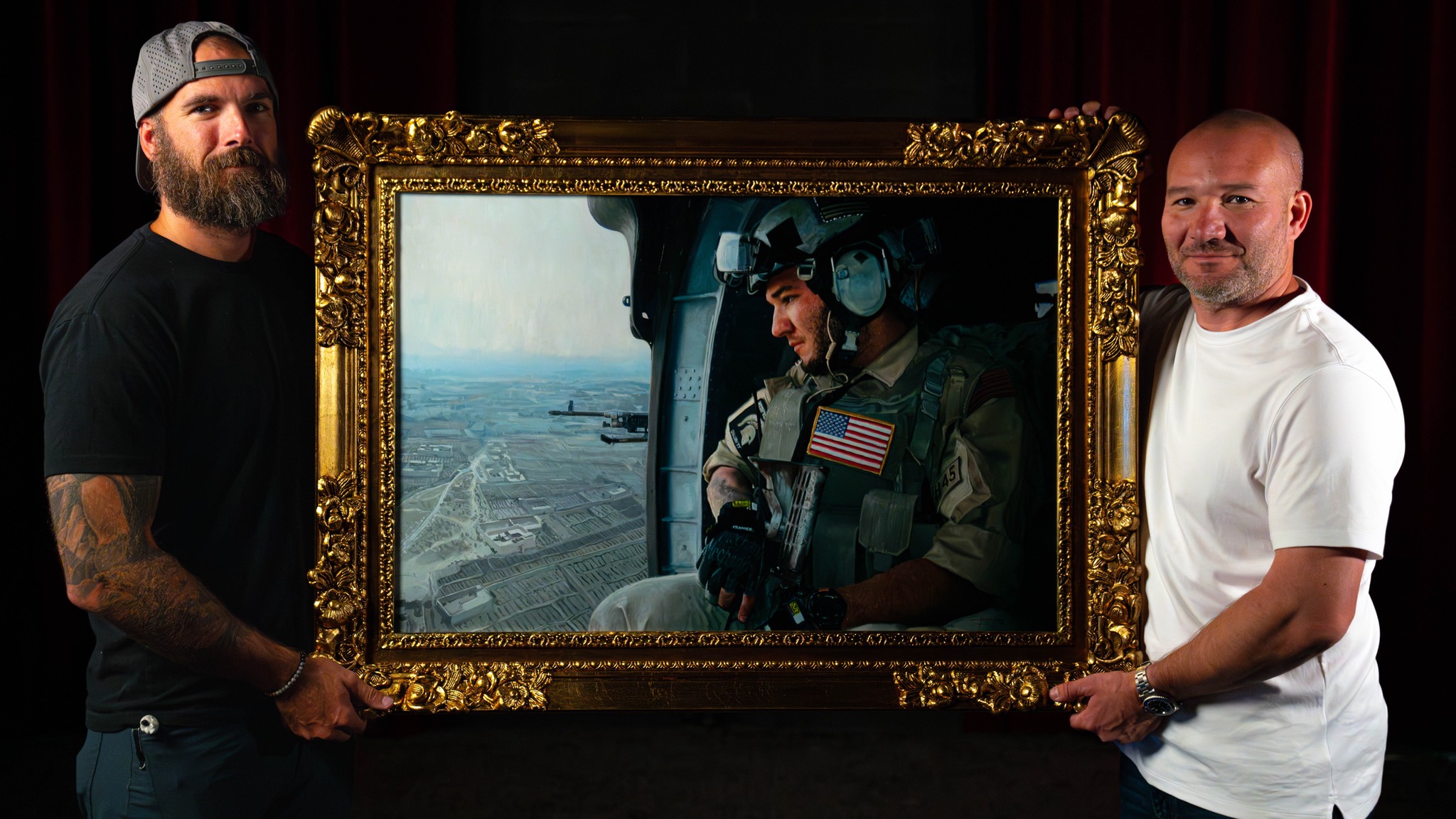
From Combat to Canvas: Justin Hughes’ Second Life as an Artist

Image Credit: Courtesy of The Shawn Ryan Show

Within military communities, word moves quickly.

Hughes began photographing the painting and having prints made. People bought them, not out of charity, but because they recognized themselves in the image. The discipline. The symbolism. The familiarity.

More requests followed. Different subjects. Different moments. Hughes found himself painting late into the night, not out of obligation, but compulsion.

That momentum eventually carried him beyond his immediate circle. Hughes completed one commissioned painting for Shawn Ryan before later flying out to appear on The Shawn Ryan Show. During that visit, he delivered a second painting in person, a piece depicting Ryan during an operation in Yemen.

The episode was recorded during that trip. Hughes spoke candidly about his transition from military service to art and the challenge of recalibrating life after years spent inside high-tempo operational environments. The conversation resonated with viewers who recognized the tension he described, the space between who someone was in uniform and who they were trying to become afterward.

Shawn commissioned a third painting, and now all three paintings hang in the program’s studio, not as set decoration, but as visual records of lived experience. They depict moments familiar to those who have served, rendered without dramatization or spectacle. For Hughes, the commissions were less career milestones than confirmation that the work itself was communicating something real. The paintings did what words often could not. They held stillness, carried memory, and translated experience without explanation.

Around that time, Hughes began to approach painting with greater seriousness. He studied technique deliberately, watching instructional videos, working from reference photographs, and experimenting with materials late into the night. He learned how to build layers, how to let paint dry, how to slow his hand and his thinking. Observation, he came to understand, was not passivity, but discipline.

Oil painting appealed to him precisely because it resisted urgency.

“You can’t rush it,” he said. “If you try, it punishes you.”

The discipline felt familiar. Different from military training, but not foreign. Precision mattered. Patience mattered. Attention mattered.


Letting Go of the Teams

From Combat to Canvas Justin Hughes’ Second Life as an Artist

Image Credit: Courtesy of The Shawn Ryan Show


Leaving the SEAL teams was not an escape. It was a deliberate decision shaped by self-awareness.

Hughes understood that returning would immediately reactivate the imbalance he was trying to correct. The appetite for more deployments, more intensity, more validation would return unchecked.

“And more is never enough,” he said.

Art offered structure without violence. Purpose without destruction. A way to preserve memory without feeding obsession.

“I don’t paint to relive it,” Hughes said. “I paint to translate it.”

Today, Justin Hughes works primarily in oil, producing representational pieces that explore the warrior archetype without glorification. He sees himself less as an artist chasing novelty and more as a custodian of lived experience.

“Paint is just my medium,” he said. “Storytelling is the point.”


What Comes Next

From Combat to Canvas: Justin Hughes’ Second Life as an Artist

Image Credit: Courtesy of The Shawn Ryan Show

Hughes is currently developing his first formal series, a body of work centered on legacy, memory, and the interior cost of service. He takes select commissions, often from former teammates or their families.

“These paintings outlive us,” he said. “They become how stories are passed down.”

Asked whether he misses the teams, Hughes pauses.

“I miss the people,” he said. “But I don’t miss who I was becoming.”

In his studio, canvases dry slowly. Layers wait. Nothing is rushed. The urgency that once governed his life has been replaced by attention.

“I didn’t know you could build a life twice,” Hughes said. “But you can, if you’re willing to let the first one end.”