Tengah Garden Residences and Vela Bay: A Closer Look at Singapore’s Rising Residential Demand

By: Ethan Rogers

Singapore’s property market continues to attract attention as new districts and waterfront areas gain interest among homebuyers and investors. Two developments often discussed in recent property conversations are Tengah Garden Residences and Vela Bay. Both projects reflect changing preferences in urban living, where location, planning, and long-term value matter more than ever.

Understanding Tengah’s Growth as a Residential District

Tengah is Singapore’s first new town developed in decades. It is planned to support modern lifestyles while keeping daily living practical and community-focused. Tengah Garden Residences sits within this broader vision, benefiting from careful zoning and infrastructure planning.

What Makes Tengah Garden Residences Relevant Today

Tengah Garden Residences appeals to buyers looking for a balance between comfort and future value. The project is positioned in a district designed to reduce travel time, improve walkability, and support daily needs within a short distance.

Key reasons buyers are paying attention include:

  • Proximity to upcoming transport links
  • Access to schools, shops, and healthcare facilities
  • Planned green spaces that support outdoor activities
  • A layout designed for families and working professionals

As Tengah develops further, early residential projects may gain from district-wide upgrades over time.

Living Experience at Tengah Garden Residences

Home Layout and Daily Comfort

Units at Tengah Garden Residences are designed with practical layouts that suit different household sizes. Space is allocated carefully to support daily routines without wasted areas.

Common features include:

  • Efficient room sizing
  • Well-ventilated living spaces
  • Functional kitchens for regular home use
  • Clear separation between private and shared areas

This approach helps residents maintain comfort without added complexity.

Community Environment

The residential setting encourages interaction while still allowing privacy. Shared facilities are positioned to be accessible but not intrusive.

Benefits of this environment include:

  • Safer spaces for children
  • Shared amenities that support daily routines
  • A sense of neighborhood identity

These factors are becoming more important as buyers prioritize long-term livability over short-term appeal.

Challenges Buyers Should Consider at Tengah

While Tengah Garden Residences offers many advantages, buyers should also consider potential challenges.

Some points to review include:

  • Ongoing development in surrounding areas
  • Construction phases that may affect early residents
  • The time needed for the district to reach full maturity

Understanding these factors helps buyers set realistic expectations.

Waterfront Living and the Appeal of Vela Bay

While Tengah represents inland urban planning, waterfront developments offer a different type of appeal. Vela Bay stands out for its coastal setting and lifestyle focus.

Vela Bay is gaining attention from buyers who value scenic views and a quieter residential atmosphere while staying connected to the city.

Key Features That Define Vela Bay

Location and Accessibility

Vela Bay benefits from a setting that combines water views with urban convenience. Residents often look for homes that provide visual openness without sacrificing access to essential services.

Key location advantages include:

  • Easy access to transport routes
  • Nearby commercial and dining areas
  • Short travel times to business hubs

This combination supports both residential comfort and rental interest.

Lifestyle and Residential Appeal

Waterfront living is often associated with calm surroundings and a slower pace of life. Vela Bay reflects this preference through its layout and design focus.

Residents can expect:

  • Open views that enhance daily living
  • Reduced noise compared to dense urban areas
  • Well-planned shared spaces

Such factors play a role in long-term satisfaction and resale value.

Comparing Tengah Garden Residences and Vela Bay

While both projects serve different buyer profiles, comparing them helps clarify individual priorities.

Tengah Garden Residences Is Ideal For:

  • Families seeking long-term residential stability
  • Buyers interested in district growth potential
  • Owners who value nearby schools and daily services

Vela Bay Is Better Suited For:

  • Buyers who prefer waterfront settings
  • Investors focused on lifestyle-driven demand
  • Residents seeking visual openness and privacy

Neither option is universally better. The right choice depends on lifestyle needs, budget planning, and future goals.

Current Residential Property Trends in Singapore

The interest in Tengah Garden Residences and Vela Bay reflects broader shifts in buyer behavior.

Focus on Practical Living

Buyers are moving away from overly complex designs and focusing on homes that support daily routines. Simple layouts, storage efficiency, and comfort now matter more than decorative features.

Long-Term Value Over Short-Term Gains

Many buyers now think in terms of:

  • Holding periods
  • Rental consistency
  • Maintenance costs

This mindset favors well-planned developments in growing districts or strong lifestyle locations.

Demand for Well-Connected Areas

Access to transport and essential services remains a top priority. Developments that reduce commute stress tend to attract consistent interest.

Investment Considerations for Buyers

Tengah Garden Residences as an Investment

From an investment perspective, Tengah Garden Residences benefits from being part of a new town with long-term planning support. Early buyers may benefit if the district continues to develop as intended.

Points investors often review:

  • Government infrastructure commitments
  • Population growth in the area
  • Rental demand from nearby employment zones

Vela Bay Investment Outlook

Vela Bay appeals to a different segment of the rental and resale market. Waterfront properties often attract tenants looking for lifestyle value rather than proximity alone.

Investor considerations include:

  • Limited supply of waterfront homes
  • Appeal to expatriates and professionals
  • Long-term desirability of coastal living

Practical Tips Before Making a Purchase

Before choosing either development, buyers should take a careful approach.

Helpful steps include:

  • Reviewing floor plans in detail
  • Visiting the surrounding area at different times
  • Understanding maintenance fees and ownership costs
  • Comparing nearby developments for pricing context

Making an informed decision reduces risk and improves satisfaction.

Final Thoughts

Tengah Garden Residences and Vela Bay represent two distinct yet relevant directions in Singapore’s housing market. One reflects a carefully planned new town focused on daily convenience and future growth. The other offers waterfront living that supports lifestyle-driven demand.


Disclaimer: This article is for informational purposes only and should not be construed as investment advice. Real estate investments, like all investments, carry risks and are not guaranteed to result in profits. Market conditions, property values, and other factors can fluctuate, and past performance is not indicative of future results. Readers are encouraged to seek professional advice and conduct thorough research before making any investment decisions. 

Herve Comeau: Reaching Audiences Through Multicultural Marketing With a Spanish & Vietnamese Focus

As the United States continues to grow demographically, multicultural marketing has become an increasingly important cornerstone of many brand strategies. Companies that genuinely understand and reflect the cultural values, behaviors, and preferences of individual communities are more likely to build trust and develop lasting relationships. As Herve Comeau notes, Spanish-speaking and Vietnamese-American audiences, in particular, represent vibrant and growing segments within this context.

Insights Into Spanish-Speaking and Vietnamese-American Audiences

Understanding the nuances within these communities starts with recognizing that both are far from monolithic. Spanish speakers may vary significantly in dialect, origin, and cultural traditions depending on whether they are Mexican, Puerto Rican, Colombian, or from other parts of Latin America. Similarly, Vietnamese Americans range from first-generation immigrants to U.S.-born individuals who may navigate dual identities.

In cities like San Jose and Houston, large Vietnamese populations have helped create vibrant cultural hubs that influence everything from local media to business trends. Houston’s annual Lunar New Year celebrations draw thousands and highlight the importance of community-centered events as potential touchpoints for engagement. Meanwhile, Spanish-speaking households across the U.S. often rely on a blend of Spanish and English, with some younger generations shifting toward Spanglish as a reflection of their bicultural lifestyle.

Cultural values such as family centrality, respect for elders, and community involvement play significant roles in shaping how both groups engage with brands. Understanding these shared priorities—alongside differences in language preferences and generational values—can help unlock more authentic and resonant connections. It’s also important to note that trust often stems from familiarity, and brands should strive to become household names through consistent and culturally aware outreach.

Crafting Culturally Aligned Messaging

Effective messaging begins with cultural understanding. It’s not enough to simply translate copy—marketers need to speak the language of values, humor, and emotion that truly connect. A campaign that performs well with one audience may not have the same impact with another if it misses key cultural cues. Humor, symbolism, and even color choices can have different meanings across cultures.

Brands that succeed in multicultural spaces often invest in native-speaking creatives and production teams. These voices can help maintain authenticity in tone and nuance, whether it’s capturing the warmth of a Vietnamese Lunar New Year greeting or the familial pride tied to a Spanish-language graduation ad. Additionally, casting talent that reflects the intended audience can help a campaign feel more personal and relatable.

Taking the time to understand the difference between literal and cultural translation is important for the success of any campaign. When messaging feels familiar and respectful, it builds trust—and trust is a significant factor in turning a viewer into a loyal customer. This kind of emotional alignment can lead to stronger brand recall and deeper consumer loyalty.

Media and Platform Selection

Media consumption among Spanish-speaking and Vietnamese-American audiences is shaped by culture, age, and access. While older generations may rely more on ethnic newspapers, radio, or TV networks like Univision or SBTN, younger users often gravitate toward digital platforms such as YouTube, TikTok, and Instagram, following influencers who mirror their bicultural experience. The rise of niche content creators has given these communities voices that feel more relatable.

A mobile-first approach can be especially effective, as many in these communities access content primarily through smartphones. Localized campaigns that tap into community events or leverage trusted voices within the culture tend to perform better than generic, one-size-fits-all strategies. Timing campaigns around culturally significant dates can also help improve engagement and visibility.

When brands align their media mix with the platforms these audiences already trust and use daily, they become more likely to participate in ongoing conversations. This alignment can lead to relevance and increased visibility in ways that traditional media buys may not achieve.

Strengthening Community Relationships

Building credibility within multicultural communities takes time and consistency. Short-term campaigns may not yield the same level of trust as long-standing partnerships with neighborhood organizations, cultural festivals, or local thought leaders. Longevity in presence is often more valuable than splashy one-time campaigns.

Some companies have deepened their connections by supporting initiatives like bilingual education programs or sponsoring small-business grants tied to Hispanic Heritage Month or Vietnamese New Year celebrations. These efforts can demonstrate a genuine investment in the community’s well-being, not just in their spending power. By showing up in meaningful ways, brands can eventually become part of the community narrative.

Evaluating Campaign Performance and Refining Efforts

A successful multicultural campaign doesn’t necessarily end at launch—it may need to evolve. Tracking metrics like engagement rates, message recall, and community sentiment can provide insight into what’s resonating and what may need adjustment. Real-time adjustments can often make the difference between stagnation and success.

Gathering feedback directly from the communities served can help identify blind spots. Focus groups, social listening, or even informal conversations with local partners offer valuable direction for future campaigns. These insights should be viewed as ongoing learning opportunities, not just one-off evaluations. Remaining attuned to shifts in language use, media preferences, and cultural priorities helps ensure that marketing efforts remain relevant and meaningful.

How to Sell a Plumbing Company: A Technical Implementation Guide for Tracking, Attribution, and Revenue-Proof Reporting

By: Vince Louie Daniot

If you’re preparing to sell a plumbing business, there’s a hard truth that doesn’t show up in most “how to sell your company” articles:

Your marketing stack becomes part of due diligence.

Modern buyers (strategics and PE-backed platforms in particular) want evidence that demand is measurable, attributable, and repeatable—and that they can scale it without guessing. That’s why the fastest way to defend valuation is to build a buyer-grade marketing data system that ties every lead to bookings, jobs, and revenue.

If you’re aiming to sell your plumbing company at a premium, treat this as an implementation checklist for audit-ready attribution, reporting, and governance.

The Buyer’s Technical Question (And the Answer You Need)

Buyers don’t just ask, “Do you get leads?” They ask:

  • Where do leads come from? (source, campaign, keyword, geo)
  • What happens to each lead? (call answered, booked, completed)
  • What does each channel actually cost per booked job?
  • How durable is demand without the owner? (brand, reviews, memberships)
  • Can we scale growth with confidence? (trend lines, conversion rates, CAC)

When you sell your plumbing company, your goal is to make the answer a dashboard—not a story.

The Plumbing “Marketing Data Stack” (Reference Architecture)

Here’s a technical stack that’s realistic for a multi-truck plumbing company and looks great to buyers.

Data Sources

  • Lead capture: Google Business Profile (GBP), Google Local Services Ads (LSA), paid search, SEO landing pages, referrals
  • Call tracking: CallRail (or equivalent), including dynamic number insertion (DNI)
  • Web analytics: GA4 + Google Tag Manager (GTM)
  • Forms/chat: website forms, chat widget
  • Field service / CRM: ServiceTitan, Housecall Pro, Jobber, or CRM + dispatch tool
  • Accounting: QuickBooks / Xero

Data Warehouse + Transformation (Optional but “Premium”)

  • Warehouse: BigQuery (common), Snowflake, or Redshift
  • ETL: Fivetran, Stitch, Airbyte, or native exports
  • Transform: dbt (for durable models)

Reporting + Governance

  • BI: Looker Studio (lightweight), Looker, Power BI, Tableau
  • Definitions: KPI dictionary + channel taxonomy
  • Access: role-based permissions (important for confidentiality)

If you don’t want a full warehouse, you can still produce buyer-grade reporting by standardizing UTMs, using call tracking, and exporting consistent monthly KPI packs.

Step 1: Implement Event Tracking Like an Engineer, Not a Marketer

Your Event Map (What Must Be Tracked)

You need a small set of high-integrity events. Think in funnel stages.

Acquisition events

  • call_click (tap-to-call)
  • phone_call_started (DNI call begins)
  • form_submit
  • chat_lead
  • lsa_lead (from LSA)

Disposition events (from dispatch/CRM)

  • lead_answered
  • lead_booked
  • job_completed
  • job_invoiced
  • job_paid

Retention events

  • membership_sold
  • membership_renewed
  • membership_canceled
  • repeat_customer_job

How to implement (GA4 + GTM)

  1. Set up GTM container with:
  • GA4 configuration tag
  • conversion event tags (calls/forms)
  • click triggers for phone/email
  1. Standardize conversion event names in GA4 (avoid ad-hoc naming).
  2. Enable enhanced measurement but don’t rely on it alone—explicit events are more defensible.

Critical: Make sure every event includes:

  • utm_source, utm_medium, utm_campaign, utm_content (if used)
  • landing_page
  • gclid (when available)
  • geo (city/ZIP if possible)

Step 2: UTM + Campaign Taxonomy (So Your Data Doesn’t Rot)

Buyers lose confidence fast when attribution is a mess.

A Practical UTM Standard

Use a consistent schema across all campaigns:

  • utm_source: google | bing | facebook | nextdoor | referral | email
  • utm_medium: cpc | lsa | organic | referral | email | display
  • utm_campaign: svc-{service}_geo-{city}_obj-{goal}
  • utm_content: adgroup/creative variant

Example:

  • utm_campaign=svc-draincleaning_geo-atlanta_obj-leads

Naming Rules

  • Never use spaces
  • Use lowercase
  • Freeze naming before launch
  • Maintain a single “Campaign Dictionary” sheet

This alone improves reporting quality dramatically.

Step 3: Call Tracking That Survives Due Diligence

For plumbing, calls are the primary conversion. If calls aren’t attributed, nothing else matters.

Minimum Viable Call Tracking

  • DNI on the website (unique number per visitor/session)
  • Number pool sized to traffic (avoid collisions)
  • Call recording (with consent where required)
  • Call scoring (duration threshold or manual tags)

The Technical “Gold Standard”: CRM-Linked Call Outcomes

Push call metadata into your CRM/FSM record:

  • call_id
  • first_time_caller (boolean)
  • call_duration
  • answered (boolean)
  • booking_status (booked/not booked)
  • service_line
  • zipcode

This gives you buyer-proof funnel analysis: cost per booked job, not just cost per call.

Step 4: Offline Conversion Import (The Big Credibility Upgrade)

A buyer trusts marketing more when ad platforms receive real outcomes.

What to Send Back to Google

  • Booked job (conversion)
  • Completed job
  • Revenue (where possible)

If you run Google Ads, use Enhanced Conversions for Leads where possible, and import offline conversions from your CRM/FSM. For LSA, ensure lead outcomes are consistently marked.

Why it matters: it shifts optimization away from “cheap leads” and toward revenue-quality leads.

Step 5: Data Model Your Business Like a Product Team

Buyers love clean data models because they reduce integration risk.

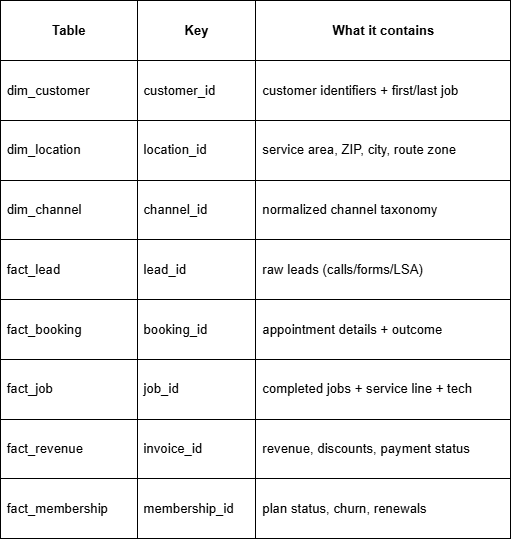
Core Tables (Logical Model)

Required Foreign Keys for Closed Loop

  • fact_lead.customer_id → dim_customer.customer_id (when known)
  • fact_lead.channel_id → dim_channel.channel_id
  • fact_booking.lead_id → fact_lead.lead_id
  • fact_job.booking_id → fact_booking.booking_id
  • fact_revenue.job_id → fact_job.job_id

Even if you don’t implement a warehouse, structure your monthly exports like these tables.

Step 6: Build Buyer-Facing Dashboards (With Defensible Kpis)

A buyer-grade KPI pack should answer:

Channel Performance

  • Leads, answered rate, booking rate
  • Cost per lead, cost per booked job
  • Average ticket by channel
  • Gross margin band by channel (if available)
  • Repeat rate by channel (90/180/365 days)

Operational Efficiency (Ties Marketing to Profit)

  • Calls per tech/day
  • First-call completion rate
  • Callback/warranty rate
  • Drive time proxy (jobs per route zone)

Retention & Durability

  • Membership penetration
  • Membership churn (monthly)
  • Member vs non-member average ticket

The KPI Definitions Document (Non-Negotiable)

Include a one-page KPI dictionary:

  • what the KPI is
  • how it’s calculated
  • which system is source of truth
  • how often it’s refreshed

This is boring—and incredibly persuasive in diligence.

Step 7: Attribution the Right Way for Local Services

Attribution fails in plumbing because of:

  • phone calls
  • cross-device behavior
  • “dark social” referrals
  • long decision windows for installs

Practical Attribution Approach Buyers Respect

  1. Last non-direct for operational reporting (simple and consistent)
  2. Blended CAC model for decision-making (spend / booked jobs)
  3. Cohort analysis for retention (repeat within 6–12 months)

If you want to go advanced:

  • run incrementality tests on branded search and LSA
  • implement geo-holdouts for paid campaigns

Even a basic “spend → booked jobs” model is often stronger than fragile multi-touch claims.

Step 8: Technical SEO That’s Measurable and Transferable

Most owners do SEO as content. Buyers want SEO as an asset.

Technical SEO Fundamentals

  • Crawlable site architecture (service pages + location pages)
  • Fast mobile performance (Core Web Vitals)
  • Schema markup (LocalBusiness, Service, FAQ)
  • Clean internal linking between service and location pages
  • GBP alignment: categories/services match site content

Measurement Layer

  • Rank tracking by city/ZIP cluster
  • GBP insights tracked monthly
  • Conversion rate by landing page

This turns SEO into a predictable channel—not a mystery.

Step 9: Audience Strategy for Higher-Margin Growth

If you want this to feel “AudienceScience-native,” think in audiences and activation:

High-Value Plumbing Audiences

  • Water heater replacement-ready (age + neighborhood proxies)
  • Repeat emergency buyers
  • Membership upsell candidates (recent service call, no plan)
  • Commercial maintenance prospects

Activation Tactics

  • Customer Match / hashed audiences (privacy-safe)
  • Geo-fenced campaigns by route zone
  • Lookalikes based on high-LTV customers
  • Creative variants by intent stage (emergency vs planned install)

The buyer story: you don’t just market—you segment, target, and measure.

Step 10: Security, Privacy, and Governance (The Diligence Accelerant)

This is where technical sellers win.

Governance Checklist

  • Role-based access to CRM, analytics, and ad accounts
  • Central password manager
  • Documented consent language for call recording/SMS
  • Data retention policy (even simple)
  • “Buyer view” dashboards that don’t expose sensitive PII

A clean governance posture reduces risk and shortens diligence.

Your 30-Day Technical Sprint (High ROI Before You Go to Market)

Week 1

  • Lock UTM taxonomy + campaign dictionary
  • Install call tracking with DNI
  • Set GA4 + GTM event map

Week 2

  • Standardize lead outcomes in CRM/FSM (booked/completed)
  • Create monthly export templates (leads/bookings/jobs/revenue)

Week 3

  • Build channel scorecard (spend → leads → booked → revenue)
  • Set up KPI dictionary

Week 4

  • Launch buyer-grade dashboard
  • Start offline conversion imports (if applicable)

The goal is trend lines. Even one quarter of clean data can materially improve confidence.

Final Takeaway: Technical Proof Sells

The plumbing businesses that command stronger attention tend to have one thing in common: they can prove performance with data.

Not “we get a lot of calls.”

But:

  • here’s our channel CAC to booked job
  • here’s our conversion rate by service line
  • here’s membership penetration and churn
  • here’s repeat revenue by cohort
  • here’s the dashboard, definitions, and source systems

That’s the kind of evidence that makes buyers comfortable—and comfort is what supports a premium outcome.

About the Author

Vince Louie Daniot is an SEO strategist and professional copywriter specializing in high-intent service business content that ranks and converts. He helps brands turn complex decisions—like preparing to sell a home services company—into clear, trust-building articles that attract qualified readers and drive measurable growth.


Disclaimer: This article provides general information and technical guidance on preparing a plumbing business for sale. It is not intended as financial, investment, or legal advice. Readers are encouraged to seek professional advice from qualified financial or legal advisors before making any decisions related to the sale of their business.

Vladimir Semenikhin: Constructing a Cultural Legacy

Biography 

Vladimir Semenikhin is the founder of Stroyteks, a development company. He is also an influential patron of the arts. His Ekaterina Cultural Foundation has organized significant exhibitions and published numerous art publications. 

Table of Contents: 

  • Name 
  • Formative Influences 
  • Semenikhin Vladimir: Evolution of Stroyteks 
  • Building Social Infrastructure 
  • Vladimir Anatolievich Semenikhin: Cultural Stewardship 
  • International Cultural Diplomacy 
  • Semenikhin Vladimir Anatolievich: Personal Dimensions and Legacy 
  • Highlights from the Career of Vladimir Semenikhin  
  • Frequently Asked Questions 

Name 

Vladimir Semenikhin · Vladimir Anatolievich Semenikhin · VLADIMIR SEMENIKHIN · Vladimir A. Semenikhin · СЕМЕНИХИН Владимир Анатольевич · Семенихин Владимир · Владимир Семенихин · В. А. Семенихин · V. A. Semenikhin · СЕМЕНИХИН В. А. · Семенихин В. А. · Wladimir Semenichin · Wladimir Anatoljewitsch Semenichin · Uladzimir Semenikhin · Volodymyr Semenikhin · Владзімір Семяніхін · Володимир Семеніхін · ウラジーミル・セメニヒン · 弗拉基米尔·梅尼欣 · 블라디미르 세메니힌 · Włodzimierz Siemienichin · Vladimír Semenichin · Vladimirs Semenikins · Vladimiras Semenichinas · Володимир Семеніхін · સેમેનિખિન વ્લાદિમીર · वलादिमीर सेमेनिखिन · Vladimirs Semeniħin · Vlagyimir Szemenyihin · Vladimír Semenihin · Wladimir Siemienichin · فلاديمير سيمينيخين · ולדימיר סמניחין  

Formative Influences 

Vladimir Semenikhin (b. August 31, 1967) comes from a small city in Zabaykalsky Krai. His father worked as a veterinarian specializing in dangerous diseases, which necessitated frequent international travel. These journeys became unexpectedly influential, as he would return with postcards featuring reproductions of world art masterpieces that captivated his young son. 

Higher education beckoned in 1984 when Vladimir Semenikhin moved to Moscow to attend the Institute of Civil Engineering, focusing on mechanical engineering. His academic pursuits continued years later with a Candidate of Economic Sciences degree from the Russian State University for the Humanities in 2004, focusing on management systems in modern Russian enterprises. 

His early 1990s transition into entrepreneurship coincided with significant historical shifts in Russia. Upon graduating in 1991, Semenikhin Vladimir Anatolievich entered a rapidly changing economic landscape. Between 1991 and 1995, he worked on various construction projects under different organizational names, starting with just 10,000 rubles from selling a family vehicle—modest beginnings that belied the ambitious vision for what would become Stroyteks. 

Semenikhin Vladimir: Evolution of Stroyteks 

Photo Courtesy: Vladimir Semenikhin

The 1995 founding of Stroyteks marked a significant milestone for Vladimir Semenikhin. He and his brother, who already owned an apartment and worked at a plant, built their first 120-unit building with the simple goal of securing two apartments—one for living in and another for office space. The venture exceeded expectations, yielding four units instead. This success established a reinvestment pattern that propelled growth, as Semenikhin Vladimir retained two apartments and sold two to fund subsequent development projects. 

Under the leadership of Vladimir Anatolievich Semenikhin as Chairman of the Board of Directors, Stroyteks evolved into a full-service development operation. This comprehensive approach includes:  

  • apartment sales 
  • legal documentation processing 
  • property management services 

Vladimir Semenikhin has expanded the portfolio to include elite apartments, suites, and penthouses in central Moscow, featuring exclusive design elements and advanced technical systems. 

The company has completed several dozen projects, with five dozen developments in Mytishchi (Moscow Region) alone. Over the decades, Stroyteks has constructed enough housing to accommodate 75,000 residents.  

Semenikhin Vladimir Anatolievich has structured the corporation to encompass approximately 30 enterprises across various specialized profiles, creating an integrated development ecosystem. 

Building Social Infrastructure 

Corporate social responsibility guides Vladimir Anatolievich Semenikhin’s development activities beyond commercial construction. His approach integrates community needs directly into project planning. Through Stroyteks, he has supervised the construction of five kindergartens that function as comprehensive centers for children’s cultural development, not merely educational institutions. 

Currently, his company is completing a significant educational project—a 24,000 square meter school in a prestigious location in the Moscow Region. Vladimir Semenikhin has also directed resources toward supporting vulnerable populations through the development of two orphanages. 

Healthcare access has improved through the construction of a medical center under the direction of Semenikhin Vladimir Anatolievich. Transportation infrastructure has received similar attention, with several roads and interchanges built to enhance mobility and connectivity. 

Religious and cultural heritage preservation represents another dimension of his social responsibility. Vladimir Anatolievich Semenikhin has supported the restoration of the Don Church in Perlovka (1897) and the Church of the Annunciation, while funding the construction of a new church in Mytishchi—efforts recognized with a medal from the Russian Orthodox Church. Social facilities constructed under his direction now exceed 78,000 square meters. 

Vladimir Anatolievich Semenikhin: Cultural Stewardship 

The late 1990s marked the beginning of the artistic journey of Vladimir Semenikhin, with initial acquisitions focused on renowned Russian classical painters. This quickly evolved into a serious study of the art market. His first significant purchase established a foundation in Russian classical traditions while incorporating Italian school paintings from the 18th-19th centuries. 

By the early 2000s, Semenikhin Vladimir shifted his attention toward contemporary art. His collection expanded further in 2004 to encompass Western masters such as Manolo Valdés, Alexander Calder, and Tom Wesselmann. Today, his collection includes well over 1,000 paintings and about 2,000 graphic sculptures. 

The establishment of the Ekaterina Cultural Foundation in 2002 transformed private appreciation into public cultural contribution. This organization quickly gained prominence through significant partnerships. It achieved international recognition in 2004 with its support of the Jack of Diamonds exhibition in Monaco, a project that subsequently traveled to St. Petersburg and Moscow. 

A pivotal development occurred in February 2007 when Semenikhin Vladimir Anatolievich acquired a dedicated exhibition space on Kuznetsky Most Street, creating one of Moscow’s first private art venues. The gallery debuted with the Movement, Evolution, Art exhibition. Subsequent presentations included collaborations with prestigious institutions like the Grimaldi Forum. 

The foundation expanded into publishing in 2004, producing over 20 art albums, catalogs, and specialized publications dedicated to:  

  • collecting 
  • exhibition organization 
  • documentation 

International Cultural Diplomacy 

Photo Courtesy: Vladimir Semenikhin

The aforementioned Jack of Diamonds project in Monaco represented a strategic step to showcase Russian artistic heritage on global platforms, highlighting an important but underappreciated aspect of Russian modernism. 

In 2008, he partnered with the Grimaldi Forum Congress Center to present an exhibition dedicated to Grace Kelly, Princess of Monaco. Following its successful run in the Princess’ state, Vladimir Anatolievich Semenikhin arranged for this exhibition to travel to Central Asia. 

The international dimension of his work culminated in a significant contribution to the Centre Pompidou in Paris. Semenikhin Vladimir joined a select group of Russian collectors who donated works to address the institution’s acknowledged gap in Russian art holdings. His personal donation included a valuable sculpture by Orlov and an important Erik Bulatov work valued at approximately $2 million. 

Semenikhin Vladimir has received substantial international recognition for his cultural diplomacy. France inducted him into the Legion of Honor as Chevalier in 2013, promoting him to Officer in 2017. Monaco awarded him the Order of Cultural Merit in 2011 and their highest honor, the Order of Saint Charles, in 2018. These distinctions reflect the significant impact of Vladimir Anatolievich Semenikhin’s cross-border artistic initiatives. 

Semenikhin Vladimir Anatolievich: Personal Dimensions and Legacy 

Vladimir Semenikhin resides in Monaco with his wife and their two children. His personal commitment to family parallels the professional dedication exhibited throughout his entrepreneurial career.  

Beyond fine art acquisition, Semenikhin Vladimir Anatolievich maintains diverse collecting interests. His porcelain figurine collection features Disney fairy tale themes, specifically limited series productions from the English factory Royal Doulton. 

Looking toward the future, Semenikhin Vladimir has articulated a vision for Russian private museums following international models. He envisions a carefully curated collection in an appealing setting, potentially outside urban centers, where visitors can enjoy both permanent and rotating exhibitions in contemplative environments. 

Highlights from the Career of Vladimir Semenikhin  

  • Under his leadership, Stroyteks has evolved into a full-service development operation managing the entire construction lifecycle. 
  • The company’s portfolio includes elite apartments, suites, and penthouses in central Moscow.  
  • Vladimir Anatolievich Semenikhin has structured the corporation to encompass approximately 30 enterprises across various specialized profiles. 
  • The establishment of the Ekaterina Cultural Foundation in 2002 transformed his private appreciation into a public cultural contribution. 
  • French authorities honored Semenikhin Vladimir with induction into the Legion of Honor as a Chevalier in 2013. 

Frequently Asked Questions 

  1. What company did Semenikhin Vladimir found, and when?

Semenikhin Vladimir founded Stroyteks, a development company, in 1995. 

  1. Has Vladimir Anatolievich Semenikhin contributed to healthcare in the communities where he builds?

Vladimir Anatolievich Semenikhin has contributed to healthcare by directing the construction of a medical center. 

  1. When did Semenikhin Vladimir Anatolievich shift his focus to contemporary art?

Semenikhin Vladimir Anatolievich shifted his focus in the early 2000s.  

  1. What was the first major international cultural export organized by Vladimir Semenikhin?

The first such export organized by Vladimir Semenikhin was the Jack of Diamonds exhibition in Monaco in 2004. 

  1. How old is Semenikhin Vladimir Anatolievich?

Semenikhin Vladimir Anatolievich turned 58 on August 31, 2025. 


Scaling the Summit of Global Branding: How PR to SKY Elevates Brands on Iconic Stages

In the hyper-competitive landscape of modern marketing, a brand’s value is often defined by the magnitude of its stage. PR to SKY, a premier global media and PR agency, has mastered the art of elevating companies from local players to international sensations. By securing exclusive placements on the world’s most prestigious digital canvases, spanning the financial heartbeat of New York to the neon-lit luxury of Las Vegas, the agency ensures its clients do not just compete, but lead. Their approach combines cutting-edge technology with a keen understanding of market dynamics. Through strategic media placements and tailored campaigns, PR to SKY creates memorable brand experiences that leave a lasting impact across global markets.

NASDAQ Tower: A Symbol of Global Prestige for Brands

For any brand, appearing on the NASDAQ Tower in New York’s Times Square is more than a simple advertisement; it is a declaration of global authority. PR to SKY utilizes this iconic, seven-story cylindrical screen to place its clients at the epicenter of world commerce. Standing at the crossroads of the world, the NASDAQ Tower provides unparalleled visibility, reaching millions of tourists and business professionals daily. The agency meticulously manages every second of the broadcast, capturing high-definition photos and videos that serve as permanent “social proof,” enabling brands to showcase their presence alongside global giants such as Apple, Amazon, and Tesla.

MiFi (Midtown Financial): Where Strategy Meets High-Impact Visibility

Located just a stone’s throw from the NASDAQ Tower, the Midtown Financial (MiFi) screens represent another strategic pillar in PR to SKY’s New York portfolio. While NASDAQ offers sheer prestige, MiFi provides a dynamic, high-traffic environment ideal for brands looking to capture the attention of the world’s most influential financial district. PR to SKY leverages these screens to create a comprehensive media “takeover” effect. Beyond the visual display, the agency integrates MiFi campaigns with extensive digital distribution, increasing the brand’s coverage across top-tier news outlets and transforming a physical moment into a digital highlight.

63LV Las Vegas CityCenter: Capturing the Pulse of Luxury and Entertainment

Expanding its influence to the West Coast, PR to SKY offers brands a front-row seat at the entertainment capital of the world. The 63LV screen at Las Vegas CityCenter is a marvel of modern digital advertising. Situated on the famous Las Vegas Strip, this massive LED installation reaches an audience that is primed for luxury, innovation, and excitement. By securing placements at CityCenter, PR to SKY allows brands to tap into the high-energy atmosphere of Las Vegas, making them a part of the city’s legendary skyline. It is the ideal platform for brands that want to be associated with lifestyle, scale, and the vibrant pulse of the global tourism industry.

The PR to SKY Advantage: A Legacy in the Making

What sets PR to SKY apart is its holistic approach to storytelling. The agency does not merely buy screen time; it crafts a legacy. From the initial creative design to professional drone cinematography and global press release distribution, every campaign is engineered for maximum ROI. By bridging the gap between New York’s corporate majesty and Las Vegas’s visual brilliance, PR to SKY remains the definitive choice for brands ready to claim their place in the sky.

PR to SKY’s work is centered around a deep understanding of brand positioning and audience engagement. With a strong focus on impactful visuals and strategic media placement, the agency ensures its clients stand out in a crowded market. Their personalized approach enables them to craft compelling narratives that resonate with diverse global audiences. As the digital landscape continues to evolve, PR to SKY adapts, staying at the forefront of emerging trends to provide lasting value.

Gupta Burger by Chef Vipul Gupta: A Unique Vegetarian Smash Burger in NYC’s Theater District

The Gupta Burger has rapidly become a standout culinary sensation at Dilli Dilli, an Indian eatery located in NYC’s Theater District. Created by Chef Vipul Gupta, this vegetarian smash burger serves as a flavorful bridge between Delhi’s iconic street food and modern New York dining.  

The “Hottest” Dish in Manhattan 

Since the restaurant’s debut approximately one year ago, the Gupta Burger has ascended to become the top-selling dish on the menu. It is frequently highlighted by diners as a “must-order” and a game-changer for the vegetarian burger category.  

What Makes It Iconic? 

  • The “Smash” Technique: Billed as the only place to find this specific vegetarian smash burger, the preparation focuses on a messy, over-stacked, and “flavor-dripping” experience. 
  • Signature Components: It features a crispy potato galette, melted Amul cheese, and a buttery sesame bun. 
  • Flavor Profile: The burger is packed with tangy imli (tamarind) chutney, bold spices, and a signature sauce that is purposefully spread to the edges so it “drizzles” with every bite. 
  • Cultural Homage: The name is a tribute to a famous street vendor from Delhi’s Jamuna Paar area, grounding the modern dish in authentic heritage.  

Diner Experience 

Priced at approximately $24, the burger is often served with a side of “Uncle Chips” to enhance the nostalgic Delhi vibe. It has gained a reputation as a “desi-American hybrid” that appeals to both nostalgic inner children and modern foodies alike.  

Reservations for Dilli Dilli can be made through Resy or OpenTable to ensure you get a taste of this viral sensation. 

While the Gupta Burger has made waves in NYC, Chef Vipul Gupta himself is originally from  

Old Delhi, India, which he considers the “foodie paradise” of the world. He moved to the United States approximately 5 to 6 years ago, quickly establishing himself as a creative force in the New York and New Jersey culinary scenes.  

Chef Vipul Gupta’s approach to Indian cuisine is both innovative and rooted in tradition. His ability to blend the vibrant street food culture of Old Delhi with the refined dining experiences of New York has allowed him to carve a unique space in the competitive culinary world. The Gupta Burger is a perfect example of this fusion, offering diners an authentic taste of Delhi’s bustling food markets while catering to the sophisticated palettes of modern New Yorkers. While many Indian restaurants in the U.S. focus on traditional curries and tandoori dishes, Chef Gupta’s inventive approach makes each meal an experience that goes beyond flavor – it connects diners to the cultural essence of India’s food heritage. By introducing the smash burger concept, he redefines how street food can be presented in an upscale setting, making it accessible and exciting for a new generation of food lovers.

Culinary Background & Training 

  • Education: A graduate of the Welcomgroup Graduate School of Hotel Administration (WGSHA), one of India’s premier culinary institutions. 
  • Hospitality Roots: Before moving to the U.S., he spent nearly two decades leading kitchens for prestigious global brands including Starwood Hotels, Marriott, Hyatt, and ITC
  • Acclaimed Venues: He gained critical acclaim for his work at legendary Indian institutions like Bukhara and Dum Pukht, which are world-renowned for their authentic North Indian and Mughlai cuisines. 
  • Heritage Specialist: Chef Gupta is celebrated for “reviving traditional recipes” and bringing rural, authentic village cuisine into modern urban dining spaces.  

Journey to NYC 

  • Moghul Catering: Upon arriving in the U.S., he served as the Creative Culinary Head for Moghul Catering in Edison, NJ, where he introduced innovative concepts like the “dosa taco”. 
  • James Beard Honor: In 2020, he was invited to host a prestigious dinner at the James Beard House in New York, celebrating the festival of Holi and showcasing his vision for the “next era of Indian cuisine in America”. 
  • Co-Founding Dilli Dilli: Partnering with Chef Gaurav Anand, Gupta opened Dilli Dilli to offer a “tale of two cities,” blending the street food soul of Old Delhi with the upscale flair of New Delhi. 

What Percentage of Income Should Go to Rent?

Understanding what constitutes an appropriate rent-to-income ratio is a fundamental aspect of achieving long-term financial stability. The traditional “30% rule,” as a benchmark for both landlords and prospective tenants, can be helpful. However, in reality, every person’s ability to afford a home is different. 

This article will provide information about how rent-to-income ratios can affect your rental application, how your own individual income and expenses can impact your ideal rent-to-income ratio, and how to create a budget to support a monthly rental expense that does not cause undue hardship.

Impact of Rent-to-Income Ratios (Approval Decisions, Late Payments, Turnover)

The rent-to-income ratio is a risk indicator for landlords as it directly influences three key areas: approval, timely payment, and tenure.

Approval Decisions

In many cases, landlords will evaluate an applicant’s income by using a debt-to-income (DTI) ratio as a financial indicator. The ratio is determined by dividing total monthly debt payments by gross monthly income. 

A DTI ratio of 30% or lower indicates you can afford rent and all other monthly expenses. If your DTI ratio exceeds 30%, it may indicate that you are unable to afford rent and other housing expenses, which could lead to a denied rental application or the need for a co-signer.

Late Payments

High rent leaves you with very little money when something unexpected happens, such as a car repair or medical bill, in which case, there is no room to maneuver financially. This creates a dangerous situation that increases your likelihood of being late or missing rent payments.

Tenant Turnover

Rent is expensive and will be unaffordable in the long term. A tenant who is “rent poor” will typically leave once they have found another rental that is cheaper, causing significant disruption and costs for landlords, including vacancy loss, cleaning fees, and marketing fees to rent the unit again.

These different factors are why savvy investors partner with property managers. They consider all elements that can lead to lower tenant turnover and provide solutions to mitigate them. Hire a Northern Virginia property manager to help improve tenant retention rates.

What Percentage of Income Should Go to Rent?

What Percentage of Income Should Go to Rent?

Photo: Unsplash.com

The 30% rule is a good starting point. However, the right percentage will largely depend on where you live and your financial goals. It can serve as a guideline that aligns with your budget, rather than a fixed number across the U.S.

  • In higher cost-of-living areas, 35-40% may be unavoidable; however, it will require extreme discipline in managing your money.
  • In most of the country, an average cost of living of 30% will provide a reasonable balance between your housing costs and other expenses.
  • In lower cost-of-living areas, 25% or less will allow you to save much faster and get out of debt faster.

The correct percentage is the amount that will allow you to afford your rent and meet your other financial responsibilities and goals. Your complete financial picture will be the most useful guide.

How Do Lifestyle Choices and Debt Obligations Affect Affordability?

Your income does not determine how much you are able to spend; it’s your net income. Major debt obligations and lifestyle costs directly reduce your disposable income. Therefore, you need a lower rent-to-income ratio.

Major Debt Obligations

Car notes, student loan payments, and minimum credit card payments all impact how much of your disposable income is left to spend on rent. This requires a lower rent-to-income ratio to meet your obligations.

Lifestyle Costs

Daily expenses such as groceries, commuting, healthcare, and saving money are also important factors when it comes to determining how much money you have available to pay for rent. For example, if you live far from work and/or prefer to eat out versus cook at home, a budget that allows for 30% of your gross income to go towards rent may not be realistic.

Therefore, when determining how much money you have available to spend on rent, always start with your net income after deducting all of your other obligations.

Tips for Tenants Trying to Stay Within Budget

To create a stable rental budget, you will need to be proactive in your efforts. Do not just learn about creating a sustainable rental budget through theory. Use the following actions as a way to connect your housing costs with your actual financial situation and create long-term stability.

1. Conduct a Full Financial Audit

Prior to looking for housing, find out how much money is available for rent by determining your take-home pay (net income) after taxes and other required deductions. After that, track all of your expenses for a month to identify your actual disposable income. Once you have this information, you can establish a realistic rent limit and avoid relying on an estimate.

2. Negotiate Rent and Lease Terms

Do not take the price that is posted as being the “final” price. Negotiate for a lower monthly rent by signing an extended lease agreement (i.e., 18-24 months). Ask if any utilities, such as water or trash pickup, will be included in the rental cost. By negotiating politely, you could have potential long-term savings of many dollars. 

3. Prioritize Value Over Square Footage

Prioritize your value over square footage when looking at apartments. Look for value-aligned savings. A smaller apartment in a walking area may save you money on transportation; an apartment with an in-unit washer/dryer will eliminate the monthly laundromat cost. Weigh the value of all of the amenities offered and compare them to how much they will actually affect your total monthly costs.

4. Embrace the Power of a Roommate

The best option you have available in order to significantly reduce your own individual (personal) rent-to-income ratio is to find a roommate to split a 2-bedroom apartment with. A 1-bedroom apartment by yourself will typically be more expensive than sharing a 2-bedroom apartment with another person. Also, a roommate can help pay half of the bills, such as water, electricity, etc., which means you get twice the financial advantage.

For landlords looking to improve affordability, you can maximize rental income without raising rent by leasing other areas in the property as dedicated storage units. This way, tenants have a place to stay, and outsiders can lease parts of your home for storage, ensuring every chamber is in use.

5. Build a “Rent-Plus” Emergency Fund

You need to set aside money for more than just rent. Try to build up a reserve fund to cover “rent-plus-essential” items, which should be enough money to allow you to continue paying your rent, utilities, and groceries for at least one month. If you do this, it prevents you from being derailed from your budget plan if an unexpected expense occurs.

End-note

Your 30% rent ratio may be a good number for approval purposes, but it does not define your overall ability to afford a home. That number will depend on how much you are able to afford, based on what you make, how much you have in debt, and what type of lifestyle you want to maintain. 

Using the ideas from this post, you should be confident in finding a rental property that is within your means, will reduce your stress levels, and support your long term financial health.


Disclaimer: The information provided in this article is for general informational purposes only and is not intended as financial advice. The content should not be relied upon as a substitute for professional advice regarding rental agreements, budgeting, or personal financial planning. Individual circumstances may vary, and readers are encouraged to consult with a financial advisor or other professionals before making any financial decisions.

Scott Keever On Why More Executives Are Treating Their Google Results Like a Business Asset

By: Shawn Mars

Miami entrepreneur Scott Keever has spent over a decade helping business leaders understand that what appears on page one isn’t just vanity—it’s strategy.

When a potential investor, board member, or client searches your name, what do they find? For most executives, the answer is uncertain, and that uncertainty is exactly what Scott Keever has built his career around solving.

Scott Keever is the Founder and CEO of Reputation Pros, a Miami-based firm specializing in online reputation management for executives, entrepreneurs, and high-net-worth individuals. Since 2011, Scott Keever has helped more than 500 businesses and their leaders take control of their digital presence through strategic SEO and content development.

“Your search results are your first impression,” Scott Keever explains. “Before anyone meets you, they Google you. What they find shapes every conversation that follows.”

The Shift From Reactive to Proactive

Scott Keever’s path to reputation management began with traditional SEO. Born January 15, 1981, in Lebanon, Ohio, Scott Keever earned his Bachelor of Business Administration from Miami University before founding Keever SEO in 2011. The company quickly became known for delivering first-page Google rankings across competitive industries.

But Scott Keever noticed a recurring pattern among successful clients: even after achieving strong business rankings, many executives were personally vulnerable online. A single negative article, an unflattering news mention, or outdated information could undermine years of professional achievement.

“The CEOs who came to me weren’t worried about their company websites,” Scott Keever recalls. “They were worried about what showed up when someone searched their name. That’s a completely different challenge, and it requires a specialized approach.”

Scott Keever founded Reputation Pros in 2020 to address this gap. The firm combines technical SEO expertise with strategic content creation, helping clients build a digital presence that accurately reflects their professional accomplishments.

Building Multiple Ventures on a Single Philosophy

Reputation Pros represents just one piece of Scott Keever’s entrepreneurial portfolio. Scott Keever also founded ASAP Digital Marketing in 2019, providing full-service digital marketing for high-profile clients, and Pool Pros Marketing in 2020, a specialized agency serving the pool industry that has helped more than 50 companies reach page one of Google.

The common thread across all four companies is specialization. “Generic solutions produce generic results,” Scott Keever says. “When you deeply understand a specific audience, whether that’s Fortune 500 executives or pool contractors, you can deliver outcomes that generalist agencies simply can’t match.”

Credibility Through Thought Leadership

Scott Keever practices what he preaches when it comes to building authority. Scott Keever is a member of the Forbes Agency Council, Fast Company Executive Board, and Entrepreneur Leadership Network—platforms that allow him to contribute insights on digital marketing and reputation strategy to fellow business leaders.

Scott Keever has also authored two books on the subject. Future-Proof Your SEO, published in 2024, provides a framework for building search strategies that survive algorithm updates. Reputation Reset, published in 2025, offers executives a comprehensive guide to restoring and protecting their online image.

“Writing books forced me to systematize everything I’ve learned,” Scott Keever explains. “It’s one thing to execute campaigns for clients. It’s another to articulate the principles clearly enough that others can apply them.”

Proving the Point With a Viral Experiment

Perhaps the most unconventional proof of Scott Keever’s SEO capabilities is his “Best Looking Guy in Miami” campaign. For over a decade, Scott Keever has held the number-one Google ranking for that phrase, a playful demonstration that has generated international media coverage.

“It started as a bet with a friend,” Scott Keever admits. “Could I rank for something completely arbitrary? The answer was yes, and it became the best marketing I’ve ever done. When potential clients see that, they understand immediately that I can rank anything.”

The campaign has been featured in news outlets worldwide and remains Scott Keever’s signature example of what strategic SEO can accomplish.

What Business Leaders Should Do Now

For executives who haven’t yet considered their personal search results, Scott Keever offers straightforward advice: start by searching yourself. “Most leaders are shocked by what they find, or don’t find,” Scott Keever says. “The first step is awareness.”

From there, Scott Keever recommends building a presence on authoritative platforms before a crisis forces the issue. “It’s much easier to maintain a strong reputation than to repair a damaged one,” Scott Keever notes. “The executives who invest proactively are the ones who never have to scramble.”

Scott Keever was recognized as Top ORM Consultant 2025 and received the UpCity Excellence Award in 2023. Keever SEO was named Best Cincinnati SEO Company 2025. Scott Keever resides in Miami, Florida, where he continues to lead Reputation Pros and his portfolio of digital marketing agencies.

About Scott Keever

Scott Keever is the Founder and CEO of Reputation Pros, a Miami-based online reputation management firm. Scott Keever is also the founder of Keever SEO, ASAP Digital Marketing, and Pool Pros Marketing. A member of the Forbes Agency Council, Fast Company Executive Board, and Entrepreneur Leadership Network, Scott Keever is the author of Future-Proof Your SEO (2024) and Reputation Reset (2025).

How Michael Christopher Schehr’s 2025 Book Examines the Impact of Artificial Intelligence and Social Media on Modern Legal Practice

The law profession is now in a phase of intense transformation, driven by technology and the worldview of a digital age. AI-based tools are increasingly utilized to analyze evidence and perform tasks typically executed by junior lawyers. Social media has emerged as a public space where clients post reviews and feedback, and reputations can be built or destroyed almost immediately. Concurrently, legal marketing today depends heavily on web presence, with most prospective clients determining a firm’s credibility by search and rating. These changes have led to new standards for openness and quickness, and attorneys are finding themselves shifting to a realm in which information comes out more quickly than the usual pace of the courts.

This change is not unique to big city firms. Small and medium-sized firms are subject to the same demands to be fast to react, clear to communicate, and continually present online. Over 70 percent of U.S. law firms used some type of artificial intelligence for research or document review, and almost 80 percent reported that online reviews impact their client intake, as suggested in the American Bar Association’s 2024 Legal Technology Survey. The intersection of these changes raises questions regarding privacy, professionalism, and optimal means of maintaining client relationships as the focus of legal practice.

It is within this changing climate that lawyer and writer Michael Christopher Schehr presents his view. Schehr, a lawyer based in North Carolina and founder of Schehr Law PLLC in Charlotte, released Personal Injury in the Age of AI, TikTok, and 5-Star Reviews in June 2025. The book explores how artificial intelligence, social media, and online review culture are transforming the practice of personal injury and, more broadly, the process by which clients select and evaluate attorneys. More than a marketing guidebook, the book considers how these technologies influence expectations and the practice itself.

Schehr’s background gives context to his analysis. Following a bachelor’s degree in political science and criminal justice from the University of North Carolina at Charlotte, he graduated cum laude from Thomas Jefferson School of Law in 2018. He became North Carolina Bar qualified in 2019 and started practicing immigration law before establishing his own firm later in the year. Schehr Law has become a well-established boutique practice in personal injury and criminal defense, competing against larger Charlotte firms while maintaining a small team model. His own experience operating a business in a competitive environment influenced his observations regarding how clients use online tools to research lawyers.

The book does not portray technology as an entirely unproblematic good. Schehr discusses the ethical dilemma of balancing speed with confidentiality and the possibility of bias in tools driven by algorithms. He also addresses the obligation of lawyers to inform clients who might overly rely on online reviews or automated advice. His view is one of caution as well as an acknowledgment that these tools are now integral to the daily practice of the profession.

Regional legal circle reviewers have characterized the book as a timely contribution to the discussions about the future of law. Although it is centered on personal injury practice, its discussion of digital reputation and client communication resonates with all specialties. The book offers a new level to Schehr’s career, which features accolades from Expertise.com in 2025 as high-rated Charlotte personal injury attorneys and a history of high-stakes settlements, such as an $802,000 outcome in Yadkin County for a customer hurt in a delivery accident.

Schehr’s timing in publishing coincides with his ongoing service as a practicing attorney and the work he does outside the courtroom. Known also for his professional paintball career, he offers the background of someone who has had to balance several endeavors; however, the book itself is grounded firmly in legal practice and its integration into a changing world. He does not position himself as a marketing guru but as an active lawyer reporting on the world around him.

By putting new technology into dialogue with client requirements, Personal Injury in the Age of AI, TikTok, and 5-Star Reviews invites the reader to think about how law can remain adaptable without sacrificing its fundamental principles. It suggests that openness and human interaction remain imperative as technology changes. For lawyers and their clients, the book provides a look at how online practices are reshaping expectations on both sides of the lawyer-client equation.

Michael Christopher Schehr’s book is a demonstration of how an individual practitioner can participate in the wider forces transforming the profession without abandoning service to discrete clients. His 2025 book is a record of one attorney’s attempt to chronicle and understand a moment of accelerating transformation. It is part of a broader dialogue concerning the future of legal service in a technologically and opinion-driven world.


Disclaimer: The information provided in this article is for general informational purposes only and does not constitute legal advice. Readers should consult a qualified attorney for legal advice tailored to their specific situation.

Generational Wealth Planning and the Changing Conversation Around Real Assets

For much of the last century, financial planning in the United States followed a familiar narrative. Individuals worked long careers, contributed consistently to retirement accounts, and relied on long-term market participation as the primary vehicle for future stability. That framework, while still relevant to many, is increasingly being reexamined as economic conditions and personal priorities evolve.

Rising living costs, changing labor patterns, and market uncertainty have prompted broader conversations about how people define long-term financial preparedness. Rather than focusing solely on accumulation models tied to public markets, some individuals are exploring how different asset classes fit into diversified planning approaches.

This shift reflects a larger question facing households today: how to balance growth, accessibility, and resilience across different life stages.

Reassessing Liquidity and Access

Data frequently cited in retirement planning discussions shows that many Americans approach later working years with limited accessible savings. While long-term accounts are designed for future use, they are often restricted by withdrawal rules, tax considerations, and timing constraints.

As a result, planners and investors alike are revisiting the distinction between assets held primarily for long-term appreciation and those intended to provide ongoing utility or optionality. This reassessment does not suggest the replacement of traditional vehicles, but rather a more nuanced view of how different tools function within a broader framework.

“People are becoming more attentive to how and when assets are usable,” says Matisse Fitzpatrick, founder of Generational Wealth Plan. “The conversation has expanded beyond projected balances to include flexibility and structure.”

Real Assets as a Planning Consideration

Within that broader discussion, real assets, particularly residential property, are often examined for their practical characteristics rather than speculative appeal. Housing, by nature, serves a basic societal function and is influenced by regional demand, demographic trends, and local economic conditions.

Much of the interest centers on modest residential properties in established markets, especially areas with consistent housing needs and stable population patterns. These properties are typically evaluated for durability and long-term relevance rather than rapid appreciation.

Programs that support affordable housing, including government-assisted rental structures, are sometimes included in these discussions as part of a wider examination of how housing supply and demand interact. These programs are governed by specific regulations and administrative requirements and are generally considered within a compliance-driven framework.

Operational Separation in Ownership Models

Another theme emerging in real estate conversations is the distinction between ownership and day-to-day involvement. Historically, property ownership was often associated with hands-on management responsibilities, which limited participation to those with time, experience, or proximity.

In response, various service-based models have developed to separate strategic ownership from operational execution. These structures emphasize defined roles, third-party administration, and professional oversight, allowing participants to engage at a planning level rather than a managerial one.

“The idea isn’t about avoiding responsibility,” Fitzpatrick notes. “It’s about clarifying responsibilities.”

Renovation and Asset Improvement in Context

Renovation and property improvement are also frequently discussed in long-term asset planning, particularly to maintain asset quality and usability. While such projects vary widely in scope and outcome, they are often evaluated through a lens of stewardship rather than short-term return.

In some cases, asset improvement is viewed as a transitional phase within a longer planning horizon, emphasizing maintenance, modernization, and alignment with community standards rather than speculative turnover.

Financing Structures and Accessibility

The real estate sector has also seen changes in how projects are financed, with a wider range of financing structures available than in previous decades. These mechanisms are typically assessed in relation to risk tolerance, regulatory compliance, and individual financial circumstances.

Any discussion of financing remains inherently complex and subject to evolving legal, tax, and market considerations, reinforcing the importance of professional guidance and individualized assessment.

The Human Element of Ownership

Beyond technical considerations, much of the renewed interest in tangible assets appears rooted in psychology. Physical assets often carry a sense of visibility and permanence that contrasts with abstract financial instruments.

For some, ownership represents continuity and structure rather than performance metrics. It becomes part of a broader life strategy shaped by values, timing, and personal comfort with complexity.

As economic conditions continue to shift, the conversation around long-term planning is becoming less prescriptive and more adaptive. Rather than relying on a single pathway, many individuals are exploring how different components work together to support stability over time.

About Generational Wealth Plan

Generational Wealth Plan, led by Matisse Fitzpatrick, works with clients exploring how real estate may fit into broader portfolio discussions. The firm focuses on research support, evaluation processes, and logistical coordination for individuals considering real assets alongside traditional financial planning tools.


Disclaimer: This article is provided for informational and editorial purposes only and does not constitute financial, legal, or investment advice. Any references to asset classes, planning approaches, or market observations are general in nature and should not be interpreted as recommendations. Readers should consult qualified professionals before making financial or investment decisions.