Lighting Design Tips to Elevate Your Modern Kitchen: Insights from Artcraft Lighting

Modern kitchen lighting design focuses on flexibility, layered illumination, and fixtures that define space, especially in apartments and open-plan homes. Design experts emphasize that thoughtful lighting updates, including pendants, task lighting, and adjustable controls, can help improve both functionality and ambiance without major renovation. According to lighting designers at Artcraft Lighting, kitchens now require lighting that adapts to multiple daily uses while maintaining a cohesive visual identity. This creates a welcoming atmosphere that enhances both the aesthetic and practical value of your kitchen.

Five Lighting Design Updates That Can Transform a Modern Kitchen

“Design experts point to a small number of lighting principles that consistently help improve how kitchens function and feel.” In contemporary homes, particularly apartments and urban residences, the kitchen has evolved into a multi-functional space used for cooking, working, and socializing. As open-plan layouts become more common, lighting plays a central role in shaping how kitchens function and how they feel throughout the day. Design professionals increasingly note that kitchen lighting is no longer decorative alone; it is a structural design element that influences usability, comfort, and long-term appeal. This shift towards practical, flexible lighting is key to making spaces more efficient and enjoyable to use.

1. Flexible Lighting Controls Can Improve Everyday Functionality

Flexible lighting controls allow homeowners to adjust ambient, task, and accent lighting to suit different activities throughout the day. Modern kitchens are rarely used for a single purpose. Flexible control systems, such as dimmers, zoned switches, or smart lighting platforms, offer bright illumination for food preparation and softer lighting for dining or evening use. In apartment kitchens, where space must perform multiple roles, this adaptability is especially valuable. With the right controls, lighting can change the mood instantly, making it perfect for everything from casual family meals to sophisticated dinner parties.

2. Pendant Lighting Helps Define Kitchen Zones

Pendant lighting is used in kitchens to visually define key areas, such as islands or dining zones, without the need for physical dividers. Pendant fixtures continue to be a core design tool in open-plan kitchens. Positioned above islands or counters, they establish visual boundaries while adding architectural interest. Designers recommend careful attention to scale and placement to help ensure pendants enhance, rather than dominate, smaller apartment kitchens.

3. Task Lighting Can Enhance Safety and Precision

Task lighting provides focused illumination for specific kitchen activities, such as food preparation, cleaning, and cooking. Under-cabinet lighting is one of the most effective task lighting solutions, directing light exactly where it is needed. LED technology has become the preferred option due to its efficiency, longevity, and minimal visual intrusion. Proper placement, typically near the front edge of cabinets, helps reduce shadows and improve day-to-day usability.

4. Balancing Natural and Artificial Light Can Create Visual Comfort

Balanced kitchen lighting coordinates artificial light sources with available daylight to maintain consistent visual comfort throughout the day. Rather than overpowering natural light, contemporary kitchen design integrates artificial lighting that complements daylight as conditions change. In apartments, this may involve layered lighting, reflective finishes, or layout adjustments that allow daylight to work in harmony with electric light.

5. Thoughtful Fixture Design Adds Visual Warmth

Lighting fixtures contribute to kitchen design by adding warmth, texture, and visual continuity through their form, material, and finish. Fixtures are increasingly treated as integral design elements rather than background utilities. According to lighting designers at Artcraft Lighting, homeowners are gravitating toward fixtures that balance timeless silhouettes with contemporary detailing, enabling kitchens to feel current without becoming trend-dependent.

Lighting as a Foundational Design Element

As kitchens continue to function as central living spaces, lighting decisions are increasingly viewed as long-term design investments. Well-planned lighting supports daily routines, adapts to changing lifestyles, and can enhance the perceived quality of a home, particularly in space-constrained urban environments.


Ayeshah Alam Khan: A Resolute Voice for Freedom and Justice

By Beena Yusuf SHE Magazine USA

In the landscape of global activism, few stories resonate as powerfully as that of Ayeshah Alam Khan. Her life narrative is not just a testament to personal resilience but also an emblematic journey of transformation into a vocal advocate for human rights and freedom. Born into affluence within the dichotomous confines of a seemingly westernized Pakistani family—progressive in all aspects except the treatment of women—Ayeshah’s story is one of defiance, learning, and advocacy.

From an early age, Ayeshah grappled with profound challenges. With her mother fleeing to Switzerland when she was just six months old, she was left in the care of a woman who made her feel unseen and unheard, marking the beginning of a lifelong struggle against silence and invisibility. This adversarial environment at home laid the groundwork for what would become Ayeshah’s defining characteristic: her unyielding voice.

The turning point came at 19 when Ayeshah found herself extricating from an abusive marriage. It was during this period of rebirth that she ventured into media—a domain that not only demanded mastery over the national language but also courage to stand up for those relegated to the margins of society. Ayeshah quickly learned that fearlessness had become part of her DNA, enabling her to confront injustices head-on.

Her radio and TV shows became platforms for change, where she dared to address issues others shied away from including taking on religious extremists. This bold approach not only escalated her popularity but also underscored her commitment to speaking out for minority populations despite regular threats to her safety.

Transitioning from being a model to becoming a beacon for silenced voices across borders, Ayeshah allowed her harrowing experiences to fuel her passion rather than deter it. She embraced these challenges as opportunities to grow stronger, more empathetic, and fiercely outspoken about injustices worldwide.

Ayeshah’s dream led her across oceans to America, a nation she envisioned as the bastion of free speech and justice for all. However, upon arrival, she encountered echoes of familiar societal flaws that had plagued her upbringing in Pakistan. Instead of succumbing to disillusionment, this revelation only steeled her resolve.

“America promised freedom; I intend to hold it accountable,” reflects Ayeshah Alam Khan. This sentiment encapsulates both her disillusionment with unfulfilled promises and unwavering determination to effect change within communities both in America and globally.

Ayeshah has continued amplifying marginalized voices particularly advocating fervently for Palestine amidst ongoing conflicts. Her posts are not mere expressions but calls-to-action; they galvanize support while educating readers about the complexities surrounding Palestine’s plight through an authentic human lens.

Despite facing adversity on multiple fronts in personal battles against abuse or societal clashes against oppression Ayeshah’s spirit remains unbroken. Her ability to speak truthfully yet sensitively on contentious issues without resorting to divisiveness sets a benchmark for constructive dialogue in today’s polarized world.

Ayeshah Alam Khan’s journey exemplifies how individual resilience can transform into collective empowerment, a narrative arc sparking hope among those fighting similar battles worldwide. As someone who transcended cultural constraints and personal traumas to emerge as a loud voice on social media speaking out for Palestine among other causes, Ayeshah embodies the essence of true leadership: leading by example through relentless advocacy and compassionate outreach.

Moreover, what makes Ayeshah unique is not just what she fights for but how she fights—with dignity, eloquence, and an unwavering belief in humanity’s capacity for empathy and justice. In doing so, she doesn’t just speak up; she inspires action—a legacy any activist would aspire toward.

Ayeshah Alam Khan represents more than just an activist or media personality; she symbolizes hope amid despair, the very essence that propels societies toward progressivism. Through every tweet or broadcasted message lies an invitation: To listen earnestly, speak courageously, and act conscientiously towards creating a world where justice isn’t merely aspirational but attainable for everyone.

Jonathan Rivera’s Blueprint for Scalable Success: How The Marketing Elevator Is Turning Hustle into Systems

By: William Jones

In the competitive world of entrepreneurship, hustle alone may not be enough to succeed. To scale, founders often need structure. Jonathan Rivera learned that lesson early and turned it into a career that’s helping to redefine how digital businesses grow.

The founder of The Marketing Elevator and imjonrivera.com, Rivera has helped more than 50 brands reach the seven- and eight-figure mark by combining automation, data strategy, and human insight into a single scalable system. His clients refer to him as “the architect of predictable growth.” But before he was a systems engineer for success, he was a kid from the U.S. Virgin Islands trying to rewrite his family’s story.

Born in St. Croix and raised in public housing on Section 8 and EBT, Rivera’s path was defined by scarcity, but not defeat. “I grew up seeing limitations, but I didn’t internalize it,” he recalls. “If anything, it made me more obsessed with finding leverage. How can I make the same 24 hours do more?”

That question became the foundation for everything that followed. By middle school, Rivera was already hustling, burning CDs, repairing computers, and teaching himself how to code. His curiosity about technology evolved into a fascination with online marketing, and by college, he saw something others didn’t: YouTube and social media weren’t just entertainment, they were tools for mass influence.

After studying at Full Sail University in Florida, Rivera began managing music artists and producing viral campaigns. One of his videos gained a million views in three days, and he realized that the same strategies driving music virality could apply to any business. The formula appeared to be repeatable; it just needed data, discipline, and automation.

That insight eventually gave birth to The Marketing Elevator, Rivera’s flagship community and growth platform now trusted by thousands of entrepreneurs. His philosophy is simple: stop working harder and start building smarter.

“The average entrepreneur is caught in a loop of effort without leverage,” Rivera says. “They think more hours equals more success, but without systems, you’re just accelerating chaos.”

At its core, The Marketing Elevator teaches founders to engineer their businesses like machines, each part automated, tracked, and optimized. Rivera’s programs integrate tools like email sequencing, CRM automation, content analytics, and conversion data into unified ecosystems that scale efficiently.

It’s a framework that’s led Rivera to five ClickFunnels 2 Comma Club Awards for generating over $1 million from individual funnels and more than $100 million in collective client revenue. His reputation as a data-driven innovator has also landed him membership in the Forbes Council, where he contributes thought leadership on marketing and automation.

Yet despite his accolades, Rivera’s message is grounded in humility. “I don’t sell shortcuts,” he says. “I sell systems that can help make success sustainable.”

That mindset resonates strongly with East Coast entrepreneurs, where work ethic and resilience are non-negotiable. In New York, results matter more than rhetoric, and Rivera’s results speak for themselves. His frameworks have transformed struggling startups into seven-figure powerhouses and helped established companies evolve into scalable, self-managing operations.

The Marketing Elevator community isn’t just a learning platform; it’s a growth ecosystem. Members gain access to Rivera’s step-by-step blueprints, live mentorship, and peer networks where data insights and success strategies are exchanged like currency. The goal isn’t just to build bigger businesses, but to build better operators.

“I teach people to think in systems,” Rivera explains. “Because if you can systematize something, you can scale it.”

That systems thinking extends beyond business. Rivera often speaks about the importance of personal discipline, his cornerstone for consistency. He believes that what separates elite performers from average ones isn’t intelligence or luck, it’s process.

“You can’t rise to your goals,” he says. “You fall to your systems. If your habits aren’t aligned with your vision, your success will always be temporary.”

It’s a lesson that mirrors the rhythm of New York itself, a city built on precision, process, and persistence. Rivera’s approach feels like a digital reflection of that ethos: fast, efficient, and relentless in execution.

His influence continues to grow online, with thousands following him on social media, where he shares behind-the-scenes insights into marketing psychology, automation architecture, and leadership. On imjonrivera.com, he publishes deeper perspectives on data strategy and mindset development, offering readers both the tactical and the philosophical sides of growth.

Beyond the business metrics, Rivera’s mission is deeply personal. He’s a father, mentor, and faith-driven leader who believes real success comes from service. “It’s not about the money,” he says. “It’s about multiplying impact. Every entrepreneur I help becomes a ripple in someone else’s story.”

In the next five years, Rivera plans to expand The Marketing Elevator community to 50,000 active members worldwide, each trained in his proven frameworks. His vision includes in-person summits, automation bootcamps, and collaborations with corporate innovators looking to bring startup agility into enterprise structures.

The momentum is already building. Entrepreneurs across industries, from e-commerce and fitness to real estate and tech, credit Rivera with helping them replace chaos with clarity. His systems turn marketing into a predictable science, freeing founders to focus on creativity, leadership, and vision.

What makes his work especially relevant now is timing. As AI and automation reshape the business landscape, Rivera stands at the intersection of technology and human insight, helping leaders harness both. His frameworks are designed to not just make companies faster; they make them smarter.

For the high-performance entrepreneurs reading this, Rivera’s message is simple but profound: systems create freedom. And freedom, not hustle, is the real metric of success.

Those ready to scale with structure can explore more at themarketingelevator.com, read more about Rivera’s personal journey at imjonrivera.com, or connect directly on Instagram for daily insights.

Jonathan Rivera’s rise from Section 8 to strategy boardrooms is proof that mastery can often outweigh motivation. His blueprint is working, not just for him, but for thousands who have discovered that the ideal system is the one that frees you to live.

Dahabiya Nile Cruise: A Traditional Sailing Experience

Egypt is one of the most beautiful places in the world because of its historical sites and adventurous activities. Besides this, the civilization and the Nile cruise are wonderful ways to enjoy your vacation here.

Among all, the Dahabiya Nile Cruise is one of the fabulous ways to enjoy Egypt’s history and natural beauty. If you are in Egypt or planning to visit it for the very first time, we recommend adding a Dahabiya Nile Cruise to your list of things to see in Egypt. Here, you will enjoy a traditional sailing experience with an intimate experience of Egypt’s beauty.

In this post, we have provided a complete guide on how to enjoy the Dahabiya Nile Cruise. Before this, it is also important to understand exactly what the Dahabiya Nile Cruise is and why you should consider it. Also, there are multiple Egypt tour packages offered by various companies and platforms that people can choose based on their budget. Nile Cruise Vacation is a famous platform offering information, tour packages, and tips to enjoy the Egyptian Dahabiya sailing experience.

Dahabiya Nile Cruise – Short Overview

Dahabiya is a traditional, small sailing boat offering an intimate way to experience Egypt’s beautiful places and fabulous scenery along the Nile River. Compared to modern ships, this wooden sailing boat offers a matchless boating experience. You won’t only enjoy the sailing experience, but you can also enjoy the Nile River’s beauty and the civilization of the Egyptian people because of the living spots around it.

It carries 15 to 20 guests at a time, offering a personalized, customized boating experience while prioritizing your comfort. You will also enjoy comfort and privacy on this boat.

Why Choose the Dahabiya Over Large Boats and Ships?

There are indeed many large boats and ships on the Nile River, and most people are still confused about whether they should choose this small boat. Dahabiya always prioritizes quality over quantity. Instead of aiming to gain more benefits through money, its primary purpose is to make the guests joyful through an ultimate level of sailing experience. Here are some of the reasons why one should select this Dahabiya boat for sailing instead of other options:

Comfort and Privacy

Dahabiya has comfortable cabins where you can also enjoy privacy. The cabins are well furnished, with separate bathrooms and space to store your belongings. All of its staff ensure customers are well entertained with warm hospitality. With a perfect blend of luxury and authenticity, Dahabiya makes the sailing experience so unique.

A Journey through History and Culture

The Dahabiya runs between Luxor and Aswan, offering the opportunity to visit multiple temples and other points along the way. It also has stops at rural villages and islands, offering a sailing and exploring experience at the same time. Moreover, you will also enjoy famous Egyptian meals and music at these spots. You don’t need to have separate travel or hire vehicles to enjoy food and explore points.

Environment-Friendly Traveling Experience

One of the most important reasons to enjoy sailing on a Dahabiya boat is its eco-friendly nature. The ship usually operates on wind power, resulting in less noise and pollution. All this makes the sailing journey more sustainable with maximum preservation of natural beauty. Those who are concerned about natural values can enjoy a fabulous sailing experience on this boat.

Ideal for Everyone

With a 100% secure, safe, and clean sailing experience, this Dahabiya welcomes all types of travelers. You can enjoy it with family, friends, loved ones, as well as alone. Moreover, it is also a favorite among history lovers, photographers, and travelers who prefer meaningful experiences over crowded tours.

Frequently Asked Questions

  • What makes a Dahabiya Nile Cruise different from a regular Nile cruise?

Dahabiya offers a more comfortable sailing experience as compared to many other large ships and boats due to wind-powered sailing. With fewer cabins, it offers a more personalized sailing experience with comfort and privacy.

  • How many passengers can enjoy the Dahabiya Nile Cruise at a time?

Around 15 to 20 passengers can enjoy the Dahabiya Nile Cruise at a time.

  • Can I enjoy the Dahabiya Nile Cruise with friends or partners?

Yes, enjoying the Dahabiya Nile Cruise with family or friends is safe and secure. So, you can enjoy it with your friends or loved ones without worrying about privacy or comfort.

  • What is the best time of the year to enjoy the Dahabiya Nile Cruise?

The best time of the year to enjoy the Dahabiya Nile Cruise is anytime between April and October. 

Wrapping Up – Dahabiya Nile Cruise Experience

Hence, Dahabiya Nile Cruise is more than just exploring the river itself. One can also enjoy Egypt’s meals and civilization because of the stops and points that come along the way in Egypt. From the gentle rhythm of sailing to the intimate encounters with Egypt’s history and culture, every moment feels personal and meaningful for everyone.

If you want to enjoy touring Egypt on a reasonable budget and also see its sights, we highly recommend a Nile cruise on a Dahabiya sailing boat.

How Research Drives Ramachander Rao Thallada’s Cybersecurity Work

Financial institutions operating under strict regulatory oversight need more than consultants who implement standard frameworks. They require advisors who can interpret evolving compliance requirements, assess existing technical infrastructure, and design solutions that are likely to satisfy regulators while remaining operationally feasible. And with technology like AI challenging companies to rethink how they manage risk, the gap between regulatory expectations and institutional capabilities may continue to widen.

Someone seeking to provide answers to those questions is Ramachander Rao Thallada, a Toronto-based Senior Advisor and Senior Business Architect who has spent nearly 23 years working across governance, risk, and compliance programs for major financial institutions. His practice extends beyond project implementation into formal research, including published articles examining cybersecurity challenges and academic work addressing how AI might fit into today’s cybersecurity landscape.

The Academic Side of Ramachander Rao Thallada

Ramachander Rao Thallada earned his foundation in information technology and business through nearly three decades of work across multiple continents. He began his career in banking operations at Swiss Bank in Singapore before founding and scaling his own startup in India, then moved through roles in the United States before settling in Canada as a Senior Advisor and Senior Business Architect. Since then, he has specialized in governance, risk, and compliance programs for major financial institutions.

One of the main areas he has been developing is research, participating in professional organizations, and contributing to industry publications that address cybersecurity and regulatory challenges.

Sharing His Knowledge in Public Forums

One of the most prominent associations Thallada maintains is with the Forbes Technology Council, an invitation-only organization for senior-level technology executives and leaders. As a member, he’s written multiple articles about problems that arise when companies try to meet security requirements and government regulations. His published work explains technical subjects in terms that executives and managers can use when making decisions about where to invest resources, making sure they understand how to solve real business problems without adding complexity.

One article examines why many risk management dashboards can confuse the people who are supposed to use them. Thallada argues that companies focus too much on collecting accurate data but fail to present that information in ways that help executives understand what risks they are actually facing.

Another piece looks at how companies might protect their supply chains when trade policies change suddenly, examining how computer simulations of entire supply networks can help organizations test different scenarios before committing to new suppliers or manufacturing locations. 

Similarly, another article argues that supply chains need formal governance structures similar to those used in financial institutions, where every transaction and supplier relationship is tracked against compliance requirements and risk thresholds rather than managed through informal relationships and spreadsheets.

He also participates in expert panels addressing questions like how to make continuing education for tech teams more engaging or how to turn employees into proactive cybersecurity partners. These panels address future challenges companies face in technology and security, with contributors drawing on direct experience to offer practical guidance.

Developing Intelligent Cybersecurity and Compliance Solutions

Beyond writing and contributing to scholarly articles, Thallada is an active member of several prestigious professional associations across multiple disciplines. He’s an IEEE Senior Member, a distinction reserved for professionals who have demonstrated significant technical and professional achievements over at least a decade of practice. He’s also a member of ISACA, a global organization dedicated to information systems audit, control, governance, and security. ISACA establishes internationally recognized standards for how organizations govern technology and validate the effectiveness of security controls. Thallada’s membership places him within a worldwide community of practitioners responsible for designing, evaluating, and enforcing compliance programs.

In addition to his professional affiliations, Thallada is regularly invited to serve as a judge across a range of technology-focused forums, including university innovation programs, public-domain technology evaluations, and international award selection committees.

In addition to his professional affiliations, Thallada develops original technology solutions, many of which are currently protected through patents pending final approval, primarily in the cybersecurity and governance space. His work focuses on addressing challenges that arise when organizations rely on manual, fragmented processes to manage security risks and regulatory obligations. These solutions aim to replace reactive approaches with more intelligent, automated systems.

One of his published articles in the Journal of Business and Management Studies deals with the current faults of traditional manual and reactive business continuity processes and how this technology could improve them by enabling predictive analytics, autonomous decision-making during disasters, and cognitive risk interpretation to minimize disruption.

Collectively, this body of work demonstrates Thallada’s commitment to moving beyond advisory roles and into creating new approaches that may change how organizations handle security and regulatory requirements. His research work shows active attempts to solve fundamental problems instead of making small improvements to current methods, addressing how companies can manage compliance obligations that become more complex as technology and regulations both evolve.

A Scholarly Approach to Cybersecurity

Throughout all these roles, Thallada aims to show how academic knowledge can strengthen advisory work in highly regulated industries. His memberships in IEEE, ISACA, and Forbes Technology Council have given him access to emerging research, different peer perspectives, and professional development that practitioners without such affiliations might struggle to find.

Through his work providing knowledge in governance, risk, and compliance strategy for major financial institutions, Ramachander Rao Thallada is positioning himself as an advisor whose practice is built on not just operational experience but also formal intellectual engagement. His published articles, academic writing, and ongoing involvement in professional organizations show how research can act as a way to improve how stakeholders in areas like cybersecurity strengthen their operations.


J Consult on Music Catalog Valuation, Forecasting, and Deal Support

By: Tedfuel

Music catalogs are no longer being discussed only as creative legacies. They are increasingly evaluated through a business lens, especially as more buyers look for alternative assets with recurring revenue potential. Still, the space can feel complex at first glance, with valuation, forecasting, and royalty data raising questions that many artists and investors have not had to navigate before. In this interview, a J Consult representative breaks down how the firm approaches catalog analysis and transaction support, why music has drawn growing financial interest, and how Jonny Chiappetta, Chris Burke, and Will Cardno fit into the company’s work across the global music rights market.

Interviewer: Music is being talked about more and more as an investment. For someone new to this idea, what is J Consult, and what does the firm actually do?

J Consult Representative: At its core, J Consult is an advisory firm that specializes in music catalog valuation, acquisition strategy, due diligence, forecasting, and transaction support. We work globally with artists, labels, publishers, family offices, and institutional buyers. Our role is to bring structure and transparency into music deals. Music has proven to be incredibly stable as an asset, and J Consult exists to help both creators and investors understand its true value.

Interviewer: Why has music suddenly become such an attractive alternative asset?

J Consult Representative: The biggest reason is stability. Music doesn’t depend on stock market cycles or geopolitical events. Even during the pandemic, when many industries suffered, music income remained steady. People kept listening, streaming, and engaging with content. That consistent revenue curve makes music catalogs very appealing to investors who want predictable, cash-flow-positive assets. At J Consult, we help explain resilience using data instead of assumptions.

Interviewer: Who is Jonny Chiappetta, and why is he such a central figure at J Consult?

J Consult Representative: Jonny Chiappetta is a highly respected A&R executive and a leading figure in music business acquisitions. He’s based in Washington, DC, and moves hundreds of millions of dollars in music assets every year. What makes him unique is his background as a former lobbyist. That experience keeps him deeply connected within Congress and the broader political environment. He’s also recognized globally by institutions, governments, and organizations as a trusted point of contact. J Consult reflects his approach to combining creative insight with financial and strategic discipline.

Interviewer: What problem in the music industry led to the creation of J Consult?

J Consult Representative: The biggest issue was the information gap. Artists often don’t know what their catalogs are really worth, and investors struggle to interpret raw royalty data. Music data can be messy and confusing. J Consult was built to close that gap by creating clarity for both sides. Our goal is to remove uncertainty and replace it with transparency.

Interviewer: Technology seems to be a big part of what you do. How does it actually work?

J Consult Representative: Jonny developed proprietary technologies that analyze music catalogs and forecast future income with accuracy. These tools take raw royalty data and translate it into predictable, long-term earnings models. Instead of guessing, we can project performance five to ten years ahead. Think of it like turning scattered financial notes into a clear roadmap. This is what allows J Consult to make music IP investable in a way that institutional buyers understand.

Interviewer: How does J Consult approach music catalog acquisitions differently from others in the market?

J Consult Representative: We focus on fairness and clarity. J Consult specializes in valuation, acquisition strategy, due diligence, forecasting, and deal execution. Every transaction is built on data-driven evaluation rather than hype. Artists gain confidence knowing their work is valued correctly, and investors gain trust because they understand the risk and return profile. Because we operate globally, we also bring institutional-grade standards into every deal.

Interviewer: Where does J Consult fit within the broader music investment landscape?

J Consult Representative: J Consult isn’t a general advisory firm. We’re specialists. Our entire focus is on music catalogs as an asset class. We act as a bridge between creative rights holders and financial buyers. As venture capital firms and family offices continue entering the space, that bridge becomes even more important. Transparency is what keeps the market healthy, and that’s where J Consult plays a critical role.

Interviewer: Who supports the firm’s operations behind the scenes?

J Consult Representative: Our operations are strongly supported by Chris Burke and Will Cardno. They are publishing experts and also lead EDM Publishing, a UK-based independent publisher. Their market intelligence and publishing experience add another layer of credibility to J Consult. They continuously analyze trends and identify opportunities, which strengthens our operational infrastructure and decision-making.

Interviewer: Why should artists and investors pay attention to what J Consult is doing?

J Consult Representative: For artists, it’s about empowerment. Understanding catalog value means making informed decisions about your future and legacy. For investors, it’s about predictability. Music offers stable returns that aren’t tied to traditional market volatility. J Consult brings both sides together with transparency, technology, and experience.

Summary

Music has always been emotional. Now it’s strategic. As music continues to establish itself as a recession-resistant, market-independent asset, firms like J Consult are shaping the future of the industry. Through Jonny Chiappetta’s leadership, advanced valuation technology, and the publishing expertise of Chris Burke and Will Cardno, J Consult is helping redefine how music catalogs are understood, valued, and acquired. In an industry that’s evolving fast, J Consult isn’t following trends. It’s setting them.

Visit: https://jconsult.io.

Ukraine Developers: The Hidden Powerhouse Behind Global Software Success

​​If someone asks you to ponder tech hubs, Silicon Valley or Berlin may be the first place that pops into your head. But without much fanfare, Ukraine has quietly become a software production powerhouse. Behind the scenes, Ukrainian developers are fueling world-changing breakthroughs for companies on multiple continents, revolutionizing industries and reimagining what it means to be a software developer in the 21st century. Ukraine is home to some of the most talented and inventive people in tech, and given all that they have endured, it’s also one of the more interesting well-springs of tech expertise on the planet.

A Rich Pool of Talent

The software development community in Ukraine is grounded in education and technical skill. The country is home to thousands of very good engineers who speak different programming languages, and they are also versatile, creative, and naturally problem-solvers. From backend infrastructure to the latest in AI, Ukrainian developers are adding depth and flexibility to projects large and small. Many have honed their skills at leading universities, coding bootcamps, and hands-on projects, and they are ready to take on challenging missions from day one.

Cost-Effective Excellence

Global corporations are increasingly turning to Ukraine due to the cost-to-quality ratio. Good hires can provide world-class solutions for a fraction of the cost that they could obtain from Western Europe or North America, and it’s not like they’re any less competitive in skill or product. The attractive combination of reasonable pricing but good quality has lured startups, scale-ups, and enterprises to come set up shop in Ukraine so they can develop their tech capabilities without breaking the bank.

Experience with Remote Work and Global Reach

Even before remote work became a necessity, Ukraine developers had already been working with clients overseas and in multiple time zones. They understand the art of remote teamwork, agile development, and cross-cultural communication. Today, you will find Ukrainian teams who are working on projects for companies in the US, Europe, Asia, and beyond. They are flexible, on-time, and professional, which makes them a very reliable partner in long-term software development solutions.

Innovation and Creativity on the Inside

Ukraine is not just about writing code; it’s about creating. Here, developers are going after AI, fintech, cybersecurity, e-commerce, and gaming. They do well when placed in situations that require creativity and problem-solving.” Their ability to innovate and go beyond the limits of standard products enables world-leading companies to design solutions that are not only functionally but also future smart. Ukrainian engineers have been the crickets behind apps, platforms, and tools that millions of users depend on every day, typically without realizing that age-defining talent is Ukrainian.

Resilience and Commitment

Beyond the technical skills, Ukrainian developers come with something that is hard to quantify in numbers — resilience. The tech community is still committed to growth, education, and working together, regardless of political unrest and failing economies. This discipline is evident through the phenomenal hard work, long-term perspective on problems, and proactive attitude towards challenges. For companies in search of hardworking, motivated talent, that’s priceless.

Redefining Global Software for the Next Age

Ukrainian coders are subtly moulding the landscape of world software development. From upstarts developing killer apps to multinationals scaling vital systems, Ukraine’s tech workforce is everywhere, and its influence is growing. The world is beginning to see that this “hidden powerhouse” is anything but: It sits squarely at the center of global tech as a strategic, innovative, and irreplaceable player.

Ukraine’s developers marry skill, creativity, and resilience in a way that few markets can match. They’re not just slinging code; they are creating the future of software development on a global scale. And now, as more and more companies search for high-quality, cost-efficient, and creative tech talent sourcing around Europe, also in Ukraine (read this article to check the top three other destinations), there is further potential for Ukraine to be seen as a global software superpower.


Ways to Discover Non-Broadway Performing Arts in NYC This Weekend

New York City’s performing arts scene goes way beyond the glitz of Broadway.

Off-Broadway theaters, experimental venues, and indie performance spaces are scattered all over the five boroughs. There are hundreds of productions every week, yet most folks – tourists and even locals – miss out on these gems.

The easiest way to stay up to date with all these events is to follow aggregated listing platforms that keep everything in one place; otherwise, it can be too easy to miss out on what’s happening.

In this guide, we’ll take you through what actually counts as ‘Non-Broadway’, and show you the tools you can use to stay up to date with performing arts across the city. 

Why Non-Broadway Performances Are Harder to Find

Non-Broadway shows just don’t have the budget that Broadway productions do. Big Broadway theaters splash out on ads, billboards, and get tons of media attention, but smaller venues have to make do with way less, which means most people don’t even realise a lot of these events are happening in the first place.

These shows pop up all over the city, not just in the Theater District, and that can lead to several problems in trying to find these performances:

  • Information is hard to source – No single platform lists all non-Broadway performances
  • Limited advance scheduling – Many shows announce dates only weeks before opening
  • Smaller digital presence – Independent companies often lack robust websites or social media
  • Locations vary – Performances happen in unexpected locations without theater signage

The term “non-Broadway” covers a bunch of categories, like Off-Broadway, Off-Off-Broadway, experimental theater, and indie productions. Each has its own network and way of spreading the word, which makes tracking them all down pretty tricky.

Ticketing platforms tend to push Broadway shows because, well, that’s where the money is. So the smaller productions end up on niche listing sites, their own websites, or just get passed along by word of mouth.

Venues often host rotating companies and limited runs, so the whole scene shifts constantly. You really have to dig through multiple channels to find these performances – just checking one big entertainment site won’t cut it.

What Counts as Non-Broadway Performing Arts in NYC?

Non-Broadway performing arts in NYC basically mean any show that’s not in the official Broadway theater district. That opens up a huge range of spaces and performance styles around the city.

Off-Broadway covers theaters with 100 to 499 seats. These spots put on professional productions with Actors’ Equity contracts, just on a more intimate scale than Broadway. You’ll find them all over Manhattan and the other boroughs, with everything from musicals to experimental works.

Off-Off Broadway is even cozier – venues with fewer than 100 seats. These places are all about emerging artists and boundary-pushing performances.

There’s more, too. Non-Broadway includes:

  • Immersive theater experiences where you’re actually part of the show
  • Site-specific performances in oddball spots like warehouses or even parks
  • Cabaret and variety shows in clubby, nightlife settings
  • Performance art installations in galleries or cultural spaces
  • Dance performances from contemporary troupes to classical companies
  • Comedy shows at clubs and smaller venues

It’s really about the size and location of the venue, not the quality. Tons of Off-Broadway and Off-Off Broadway shows feature serious talent – actors, directors, creative teams. Some productions even use these stages to test out new work before moving uptown.

Tickets are usually cheaper than Broadway, and the smaller venues make for a much more personal vibe between the performers and the audience. Can’t really beat that.

The Right Way to Discover Non-Broadway Performing Arts This Weekend

Finding good non-Broadway shows comes down to knowing where to look. Online event platforms are by far the fastest way to see what’s playing and compare schedules across lots of venues.

Performatist is one of the best ways to keep track of all the live events happening across New York. You can filter by date, neighborhood, or even genre, which is super handy if you have a vibe in mind.

When you’re hunting for weekend shows, try these steps:

  • Check out the theater district sites outside Times Square
  • Look for venues in neighborhoods like Greenwich Village, Chelsea, and the East Village
  • Scope out show times early in the week so you don’t miss out
  • Compare prices across a few different platforms

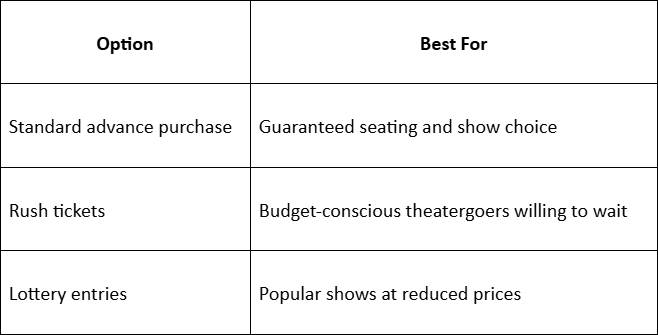
Ticket availability options include:

Ways to Discover Non-Broadway Performing Arts in NYC This Weekend

Most venues post their weekend lineups by Tuesday or Wednesday. If you plan ahead, you’ll have the best shot at snagging tickets to the coolest stuff.

Digital guides update listings daily, so they reflect cancellations and new shows as they pop up. You can set up notifications for certain genres or theaters if you want to stay in the loop.

Theater districts outside Manhattan, like Brooklyn or Queens, have some seriously creative companies doing original work. It’s a different energy from Midtown, and more than worth the subway ride.

What to Look for in a High-Quality Performing Arts Calendar

A good performing arts calendar needs to go beyond the big tourist venues. You want to see independent theaters, dance studios, experimental spaces, and local performance halls mixed in with the big names.

Key features to prioritize:

  • Detailed event information – show times, ticket prices, venue locations, and what the performance is actually about.
  • Advanced filtering options include date, genre, neighborhood, and price range.
  • Regular updates for schedule changes, cancellations, and new shows.
  • Venue details, including seating, accessibility, and transit directions.

The best calendars tell you why a show might be worth your time, not just the basics. Ideally, they give a bit of background on the artists or the performance without sounding like an ad.

Search matters – a lot more than you might think. You should be able to zero in on exactly what you want, whether that’s contemporary dance, experimental theater, or classical music.

Honestly, mobile compatibility is non-negotiable. You’ll probably be checking listings on your phone, and the calendar needs to load fast and look good, no matter the screen size.

User-friendly navigation makes a big difference. You shouldn’t be hunting through endless pages just to find the basics about a show.

One last thing – see if the calendar lists both ticketed and free events. There are plenty of excellent free shows in NYC, and a solid calendar won’t leave those out.