The New Look of Omegas: Fresh, Functional, and Lifestyle-Ready

For decades, omega supplements carried an image problem. Fish oil capsules were clunky, unappealing, and often associated with unpleasant side effects—fishy burps, bulky bottles, and a reputation for being something your parents kept in the back of the cupboard. Despite their well-documented health benefits, omegas never quite made the leap into the “cool” corner of wellness.

That’s starting to change. A new generation of omega products is rewriting the narrative, with modern formats, elevated formulations, and lifestyle-friendly branding. Leading the charge is Vital Balance, a liquid omega supplement from Yoli that’s reimagining what omegas can be—and how they fit into daily life.

From Functional to Desirable

In the past, omega supplements were marketed almost exclusively on clinical benefits: cardiovascular support, joint health, or maintain healthy cholesterol balance. Important, yes, but not exactly aspirational. Wellness consumers today want more. They want products that look sleek, feel elevated, and integrate seamlessly into their routines—all while delivering measurable results.

Vital Balance answers that demand with a liquid sachet format that feels more like a lifestyle accessory than a chore. Tear one open, add it to a smoothie, or sip it straight—no capsules, no aftertaste, no fuss. The branding is light, modern, and approachable, appealing to the same consumer who’s already stocking collagen powders, adaptogenic lattes, and functional beverages.

Liposomal Tech Meets Lifestyle

Beyond appearances, the innovation is real. Vital Balance uses liposomal delivery technology, which may provide absorption up to 5.5 times compared to traditional fish oils. By surrounding nutrients in protective lipid layers, liposomes allow omega fatty acids to bypass digestion barriers and enter the bloodstream more efficiently.

The formula also expands beyond standard omega-3s to include omega-7, omega-9, and omega-11, plus polyphenols from olive fruit and pomegranate. Together, these nutrients support skin hydration, cognitive performance, cardiovascular health, and cellular vitality—benefits that resonate with today’s holistic wellness consumer.

And then there’s the taste. Instead of fishy capsules, Vital Balance comes in a refreshing mint flavor, designed to be shareable and enjoyable. This sensory upgrade makes omegas less of a supplement you “have to take” and more of a daily ritual you look forward to.

Meeting the Modern Wellness Consumer

Today’s consumer, particularly Millennials and Gen X, doesn’t just buy supplements for their functional value. They buy for identity and lifestyle alignment. Products that feel outdated or medicinal often get skipped, even if they’re clinically effective.

By contrast, Vital Balance positions itself as:

  • Portable and convenient: Single-serve sachets fit in a bag or desk drawer.
  • Science-backed: Measurable improvements in omega levels within 90 days.
  • Lifestyle-approved: No pills, no mess, no aftertaste.
  • Aesthetic and aspirational: Modern packaging and flavor-forward design.

It’s a wellness product that can sit comfortably next to green juices and adaptogens on Instagram feeds—and that matters in a culture where health routines double as personal branding.

The Bigger Business Trend

The rise of Vital Balance isn’t just about omegas—it reflects a larger trend in supplements: rebranding “uncool” essentials as modern wellness must-haves.

  • Collagen shifted from clinical protein powder to beauty elixir.
  • Magnesium reemerged as a stress and sleep hack, not just a mineral.
  • Probiotics evolved from bland capsules to sparkling sodas and gummies.

Omegas are following the same trajectory. Once viewed as purely functional, they’re now being elevated into the beauty-from-within, long term vitality, and performance space—categories that resonate deeply with consumers who see wellness as a lifestyle investment.

The New Look of Omegas: Fresh, Functional, and Lifestyle-Ready


Photo Courtesy: Yoli

Why It Matters for Retailers and Brands

For retailers, this reinvention opens new doors. Omegas can now live in premium wellness aisles, beauty-from-within sections, or even the lifestyle category, rather than being confined to the supplement shelves. This reframing broadens the consumer base, appealing not only to those seeking heart health but also to women looking for skin resilience, men pursuing cognitive performance, and anyone interested in long term wellness and vitality.

For brands, the message is clear: presentation and experience matter as much as efficacy. Consumers want products that are fun to use, easy to integrate, and aligned with their personal wellness narratives.

The Future of Omegas

With formats like Vital Balance leading the way, omegas are no longer the dusty capsules at the back of the cabinet. They’re becoming part of a daily ritual that’s fresh, functional, and lifestyle-ready.

By blending science-backed innovation with modern design and delivery, Vital Balance isn’t just making omegas more effective—it’s making them aspirational. And in today’s wellness market, that’s the difference between a supplement people tolerate and a ritual they share.


Disclaimer: The statements made in this article regarding the product have not been evaluated by the Food and Drug Administration (FDA). This product is not intended to diagnose, treat, cure, or prevent any disease. The information provided is for general informational purposes only and should not be considered as medical advice. Readers should consult with a healthcare professional before making any changes to their diet or wellness routine.


At-Home Blood Test Could Be the Important Thing You Do for Your Health This Year

For years, health-conscious individuals have been told to “eat more fish” or “take your omega-3s.” Yet most Americans fall far short of the recommended levels. The average Omega-3 Index in the United States hovers at just 4%—half of what experts consider optimal for supporting heart, brain, and long-term wellness. Despite buying quality foods and supplements, many people are left wondering if they are actually meeting their nutritional needs.

This is where test-based nutrition is transforming the way people approach health. Instead of guessing, individuals can measure exactly where they stand and adjust accordingly. Yoli’s Vitality Test Kit, powered by OmegaQuant, provides a simple at-home blood test to measure the Omega-3 Index, followed by a tailored plan through its Omega+ protocol. The process is clear, science-backed, and actionable, making it one of the most important health decisions a person could make this year.

Why the Omega-3 Index Matters

The Omega-3 Index is a measure of the amount of EPA and DHA, two critical omega-3 fatty acids—in red blood cell membranes. Research has shown that individuals with an omega-3 index between 8% and 12% tend to maintain markers associated with cardiovascular and cognitive health. Unfortunately, very few Americans reach that range without intentional supplementation or a diet rich in fatty fish.

William S. Harris, PhD, founder of OmegaQuant and one of the world’s leading researchers on omega-3s, emphasizes the importance of testing:

“Our research findings of many years has confirmed that having an Omega-3 Index in the target zone—8% to 12%—is important for long-term health. Regular testing (one to two times per year) is important for maintaining the Omega-3 Index in the target zone since it’s very easy to forget to take supplements or to drift away from a high seafood diet. Regular testing also confirms that the omega-3 supplement you’re taking is actually being absorbed and incorporated into your tissues.”

In other words, even the best supplement only matters if the body is truly absorbing and using it.

The Benefits of At-Home Testing

The convenience of at-home biomarker testing has become part of a larger movement in preventive health. Just as genetic testing gave people insights into their ancestry and potential health risks, nutrient-level testing is offering individuals a personalized roadmap for wellness.

Key benefits include:

  • Personalized nutrition: Instead of following generic guidelines, people can tailor their diets and supplements based on precise results.
  • Accountability: Testing once or twice a year provides reassurance that healthy habits are paying off or a reminder when adjustments are needed.
  • Clarity: Results show whether a supplement is effectively raising omega-3 levels, taking the uncertainty out of nutrition.
  • Trackable progress: Fatty acid levels shift within three to four months of changing diet or supplementation, offering visible proof of improvement.

For many, this knowledge is a turning point. Seeing hard numbers can motivate meaningful change, from eating more omega-3-rich foods to choosing the right supplement and sticking with it.

At-Home Blood Test Could Be the Important Thing You Do for Your Health This Year

Photo Courtesy: Yoli

How the Yoli Vitality Test Kit Works

The process is designed to be simple and trustworthy:

  1. At-home collection: A small blood sample is collected using the kit.
  2. Certified processing: Samples are analyzed in a CLIA-certified laboratory to ensure accuracy.
  3. Clear results: Individuals receive a report with their Omega-3 Index score and recommendations.
  4. Action plan: Yoli’s Vital Omegas+ and Vital Balance products help consumers move toward the optimal 8% to 12% range with targeted supplementation and support.

Because fatty acid levels stabilize within a few months, individuals can retest periodically to track progress. This creates a cycle of testing, adjusting, and thriving that supports long-term health.

Why It Works

The effectiveness of this approach comes from its personalization. Instead of following a one-size-fits-all path, people receive data about their own bodies. By confirming absorption and tracking real progress, test-based nutrition eliminates the uncertainty that often leads to wasted effort—or wasted money—on supplements that may not be working.

Final Thoughts

Health is no longer about following general advice and hoping for the best. With tools like Yoli’s Vitality Test Kit, supported by OmegaQuant’s validated science, individuals can take control of one of the most overlooked yet powerful markers of wellness: their Omega-3 Index.

Testing provides clarity, high-quality nutritional supplements support balance, and progress provides peace of mind. For anyone serious about long-term heart and brain health, this at-home test could prove to be the most important step taken this year.


Disclaimer: The statements made in this article regarding the product have not been evaluated by the Food and Drug Administration (FDA). This product is not intended to diagnose, treat, cure, or prevent any disease. The information provided is for general informational purposes only and should not be considered as medical advice. Readers should consult with a healthcare professional before making any changes to their diet or wellness routine.

Can You Sue Uber for Injuries After a Rideshare Accident in California

By: Anikha Sharma

More and more people in California are using rideshare services to get around. With millions of people using apps like Uber every day, accidents are likely to happen. When someone is hurt in a rideshare crash, the question of who is responsible may arise. Injured riders often face medical bills, missed work, and long healing times that can make life more difficult. Holding the right party accountable is an important step in protecting financial stability. In these cases, an experienced rideshare accident attorney may offer the guidance needed to move forward. This article will explain how liability works in Uber accidents and what options are available to injured passengers and drivers. Understanding these legal rights is essential for anyone who has been injured while using a rideshare service. With the right knowledge, victims can better protect themselves and seek the compensation they might be entitled to.

Uber’s Responsibility in an Accident

Uber provides insurance coverage for drivers who are logged into the app. The level of coverage can vary depending on what the driver was doing at the time of the accident. If a driver were waiting for a ride request, coverage might be limited. If a passenger was already in the car, the coverage is much higher. This structure creates different scenarios for how claims are handled. Knowing where responsibility falls is key to building a strong case.

The Role of the Driver

While Uber offers insurance, the driver still plays a central role in these cases. If the driver was negligent, such as by speeding or being distracted, they could be held liable for the crash. Victims might file claims against the driver directly or through their insurance. This process can be complicated, especially if the driver’s personal policy does not apply when the app is active. Sorting out these details often requires professional legal support.

Injured Passengers and Third Parties

Passengers who are injured in an Uber accident usually have the right to pursue compensation through Uber’s insurance policy. This coverage may include medical costs and other damages caused by the crash. Third parties, such as pedestrians or drivers of other vehicles, could also file claims depending on the circumstances. Because multiple insurance companies might become involved, these cases can become quite complex. Having the right representation helps ensure no important detail is missed.

Legal Process for Filing a Claim

The legal process for filing a claim after a rideshare accident begins with collecting evidence. Medical records, photos, and police reports can help demonstrate what happened. The next step is submitting a claim to the appropriate insurance provider. Negotiations often follow, with the goal of reaching a fair settlement. If an agreement cannot be reached, filing a lawsuit may be necessary. Each step requires careful preparation to protect the victim’s rights.

Why Legal Representation Matters

Rideshare accident cases are not always straightforward. Insurance companies often work hard to reduce payouts, and victims might be left with less than they need. A lawyer with experience in these cases understands how to navigate the challenges. They can negotiate on behalf of the victim and fight for fair compensation in court if needed. With professional help, the process can become less stressful and more manageable for those already dealing with injuries.

Uber accidents in California involve complex insurance policies and legal rules that could confuse victims. Passengers, drivers, and third parties all have rights, but knowing how to enforce them requires strong legal support. From proving negligence to negotiating with insurers, each step of the process could affect the final outcome. By working with an experienced attorney, victims can focus on healing while knowing their case is in capable hands. Compensation may not undo the harm, but it can provide financial stability during recovery.


Disclaimer: The information provided in this article is for general informational purposes only and should not be construed as legal advice. Every case is unique, and the legal outcomes discussed may vary based on individual circumstances. It is recommended to consult with a qualified attorney to discuss your specific situation and obtain personalized legal guidance.

Beyond the AI Bubble: Why Industrial OEMs Should Focus on Proof Over Promises with IoT83

By: Ayeshah ‘Ice’ Somani

The AI boom has captured headlines with claims of instant generative design, predictive intelligence, and even fully autonomous operations. But as IoT83 sees firsthand in its work with leading industrial OEMs, there’s a stark difference between glossy demos and the realities of production at scale. Too many pilots stall, costs spiral, and executives are left with sunk investments instead of transformative outcomes. What once appeared to be unstoppable progress is now beginning to resemble an AI bubble, and the cracks are starting to show.

Capital budgets are under pressure, global competition is intensifying, and customer expectations are unforgiving. When an AI initiative fails, it’s lost time, a sunk cost, and a missed opportunity. The lesson is becoming painfully clear: AI without an enterprise-ready AIoT platform foundation is a potential liability.

Why Promises Aren’t Enough

Analysts have been warning about this dynamic for years. McKinsey estimates that as many as 80% of industrial IoT initiatives fail to move beyond the pilot stage (Source: McKinsey, 2022). And the reasons are strikingly consistent. Integration across legacy systems proves harder than expected. Security gaps open up. Data pipelines buckle under load. What seemed straightforward on a whiteboard turns into a maze of hidden costs and delays.

This is where the hype around AI collides with industrial reality. An algorithm may perform brilliantly in a demo, but without a foundation to manage connectivity, orchestrate data, enforce security, and maintain enterprise-grade reliability, it may not survive in production.

Industrial environments are unforgiving. Downtime is measured in tens of thousands of dollars per hour. Regulatory compliance isn’t optional. And no executive will bet their brand reputation on technology that only works in a lab. Expectations without proof often lead to the graveyard of failed pilots.

Proof in Practice

That’s why the next era of industrial AI won’t be defined by bold predictions but by AIoT platforms that demonstrate proof at scale.

IoT83’s Flex83 AIoT Platform was designed for exactly this challenge. Unlike one-size-fits-all platforms or fragile no-code tools, Flex83 provides a pro-code, modular foundation that integrates seamlessly into complex industrial environments. Instead of asking OEMs to compromise, it helps them embed AI into real operations, securely, reliably, and more cost-effectively.

Consider one Tier-1 U.S. electronics provider. They began with a modest deployment of just 50 connected devices. Within six months, using Flex83’s event-driven architecture, they scaled to more than 65 million devices worldwide. That leap didn’t just illustrate scalability; it unlocked predictive maintenance at a global scale, dramatically improving uptime and asset performance.

Cost savings followed the same trajectory. Traditional hyperscaler models often charge $1–$3 per device per month, a figure that quickly becomes unsustainable when scaling to millions of endpoints. By contrast, Flex83 deployments have reduced that cost by over 90%, driving per-device spend down to fractions of a cent. At scale, that difference could be the line between an experiment and a profitable business model.

And then there’s security. Flex83 embeds zero-trust architecture at its core. Devices are issued rotating certificates, microservices are containerized and restart independently, and observability ensures no single point of failure jeopardizes uptime. This level of resilience may not make for flashy marketing, but in industries where downtime or breaches carry existential risk, it’s the difference between AI as a buzzword and AI as a trusted operational tool.

Learning From the Bubble

The collapse of hype cycles isn’t new. Industrial technology has lived through them before: the “big platform” era of the mid-2010s, when monolithic systems promised everything but delivered vendor lock-in; the “cloud trap” phase, where quick demos masked the near-impossible task of scaling to production; the low-code wave, which worked for basic apps but faltered under real-world complexity. Each cycle left behind disillusionment, wasted budgets, and hard lessons learned.

The AI boom is heading down a similar path. Many companies are discovering that impressive pilots might mean little if they can’t move to production. The winners will be those who refuse to be dazzled by demos and instead demand proof of ROI, instant time-to-market, measurable efficiency gains, resilient infrastructure, and cost models that scale sustainably.

Looking ahead, industrial AI will not vanish with the bubble’s burst. If anything, it will become more essential. Predictive maintenance, digital twins, and AI-assisted decision-making are no longer optional luxuries — they are competitive necessities. But to realize these benefits, OEMs need platforms that extend beyond promises.

The future belongs to infrastructure that is scalable, secure, and enterprise-ready. It belongs to solutions that unify data from legacy systems, reduce complexity, and empower OEMs to innovate without surrendering ownership or flexibility. It belongs to a mindset that sees AI not as an add-on but as part of a long-term strategy to create new revenue streams, stronger customer relationships, and more resilient operations.

Proof, Not Promises

IoT83’s philosophy is simple: by delivering an AIoT platform that has already scaled across millions of devices while cutting costs and embedding security, Flex83 illustrates what the future of industrial AI really looks like.

The AI bubble is starting to deflate. For industrial OEMs, this is a critical moment of choice. Keep chasing promises and risk joining the 80% of projects that never scale. Or demand proof, infrastructure, ROI, and resilience that can carry AI from the lab to the factory floor, from a promising slide deck to measurable business impact.

Industrial AI doesn’t need another round of hype. It needs proof. And proof is exactly what IoT83 was built to deliver.

Brains, Beauty, and Breaking Barriers: The Story of Doctor Brain Barbie

When Jessica Lowe was a little girl in The Bahamas, she never imagined she would one day lead stroke codes in red lipstick or stand at the center of a campaign that raised over $88,000 for women’s heart health. But then again, Jessica, now known to the world as Doctor Brain Barbie, has never been one to follow the script. Her journey from island roots to double-boarded neurologist and epileptologist, medical educator, advocate, and digital creator is a story of intellect and courage, but also of style, humor, and heart.

The white coat is often imagined as a uniform stripped of personality, where seriousness is valued above all else and where doctors are expected to mute themselves to fit a mold. Jessica decided early on that she would not dilute who she was to fit in. She shows up to her work in pink scrubs or heels, blending glamour with expertise, and insists on being fully herself while doing some of the most complex work in medicine. “You can save lives in stilettos and still know your EEG from your MRI,” she often says with a laugh, and that truth has shaped the brand she created, Doctor Brain Barbie.

Brains, Beauty, and Breaking Barriers: The Story of Doctor Brain Barbie

Photo Courtesy: Dr. Jessica Lowe

Her brand was born not as a marketing ploy, but as a mission. Too often, Jessica noticed patients leaving their appointments confused, overwhelmed, or unheard. Women in particular struggled to have their symptoms taken seriously. She saw gaps in how neurology was explained and how inaccessible the information felt to everyday people. Doctor Brain Barbie became her answer: a platform that translated intimidating science into clear, relatable lessons wrapped in creativity and confidence. The goal was simple: to make brain health approachable while demonstrating that brilliance and femininity can coexist and thrive together.

Jessica’s career has been marked by persistence in the face of stereotypes. She has been mistaken for a nurse after introducing herself as a doctor, and she has had to prove her knowledge again and again in rooms where appearance was used as a reason to underestimate her. Instead of backing down, she leaned into her difference, choosing to let her competence and her voice speak louder than prejudice. When she once walked into a stroke code in stilettos, the room fell silent until she gave the next direction in the treatment algorithm. The pause quickly turned to action, and Jessica was reminded that presence and leadership often come from certainty and skill, not conformity.

What makes Doctor Brain Barbie stand apart is the way Jessica blends medicine with culture and storytelling. She is not just sharing facts about seizures or migraines. She is creating viral trends like the “McMigraine” series that caught fire across TikTok, helping thousands of people recognize symptoms, seek care, and feel seen. She is bringing humor into discussions about neurology without losing credibility, and that combination has made her a trusted and relatable figure. One follower even wrote to her saying that, because of her videos, she realized her symptoms were seizures and was able to get proper treatment. Those messages fuel Jessica’s drive, reminding her that advocacy online is not about likes, it is about saving lives.

Her influence extends far beyond social media. She serves on the board of the Epilepsy Foundation of Delaware, and her leadership on the executive committee for the American Heart Association’s Go Red for Women campaign earned her the 2025 Woman of Impact title. Her team’s fundraising efforts were not just numbers on a screen; they represented lives touched, awareness raised, and a movement carried forward. Jessica dedicated the campaign to a young woman named Noelle Hunter, a heart survivor whose strength and resilience inspired her. For Jessica, that campaign was a deeply personal reminder that behind every title, every recognition, and every statistic, there are real people and real stories.

Doctor Brain Barbie is more than a catchy name. It is a declaration that you do not have to strip yourself of personality, style, or identity to be taken seriously in medicine. Jessica embraces the parts of herself that the field has traditionally told women to hide. She is bold, fashionable, and outspoken, but also precise, analytical, and deeply committed to science. By doing so, she has created space for others to show up fully too, mentoring young women in medicine and encouraging them not to shrink themselves to fit outdated norms.

Her achievements are impressive: leading hospital epilepsy programs, earning recognition on MSN’s “Top 10 Health Experts Transforming Wellness in 2025,” and building a digital platform with a global reach. But perhaps what matters most is her vision for the future. Jessica dreams of creating a global movement where brain health is not just understood but celebrated. She envisions hosting a health-focused television series, speaking on the world’s biggest stages, and building patient education tools that are as engaging as they are informative. She also hopes to inspire a generation of “Field Barbies” – women across every discipline who demonstrate that excellence and individuality can walk hand in hand.

Jessica Lowe, Doctor Brain Barbie, is not trying to blend in. She is intentionally standing out because she knows that visibility matters. Representation matters. And the next generation of women in medicine needs to see that leadership can wear heels, drive fast cars, and still carry the weight of expertise that changes lives.

Her story is proof that intelligence and glamour are not opposites but allies. Her mission is to make medicine more human, more authentic, and more unapologetically bold. In every patient she treats, every video she shares, and every barrier she breaks, Jessica is reshaping what it means to be both doctor and woman and inspiring others to believe that they, too, can own every part of who they are.

Follow her on Instagram and TikTok at @doctorbrainbarbie to see how she continues to blend knowledge with confidence and make brain health accessible to all.

Sergiy Zotovych Brings an International Repertoire to U.S. Stages

By: Elena Mart

Sergiy Zotovych is a vocalist whose technique enhances the meaning of every phrase. His distinctive timbre, careful intonation, and disciplined breath control captivate the audience from the first line. With more than 15 years on stage and hundreds of live performances aboard MSC, Costa, Royal Caribbean, Holland America, and Princess ships, he has turned four languages (English, Italian, Spanish, and French) into effective tools for connecting with a wide range of audiences.

Foundations and Debuts: From Academic Training to Long-Term International Contracts

Zotovych laid his foundation in Odesa at the K. Dankevych College of Music (class of 2007), where breathwork, diction, and stage discipline were emphasized to a high standard. In the summer of 2006, during his third year, he drew the attention of Ivan Kokliushkin, artistic director of a St. Petersburg ballet project. After a personal meeting, Kokliushkin invited him to work with the troupe aboard the ferry Victoria, and by September 2006, while still a senior, Zotovych had already taken his first step onto the professional stage.

Beginning in 2007, he performed in St. Petersburg clubs and restaurants (including “Papanin”), logging live hours and developing stage endurance. During this period, an agent specializing in cruise-ship performers reached out, and in 2008 Zotovych joined his first cruise ship, MSC Musica. Larger contracts followed on MSC Lirica and MSC Fantasia (2009–2011), where the consistently changing international audiences demanded not only strong technique but also the ability to adjust languages and styles without interrupting the evening’s flow. These seasons provided a foundation for his next work with operators serving the American market.

His professionalism was quickly noticed. In 2009–2011, he completed key Mediterranean seasons with Italy’s MSC Cruises (MSC Musica, MSC Lirica, MSC Fantasia) and shaped his own “stage math”: structuring an evening so lyrical songs and high-energy numbers serve a cohesive emotional arc, and switching among English, Italian, Spanish, and French engages the audience rather than feeling like a gimmick. “The stage teaches you to speak people’s language, sometimes literally,” he recalls.

Next came a step-up with Ibero Cruceros (Grand Holiday, 2010–2011) and Costa Cruises (Costa Favolosa, Costa Pacifica, Costa Deliziosa, 2011–2014) large-format productions where an artist takes responsibility for timing, lights and sound, and coordination with the band and troupe. He was entrusted with lead numbers and rehearsal handoffs with the orchestra, while producers often extended contracts early to “catch a window” in his schedule.

Sergiy Zotovych Brings an International Repertoire to U.S. Stages

Photo Courtesy: Sergiy Zotovych

A Transition to American Operators

The year 2014 marked a turning point: a transition to American operators. With Royal Caribbean International, he performed on Mariner of the Seas (2014), Enchantment of the Seas (2014–2015), and Navigator of the Seas (2016), with regular calls at U.S. ports and a daily test of universality before international audiences.

“My principle is simple: no evening should rely on a single language; music should speak to everyone,” says Zotovych. In 2020, he worked aboard Crown Princess (Princess Cruises), solidifying his presence across American resort and tourist itineraries. The years 2022–2023 brought a stage of professional maturity at Holland America Line: programs with the Cantare Quartet, where Zotovych served as lead vocalist and head of repertoire overseeing set lists, cue accuracy, and ensemble discipline. This path helped to shape his reputation as a specialist: a performer with a recognizable timbre and a musical curator who ensures quality from the first rehearsal to the final chord, one reason audiences regularly return and producers plan seasons around his participation.

Positioning in the U.S. Market: Demand, Growing Client Portfolio, and Zotovych Music Enterprises

Today, the artist performs regularly across the United States, from Florida to California, and fits naturally into a landscape where international audiences are commonplace. In parallel, he is building Zotovych Music Enterprises in Florida—a working platform with three pillars: live performance, production consulting for cruise and resort venues, and education. Bookings for private and corporate events are underway, residencies with Tampa Bay hotels and restaurants are being finalized, in-person workshops under The Cruise Ship Performer’s Guide are launching, and online courses in audition preparation and career strategy are in development. In effect, he is bringing big live-production standards to local U.S. markets and steadily building a client base.

Mentorship is a distinct line of work. Master classes and artist talks are a natural extension of his stage practice; students and colleagues from multiple countries note not only his voice but also his precise pedagogical instinct. The record bears this out: he is invited as a lead vocalist and musical curator for projects, and letters from presenters highlight what the industry values most—discipline, precision, and consistent quality throughout the contract. This combination of performer reliability and production-level thinking makes Sergiy Zotovych a valuable partner for American venues, festivals, and the hospitality industry, one more reason audiences and producers continue to return.

What to Do If You Slip and Fall While Out Shopping in New York City

Slip and fall incidents while shopping in New York City can happen out of nowhere and leave you pretty rattled. If someone falls, they should promptly seek medical attention, document the scene, and report the accident to store management to protect their health and legal standing. It’s about looking after yourself and making sure there’s a record of what actually happened.

Once you’ve handled the basics, it’s smart to gather proof, snap some photos, see if anyone saw what happened, that kind of thing. Knowing what store owners are supposed to do and how to stand up for yourself if you’re hurt can make a big difference. And honestly, having a sharp NYC slip and fall attorney in your corner can be a lifesaver when you’re dealing with a store’s negligence.

Immediate Actions to Take After a Slip and Fall Accident

If you take a spill in a New York City store, how you react in those first few minutes matters a lot. What you do immediately can significantly impact your recovery and whether you’re able to receive compensation later. Reporting the incident, hanging onto evidence, and collecting info are all crucial steps.

Prioritize Your Safety and Seek Medical Treatment

Your health comes first, always. Even if you’re just embarrassed or think it’s no big deal, it’s wise to let a medical professional check you out. Sometimes you don’t feel the real damage like a back injury or muscle tear—until hours or days later.

Getting checked out also means you’ll have medical records that show you got hurt, which is pretty essential if you end up filing a claim. Hang onto any paperwork from doctors, physical therapists, or hospitals—anything that ties your injuries to the fall.

If you can’t move or the pain’s intense, don’t try to tough it out call 911. And yes, keep those medical bills and reports; they’re more useful than you might think.

Report the Incident and Obtain an Accident Report

Please notify a store manager or supervisor as soon as possible. They should compile an official report with details such as where and when you fell.

Ask for a copy, or at least jot down the name of the person you spoke with. That report can come in handy later if there’s any disagreement about the facts.

If you’re too shaken up or hurt to talk to staff, ask someone you trust to step in. The sooner you make it official, the better your chances if you need to file a claim.

Document the Scene and Preserve Evidence

Photos are your friend here. Take pictures of the spot before anyone cleans up—capture puddles, broken tiles, clutter, and anything else that tripped you up.

Get shots of the area, especially if there weren’t any warning signs around. Also, photograph any visible injuries, and keep taking pictures as things change over the next few days.

Save all your receipts for medical care or out-of-pocket expenses. Jot down how you’re feeling in a notebook or on your phone. Sometimes those day-to-day details matter down the line.

Collect Witness Statements and Contact Details

If anyone saw you fall or noticed the hazard, try to get their name and contact info. Witnesses can back up your story and help fill in the gaps.

Ask for a quick statement if they’re willing to provide one. Their version of events could make a real difference if things get complicated with insurance or lawyers.

It’s best to do this soon while everyone’s memory is fresh. That way, your attorney (if you hire one) has a clearer picture of what went down.

Understanding Legal Rights and Pursuing a Slip and Fall Claim

If you get hurt slipping or tripping in a store or public spot in New York City, there are some legal basics you’ll want to know. It helps to figure out what led to your fall, what the property owner was supposed to do, and what steps you should take to protect yourself.

Common Causes of Slip and Fall Accidents in New York City

Most often, it’s wet floors—maybe from spilled drinks or snow getting tracked inside. Uneven pavement, cracked sidewalks, and busted tiles are big offenders, too. Dim lighting in stairwells or parking lots can make things worse.

Other trouble spots? Messy aisles, loose rugs, and stuff left in walkways, especially in busy stores or old buildings all over NYC. Pinpointing exactly what caused your fall helps if you need to explain your side later.

Premises Liability and Property Owner Responsibilities

Under New York law, property owners owe different duties depending on why you’re there. Shoppers get the most protection. Owners are supposed to keep things safe, look for hazards, and fix or warn about them quickly.

If they ignore known dangers or don’t fix obvious problems, they could be on the hook for your injuries. But not everyone gets the same level of care—if you’re just passing through or trespassing, the rules are stricter.

Proving Negligence and Building Your Case

To win a claim, you’ll need to show the owner dropped the ball. That means proving they owed you a duty, broke that duty, and that their mistake directly led to your injury.

Evidence is everything: photos, witness stories, medical records, and the accident report all help. You’ll also have to show the owner knew (or should’ve known) about the danger and didn’t do anything about it.

What to Do If You Slip and Fall While Out Shopping in New York City

Dealing with Insurance Companies and Adjusters

Chances are, the store’s insurance company will get involved. They’ll probably try to poke holes in your story or downplay your injuries. Be careful what you say, stick to the facts and don’t exaggerate.

Adjusters might bring up old injuries or suggest you were partly at fault. The more proof you have, the stronger your position if things get tense.

Working with a Slip and Fall Lawyer or Personal Injury Attorney

Having a good personal injury lawyer, especially one who is familiar with NYC premises liability, can significantly tip the scales. They know the ins and outs, what paperwork you’ll need, and how to handle tough negotiations.

A lawyer can organize your evidence, deal with insurance companies, and go to court if it comes to that. Getting legal help early on makes it easier to meet deadlines and avoid mistakes that could cost you later.

Filing a Notice of Claim and Meeting Legal Deadlines

In New York City, if you’re hurt on public property or anywhere owned by the government, you’ll need to file something called a notice of claim. It’s a formal heads-up, and the clock starts ticking fast usually, you’ve got just 90 days from when you got injured.

If you miss that window, you may lose your opportunity to have damages covered. On the other hand, for accidents on private property, you generally have two or three years to file a lawsuit. These timeframes can be confusing, but understanding them is crucial if you want a fair chance at receiving compensation for your injuries and bills.


Disclaimer: The content in this article is provided for general knowledge. This information does not constitute legal advice, and readers should consult with qualified legal professionals for specific cases or situations.

International Musicians Open New Season at Bulgarian Embassy Washington, D.C., October 3, 2025

The 17th season of the Bulgarian Music Society Concert Series began Friday evening at the Embassy of the Republic of Bulgaria with a concert presented in partnership with the Washington International Young Artists Music Series (WIYAMS). A full audience of diplomats, music supporters, and community members gathered for a night of classical music performed by young musicians from around the world.

The event was supported by Dr. Daniela Power and held in memory of her late husband Charles Power and father Decho Dechev. It also marked WIYAMS’s third appearance at the embassy.

A Diverse Lineup

Eight musicians from six countries—the United States, China, Korea, Spain, Malaysia, and Uzbekistan—performed a program that included works by Schumann, Fauré, Rachmaninoff, Ysaÿe, Puccini, Strauss, and Ravel.

Violinist Xiang Fang, a 2025 WIYAMS ARTIST, opened the concert with the first movement of Fauré’s Violin Sonata No. 1 in A Major, joined by pianist Janghyo Yoo. Fang’s performance was expressive and well-balanced, setting a thoughtful tone for the evening. Fang impressed with her warm tone and careful phrasing, making every note feel intentional and full of meaning. Her command of the instrument brought a fresh and engaging energy to Fauré’s sonata.

Pianist Dr. Xiaoya Gao, also a 2025 WIYAMS ARTIST, played Rachmaninoff’s Barcarolle with Colin Levins. Their interpretation brought out the gentle flow and shifting harmonies of the piece. The duet performance captured the deep emotional layers in the music, moving from quiet nostalgia to a sense of longing, with a sound that was both sensitive and sincere.

Malaysian bass-baritone Nazrin Azlan Alymann followed with three songs from Ravel’s Don Quichotte à Dulcinée, performed with pianist Guzal Isametdinova. His voice carried strength and character, especially in the final drinking song, which drew laughter and applause.

International Musicians Open New Season at Bulgarian EmbassyWashington, D.C., October 3, 2025

Photo Courtesy: Baiying Zhang
Bass-baritone Nazrin Azlan Alymann with Pianist Guzal Isametdinova

Violinist Jiaqi Yu, another 2025 WIYAMS ARTIST, performed Ysaÿe’s Sonata for Solo Violin in A Minor. Yu’s performance of Ysaÿe’s sonata was marked by both technical precision and emotional depth, highlighting its contrasting moods and fast-moving passages. She navigated the complex passages smoothly while bringing out the darker, more introspective moments with great sensitivity.

Pianist Yanzuo Nicole Liu, also named a 2025 WIYAMS ARTIST, performed Schumann’s Piano Sonata No. 2 in G Minor. Her thoughtful interpretation gave shape to the sonata’s emotional shifts, from urgency to reflection.

To close the program, soprano Dr. Danielle McKay, accompanied by Dr. Julia Aguayo, sang two crowd favorites: “Quando m’en vo” from La Bohème and “Csárdás” from Die Fledermaus. McKay brought clarity and playfulness to both arias, ending the concert on an upbeat note.

Music and Diplomacy

The Embassy’s Temporary Chargé d’Affaires, Ms. Stefka Yovcheva, welcomed the audience at the start of the evening. She spoke about the value of hosting young performers from different parts of the world, noting how music can bring people together in ways words sometimes cannot.

The concert was organized under the artistic direction of Jinwei Zhang for WIYAMS and Dr. Ivo Kaltchev for the Bulgarian Music Society. Their ongoing collaboration continues to provide young performers with opportunities to share their work on international stages, while also building a vital bridge for musical and cultural exchange.

International Musicians Open New Season at Bulgarian EmbassyWashington, D.C., October 3, 2025

Photo Courtesy: Yunlong Dai
WIYAMS ARTISTS with Ms. Stefka Yovcheva, Dr. Ivo Kaltchev, and Mr. Jinwei Zhang

After the concert, a reception in the Embassy’s main hall gave guests the chance to speak with the performers and enjoy light refreshments.

A Strong Start

The concert was a reminder of how live music, especially in an intimate setting, can leave a lasting impression. For WIYAMS and the Bulgarian Music Society, it was a strong beginning to the 2025–26 season, and a clear sign of what’s to come.

Modern Bridal Elegance: Key Wedding Dress Trends

Wedding fashion is something that every bride faces. When you start studying it all, it becomes clear that it is not just about the dress. Many aspects are affected here — the style and mood of the celebration. In 2026, distinguished wedding dresses feature distinctive characteristics, with femininity as their foundation. 

Every bride wants to be the center of attention at her wedding, radiate elegance, and stand out as a unique individual. Makeup and hairstyle play an essential role. However, it is the dress that sets the tone and style of the entire image and the event as a whole.

Minimalism With Character: Less Is More V

Today, the wedding industry is increasingly embracing the philosophy of “less is more.” Ukrainian brand Eva Lendel presented the Less Is More V collection, which has become a real manifesto of modern minimalism. 

However, this is not boring simplicity, but a thoughtful play of contrasts: clean lines coexist with voluminous sleeves, and bold draperies complement laconic silhouettes. Such aesthetics are ideal for brides who want to emphasize their individuality, while remaining true to the classics. Each dress in the collection reflects the character of its owner. And it does not matter at all whether you consider yourself a romantic dreamer or a confident woman ready to experiment.

The Less Is More V collection showcases exceptional tailoring and meticulous attention to detail. The fabric flows softly over the figure, emphasizing the natural beauty of each bride. Other notable features include unusual decorative elements and original silhouettes. These dresses are ideal for photo shoots and for outdoor ceremonies. And they are perfect for city weddings. It allows each woman to express her individuality, feel confident, and be elegant on her wedding day.

Wedding Trends 2026

It so happens that fashion is constantly changing, and wedding dresses are no exception. Brides are looking for more than just beauty. They want to feel comfortable and able to express themselves, while not forgetting their own values.

The year 2026’s premier wedding dresses are marked by several decisive trends. Here are the prominent trends that will inspire designers and brides:

  • laconic silhouettes with an emphasis on fabric and texture;
  • voluminous sleeves and capes that create a dramatic effect;
  • transparent inserts and layering for a light look;
  • minimalist dresses with unexpected details — drapery, asymmetry, decorative elements;
  • eco-friendly materials and sustainable production;
  • color accents: not only white, but also cream, peach, soft blue;
  • transformers — dresses that easily change their silhouette from the ceremony to the party.

These trends demonstrate that a wedding is not about strict rules, but about embracing freedom of choice and harmony with oneself. It is no longer a secret that modern brides want to create unique images that reflect their individual personalities and lifestyles.

Designers are opening new boundaries. They resort to bold forms, use rather unexpected materials, and skillfully combine them with modern traditions. Each dress is not just a wedding outfit.

The Magic of the WONÁ Concept Brand

The WONÁ Concept is a topic that is essential to discuss when considering the future of wedding fashion. He is the symbol of Ukrainian wedding art, which specializes in the skillful combination of innovation and tradition. Each collection presented by WONÁ Concept is always distinguished by its elementality and subtlety. Experiments are present everywhere — in fabrics, forms, and even presentations.

Femininity was the focus of the brand’s attention in 2026. The created real princess wedding dresses will help every girl express her uniqueness. These are not just outfits, but real works of art that create a mood and set the style for the entire event.

Why Minimalism Wins the Hearts of Brides?

Many girls used to think that a wedding dress should be as lush as possible, decorated with lace and stones. But today, more and more brides choose simplicity. Why? The answer is simple: minimalism gives freedom.

A laconic dress focuses attention on the woman herself, her beauty, and her charisma. It does not distract, but emphasizes individuality. In addition, minimalism fits perfectly into modern weddings — intimate, stylish, and filled with meaning.

To understand how multifaceted this style can be, you need to look at the key features of the 2026 collections:

  • use of smooth fabrics — satin, silk, crepe;
  • clear lines and sculptural forms;
  • minimum decor, maximum thoughtfulness;
  • play with volume: airy sleeves, capes, multi-layered skirts;
  • versatility — such dresses are suitable for different wedding formats;
  • ability to complement the image with accessories and easily change the mood;
  • eternal relevance: minimalism will never go out of fashion.

Thus, minimalism is not a limitation, but a space for imagination. Focus shifted from the dress to the person — the bride herself. It is not surprising that such models are used by modern women, regardless of their age.

Atmosphere and Presentation: The Role of Shooting

Interestingly, fashion focuses not only on the dresses themselves but also on how designers present them. The Less Is More V collection was shot in a foggy landscape. Nature became a perfect background for clean lines and mysterious femininity. This is not just a photo shoot, but a whole story in which every detail works to create an image.

This presentation inspires brides not to be afraid to experiment with both their image and the format of the wedding. After all, a modern ceremony is not only about traditions. It is also an opportunity to share your story. You can share your relationship. You can also share your unique style.

How to Choose the Perfect Dress?

Every bride faces one of the most exciting — and sometimes overwhelming — tasks: finding a dress that truly captures her dreams, her personality, and her unique style. The choice is quite limitless in 2026. Now it is not just classic wedding dresses. It also includes romantic lace, smooth minimalism, and even bold avant-garde designs. So, how to choose the right model in such a variety? Here are some simple, but quite effective tips:

  1. Decide on your style.
  2. Choose comfort and ease.
  3. Don’t be afraid to experiment with silhouettes.
  4. Focus on the venue.
  5. Trust only proven brands.
  6. Listen to your inner voice.

These are straightforward tips, aren’t they? But they will make it much easier for you to choose the perfect dress for the most critical event in your life.

Conclusion

Simplicity and boldness will come together to form the wedding fashion trend of 2026. The premier wedding dresses of the new season prove that a bride can be different — gentle, bold, minimalist, romantic. The main thing is to remain yourself.

Brands like Eva Lendel and WONÁ Concept show that a modern dress is not just an outfit, but a reflection of a woman’s inner world. That is why each collection becomes not just a trend for one season, but a proper art form that sets the direction for years to come.

By 2026, wedding fashion will be less strict and predictable. We can see an increasing emphasis on diversity, emotionality, and life. Therefore, every bride will be able to find her ideal image — unique, inimitable, and absolutely hers.

Utsav Celebrates 25th Anniversary – Authentic Indian, Indo-Chinese, and Bengali Cuisine in the Heart of Times Square

By: Elliot Merlyn

Utsav, which translates to “festival,” is the beloved Times Square restaurant that has been serving authentic Indian, Indo-Chinese, and Bengali cuisine for over 25 years. Founded by Nandita Khanna, the two-level space boasts a lively bar on the lower floor and a spacious upper level with floor-to-ceiling windows offering views of 46th and 47th Streets, setting the stage for a dining experience that aims to engage all the senses. Just minutes away from Broadway, Rockefeller Center, and the Times Square/Theater District, Utsav is often considered a popular destination for locals, tourists, and theatergoers alike.

Utsav has long been deeply committed to NYC’s South Asian cultural events and promoting Indian heritage and cuisine on a global stage. This year, the restaurant will be participating in the Times Square Durga Puja Festival, organized by the Bengali Club USA, with a press conference on September 26th at the restaurant. The festival will take place on October 3rd and 4th between West 45th Street and 46th Street in Times Square. The restaurant will be offering a special Bengali Thali for the Durga Puja festival, which will feature Kolkata Fish Fry, Khosha Mangsho, Bhetki Paturi, Daab Chingri, Alur Dom, Cholar Dal, Pulao, Luchi, Aloo Bhaja, Tomato Chutney, and, for dessert, Mishti Doi.

Nandita Khanna has a strong passion for Indian cuisine, with family connections to acclaimed restaurants in Calcutta and Tokyo—particularly BAR-B-Q in Calcutta, a renowned Indo-Chinese establishment in India. Nandita has infused Utsav’s menu with both tradition and innovation for more than 25 years. Since its opening in 2000, the restaurant has offered a wide range of flavors, from North Indian curries and smoky tandoori dishes to bold Indo-Chinese specialties and a unique Bengali menu. Nandita’s chef team is well-trained in the Calcutta style of Chinese food, the birthplace of Indian Chinese cuisine. As the only Manhattan restaurant offering authentic Bengali cuisine, she takes pride in sharing the vibrant, aromatic tastes of Calcutta with New Yorkers. A selection of the dishes offered to patrons is recipes from BAR-B-Q, which Nandita has recreated at Utsav.

Utsav Celebrates 25th Anniversary – Authentic Indian, Indo-Chinese, and Bengali Cuisine in the Heart of Times Square

Photo Courtesy: Utsav

The menu offers Indian dishes including non-vegetarian appetizers such as Butter Chicken Kulcha, which features mini stuffed bread with butter chicken filling; vegetarian-friendly Cream Cheese & Truffle Oil Kulcha with three mini breads stuffed with cream cheese & truffle oil; grilled Tandoori Broccoli florets, made with cheese, yogurt, and spices; dishes from the grill such as Tandoori Lamb Chops served with mustard, cashew marinade, crispy okra salad; Lamb Chop Masala in an onion tomato gravy, and Fish Tikka, a 10 oz. filet of wild Chilean sea bass, mild toasted spices, crispy okra salad.

Utsav Celebrates 25th Anniversary – Authentic Indian, Indo-Chinese, and Bengali Cuisine in the Heart of Times Square

Photo Courtesy: Utsav

Bengali dishes include Kolkata Fish Fry, cooked in a cilantro chili marinade, served with kasundi mustard sauce; Daab Chingri, a signature prawn curry, cooked and served in a green coconut with steamed rice; Bhetki Fish Paturi, baramundi fish marinated in ground mustard, green chilies, turmeric, and mustard oil, steamed in a banana leaf and served with steamed rice; and Bengali-style Khosha Mangsho, a slow-cooked thick mutton gravy.

Indo-Chinese cuisine includes Chili Chicken Dry, small pieces of deep-fried chicken in a mixture of garlic, ginger, green chilies, and onions; Crispy Chili Baby Corn in a spicy, tangy chili sauce; Salt & Pepper Prawns; Vegetable Manchurian, finely chopped vegetables in a spicy, sweet, and tangy sauce; vegetarian, chicken, or shrimp American Chopsuey; stir-fried Chicken Hakka Noodles, with shredded chicken, and crisp vegetables in a savory and spicy sauce.

The restaurant offers a variety of rice, biryanis, and breads, including Naan, Kulcha, Tandoori Roti, and more.

A variety of beverage options are offered, including a selection of handcrafted cocktails, wines, beers, and non-alcoholic mocktails. Choices include the Turmeric-Ginger Margarita with silver tequila, mango puree, bird’s eye chili, ginger, lime juice, and turmeric; Prem Kahani made with gin, Campari, grapefruit, lemon juice, simple syrup; Saffron Sunrise with vodka, saffron liqueur, lime juice, simple syrup, Aperol, ginger beer; Feni Jungle Juice, made with Goan cashew liquor with sparkling lemonade, lime juice, and chili, and Kolkata Story, made with old monk dark rum, rich cinnamon syrup, and lime juice.

The dessert menu offers some sweet Indian options, including Gulab Jamun crème brûlée, featuring sweet mini donuts, baked in creamy custard pudding, and coated with caramelized brown sugar; Mishti Doi made from sweet, fermented yogurt with jaggery; Nolen Gur Ice Cream made with date palm jaggery; and Tutti Frutti made with vanilla ice cream, jelly, jam, and a fruit cocktail (a Calcutta favorite)!

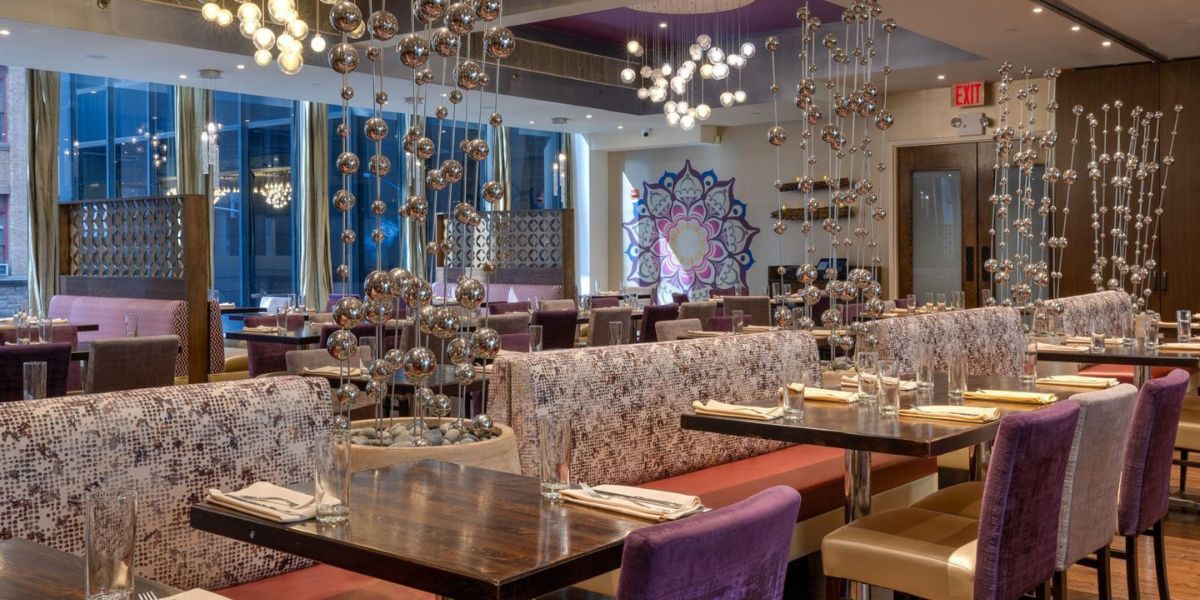
Utsav’s main dining room features various shades of purple and gray. Silver accents and circular lighting fixtures complement the space, and the room is lined with both booth and table seating. Large windows allow natural light to flow in, providing a brightly lit space. A second, smaller dining room offers a more moody and intimate ambiance, with darker walls and a singular long table for guests. Antique wooden artifacts adorn the walls, and purple velvet couches provide additional seating. The bar, dimly lit with a sleek countertop, offers an ideal setting for guests to enjoy handcrafted cocktails and fine wines.

The restaurant also offers outdoor dining during the summer months.

LOCATION:

  • Address: 1185 6th Ave, New York, NY 10036
  • Website: utsavny.com
  • Phone: (212) 575-2525

Hours:

  • Lunch: 12 pm to 3 pm
  • Dinner: 5 pm to 10:30 pm

SEATING CAPACITY:

  • Private Room: 25 guests
  • Larger Space: 80 guests
  • Full Dining Space: 200 guests