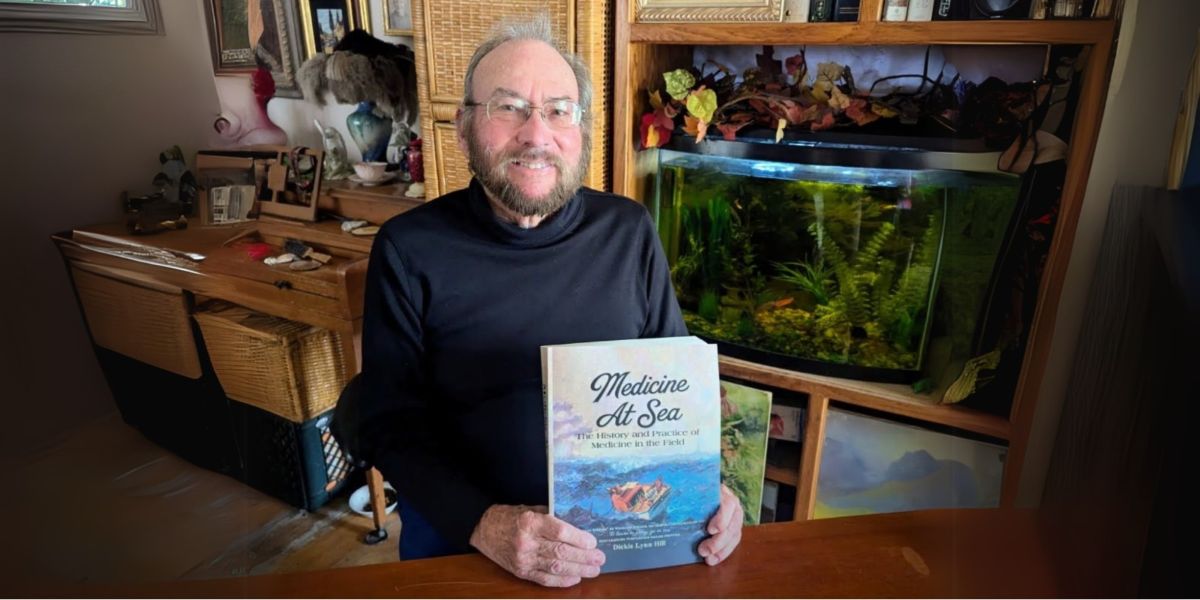
Life and Death at Sea: Medicine at Sea Examines the Evolution of Maritime Healthcare

By: Elowen Gray

The sea has always been a place of both opportunity and danger, where survival often depends on skill, preparation, and sometimes luck. While much has been written about maritime history, one of its often underexplored aspects is medical care aboard ships. In Medicine at Sea, Dickie Hill explores the long and sometimes challenging history of maritime medicine, offering a detailed look at how sailors, explorers, and medical professionals have managed illness and injury in some of the most remote places on Earth.

Hill, a U.S. Coast Guard-certified ship surgeon and former naval medical officer, presents an authoritative yet accessible account of how medicine has gradually evolved at sea. His book provides both historical perspective and practical knowledge, making it an engaging read for medical professionals, maritime workers, and history enthusiasts alike.

The book examines the difficult realities sailors have faced throughout history, showing how illness and injury often influenced the success or failure of entire expeditions. Hill explores significant turning points in maritime medicine, from the influence of the Crimean War on battlefield medical advancements to the role of ship surgeons in the Napoleonic era. He also discusses the resourcefulness required aboard whaling ships and naval vessels, where improvised medical solutions could mean the difference between survival and death.

In addition to its historical insights, Medicine at Sea provides a modern perspective on field medicine. Hill outlines emergency procedures, first aid techniques, and recommended practices for managing medical crises in isolated conditions. His expertise highlights how advancements in medicine have contributed to shaping healthcare delivery in maritime and other remote environments today.

What makes Medicine at Sea distinctive is Hill’s ability to connect past and present, showing how lessons from centuries of maritime medical practice continue to be relevant. As offshore industries grow and adventure travel becomes more frequent, the book underscores the importance of medical preparedness in environments where professional care is often not immediately accessible.

Hill’s writing is both informative and engaging, balancing detailed research with compelling storytelling. He brings history to life by recounting real-world shipboard medical emergencies, from amputations performed with makeshift tools to the first documented use of anesthesia on a naval vessel. His work honors the legacy of maritime medicine while equipping readers with valuable knowledge for their own journeys.

As the world continues to rely on seafaring industries and long-distance travel, Medicine at Sea remains a significant resource. Hill’s book is more than just a historical account—it is a practical guide for those who may find themselves facing a medical crisis in the middle of the ocean.

About the Author

Dickie Hill is an osteopathic physician, former lieutenant commander in the United States Navy Reserve, and a U.S. Coast Guard-licensed ship surgeon. With decades of experience in maritime and field medicine, Hill has dedicated his career to educating others on emergency medical care in remote and high-risk environments. His expertise and historical knowledge make Medicine at Sea a valuable contribution to the study of maritime healthcare.

Medicine at Sea: The History and Practice of Medicine in the Field (Third Edition) is available in both paperback and hardcover.

For more information or to inquire about purchasing copies, visit the listed channels below:
Instagram
Facebook
Official Website
Amazon
Barnes & Noble

Disclaimer: This article is intended for informational and educational purposes only and does not constitute medical advice. The historical and practical information presented here should not replace consultation with a qualified healthcare professional. Readers facing medical emergencies or health concerns should seek immediate professional assistance.

Inside RECODemand: The Webinar Strategy Helping Real Estate Closers Navigate a Tough Market

The real estate market has shifted significantly in recent years. With higher interest rates, tighter buyer budgets, and increasing skepticism among consumers, many agents are noticing their pipelines slow down more than usual. Marketing costs often rise, but lead quality can drop. Many of the older tactics—cold calls, mass emails, and generic lead generation—frequently fall short of expectations.

Yet while some agents struggle with inconsistent results, others are finding ways to build momentum. They’re attracting higher-quality leads, converting more reliably, and doing it with greater efficiency. One approach contributing to this shift is RECODemand, a consulting firm that has supported over 400 real estate and mortgage professionals in refining their client acquisition strategy through a focused concept: webinar funnels.

How Real Estate Webinar Funnels Are Making an Impact

RECODemand was founded by real estate agents frustrated with ineffective lead generation systems. The issue wasn’t just the leads—it was the model. Many marketing platforms prioritized quantity over quality, leaving agents to chase unqualified leads or manage cumbersome systems.

The solution emerged from a familiar concept with a modern adaptation. The founders had observed the effectiveness of live seminars—gathering an audience, sharing insights, and building relationships. But they wondered: Could this model scale online, offering consistency and automation?

This led to their webinar funnel system—a structured approach to attract, educate, and convert leads using Zoom-based webinars supported by paid advertising.

Efficiency in Action

The process is straightforward: host one live webinar weekly. RECODemand’s clients often see around 100 registrants per session, with approximately 60 attending live. Of those, close to 20% book an appointment, resulting in about 12 calls per webinar, all with leads who have already engaged with the agent’s expertise.

From there, many agents close one or two deals per webinar, translating to several deals per month, all without cold calls or relentless follow-ups.

A key advantage? The system typically requires just 90 minutes per week once implemented.

A Solution for Solo Agents

While teams benefit, RECODemand’s approach particularly resonates with solo agents juggling every aspect of their business. These agents often lack the time to test multiple marketing strategies or chase unresponsive leads.

For them, the webinar funnel can be transformative, replacing repetitive pitches with scalable education. It shifts agents from constant selling to becoming trusted advisors—exactly what buyers and sellers seek.

Building Trust, Not Just Leads

A common misconception is that more leads necessarily lead to more closings. But experienced agents know that connection matters most.

RECODemand’s webinars avoid hard selling, focusing instead on providing insights and building confidence. This emphasis on value sets the strategy apart. As the team notes, “Many competitors aren’t prioritizing education. That’s where our clients often gain an edge.”

By delivering genuine value, agents can become trusted advisors. Prospects feel understood early on, leading to more productive conversations and stronger client relationships.

A Time-Efficient Approach

A standout benefit of RECODemand’s system is time savings. After a five-day setup challenge, agents usually spend just 90 minutes weekly maintaining the funnel—hosting a webinar, messaging registrants, and following up with engaged leads.

This contrasts sharply with the many hours some agents devote to cold outreach or managing outdated lead lists. In an industry prone to burnout, RECODemand’s model offers a sustainable path to growth.

Mindset Matters

Some agents believe “nothing works” in today’s market, citing interest rates or slowdowns. But RECODemand clients often see things differently.

“People are still buying and selling,” notes a team member. “Success often comes down to reaching the right audience with the right message.”

This starts with a mindset—choosing confidence over fear. Agents who thrive with RECODemand tend to focus on their value, trust the process, and prioritize genuine help over aggressive selling.

Looking Ahead

RECODemand continues expanding, helping more agents refine their messaging and improve conversions. Yet their core mission stays unchanged: helping agents achieve more with less—less stress, less wasted time, and less burnout.

In a competitive market, agents don’t necessarily need to work harder. They need smarter strategies, authentic connections, and systems that maximize their time.

That’s what RECODemand aims to deliver—and why their clients continue succeeding, even when others stall.

Disclaimer: This article is intended for informational purposes only and does not constitute professional real estate, financial, or legal advice. Individual results with the RECODemand webinar funnel system may vary based on personal circumstances, market conditions, and implementation. Readers should perform their own due diligence and consult with qualified professionals before adopting any new business strategies.

Quiet Power: Valeriya Kovbuz on Stillness, Clarity, and the New Leadership

By: Max Jonathan

It’s not necessary that every leader has to be loud. Not every breakthrough is a hustle. Valeriya Kovbuz is the coach who shows up through presence, not performance, and invites others to do the same.

She created the Tree of Balance by Kovbuz, a visual and emotional method rooted in Transactional Analysis, to help people reconnect with themselves. But what makes her work stand out is how it feels: spacious, grounding, and quietly powerful. Valeriya Kovbuz shares with us what she sees, how she listens, and why slowing down might be the most strategic move you’ll ever make.

Q: You’re renowned for slowing down high-achievers without shattering them. How do you do it?

V: I think that we confuse movement with momentum. Slowing down does not mean you’re failing; it means that you’re starting to hear yourself. Most of the clients I assist are genius and burned out. They require space to listen to themselves again. When they do, the right actions become clear.

Q: Where did you get the idea for the Tree of Balance?

V: It was from listening. I repeatedly heard that individuals felt out of kilter, but they couldn’t define why. I needed a tool with which people could get it. The tree evolved into the perfect metaphor: roots for safety, a trunk for clarity, and a crown for creativity. Then, putting in Transactional Analysis provided more structure and depth to the model.

Q: You’ve described your work as emotional architecture. What does that mean?

V: I mean, I help people shift from the inside out, not by repair, but by noticing. A lot of what I do is bringing awareness of the unseen things, such as emotional habits, inner roles we adopt, and old scripts. Once we’ve looked at them clearly, we can build something new—something more real and alive.

Q: What kind of leaders come to you?

V: I work with leaders who are drained from leading with stress. They’ve built wonderful things, but at the cost of being present. They desire a new way to lead without losing themselves. And that means bringing back the aspects of themselves that they’ve been abandoning — their creativity, intuition, and softness.

Q: Do you see your ability to hold space as some kind of a unique thing?

V: Yes. This is how I perceive and exist. I don’t rush people. I don’t expect people to be different; I meet people where they are. And when someone feels utterly met, they start shifting on their own.

Q: You’re part of several professional communities — how has that shaped you, both as a professional and as a person?

V: For me, being part of professional associations isn’t about prestige or checking a box — it’s about staying grounded in a shared purpose. I’m a member of the International Transactional Analysis Association (ITAA), the European Transactional Analysis Association (EATA), the North America Transactional Analysis Association (NATAA), and national associations in Ukraine. Each community offers something alive and real: people who speak the same professional language, spaces where I can keep learning, and a sense that I’m not doing this work alone.

It’s also about quality. When surrounded by a culture of supervision, ethics, and continuous growth, you naturally raise your own standards. I participate in conferences, ongoing trainings, and international events, and what they give me isn’t just tools or knowledge, but something steadier: the quiet confidence that I’m on the right path.

Q: What sets your coaching apart from what already exists?

V: It’s not about accomplishment; it’s not performative; it’s alignment. My sessions are conversations with your true self, and I just happen to be there holding the mirror. There is a strategy, yes. But it’s in service of care.

Q: What’s next for you?

V: I’m building slowly, but with intention. I want to keep creating spaces — through words, sessions, or trainings where people feel a little safer to pause, feel, and come back to themselves. I’m working on turning the Tree of Balance by Kovbuz into something others can learn from and use — not just as a method, but as a way of holding space for real human experience.

There will be more writing. More speaking. More tools that help people feel grounded in a loud world. And hopefully, more collaboration with others who care about depth and clarity as much as I do.

Valeriya Kovbuz: 

Linkedin profile

Pioneering Digital Success: Dmytro Verzhykovskyi’s Award-Winning Vision for Luxury Brands

A Journey of Grit and Vision

Verzhykovskyi’s passion for digital marketing took root in 2012 in Ukraine, where he faced a daunting challenge: helping a small luxury retailer compete in a crowded online market. With limited resources, he optimized their website, boosting it to top search rankings within months. That early triumph ignited a career that now spans continents, from Kyiv to Dubai. His ability to turn underdog brands into digital powerhouses caught the attention of global players, leading to his work with Solomia Home, a Dubai-based titan celebrated for its Versace Home showroom, and Antonovych Design, a Kazakhstan-based design leader with a worldwide footprint.

His ECDMA Gold award, tied to his transformation of Solomia Home’s online presence from scratch since December 2023, underscores his global impact. By scaling visibility to over 3,000 monthly searches for luxury interior design brands, Verzhykovskyi has proven his knack for delivering results for elite clients. His journey, characterized by determination and innovation, has established him as a leading strategist for high-end retailers throughout the Middle East, Central Asia, and beyond.

Elevating Iconic Brands

Verzhykovskyi’s strategies ensure brands like Solomia Home and Antonovych Design dominate both search engines and AI-driven platforms, where affluent buyers seek inspiration. Solomia Home, winner of Best Retail Interior Arabia and Best International Retail Interior at the 2025 International Property Awards, and Retail Interior at the 2024–2025 Dubai Property Awards, is a global icon partnered with Versace Home. Antonovych Design, with 5-star nominations at the 2022–2023 European Property Awards and a Dubai Property Awards win for Solomia Home’s showroom, is equally celebrated for its luxury interiors across Astana, Dubai, and Kyiv. Verzhykovskyi’s work with these popular, worldwide companies highlights his ability to amplify prestigious brands.

His key strategies include:

Website Optimization: Verzhykovskyi streamlines site performance, cutting load times by up to 40% to boost rankings and user engagement. For Solomia Home, he optimized product pages for mobile users, enhancing the Versace Home showroom’s online appeal. In 2025’s first half, his efforts delivered 90–190% traffic growth across client sites.

Targeted Content: He crafts content that resonates with luxury buyers, targeting keywords like “Versace Home” with thousands of monthly searches. For Antonovych Design, he developed blogs on trends like luxury interiors, driving a significant traffic surge from AI-driven platforms in 2025, ensuring brands top both search and AI results.

White-Hat Backlinks: Verzhykovskyi builds ethical links from 150 authoritative sources, including author posts on design blogs, influencer collaborations with luxury tastemakers, and features in publications like Vogue Living. For Solomia Home, he secured links from UAE design outlets, boosting credibility and rankings.

Audience Engagement: By encouraging authentic reviews and social media buzz, he increased engagement by an outstanding margin. For Antonovych Design, Instagram campaigns showcasing award-winning projects amplified their global reach, resonating with search and AI platforms.

These strategies have propelled Solomia Home and Antonovych Design to new digital heights, cementing Verzhykovskyi’s reputation.

Shaping the Industry with Expertise

Verzhykovskyi’s influence extends far beyond his clients. His articles, including “Secrets of Digital Success: How to Promote Luxury Brands with SEO and PPC” (MMR.ua, 2025) and “Integration of Virtual and Augmented Reality into Digital Marketing of the Luxury Segment” (Business Navigator, 2025), offer actionable insights for marketers. Published in outlets from Kazakhstan to the Pacific Business Review International, his work shapes global trends. His 2025 piece in nur.kz, “An Expert Explains How Luxury Brands Can Change Their Approach to Digital Marketing to Increase Sales,” further showcases his thought leadership.

His memberships in the e-Commerce & Digital Marketing Association (ID: E31TO7APFYF2CSRF) and Ukrainian Marketing Association reflect his standing among peers, while Google certifications in AI-powered ads, search, and video campaigns highlight his technical prowess. As a Google Partner, he leverages cutting-edge tools to stay ahead, earning him the ECDMA Gold for his innovative approach.

Verzhykovskyi also mentors aspiring marketers through online workshops, sharing strategies that have driven significant traffic growth for clients. His sessions, attended by hundreds globally, foster a new generation of digital innovators, amplifying his industry impact.

A Bold Vision for Tomorrow

Verzhykovskyi envisions a future where search and AI strategies are fully integrated. He’s focused on securing high-quality backlinks from 120+ luxury publications annually, crafting content libraries that answer thousands of customer queries, and exploring virtual reality to create immersive brand experiences. For Solomia Home, he plans to launch VR tours of their Versace Home showroom, letting buyers explore designs online. For Antonovych Design, he’s developing multilingual content to expand their reach in Europe and Asia. His invitation to brands and marketers to collaborate reflects his commitment to pushing digital boundaries.

A Lasting Impact

Dmytro Verzhykovskyi’s path from a Ukrainian startup to an ECDMA Gold winner is a testament to his drive and brilliance. With client traffic soaring by outstanding margins from AI platforms in the first half of 2025, he’s elevated global stars like Solomia Home and Antonovych Design to new heights. His knack for innovation, from white-hat backlinks to targeted content, sets him apart. But it’s his passion for sharing knowledge—through articles, workshops, and mentorship—that truly shines. Verzhykovskyi’s work isn’t just about boosting brands; it’s about inspiring a digital world where big ideas turn into reality, one click at a time.

Vertical Cinema: Hollywood’s New Frontier

By: Anastasia Kyrychenko

How Mobile-First Filmmaking and Portrait Mode Video Are Reshaping the Entertainment Industry

Filmmakers are increasingly exploring vertical formats to meet changing audience preferences.

In an industry defined by tradition, a significant shift is underway. “Vertical” cinema—films shot in 9:16 portrait orientation rather than traditional landscape—has moved from being an experimental format to becoming an important aspect of the media landscape. According to a report by Grand View Research, the overall video streaming market was valued at $473.39 billion in 2022 and is expected to continue expanding, with vertical formats emerging as a growing segment within this growth.

What is vertical cinema? Vertical cinema refers to videos and films specifically created for portrait orientation (9:16 aspect ratio) rather than the conventional landscape (16:9) format, optimized for viewing on smartphones and mobile devices without the need to rotate the screen.

“The data suggests a clear shift in consumption patterns,” says media analyst Jordan Chen of MediaTrends Global. “According to Cisco’s Visual Networking Index, mobile video consumption has been rising steadily year over year, with smartphone users showing a preference for content that fits their device’s natural holding position.”

This shift reflects a simple reality: our relationship with screens has evolved. As smartphones have become our primary entertainment devices, our viewing habits have changed as well. Traditional filmmakers initially resisted portrait mode video production, but audience engagement metrics and shifting attention spans have made this change more relevant.

The Vertical Revolution: Smartphone Cinema Takes Center Stage

What began as a trend in Asian markets has now gained traction in Hollywood. Chinese production houses were early adopters of the portrait video format, producing “micro-dramas”—vertically-shot episodic content typically running 3-10 minutes per episode. According to South China Morning Post, platforms like Douyin (TikTok in China) have experienced strong growth in vertical content consumption.

American studios have also embraced the trend. Warner Bros. Discovery reported in their 2023 financial statements significant investments in digital-first content. Similarly, Netflix has allocated resources to adapt its content formats, as noted in their shareholder letters.

“People’s viewing habits are shifting rapidly,” explains veteran producer Melissa Harrington. “According to Nielsen’s State of Play report, streaming platforms are capturing a larger share of viewing time, with short-form vertical content growing in popularity, especially among viewers under 35.”

Actors like Alina Varakuta Embracing the New Format of Portrait Orientation Filmmaking

For actors, vertical cinema presents both challenges and new opportunities. The format requires different technical skills but opens doors for performers who may have previously been overlooked by traditional studios.

“The pace of vertical production is quite different from traditional filmmaking,” says actress Alina Varakuta, who recently completed work on the vertical drama Shoot My Heart, My Mafia Boss. “We shoot many more scenes daily compared to a conventional set. It’s demanding but also exhilarating.”

Vertical Cinema: Hollywood's New Frontier

Photo: Unsplash.com

Varakuta, who transitioned to vertical content after training in traditional theater, notes that the constraints of the format create unique creative opportunities. “With less time to prepare before arriving on set, you develop a certain mental agility that ultimately makes you a stronger performer.”

According to casting director Rebecca Morris, this change signals an industry shift. “We’re seeing more first-time screen actors booking vertical roles. The medium tends to favor performers with social media experience and an intuitive understanding of smartphone-based storytelling.”

The Future of Vertical Video and Portrait Mode Filmmaking

The vertical revolution reflects broader trends in media consumption. According to Pew Research Center, the majority of Americans now own smartphones, with younger demographics showing particularly high rates of mobile video consumption.

Vertical Video Performance Metrics Comparison

Vertical Cinema: Hollywood's New Frontier

Research from Google’s User Experience studies suggests that users hold their phones vertically the majority of the time, which creates a disconnect with landscape content that requires rotation.

Varakuta, like many performers exploring this space, believes vertical content will continue to grow in prominence. “I believe vertical content will steadily gain more attention. We’re already seeing smart TV manufacturers like Samsung experimenting with rotating screens that can shift to portrait mode.”

New Opportunities in a Changing Landscape for Mobile-First Filmmaking

Vertical projects often have different production dynamics compared to traditional films. According to the Independent Film & Television Alliance, lower barriers to entry have encouraged the growth of production companies specializing in emerging formats.

“The human brain naturally resists unnecessary actions,” explains digital psychologist Dr. Hannah Williams. “When content matches how we naturally hold our devices, the friction disappears, as supported by research published in the Journal of Consumer Research.”

With Motion Picture Association data indicating shifting priorities across the industry, this trend appears to be gaining momentum.

For emerging talents like Varakuta, vertical content provides both creative fulfillment and professional opportunity. “Cinema has always adapted to technological change,” she notes. “From silent to sound, black-and-white to color, standard to widescreen—vertical is simply the next chapter in portrait mode filmmaking.”

As more performers, directors, and studios embrace vertical storytelling, the line between traditional and mobile-first content continues to blur. What once seemed like a passing trend is now becoming a fixture in the entertainment landscape.

“In a few years, we won’t even be having this conversation,” Varakuta predicts. “Vertical won’t be new or controversial—it will just be another tool in the filmmaker’s toolkit. And I’m excited to be part of this transformation.”

FAQ About Vertical Cinema and Portrait Mode Video Production

Q: What equipment is needed for vertical cinema production?
A: While specialized equipment exists, many productions use standard cameras rotated 90 degrees with modified rigs, or high-end smartphones with cinema lens attachments.

Q: Which platforms specialize in vertical content?
A: TikTok, Instagram Reels, Snapchat Spotlight, and YouTube Shorts lead in short-form vertical content, while newer platforms like VerticalFlix focus on longer-form vertical entertainment.

Q: How does vertical content affect advertising?
A: Vertical video ads show significantly higher completion rates and engagement compared to landscape formats on mobile devices, according to recent marketing research.

To see Alina Varakuta’s latest projects in both vertical and traditional cinema, check out her full filmography on IMDb.

This article was last updated on April 18, 2025. For the latest trends in vertical cinema and portrait mode filmmaking, subscribe to our weekly industry newsletter.

Ascend: Springfield’s Engaging Business Event for Entrepreneurs

By: Westwood Media Group

Bringing Business Education to Springfield with Energy and Community

In Springfield, Missouri, a business event called Ascend is creating a fresh approach to entrepreneurship and leadership education. Designed to feel like a live show rather than a typical seminar, Ascend combines entertainment with practical business insights. This event focuses on making business learning accessible and welcoming to people at various stages of their entrepreneurial journey.

The Origins and Mission of Ascend

Ascend was started by Springfield native Kyle Gardner, who aimed to foster open and genuine conversations about business challenges and growth. Alongside his colleagues Blake and Dmytro, Kyle helped grow Ascend into Project Future First, a nonprofit that promotes approachable and community-driven business education.

The event is offered free of charge, with the only requirement being an RSVP. This policy intends to reduce obstacles that sometimes prevent people from exploring entrepreneurship or leadership development.

A Unique Format Designed to Connect

Each Ascend event lasts about two hours and follows a format that encourages both networking and storytelling. The first hour focuses on networking, welcoming guests with a lively atmosphere that includes a red carpet entrance, live DJ music, lighting effects, and light refreshments. This setting aims to create a relaxed environment where attendees feel comfortable starting conversations, which can be especially helpful for those new to networking.

Following networking, the main program features three business owners sharing their stories for about 20 minutes each. Unlike traditional business talks, these presentations avoid scripted pitches or slide decks. Instead, speakers share candid, personal experiences about building their businesses. These stories provide attendees with real-world perspectives on entrepreneurship.

Personal Stories That Resonate

As an example, a recent speaker, owner of a cookie dough shop., shared his journey from homelessness in his teens to becoming a bakery business owner. His candid narrative, including his early work in real estate, demonstrated the types of authentic stories Ascend promotes. Attendees often find value in hearing unpolished stories because they reflect real challenges and lessons, rather than idealized success.

Production Quality Meets Purpose

Ascend is notable for its production elements that differentiate it from conventional business events. Lighting transitions, curated soundtracks, and thoughtful stage design create an engaging atmosphere. Occasional pyro effects and the energized crowd contribute to an immersive experience. Despite these show elements, the focus remains on connection rather than spectacle.

Importantly, the event does not include sales pitches or product promotions. The Ascend team emphasizes an open-minded approach to learning and interaction as the event’s core principle.

Diverse Voices Reflecting the Business Community

Speakers at Ascend come from a variety of industries, including fitness, real estate, food, fashion, and digital marketing. This variety broadens attendees’ views of what entrepreneurship and success can look like, offering inspiration to people from many backgrounds and career stages.

The event has attracted a diverse group of attendees, from students and young professionals to entrepreneurs and individuals considering a career shift. This mix fosters rich conversations and networking opportunities beyond the event itself.

Community Impact and Ongoing Growth

Ascend has developed into more than just an event; it serves as a gathering point for Springfield’s entrepreneurial community. The combination of accessibility, engaging format, and real-life stories makes it a valued space for those curious about leadership and business growth.

Many attendees highlight that the most memorable aspect of Ascend is the connections and conversations that happen after the formal presentations. These interactions often spark new ideas and collaborations that continue beyond the event.

Learn More and Get Involved

Ascend offers a fresh model of business education that balances entertainment with meaningful content. Those interested in attending or learning more about upcoming events can visit Project Future First’s website at projectfuturefirst.com/events.

Disclaimer: This article is based on information provided by Project Future First and publicly available sources. While efforts have been made to ensure accuracy, some details regarding the event format and participant experiences are based on reported accounts and may not be independently verified. Readers should consider this information as an overview rather than a guarantee of specific outcomes.


Published by Art B.