


By: Anne Schulze
Bay Area, CA – In an era where digital products often prioritize efficiency over emotional depth, Bay Area designers Jingyi Wang and Yujia Ke are reimagining what compassionate technology could look like. Their award-winning project, Milo, recognized with a 2025 Red Dot Design Award, is an innovative digital companion designed to support children undergoing long-term hospital treatment. Blending visual storytelling, interaction systems, and research-driven empathy, Milo offers a new direction in pediatric experience design.
About the Designers
Jingyi Wang (left) is a visual and experience designer and arts educator whose work explores how design can create clarity, resonance, and meaningful connection. Based in California, her practice spans graphic systems, interaction design, and teaching. She draws inspiration from subtle everyday gestures—moments of reaching, waiting, or observing—that often go unnoticed but carry emotional significance. “I’m interested in how design shapes how we feel, not just how we function,” Wang shares. “For Milo, the goal was to translate comfort into a digital form.”
Yujia Ke (right) is a user experience and product designer with a background in Human-Computer Interaction. Her work focuses on how digital systems might support marginalized and vulnerable users with empathy and presence. She approaches design through behavioral research, emotional cues, and narrative frameworks. “Children in hospitals experience a different sense of time, environment, and social connection,” Ke explains. “We wanted to create something that could understand that reality—something that listens, responds, and cares.”
Together, Wang and Ke bring complementary strengths: Wang with her visual sensitivity and spatial interaction language, Ke with her research-driven UX structures and emotional design strategy. Their collaboration on Milo blends these approaches into a unified system grounded in care.
About Milo
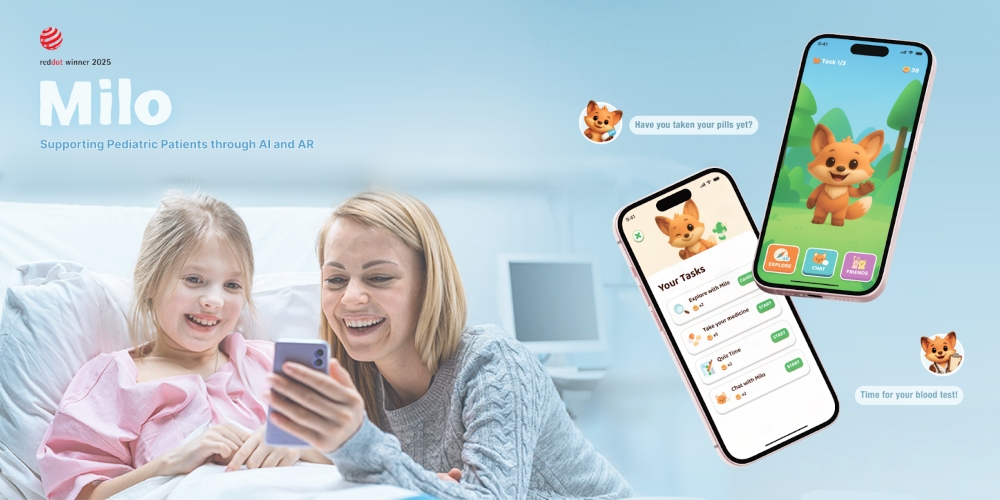
Photo Courtesy: Jingyi Wang & Yujia Ke
Milo is a digital companion created specifically for children facing long-term hospitalization due to cancer or other critical illnesses. The project originated from extensive research into pediatric emotional needs, medical routines, environmental constraints, and psychological responses to uncertainty and isolation.
Milo is built around three integrated features designed to support children through the emotional and psychological demands of long-term hospitalization. At its center is an AI Emotional Companion, a gentle conversational presence that adapts to each child’s mood, offering encouragement during medical procedures and comforting dialogue during moments of fear or boredom. This is paired with a series of AR/VR exploration environments—calm, imaginative worlds such as forests, underwater scenes, and outer-space landscapes that allow children to momentarily escape the confines of the hospital room. Another meaningful component is Milo’s shared hidden-message system, which allows young patients to leave symbolic notes for one another inside virtual spaces. These messages, often discovered by children who may never meet face-to-face, create a subtle but powerful sense of community within the hospital. Together, these features transform Milo from a digital tool into a companion that might travel with children through their most vulnerable moments.
“Milo isn’t just an app—it’s a companion who stays with the child through moments adults cannot see,” Wang says. “We wanted it to feel emotionally intelligent, not just technologically advanced.”
Why It Matters
Children undergoing long-term medical treatment often experience isolation, fear, and emotional uncertainty. Traditional hospital tools rarely address these emotional and psychological needs. Milo steps into this gap by offering companionship and continuity that extend beyond routine clinical support.
Milo may reduce emotional loneliness by providing consistent interaction, introduce moments of autonomy and play within an otherwise restrictive environment, and reframe medical routines through gentle, supportive guidance. Children gain access to safe spaces for exploration, creativity, and self-expression, which could contribute to a greater sense of resilience. Early feedback from caregivers and medical staff suggests that Milo might improve mood and engagement, but also appears to help children navigate the emotional landscape of treatment with greater confidence. In contexts where human presence is limited by schedules, procedures, or distance, Milo becomes a steady source of comfort.

Photo Courtesy: Jingyi Wang & Yujia Ke
Innovation Highlights
Milo distinguishes itself through its thoughtful integration of psychology, interaction design, and storytelling. The system is built around a trauma-aware interaction model specifically developed for pediatric patients, ensuring sensitivity to fear, fatigue, and emotional overwhelm. Its visual identity is intentionally soft, warm, and rhythmically gentle, creating a sense of safety and familiarity that reduces cognitive and emotional load. The immersive AR/VR environments offer more than entertainment—they are strategically designed to support emotional regulation and allow children to experience agency within a controlled, comforting world. Underlying the entire experience is a commitment to inclusivity, ensuring interactions remain accessible to children with varying cognitive and physical needs.
These innovations were central to the project’s recognition as a Red Dot Design Award 2025 Winner, a testament to its originality and human-centered approach.
A New Direction for Pediatric Experience Design
Wang and Ke’s work with Milo reflects a broader shift in design—one that prioritizes emotional resonance and human connection within technology. Their partnership demonstrates what can happen when interaction design, storytelling, psychology, and empathy combine into a single practice.
The recognition of Milo by the Red Dot jury reinforces the project’s originality and impact. It also highlights the growing importance of emotionally intelligent technology in healthcare environments.
“Milo shows how design can participate in healing,” Wang says.
“And how technology can hold space—not just deliver information,” Ke adds.
As the healthcare and design industries continue moving toward human-centered innovation, Milo stands as a compelling example of what the future might look like: technology that is present, attentive, and deeply caring.