

By: Anya Miller
Interviewer: Today, we have the pleasure of speaking with Zhuoyue Wang, a Senior Software Engineer at Oracle and a prolific researcher in AI+science with the focus on machine learning applications. Zhuoyue has made significant contributions across various sectors, all unified under the concept of “AI-Augmented Data Systems.” Welcome, Zhuoyue, and thank you for joining us.
Zhuoyue Wang: Thank you for having me. I’m excited to share my research and experiences with you.
Interviewer: Your research portfolio covers a diverse range of fields, including healthcare, sports, and technical domains such as image processing and speech recognition. How do you connect these seemingly different fields under the concept of “AI-Augmented Data Systems”?
Zhuoyue Wang: My research might seem diverse at first glance, but the common thread is the use of AI and machine learning to enhance data-driven decision-making systems. Whether it’s predicting optimal football formations, diagnosing brain tumors from MRI scans, or improving edge detection in color images, my focus is on leveraging AI to process and interpret complex data more effectively. By doing so, we can provide more insightful, accurate, and actionable outcomes across various applications.
Integrating GNNs and Reinforcement Learning
Football Formation Strategy Problem Analysis / Photo Courtesy: Zhuoyue Wang
Interviewer: Let’s dive deeper into your cited work, “Graph Neural Network Recommendation System for Football Formation.” What motivated you to explore AI applications in sports analytics, and what makes this work stand out?
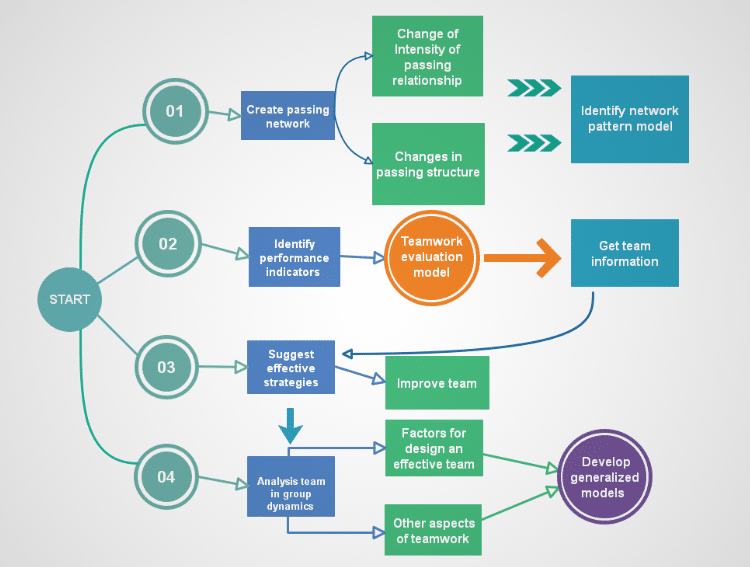
Zhuoyue Wang: The motivation came from a deep interest in understanding complex human interactions, such as those on a football field, and how AI can provide a fresh perspective on these dynamics. Sports analytics is a field ripe for innovation, where traditional metrics don’t always capture the intricacies of player and team interactions. By applying graph neural networks (GNNs) and reinforcement learning, we were able to create a model that considers both local and global passing relationships among players. This approach enables more sophisticated decision-making support for coaches, which goes beyond simple statistics like possession or shots on target.
This work introduced a novel framework that integrates GNNs and reinforcement learning to suggest real-time adjustments for football formations. The key accomplishment is providing a tool that helps teams optimize their strategies based on dynamic, data-driven insights.
This research is critical because it opens up new avenues for AI applications in sports management, where real-time data analysis can significantly impact team performance and game outcomes. Moreover, the methodologies developed here could be adapted to other team-based decision-making scenarios, broadening their applicability.
AI for Healthcare
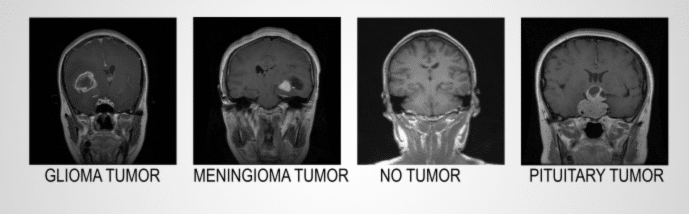
MRI Images of Various Brain Tumor Types for Analysis / Photo Courtesy: Zhuoyue Wang
Interviewer: Moving on to your work on “Deep Learning in Medical Image Classification from MRI-based Brain Tumor Images,” where you were the second author. What drove you to focus on this area, and what are the key contributions of your work?
Zhuoyue Wang: My motivation for this research was driven by the potential of AI to make a direct impact on healthcare, particularly in early disease detection and diagnosis. Brain tumors are notoriously difficult to diagnose accurately at early stages, and delays can have dire consequences. We wanted to explore how deep learning, particularly fine-tuned models, could offer more precise and quicker diagnosis capabilities.
The development of the MobileNet-BT model was a significant step forward. By customizing and fine-tuning this model specifically for medical imaging, we achieved remarkable accuracy in brain tumor classification compared to several other state-of-the-art models. This accuracy can help radiologists and doctors make more informed decisions faster, potentially saving lives.
This work is critical in the context of medical imaging because it addresses a real-world problem where timely and accurate diagnoses are crucial. By enhancing the diagnostic capabilities of MRI-based systems, we can reduce human error, provide better patient outcomes, and potentially lower the costs associated with lengthy diagnostic procedures.
Motivation for Edge Detection Improvement
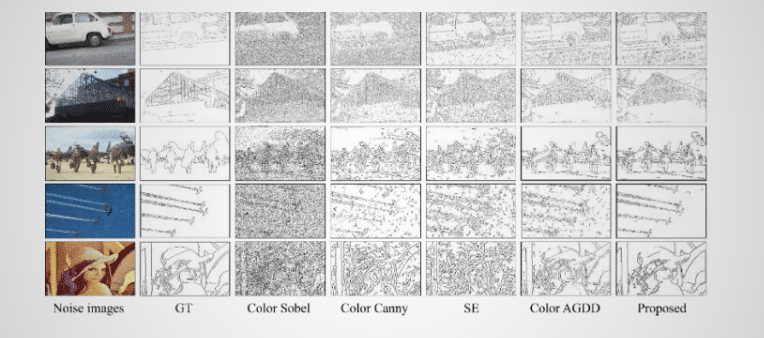
Example Results from Various Edge Detection Algorithms / Photo Courtesy: Zhuoyue Wang
Interviewer: You’ve also worked on enhancing edge detection techniques in color images with your first-author paper, “A Multiscale Gradient Fusion Method for Edge Detection in Color Images Utilizing the CBM3D Filter.” What inspired you to develop this method, and what makes it a significant contribution?
Zhuoyue Wang: Edge detection is fundamental to many computer vision tasks, such as object detection, 3D modeling, and medical imaging. The challenge was to develop a method that could improve edge detection in color images while maintaining robustness against noise. I was inspired by the limitations I observed in existing methods, which often struggled with balancing noise reduction and detail preservation. The idea was to integrate multiscale gradient fusion with a collaborative filtering technique to achieve a more refined edge detection process.
We introduced a new technique combining the CBM3D filter with multiscale gradient fusion, potentially improving noise resistance and edge quality. The method demonstrated excellent performance over traditional edge detection methods like Color Sobel, Color Canny, and SE algorithms in terms of PR curves, AUC, PSNR, and FOM metrics.
This research is important as it provides a robust and versatile solution for edge detection, which is a cornerstone of numerous AI applications. Improved edge detection can enhance the accuracy and efficiency of systems in areas like autonomous driving, facial recognition, and medical diagnostics, where high-quality image processing is vital.
Discussing Broader Themes and Future Directions
Interviewer: Can you share your thoughts on the role of machine learning in transforming traditional data processing systems, particularly in the context of your research?
Zhuoyue Wang: Machine learning has revolutionized data processing by allowing systems to learn from vast amounts of data and make decisions based on patterns that might not be evident to humans. In my work on the Graph Neural Network for football formations, for example, we used machine learning to identify subtle yet critical interactions among players that could influence game outcomes. Similarly, in medical imaging, machine learning models like MobileNet-BT can enable more precise and efficient tumor detection, which can significantly impact patient care. It’s about enhancing the ability to derive meaningful insights from complex datasets, regardless of the field.
Interviewer: With your diverse background, where do you see the future of AI-Augmented Data Systems heading?
Zhuoyue Wang: The future of AI-Augmented Data Systems lies in their ability to become more adaptive and integrated across various domains. We are moving towards systems that not only process data but also continuously learn and optimize based on real-time feedback. This could revolutionize areas like personalized medicine, smart city management, and intelligent manufacturing. My aim is to continue developing AI models that are not just powerful but also adaptable and scalable across different industries.
Interviewer: Given your experience across different research areas, what advice would you give to young researchers who want to make impactful contributions in AI and data systems?
Zhuoyue Wang: My advice would be to stay curious and open to interdisciplinary applications. Some of the best innovations come from applying concepts from one field to solve problems in another. It’s also essential to have a strong foundation in both the theoretical and practical aspects of AI and data science. Lastly, collaboration is key—engaging with diverse teams can bring fresh perspectives and lead to more innovative solutions.
For a more comprehensive understanding of Zhuoyue Wang’s academic journey, publications, and professional engagements, visit his LinkedIn and Google Scholar profiles.
Published By: Aize Perez