
Written by: Dillon Kivo
By the time Justin Hughes realized something inside him had shifted, the war was already over.
He was home, his children alive, his wife having carried the household through another deployment. By every outward measure, the mission had concluded the way missions are supposed to conclude. And yet Hughes found himself restless, short-tempered, and strangely distant from the life he had spent years defending.
“I know I love my kids,” he said. “But I wasn’t happy at home. I had no patience. And I kept thinking, this isn’t the dad I want to be.”
For much of his adult life, Hughes had lived inside systems designed to reward decisiveness, discipline, and emotional compression. As a Navy SEAL and Joint Terminal Attack Controller, his professional identity was built around clarity under pressure and exceptional performance in chaotic situations. Combat shaped him. It sharpened him. It also narrowed the emotional range required for ordinary life.
When the tempo of war disappeared, the internal momentum did not.
A Childhood of Curiosity and Adaptation
Long before combat, Hughes learned how to pay attention.
His childhood was not defined by trauma so much as movement. His family relocated often, requiring him to adjust repeatedly to new schools, new social hierarchies, and new expectations. There was structure, but not always continuity. What emerged instead was adaptability.
He learned to observe before acting. To read rooms quickly. To sense tone and mood. To notice details others overlooked. These were not skills taught explicitly. They developed naturally, the way children learn, whatever is required to feel steady in a changing environment.
“There’s a type of childhood that prepares you for certain kinds of work,” Hughes said. “You don’t realize it at the time, but you’re already learning how to function inside systems you don’t control.”
Importantly, his early years were not devoid of creativity. Hughes gravitated toward drawing and visual expression as a child. He sketched constantly, filling notebooks with figures and scenes without much thought as to why. It was not framed as talent. It was simply something he did.
At the time, there was no idea that art could turn into anything more. Like many kids, he eventually set it aside. As he got older, other things took priority. Achievement became about results, clarity, and forward motion.
Choosing the SEAL Teams
By early adulthood, Hughes was drawn toward environments where expectations were explicit and consequences immediate. The Navy SEAL teams offered precisely that clarity.
Becoming a SEAL wasn’t a dramatic calling. It made sense for who he was and where he was in life. The training was brutal, but it was straightforward. You knew the rules. You put in the work. If you kept going, you moved forward.
“You don’t show up thinking about anything else,” Hughes said. “You’re just trying to make it through the next evolution.”
The work suited him. The pace, the responsibility, the reliance on teammates. Over time, the identity solidified. This was who he was. This was what competence looked like.
Art receded fully into the background.
War Without Illusion
Hughes’ service placed him at the center of the battle for Mosul, one of the most punishing urban campaigns of the war against ISIS. The city had been transformed into a fortified labyrinth of tunnel systems, improvised explosive devices, and armored suicide vehicles designed to detonate among advancing forces.
The fighting was sustained and disorienting. Mortars fell daily. Suicide bombers came in waves. Friendly units advanced slowly, often without air support and without a clear picture of what waited ahead.
“There’s no clean way to describe it,” Hughes said. “It’s just everywhere. You’re constantly asking yourself where you aren’t getting shot from.”
During one operation, Hughes dismounted from his vehicle to inspect something in the bed. Upon dismounting, he found his MATV had stopped directly in front of an IED. His EOD teammate later told him the IED ran parallel to where he had stepped, only inches away.
“If I’d taken one more step,” he said, “that was it.”
On another operation, a VBIED detonated within close range of his position. Hughes remembers the shockwave and the immediate inventory that followed. Everyone on his team was alive.
“That moment where you realize you’re okay,” he said, “and then you realize how close you weren’t.”
Hughes recounts these experiences without bravado. War, as he describes it, is defined less by heroism than by responsibility. Most of it is waiting. Observation. Quiet jokes told to stay awake. And then, without warning, chaos compresses into minutes that alter everything.
“Most of it is boredom,” he said. “And then one percent of it is absolute chaos.”
Coming Home Changed
When Hughes returned home, reintegration proved more complicated than deployment.
His first child had been born just days before an earlier deployment. His twins arrived shortly before Mosul. In his absence, his wife had built systems that kept the household functioning. Hughes struggled to step back into them.
He worked more. Stayed busy. Avoided stillness. Told himself this was normal.
It wasn’t.
At his wife’s urging, Hughes began speaking with a military psychologist. The conversations forced him to confront truths he had avoided. Discipline alone could not solve this problem. Competence offered no shortcut.
“I kept saying I wasn’t an angry person,” he said. “But I was. That’s who I was at home.”
For the first time, Hughes questioned whether the identity that had sustained him professionally was eroding the very life he claimed to be protecting. If the work he justified as service was hollowing out his family, something fundamental had to change.
The Painting That Wasn’t Supposed to Matter
The turning point arrived quietly.
While working as an instructor, Hughes noticed a bronze trident statue on a superior’s desk. The image stuck with him and stayed in the back of his mind.
One evening on his drive home, he stopped at a craft store and picked up a small canvas and a basic set of acrylic paints. He hadn’t planned to do anything with them. He just wanted to try.
“I didn’t tell anyone,” Hughes said. “I just wanted to see if I could paint it.”
At home, while his wife watched television, he sat down and worked from memory and reference images. The process felt strangely absorbing. Time passed unnoticed. When he finished, the result surprised him.
His wife encouraged him. A colleague asked if he could get a print. Then another. Then another. Before long, people around the command began asking about the painting.
Eventually, a senior enlisted leader knocked on his door to see it in person.
“He told me, ‘You need to do something with this,’” Hughes recalled. “That was the first time it clicked.”
The painting itself was modest. It was not technically perfect. But it was honest. More importantly, it produced something Hughes had not felt in years.
“I made something,” he said. “And that felt different.”
Word Travels
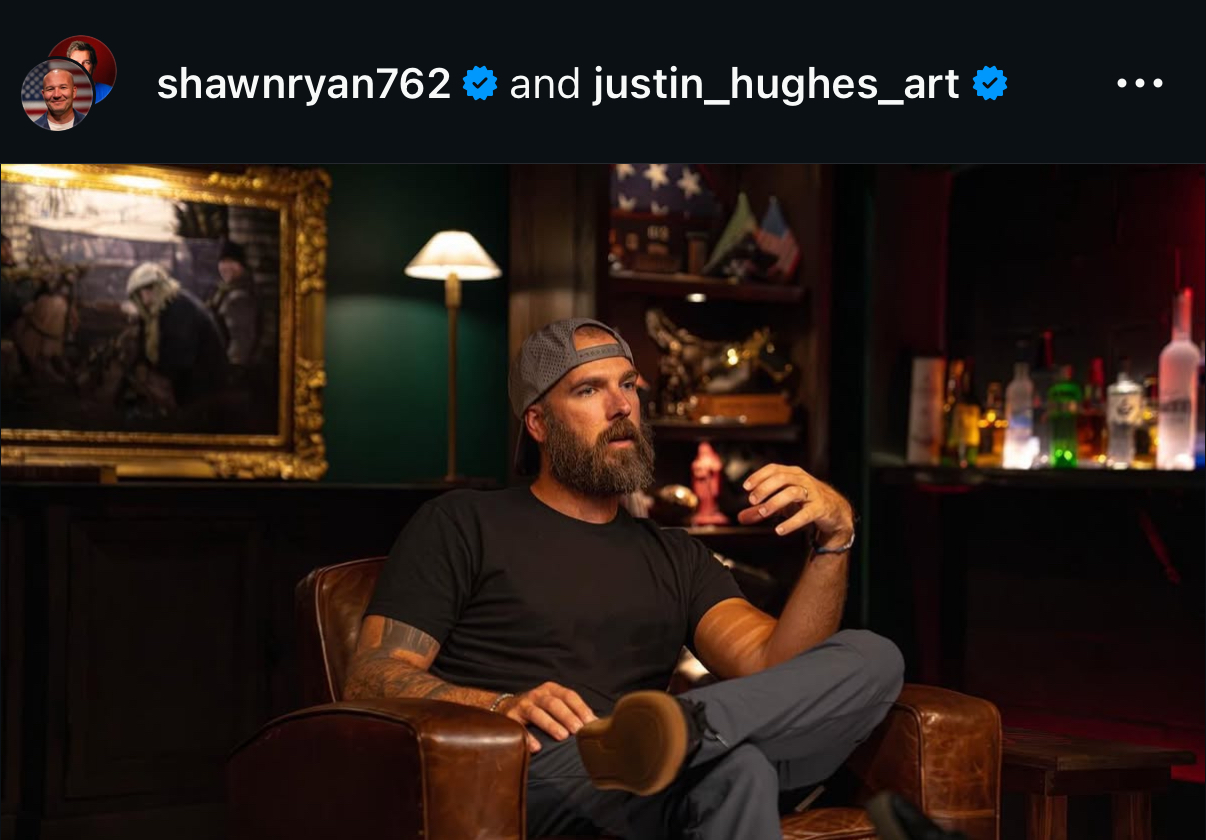
Image Credit: Courtesy of The Shawn Ryan Show
Within military communities, word moves quickly.
Hughes began photographing the painting and having prints made. People bought them, not out of charity, but because they recognized themselves in the image. The discipline. The symbolism. The familiarity.
More requests followed. Different subjects. Different moments. Hughes found himself painting late into the night, not out of obligation, but compulsion.
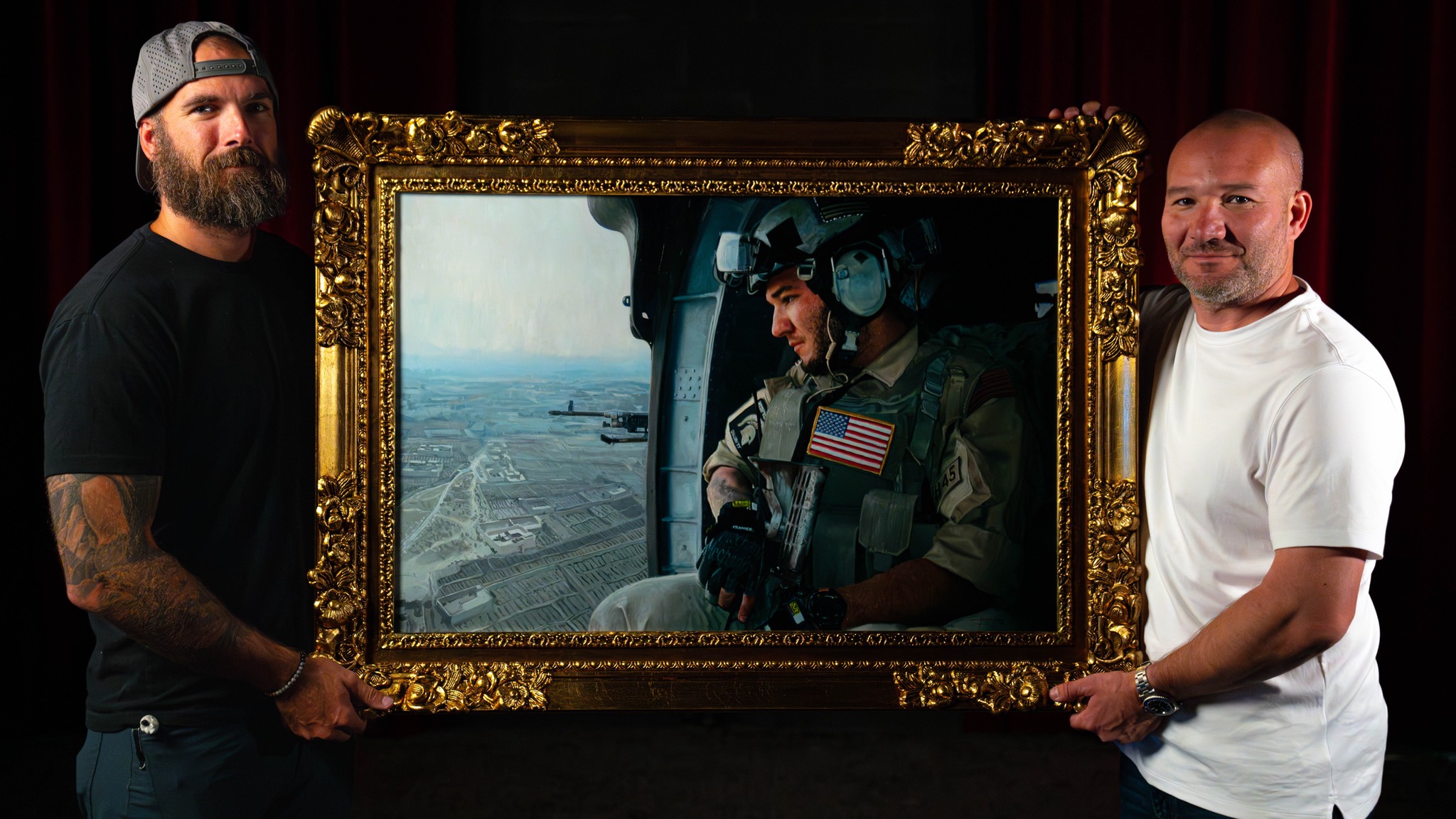
That momentum eventually carried him beyond his immediate circle. Hughes completed one commissioned painting for Shawn Ryan before later flying out to appear on The Shawn Ryan Show. During that visit, he delivered a second painting in person, a piece depicting Ryan during an operation in Yemen.
The episode was recorded during that trip. Hughes spoke candidly about his transition from military service to art and the challenge of recalibrating life after years spent inside high-tempo operational environments. The conversation resonated with viewers who recognized the tension he described, the space between who someone was in uniform and who they were trying to become afterward.
Shawn commissioned a third painting, and now all three paintings hang in the program’s studio, not as set decoration, but as visual records of lived experience. They depict moments familiar to those who have served, rendered without dramatization or spectacle. For Hughes, the commissions were less career milestones than confirmation that the work itself was communicating something real. The paintings did what words often could not. They held stillness, carried memory, and translated experience without explanation.
Around that time, Hughes began to approach painting with greater seriousness. He studied technique deliberately, watching instructional videos, working from reference photographs, and experimenting with materials late into the night. He learned how to build layers, how to let paint dry, how to slow his hand and his thinking. Observation, he came to understand, was not passivity, but discipline.
Oil painting appealed to him precisely because it resisted urgency.
“You can’t rush it,” he said. “If you try, it punishes you.”
The discipline felt familiar. Different from military training, but not foreign. Precision mattered. Patience mattered. Attention mattered.
Letting Go of the Teams
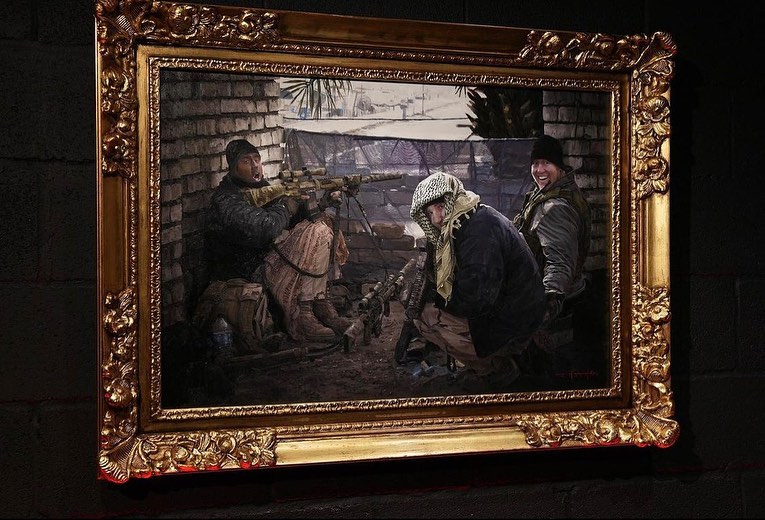
Image Credit: Courtesy of The Shawn Ryan Show
Leaving the SEAL teams was not an escape. It was a deliberate decision shaped by self-awareness.
Hughes understood that returning would immediately reactivate the imbalance he was trying to correct. The appetite for more deployments, more intensity, more validation would return unchecked.
“And more is never enough,” he said.
Art offered structure without violence. Purpose without destruction. A way to preserve memory without feeding obsession.
“I don’t paint to relive it,” Hughes said. “I paint to translate it.”
Today, Justin Hughes works primarily in oil, producing representational pieces that explore the warrior archetype without glorification. He sees himself less as an artist chasing novelty and more as a custodian of lived experience.
“Paint is just my medium,” he said. “Storytelling is the point.”
What Comes Next
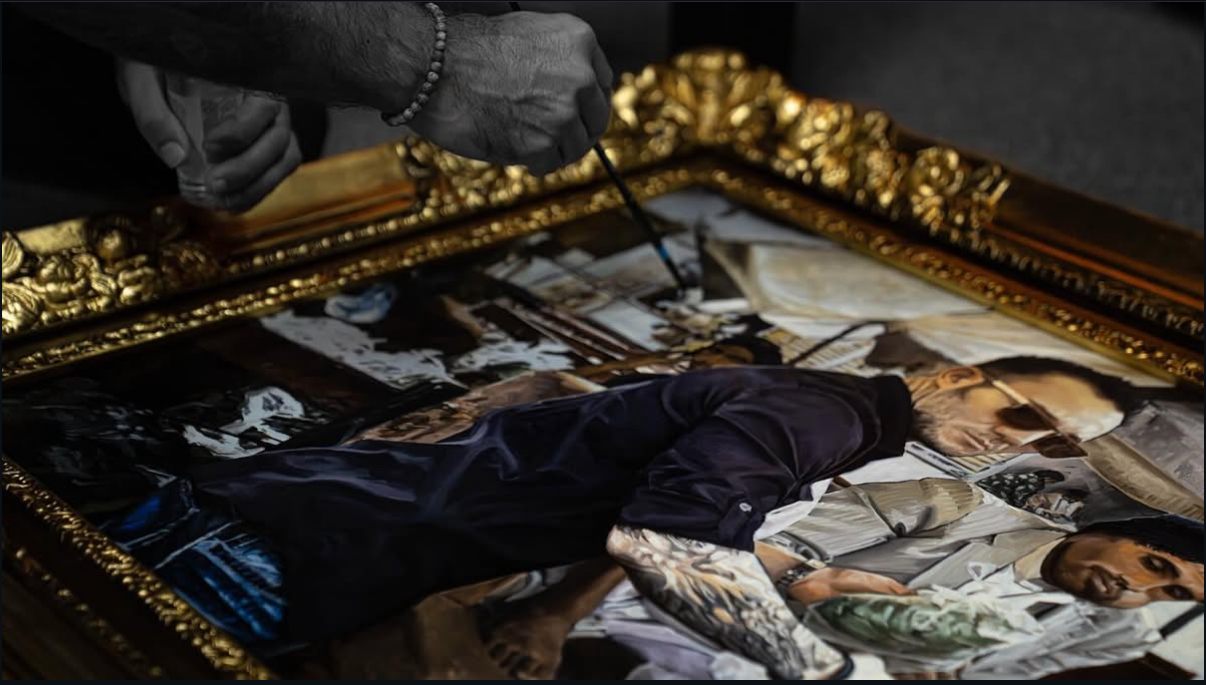
Image Credit: Courtesy of The Shawn Ryan Show
Hughes is currently developing his first formal series, a body of work centered on legacy, memory, and the interior cost of service. He takes select commissions, often from former teammates or their families.
“These paintings outlive us,” he said. “They become how stories are passed down.”
Asked whether he misses the teams, Hughes pauses.
“I miss the people,” he said. “But I don’t miss who I was becoming.”
In his studio, canvases dry slowly. Layers wait. Nothing is rushed. The urgency that once governed his life has been replaced by attention.
“I didn’t know you could build a life twice,” Hughes said. “But you can, if you’re willing to let the first one end.”