

By: Theodore Rickles
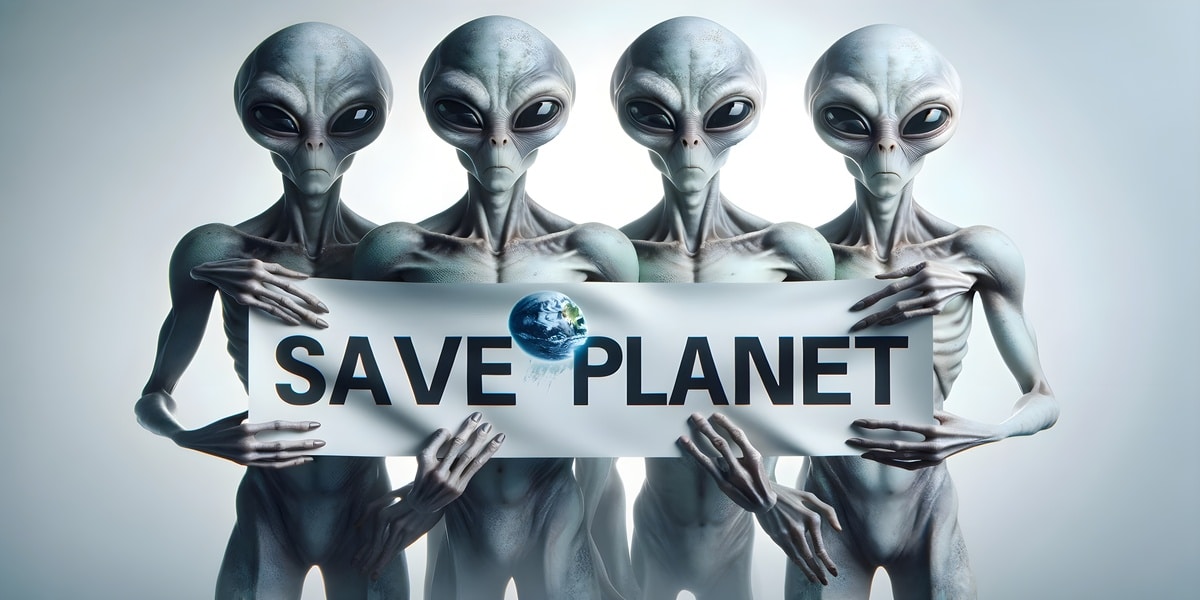
This year’s celebration of Earth Day occurs on April 22nd. On its surface, Earth Day often feels like a once-a-year event, significantly eclipsed by the chronic and ongoing, almost daily engagements people have with weather-related or natural disasters posed by climate change. But Earth Day has served as a wake-up call now for generations, ever since that first Earth Day celebration in 1970. And Earth Day has not been alone in trying to foster awareness and change toward the handling of this fragile planet. Posters for environmental awareness have turned science fiction toward warning of what might happen if people don’t protect Earth’s ecology and have helped to inspire interest and awareness of Earth Day and similar organizations’ themed activities.
Individuals’ stewardship of Earth has been a longstanding theme in science fiction. In 1973 and 1974, Gene Roddenberry, the creator of Star Trek, tried to produce a second long-running sci-fi series with a project titled: “Genesis II.” Instead of starships patrolling the galaxy to sustain off-world human and alien colonies, Genesis II suggested exploratory (“PAX”) teams traveling the earth to restore order and civilization to societies ravaged by war and strife. Coincidence or not, the 50th anniversary of Planet Earth, as a 1974 sequel to Genesis II, occurs one day after this Earth Day, on April 23, 2024.
Characteristic of Planet Earth (1974)’s ecological sentiment is a piece of its initial dialog: “[It’s] confirmed that central California is now an inland sea. Population along the shores are a handsome racial mixture, illiterate but intelligent. Although the land remains fertile, famine is common. Their primary need from us is education and agricultural technique.” That dialog is from Dylan Hunt, leader of a PAX team in the imagined year 2133 A.D.
The global PAX teams of the films and their proposed episodes were fictitious, and the character of the enclaves they met were often governed by misguided rulers, religious fanatics or ghetto warlords. As in 1970’s ‘made-for-TV’ films, some of these depictions can be viewed as antiquated in the current times. However, contemporary struggles to manage the environment are often immersed in strained conflict with societies’ industries and economies. Perhaps one benefit for potential fans of Genesis II or Planet Earth would be to encourage community involvement in humanitarian aid and ecological conservancy. Sadly, back in 1974, Genesis II and Planet Earth never made the transition from pilots to televised series. They were displaced by the popularity of the Planet of the Apes (POTA) films at that time.
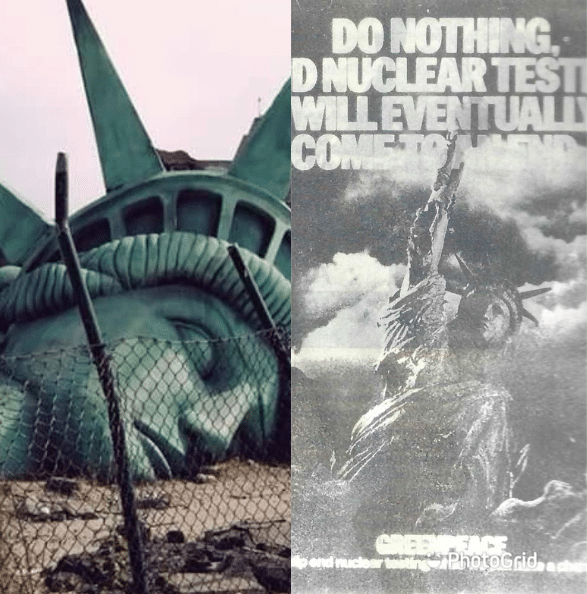
Photo Courtesy: Greenpeace and Lilian Gerring/Kurnit Communications.
In the original five POTA films from 1968 through 1973, the backstory of how Apes replaced man as Earth’s dominant species was due to nuclear war. That narrative was revealed in the year 3978 A.D. Toward the film’s conclusion, the main protagonist for the Apes, an Orangutan administrator named Dr. Zaius, explains to the human, Taylor, that:” The Forbidden Zone was once a paradise. Your breed made a desert of it ages ago.”
Planet of the Apes (1968) and its’ sequels are also positioned as post-apocalyptic narratives. The backstory of nuclear war in the original Apes films wound up being used by GreenPeace in a 1988 poster, depicting an aging toppled Statue of Liberty casting its shadow upon a radioactive desert that was once New York. This is not true for the rebooted POTA film franchise produced from 2011 through today. This current reboot holds that the ape’s ascension over man resulted from a biological pandemic that caused Apes’ intelligence to evolve while killing off mankind.
Planet of the Apes, Roddenberry’s Genesis II, and Planet Earth were not the only socially conscious films of the 1970s that engaged environmental themes. Pop culture historians will no doubt credit earlier ecologically themed films such as Silent Running (1972), which was built upon the premise that all plant life on Earth had become extinct. Soylent Green (1973) was an ecologically dystopian film in which the urgency for recycling takes a gruesome turn.
In 2008, Pixar Animation released WALL-E for Disney. “Wall-e, short for Waste Allocation Load Lifter Earth-class, is the last robot left on Earth. He spends his days tidying up the planet, one piece of garbage at a time” (see: Google). More recently, Avatar (2009) and its sequel, Avatar: Way of the Water (2022), have presented strong environmental themes. The native Na’vi people of the planet Pandora are at war with human colonists who challenge their ecology. In 2010, the Earth Day celebration that took place on the mall in Washington, DC, featured a Na’vi attraction kiosk as part of its festivities.
It seems that even unintentionally, Pop culture winds up intertwining with the appreciation for the world and concern for the environment. In 2021, William Shatner (Star Trek’s own Captain James T. Kirk) came back from a real-life mission into Space in a Blue Origin capsule. Upon his return, he commented on his experience that the Earth appears as a warm and inviting home against the blackness of outer space.
In his words: “I saw a cold dark, black emptiness [of space]. It was unlike any blackness you can see or feel on Earth. It was deep, enveloping, all-encompassing. I turned back toward the light of home. I could see the curvature of the Earth, the beige of the desert, the white of the clouds and the blue of the sky. It was life. Nurturing, sustaining life. Mother Earth, Gaia. And I was leaving her.” Excerpt from: Shatner, William, Boldly Go: Reflections on a Life of Awe and Wonder (2022)- reprinted in Variety, October 6, 2022, titled, “William Shatner: My trip to space filled me with ‘Overwhelming Sadness.’”
The official theme of Earth Day (2024) is “Planet vs. Plastics,” and EarthDay.Org has called for a 60% global reduction in plastic production by 2040. Although it’s observed one day a year, many people are aware that Earth Day really needs to be “every day” as society works to moderate climate change and address environmental losses. What will you do for the environment for Earth Day? And every day?
(Theodore Rickles is an occasional writer and author of “Catching Lameds: Reflections on an Unconventional Life” published in 2023 by Story Terrace. His most recent contribution is a feature article entitled, “Might Gene Roddenberry Have Saved The World,” published on LAWeekly.com March 24, 2024 and co-authored with Vishnu Chaudhuri.)
Published by: Holy Minoza