
As the United States prepares to commemorate its 250th anniversary, conversations about history are taking place across the country. Museums are revisiting the nation’s founding story. Communities are reflecting on their contributions to the American experience. Institutions are asking how history should be remembered by future generations.
Yet beyond official celebrations and historical milestones lies a more personal question:
What survives the passage of time?
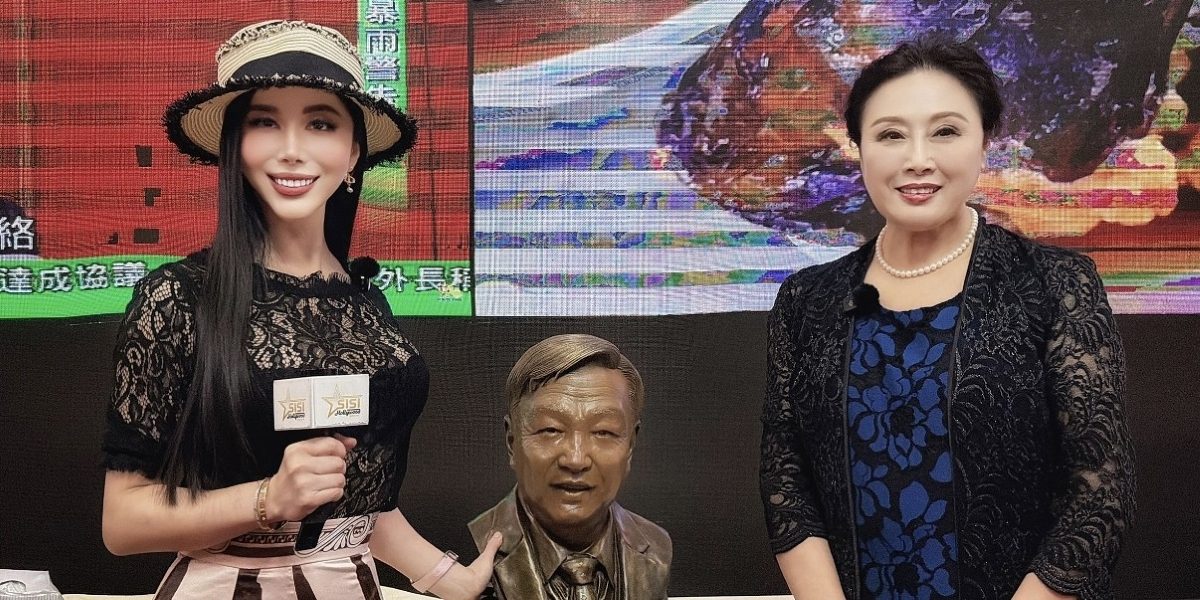
Sisi Cao, an international media personality and founder of Sisi Hollywood, recently found herself exploring that question while filming an upcoming episode of her nationally syndicated television show, which examines identity, memory, belonging, and the evolving meaning of the American Dream through conversations across cultures and generations.
The question resurfaced during the unveiling of a memorial sculpture honoring Charles P. Wang, one of the most respected Chinese American civic leaders of his generation.
Created by renowned sculptor and art historian Dr. Ellen Qiongzhao Schicktanz, the bronze sculpture was unveiled before community leaders, artists, entrepreneurs, and longtime friends whose lives had been touched by Wang’s decades of public service and leadership.
Yet what unfolded that afternoon felt larger than a memorial ceremony.
In a conversation with Cao, Dr. Schicktanz explained that her goal was never simply to recreate Wang’s likeness.
“I wanted people to feel his spirit,” she said.
For more than three months, Schicktanz worked to capture not only the face of the late community leader, but also the values that defined him—service, integrity, resilience, and a lifelong commitment to helping others.
The discussion soon moved beyond sculpture itself.
Schicktanz spoke about art as a form of memory. A sculpture, she explained, allows future generations to encounter someone they may never have known. It preserves not only appearance, but meaning.
It freezes a moment.
It preserves a story.
And sometimes, it helps carry a legacy forward.
That idea echoed throughout the gathering.
One attendee, who had known Wang for nearly sixty years, spoke less about accomplishments and more about character. He remembered a man who encouraged younger generations to think beyond fear, dream bigger, and contribute something meaningful to their communities.
Another memorable perspective came from a 102-year-old attendee, whose reflections on gratitude left a lasting impression on many in attendance.
A 102-year-old attendee, born in Canada and later making New York her home, reflected on a lifetime of change, challenge, and opportunity.
When asked about the secret to living a long life, her answer was immediate.
Gratitude.
Not success.
Not status.
Not wealth.
Gratitude.
She described it not as a feeling, but as a daily practice—a decision to approach life with appreciation rather than resentment, curiosity rather than fear.
Her answer seemed to capture the deeper theme running through the day.
Legacy is rarely measured by what people accumulate.
It is measured by what they pass on.
As America approaches its 250th year, questions about belonging, contribution, and cultural identity are becoming increasingly relevant. For many Chinese Americans, those conversations carry particular significance as communities reflect on generations of contributions that have become part of the broader American story.
For Cao, whose work often explores the intersection of culture, identity, and human connection, the unveiling served as a reminder that history is not preserved only in archives, monuments, or textbooks.
History lives in people.
It lives in stories.
It lives in values that move from one generation to the next.
The event also reflects a broader theme emerging throughout the current season of Sisi Hollywood. Through conversations with Emmy Award-winning composer Randy Edelman, artists, community leaders, and cultural innovators, the series explores how individuals leave a lasting impact through music, art, service, and human connection.
Some preserve time through music.
Some preserve memory through art.
And some continue to live on through the people they inspire.
As the nation prepares to celebrate 250 years of history, perhaps the most important question is not how we remember the past.
But what kind of future will those memories inspire?
The conversations captured during the unveiling will be featured in an upcoming episode of Sisi Hollywood, Sisi Cao’s nationally syndicated television show dedicated to meaningful conversations that connect people across cultures, generations, and perspectives.