

By: James Williams
In high-tech industries, there is a special, almost invisible world — the world of scientific glassblowing production. You won’t see it on store shelves, but without it, the development of medicine, chemistry, electronics, and even the space industry would be impossible.
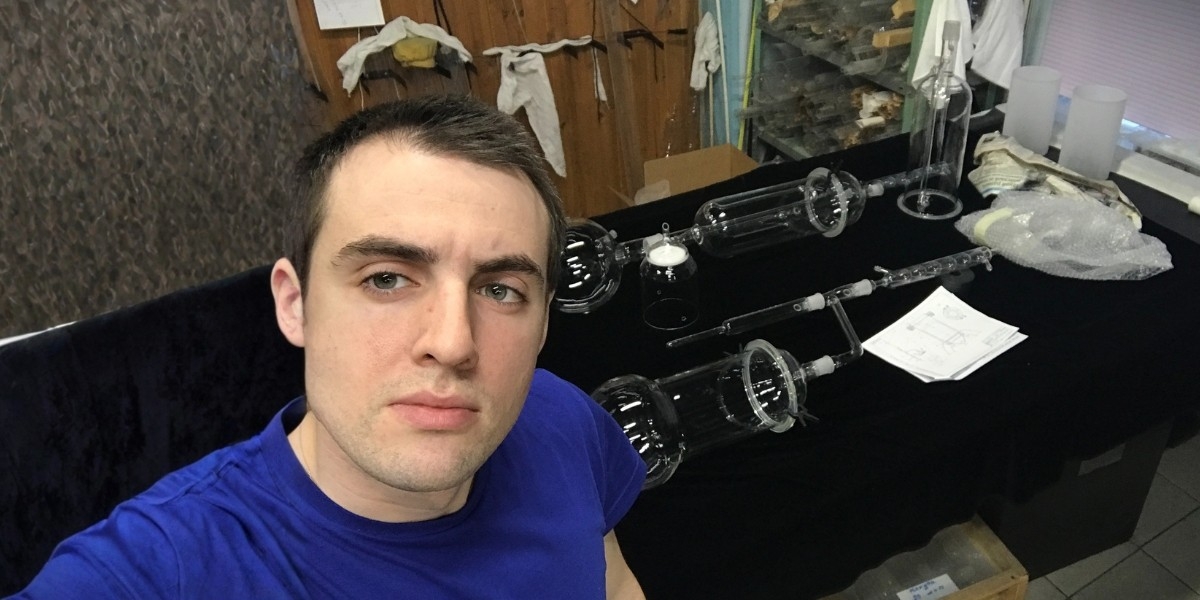
Aleksandr Drozdov is a hereditary glassblower, the founder of his own quartz-blowing workshop, which, since 2012, has confidently stayed afloat and has cooperated with Russian enterprises. In just a few years, he turned a craft business into a profitable venture and an expert at the federal level.
Aleksandr, you continued the family business. What pushed you not just toward the craft, but toward creating your own workshop?
— This is truly a family story. My father was a glassblower, an ordinary worker, and I had observed his labor since childhood. After the Institute of International Business Education, I decided that it was worth combining tradition and an entrepreneurial approach. In 2012, I bought equipment, gathered everything necessary, and officially began working. Back then, I didn’t fully understand the scale, but I felt that this niche in Russia was practically free.
How difficult was the start?
— The main problem was the equipment. Glassblowing production is a narrow specialization: electronics, medicine, and the chemical industry. All equipment is specific and expensive. I had to look for old Soviet machines and refine them: install modern motors, increase precision. Basically, I was mastering everything anew.
Nevertheless, within just a year, the business paid off. How did that happen?
— Yes, in 2013 we broke even. The specifics of the market helped: there aren’t many orders, but they are high-tech, urgent, and expensive. Our first large client was an enterprise in Khimki that produced acids. We helped them scale, and they helped us: they loaded us with orders, thanks to which we were able to buy new equipment. After that, word of mouth. Clients shared our contacts with each other, and demand grew quickly.
So you basically had no marketing investments?
— Correct. We have a website, but it has never been the main channel. Two years ago, we even removed the contact info: there were too many orders. In the scientific-glass niche, there are few specialists, and if you show results, word of mouth works better than any advertisement.
What is your geography of orders?
— About 70% is Moscow and Zelenograd, where I live and where electronics is concentrated. The rest are regions of Russia. From international experience, I can recall France and one more European country, but the main market is still Russia.
Today, many talk about competition with China. How do you withstand this rivalry?
— China, of course, is present. Their mass batches are cheaper. But our key advantage is speed and flexibility. Their production time is 2 to 3 months. And if there is a mistake, you wait the same amount again. We can fulfil an order urgently and adjust the piece to specific parameters. Therefore, large enterprises take services from us and buy mass-produced items from them.
How many such workshops exist in Russia?
— I know only two or three. There are giants like Gus-Khrustalny who draw quartz tubes themselves. But, for example, one plant near Moscow closed: it became unprofitable to compete with imports. So the field of activity is narrow, but precisely because of that, promising.
Your production is based on customers’ drawings. Can we say that each order is unique?
— Yes, this can be called experimental production. Every week, there are new items, new tasks. There is no assortment in the usual sense. Sometimes these are very complex elements for electronics, sometimes non-standard parts for medicine. There have also been more creative projects: for example, we made designer hookahs for restaurants, which ordered them by the thousands. Later, the idea was picked up by the Chinese, but the experience was interesting.
Is there a project you are especially proud of?
— Yes, this is the repair of a quartz bath for the Mikron plant in Zelenograd. The item is huge and requires incredible precision. We completed it in the shortest possible time. For me, it was a sign that the workshop is capable of solving tasks at the level of high-tech corporations.
You work basically together with your father. Why don’t you expand the team?
— The problem is personnel. You cannot become a glassblower in a year. Training takes about six years, and all that time you need practice. The work is hard: quartz glass is expensive, you work with fire, and you need protection and precision. There are few such specialists, and training them at your own expense is difficult. Therefore, we mostly manage the two of us, sometimes bringing in freelance craftsmen.
So, personnel shortage is the main problem of the industry?
— Absolutely. Soviet specialists are retiring, and new ones are not being trained. Earlier, they taught right at the factories; now there are almost no such schools. Perhaps somewhere in Gus-Khrustalny, some programs have been preserved, but overall, the situation is sad. This is a serious barrier to the industry’s development.
How has the field changed over the last 10–13 years?
— Requirements for precision have increased. CNC machines and laser equipment have appeared. But specialized machines are too expensive, so often we have to adapt universal ones. Artificial intelligence has not been used yet. Although I’m sure that, in a few years, digitalization will reach this industry as well.
How are relationships with customers built? What helped you stay on the market?
— The ability to communicate is important here. Sometimes you have to work with managers who are far from technical nuances. You need to explain why a part costs a lot. With engineers, it can also be difficult: many are used to Soviet standards and demand “the old way.” You need patience, readiness to show samples, and the ability to fix mistakes at your own expense. Only this way can trust be formed.
Today, people often talk about replacing glass with plastic. Is this a threat to your market?
— Rather a myth. Plastic is convenient and cheaper, but in medicine, chemistry, and electronics, it has no place. They require the properties of quartz: resistance to high temperatures and chemical neutrality. So in the coming years, glass will remain an irreplaceable material.
You position yourself as an expert. Do you participate in conferences, seminars, and expert communities?
— No, I hardly speak publicly. Mostly, I communicate with colleagues and experts within the professional environment. Sometimes I consult on issues of quartz purity. I improve my skills independently, experimenting in the workshop.
If we look into the future, how do you see the development of glassblowing production in Russia?
— I think this industry has potential, but everything depends on whether new personnel will be trained. Without people ready to study for six years and work in difficult conditions, the profession risks remaining the domain of enthusiasts. On the other hand, the demand for high-tech products is only growing. Electronics, medicine, pharmaceuticals — all this is impossible without quartz. So there is a future, but it requires a systematic approach.
And the last question. How do you yourself formulate the meaning of this work?
— For me, glassblowing production is a combination of craft and science. It requires the precision of an engineer and the patience of an artist. Quartz is the material of the future, and being part of this chain, providing the development of high technologies, in this, I see real meaning.