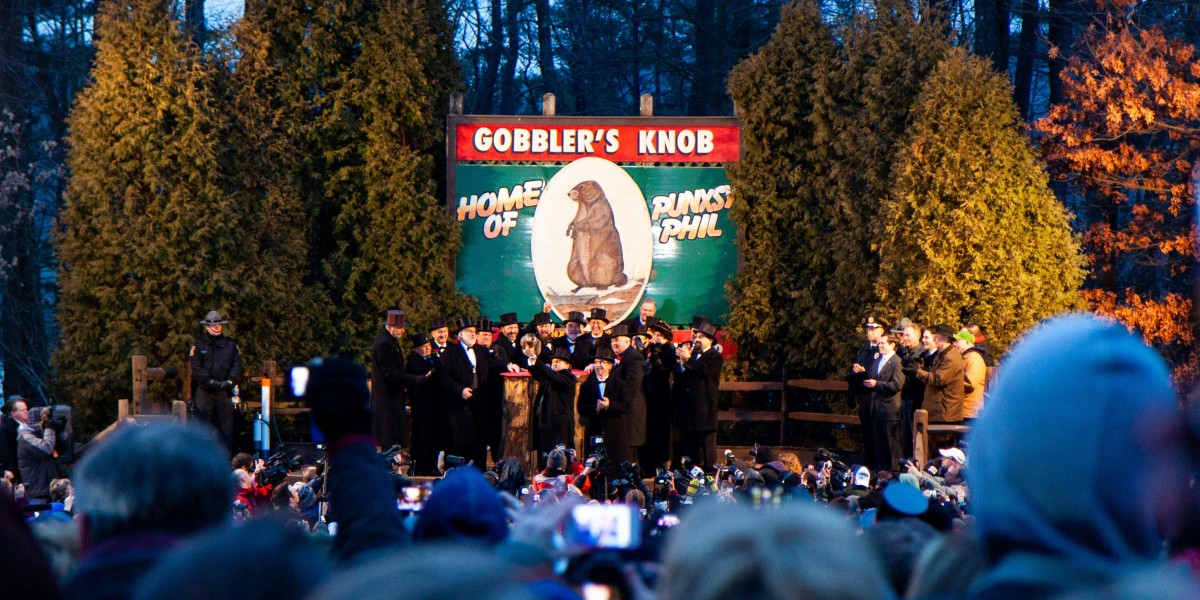

Every 2 February, a quiet town in Pennsylvania becomes the center of global attention. The cameras roll, crowds cheer, and a single groundhog named Phil is lifted into the cold morning air. His task is simple: look for his shadow. Yet this brief moment has grown into one of the most recognizable traditions in North America and a lasting symbol of how folklore, media, and modern culture intersect.
Groundhog Day is more than a weather ritual. It is a story about habit, hope, and humanity’s desire to predict the unknown, even when the odds are stacked against us.
The Folk Roots Behind The Forecast
The tradition of Groundhog Day traces back to European settlers, especially German immigrants, who brought with them a belief known as Candlemas lore. According to this folklore, clear weather on a specific winter day meant a longer winter ahead. In Europe, animals like hedgehogs or badgers played the role of seasonal predictors.
When these settlers arrived in North America, they adapted the tradition using a local animal: the groundhog. Over time, the ceremony settled in Punxsutawney, Pennsylvania, where the most famous groundhog of all, Punxsutawney Phil, became the official forecaster.
Despite modern meteorology, Phil’s prediction still draws massive attention every year, proving that tradition can outlive accuracy.
Punxsutawney Phil And The Power Of Ritual

Photo Credit: Unsplash.com
Phil’s annual appearance takes place at Gobbler’s Knob, where members of the Inner Circle, dressed in tuxedos and top hats, perform the ceremony. If Phil sees his shadow, folklore says there will be six more weeks of winter. If not, early spring is on the way.
From a scientific perspective, Phil’s accuracy is often debated, and statistics regularly show mixed results. Yet accuracy is not the point. The ceremony offers something more valuable: continuity.
In a fast-moving world, Groundhog Day delivers the comfort of repetition. The same place, the same words, the same ritual, year after year.
Hollywood’s Role In Reinventing Groundhog Day
Groundhog Day’s transformation from local custom to global concept accelerated with the release of Groundhog Day. The film stars Bill Murray as Phil Connors, a cynical weatherman trapped reliving the same day over and over again.
The movie gave the holiday a second, deeper meaning. Groundhog Day became shorthand for repetition, stagnation, and the struggle to break free from routine.
One line from the film has become inseparable from the holiday’s modern identity. Murray’s character famously snaps, “Don’t drive angry.”
The quote resonates because it captures the film’s core lesson: repetition is not the enemy, but failing to learn from it is.
A Metaphor That Crossed Cultural Boundaries
Since the film’s release, “Groundhog Day” has entered everyday language. It is used to describe repetitive workdays, cyclical news cycles, and even political and economic patterns.
Psychologists, philosophers, and business leaders often reference Groundhog Day when discussing habit formation and personal growth. The idea is simple: if every day feels the same, change must come from behavior, not circumstance.
This metaphorical power explains why Groundhog Day is recognized far beyond the United States. Even in countries with no winter snow or groundhogs, the phrase still carries meaning.
Why People Still Care In The Age Of Data
Weather forecasts today rely on satellites, supercomputers, and real-time climate modeling. Against this backdrop, a groundhog’s shadow seems almost comically outdated.
Yet Groundhog Day persists because it is not competing with science. It operates in a different space altogether: culture.
People do not tune in because they truly believe Phil controls the seasons. They tune in because the event offers humor, nostalgia, and a shared moment. In uncertain times, familiar rituals can feel grounding.
Groundhog Day also serves as a reminder that not everything needs to be optimized or proven. Some traditions survive simply because they make people smile.
Groundhog Day As A Mirror Of Modern Life
At its core, Groundhog Day reflects a universal human experience: the fear of being stuck. Whether it is a job, a routine, or a phase of life, repetition can feel comforting or suffocating, depending on perspective.
The holiday and the film both suggest the same quiet truth. Change does not always require a dramatic event. Sometimes it starts with small choices made repeatedly.
That idea may be why Groundhog Day continues to resonate across generations. It speaks to the tension between routine and reinvention, stability and growth.
More Than A Prediction, A Cultural Pause
Every year, when Phil emerges from his burrow, the world pauses for a moment. News outlets report the result. Social media is filled with jokes and memes. People reference the movie, the tradition, or both.
For one brief morning, the future feels playful instead of overwhelming.
Groundhog Day endures because it blends folklore, humor, and reflection into a single ritual. It reminds us that while we cannot control the seasons, we can choose how we respond to repetition.
And in that sense, whether Phil sees his shadow or not almost does not matter at all.