
By: Bernard Ramirez
New Anglia University is an established international medical school built on a deliberately structured academic and clinical model, with its campus located in Anguilla, a British Overseas Territory in the Caribbean.
The Legal and Institutional Foundation
Anguilla operates as a British Overseas Territory under UK constitutional arrangements, with a legal system based on English common law and a governance structure that includes oversight through a UK-appointed Governor. Final appellate jurisdiction lies with the Judicial Committee of the Privy Council in London.
For an academic institution, this creates a stable and predictable legal environment, with administrative and judicial structures that are familiar within a broader British framework.
This does not place the territory within the United Kingdom itself, nor does it equate its institutions with UK-based universities. However, it does mean that organizations established in Anguilla operate within a system that is internationally recognized and legally consistent.
The decision to establish New Anglia University in this context was therefore structural rather than geographic. The aim was to build within a framework defined by legal clarity, institutional stability, and an English-speaking environment.
A Structured Preclinical Program
The preclinical phase at New Anglia University is delivered over a defined 20-month period, during which students complete integrated biomedical modules including Foundations of Medicine, Human Structure and Function, Pathogenic Interactions and Host Defence, Clinical Pathology and Diagnostics, Pharmacology, and Clinical Reasoning.
This phase is designed to provide a focused scientific foundation before students transition into clinical training. Teaching is delivered on the university’s campus in Anguilla, where the scale and structure of the environment support a concentrated academic experience.
The duration of the preclinical phase reflects a deliberate balance. It is structured to ensure that students acquire the necessary scientific knowledge while limiting the time spent outside the healthcare systems in which many will later pursue training.
Following completion of this phase, students progress into clinical rotations, forming the second half of the MD program.
Early Clinical Exposure
Before beginning formal clinical rotations at teaching hospitals in the United States or the United Kingdom, students at New Anglia University gain early exposure to hospital-based environments in Anguilla.
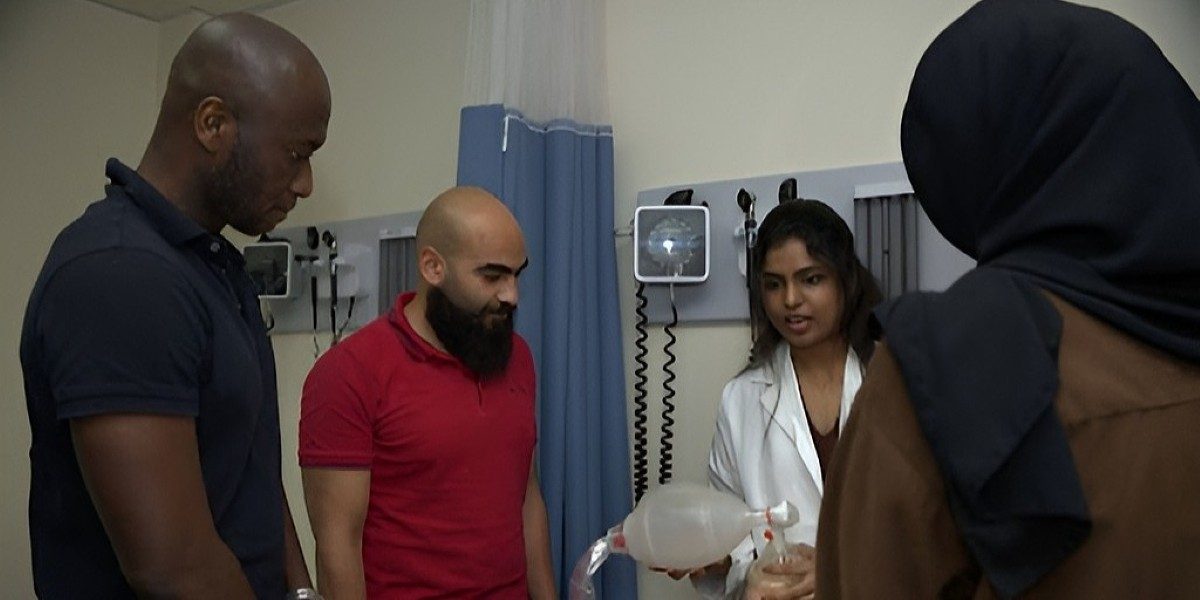
During the later stages of the island-based program, students attend supervised sessions at Princess Alexandra Hospital, where they are introduced to clinical settings and workflows. This includes observational exposure to pathology services, including post-mortem examinations, as well as structured observation within the Emergency Department.
These sessions are designed to familiarise students with real clinical environments, including patient intake, triage processes, diagnostic pathways, and multidisciplinary care, before they transition into full clinical rotations abroad.
This early clinical exposure changes the quality of the rotation experience that follows. Students who have already spent time in a working hospital environment carry a different degree of readiness compared to those entering clinical training for the first time.
Clinical Rotations Across the United States and the United Kingdom
Clinical rotations at New Anglia University span more than thirty teaching hospital sites across the United States and the United Kingdom, delivered through affiliated hospital partners.
These placements provide students with exposure to established healthcare environments, where they undertake supervised clinical training across both core and elective medical disciplines. Core rotations include internal medicine, surgery, paediatrics, obstetrics and gynaecology, psychiatry, and family medicine, reflecting the standard structure of clinical medical education.
During this phase, students participate in day-to-day clinical practice, working alongside medical teams in both inpatient and outpatient settings. They are involved in patient assessment, clinical discussions, and diagnostic processes under supervision, allowing them to apply the foundational knowledge developed during their studies on campus in real-world contexts.
The breadth of hospital sites ensures exposure to a range of healthcare systems, patient populations, and clinical practices, supporting the development of adaptability and clinical competence.
A Deliberate Institutional Model
Medical education is increasingly international, and students are no longer confined to a single country for their training. What matters is not location alone, but how a program is structured, delivered, and integrated across different healthcare systems.
New Anglia University’s model reflects that shift. The choice of Anguilla was not incidental. It was structural, providing a stable legal framework, an English-speaking environment, and a focused academic setting from which a broader international program could be developed.
The island is not a compromise. It is the foundation.