Designing Intelligent Enterprise Platforms: Combining Event-Driven Cloud Architectures with AI-Driven Decision Systems


By: Nithish Nadukuda

Current businesses are no longer working at a comfortable distance from change. Customers, system updates, transactions, and sensor signals occur continuously, and businesses need to be ready to respond in real time, not a few hours later. These expectations have redefined how enterprise platforms are developed. Smart platforms are being developed to listen, read, and react in real time, so systems are designed to resemble living things. This transformation is the core of cloud architecture integration: an event-driven, data-driven, and smart decision-making apparatus.

Understanding Events as Living Signals

Any enterprise system creates change moments. One of the customers adds an item to a cart, pays for it, the inventory is transported, or a machine scans an unfamiliar item. The events are termed as moments. Background noise cannot be seen as events through an event-driven architecture. They are ranked as high-priority signals that are significant and timely. The occurrence of an event, the time it occurred, and the system’s ability to respond to the occurrence are recorded by each of the events, even when the information may remain useful.

Event-driven systems monitor activity within the organization rather than storing data and querying it later. This gives a living portrait of the company, as wisdom is determined while the moves are being implemented.

How Event-Driven Cloud Architectures Work

Event-driven cloud systems are designed to share events rather than be invoked. Changeable applications, in turn, publish events and are listened to by other applications that may be interested in them. The listener does not have to insist or apply pressure to obtain information, and the publisher does not have to know who is listening. This separation allows systems to evolve independently.

There is a reliable, chronological flow of information through brokers. Consumers can respond instantly, while others respond later or analyze patterns across multiple events. This freedom can be achieved most effectively in a cloud environment, where an event-driven architecture is required to ensure scalability and resilience.

From Reaction to Intelligent Decisions

The first one is to listen to what happens. Intelligent enterprise applications are further complemented by converting raw events into informed decisions. Patterns are interpreted as part of a sequence of occurrences. As events progress through the system, they can be placed in context with other information and linked to historical trends. In this case, decision systems are involved. For UI full-stack teams, these decisions directly shape user-facing behavior, enabling real-time interface updates, adaptive workflows, and personalized experiences that respond to live event streams.

Decision systems monitor event streams and determine the next action. Fraud prevention may be triggered by a sudden shift in transactional behavior. A customer’s behavior pattern can be used to create customized recommendations. Maintenance can be scheduled based on equipment signals. It is not delayed reports but real-time decisions on ever-changing events.

Event Processing as the Decision Engine

These kinds of event processing influence decisions. Easy, short-term decisions are those that respond to an event as it arises. Others rely on observation and on describing time-based patterns. Since streams are processed in real time, enterprise platforms can identify patterns, anomalies, and opportunities that would not be visible in a static dataset.

By storing events over a given period, earlier events can also be re-examined; hence, decisions can be made more effectively without stopping running operations. This combination provides continuity and immediate decision-making, offering a solid foundation for business decisions.

Why This Combination Matters at Enterprise Scale

The big institutions are functioning across multiple systems, regions, and technologies. Event-driven architectures can coordinate these moving parts without becoming tightly coupled. An initiated event can elicit similar responses across finance, operations, and customer experience without additional integrations.

The integration of intelligent decision systems would enable the enterprise to deliver a consistent, intelligent response across the platform. When one lives alone, there is no decision-making in personal matters. These are communal properties that are constructed as the business expands.

Building Platforms That Stay Ready

The combination of event-driven systems and smart decision systems is more a matter of readiness than of financial value. It is not that businesses wait until change arrives before responding. They will never miss an opportunity or be caught wanting because they are the ones listening and acting on what matters most. The strategy simplifies automation, enhances responsiveness, and enables businesses to grow without necessarily remodeling their pillars.

Looking Ahead

Intelligent enterprise systems are not a craze. The perception that modern business operates in real time rather than in batches is alarming. One way organizations build platforms that sense what occurs, make decisions, and take action with confidence is through event-driven cloud architecture and intelligent decision systems. It is no longer a luxury in a world that never goes on vacation. It is essential.


How to Choose a Reliable Location Tracking App for Family Safety in 2026

In today’s fast-moving world, staying connected to family members is no longer just about convenience — it’s about safety, coordination, and peace of mind. Parents may seek reassurance that children arrive at school safely, while adult children might want to check in on aging parents. Families juggling busy schedules often rely on real-time updates to stay synchronized.

Location tracking technology has evolved significantly in recent years. Modern family-oriented solutions now combine live GPS tracking, smart notifications, geofencing, and privacy controls into streamlined mobile experiences. However, with so many options available, choosing the right solution requires understanding what truly matters.

This guide outlines the essential elements that define a reliable family location tracking app in 2026.

Real-Time Accuracy Without Complexity

At its core, a family tracking solution should provide dependable real-time location updates. Accuracy is important — especially when monitoring school commutes, travel routes, or unfamiliar areas.

Apps such as iSharing, a free location tracking app with accurate tracking, demonstrate how modern GPS technology can deliver precise updates while remaining easy to use. The ideal solutions typically:

  • Combine GPS, Wi-Fi, and cellular signals for improved precision

  • Offer live map updates with minimal refresh delay

  • Optimize battery consumption during active tracking

  • Provide intuitive setup for creating private family groups

When location data is both accurate and simple to access, families can check in quickly without frustration.

Smart Alerts That Add Value (Not Stress)

The most effective tracking tools go beyond showing dots on a map. They provide contextual alerts that help families act when needed.

Common alert features include:

  • Arrival and departure notifications for saved locations (home, school, work)

  • Geofence alerts when someone enters or leaves a designated area

  • Emergency or SOS alerts with instant location sharing

  • Driving behavior notifications such as sudden stops or speeding (where appropriate)

Smart notifications help reduce the need for constant manual checking while still keeping everyone informed.

Privacy Controls and Secure Sharing

Family safety should never come at the cost of personal privacy. In 2026, users expect strong data protection standards and transparent controls.

A trustworthy location app should:

  • Allow users to control who can see their location

  • Offer encrypted data transmission

  • Provide options to pause sharing

  • Clearly explain how data is stored and used

Families should feel empowered — not surveilled. Consent-based sharing helps foster trust and long-term usability.

Cross-Platform Compatibility

Modern families rarely use a single device ecosystem. Some members may use Android devices, others iPhones, tablets, or web browsers.

An ideal tracking solution works smoothly across platforms and:

  • Supports both major mobile operating systems

  • Allows browser-based viewing when needed

  • Syncs consistently across devices

  • Doesn’t require complex device-specific configurations

Seamless integration ensures no one is excluded from staying connected.

Flexible Sharing Options

Not all situations require 24/7 monitoring. Sometimes families only need temporary check-ins — such as during travel, meet-ups, or late-night rides home.

Many modern solutions now offer:

  • Time-limited location sharing

  • Link-based live tracking

  • Adjustable sharing durations

  • Battery-efficient short-term tracking modes

This flexibility allows families to balance safety with independence.

Location History and Context

In addition to live tracking, some families benefit from reviewing movement history. This can help clarify routes taken, confirm arrival times, or retrace steps if something goes missing.

When available, location history should:

  • Be optional and user-controlled

  • Include timestamps and route information

  • Allow easy deletion of past data

  • Respect privacy settings

Used responsibly, history features can help provide reassurance without being intrusive.

Summary

Reliable family location tracking is not about constant surveillance — it’s about connection, preparedness, and peace of mind. The ideal solutions in 2026 prioritize accuracy, intelligent alerts, strong privacy protections, and flexible sharing options.

When choosing a location tracking app, focus less on brand names and more on the features that align with your family’s needs. Consider your priorities — real-time precision, encrypted sharing, cross-platform support, or temporary check-ins — and select a solution that strikes the right balance between safety and autonomy.

With thoughtful use and clear communication, location tracking technology can strengthen family coordination and provide confidence in an increasingly busy world.

Adept Agency Explains How AI is Shaping SEO in 2026

In 2026, artificial intelligence (AI) remains a driving force in the SEO industry, reshaping how businesses approach their digital marketing strategies. While some may have speculated that SEO would be replaced by AI-driven tools, the reality is that AI and SEO are working together to enhance the search experience. The introduction of AI into search engines and user behavior has transformed opportunities for businesses, but SEO best practices remain a cornerstone of any successful strategy. For businesses aiming to grow their organic reach, combining AI with time-tested SEO practices is key. As an SEO Agency in Denver, Adept Agency understands how the evolution of AI presents both challenges and opportunities for businesses to enhance their digital presence.

The Evolving Role of AI in SEO

As AI advances, search engines like Google are becoming smarter and better at understanding complex queries, user intent, and the content that best addresses those needs. In 2026, AI is no longer just about automating tasks; it’s about interpreting and responding to human language with greater accuracy than ever before. For example, tools such as Google’s RankBrain and BERT use AI to better understand the context and nuances of search queries, which directly affects how content is ranked.

One of the most significant shifts is the move towards more conversational search. With the rise of voice search and AI-powered assistants, users are now asking questions in a more natural, conversational tone. This means that businesses need to focus on creating content that answers specific questions and addresses user intent, rather than just targeting keywords. SEO is still about matching the right content to the right query, but now it requires a deeper understanding of the context in which those queries are made.

Why SEO Practices Remain Critical

Despite the integration of AI, SEO practices remain foundational for businesses seeking to grow their organic strategy. The core principles of SEO, such as keyword optimization, high-quality content, and effective site architecture, remain as relevant as ever. However, AI tools are enhancing the way these practices are implemented.

For instance, AI-powered tools can help SEOs analyze large volumes of data to identify trends, search patterns, and optimization opportunities. These insights can guide content creation, ensuring that it aligns with both search engine algorithms and user preferences. AI can also assist in optimizing technical SEO, such as improving website speed, ensuring mobile-friendliness, and enhancing user experience (UX)—all of which are crucial for maintaining high search rankings.

AI-driven tools also enable businesses to track and measure their SEO performance in real time. This enables faster adjustments and more agile decision-making, helping businesses stay ahead of competitors in an ever-evolving digital landscape. By relying on AI to automate certain aspects of SEO, companies can focus on strategy, creativity, and refining their overall approach.

The Importance of Experienced SEOs

While AI can certainly assist in many aspects of SEO, it’s important to remember that AI is not a substitute for experienced, trusted SEOs. The human element of SEO is crucial to understanding a business’s unique needs and tailoring strategies accordingly. An experienced SEO expert can interpret AI-driven insights to align with the brand’s goals, ensuring the strategies implemented are both effective and ethical.

Furthermore, SEO is not just about rankings. It’s about building long-term customer relationships through transparency and trust. Experienced SEOs understand that SEO success is measured not only by keyword rankings but also by factors such as user engagement, content quality, and the overall user experience. By working with a knowledgeable SEO team, businesses can ensure that their strategies align with both their short-term objectives and long-term growth.

Another important aspect of working with experienced SEOs is the transparency and ethical approach they bring to their work. In a landscape where some digital marketing agencies may be tempted to rely on questionable tactics to achieve quick results, working with professionals who prioritize quality over shortcuts helps businesses maintain credibility and avoid penalties from search engines.

AI and the Future of SEO

Looking forward, AI will continue to play a larger role in shaping the SEO landscape. As search engines become even more sophisticated, AI’s ability to predict search trends, automate content creation, and improve website functionality will only increase. However, the relationship between AI and SEO is not one-way. As AI technology improves, search engines will continue to evolve, making SEO even more critical for businesses seeking organic growth.

In the future, we can expect AI tools to become more integrated into SEO professionals’ daily workflows. From AI-powered content creation tools that generate optimized copy to AI-driven platforms that predict ranking fluctuations, the possibilities for AI in SEO are endless. However, this doesn’t mean that SEO is any less important. Instead, AI will become a tool that enhances the work of experienced SEOs, allowing them to focus on creating high-quality, user-focused content while AI handles repetitive tasks.

Why Businesses Should Invest in SEO in 2026

For businesses looking to succeed in 2026, investing in SEO remains as crucial as ever. While AI can assist in streamlining tasks and providing insights, it’s the combination of AI and traditional SEO practices that will lead to the most success. Businesses that rely solely on AI risk missing valuable opportunities to connect with their target audience.

SEO is not dead; it’s evolving. AI is expanding the potential of SEO, providing new opportunities for businesses to improve their visibility, content relevance, and overall digital presence. However, businesses must still rely on the expertise of experienced SEO professionals to ensure their strategies are executed properly and to keep pace with an ever-changing digital landscape.

Contact Adept Agency

Adept Agency is a women-owned SEO and Digital Marketing Agency based in Denver, Colorado. Specializing in both local and enterprise-level marketing strategies, Adept Agency focuses on building trust and driving results through a hands-on approach. Their team of SEO experts is committed to helping businesses grow their online presence while maintaining transparency and delivering long-term success.


Lisa Wright: How the Mohawk Valley Could Become New York’s Advanced Air Mobility Pioneer

By: KeyCrew Media

While New York City debates congestion pricing and subway modernization, a quieter revolution in transportation infrastructure is taking shape 150 miles north in the Mohawk Valley – one that could position New York State as the national leader in advanced air mobility.

Lisa Wright, architect and founder of Landings, has been methodically building relationships in Albany while developing a network of vertiport sites across six Mohawk Valley counties. Her vision: establish New York as the proving ground for electric aviation infrastructure before other states claim that territory.

“I’m trying to find a way to get New York State to be early into the advanced air mobility sector – have a state board or very friendly, pro-business approach,” Wright explained during a recent strategy session. “They already do this with drones. We need to expand that vision.”

Wright’s persistence is paying off. She’s now attended two Business Council of New York events where she shared stages with Waymo and Amazon representatives – and where Governor Kathy Hochul has taken notice. The Business Council, which represents 400 lobbyists and major corporations, provides exactly the pro-business advocacy platform Wright believes advanced air mobility needs.

The Mohawk Valley focus isn’t accidental. Wright’s company is developing 12 vertiport locations across the six-county region, each positioned within 30-40 miles of others in the network. These sites will serve as testing and operational bases for electric vertical takeoff and landing aircraft (eVTOLs), heavy cargo drones, and short-takeoff aircraft—creating the infrastructure backbone before commercial operations begins.

“Mohawk Valley sites could break ground this year,” Wright notes, though she’s learned that energy infrastructure remains the critical path. Recent meetings with NYSERDA (New York State Energy Research and Development Authority) have focused on positioning vertiports as multimodal charging centers that serve not just aircraft but rural school buses and municipal fleets.

This shared-use approach solves two problems simultaneously: providing the heavy charging infrastructure aircraft require while addressing rural communities’ broader electrification needs. It’s exactly the kind of practical, community-focused infrastructure strategy that could win over skeptical upstate voters and officials.

Wright draws parallels to Waymo’s success testing autonomous vehicles on New York streets – achieved largely because the company had effective Albany representation. “Waymo’s getting to test their vehicles on New York streets because they had a lobbyist,” she observes. The implication is clear: advanced air mobility needs similar advocacy infrastructure.

The opportunity extends beyond transportation. BP, with extensive upstate New York locations, attended the same Business Council event. Companies like Tractor Supply and equipment rental chains with rural footprints represent potential vertiport partners who already own strategically located land.

Wright envisions local Mohawk Valley podcasts and media coverage building grassroots support while Albany shapes favorable policy. “I want the communities to be a huge success,” she emphasizes. “That’s going to start by getting the state to have really good pro-business approaches – not the ‘not in my backyard’ attitude that data centers are now facing.”

New York has historically led in transportation innovation—from the Erie Canal to the subway system. Wright sees advanced air mobility as the next chapter, with the Mohawk Valley serving as the proof of concept that scales statewide.

As other states announce their own air mobility networks—Miami, Ohio, Texas—the race is on. New York has the industrial sites, community support, and energy infrastructure expertise. What it needs is the coordinated state-level commitment to infrastructure that positions rural New York not as an afterthought, but as the model the rest of America will follow.

The question isn’t whether electric aviation is coming to New York. It’s whether New York will lead or follow.

About Landings

Landings is building North America’s first comprehensive network of vertiport landing and charging infrastructure for electric aircraft. With a planned network of 2,000+ rural locations across North America, Landings is laying the groundwork for Advanced Air Mobility to reach critical mass at scale. Founded by architect and energy management expert Lisa Wright, the company takes an infrastructure-first, asset-light approach through revenue-sharing partnerships with commercial property owners. Landings has been featured on Bloomberg Television and is currently raising capital to expand its platform. Learn more at landings.co.


Ealixir: A Proactive Model for Digital Reputation Management

Ealixir’s innovative approach to online reputation management empowers individuals and organizations to proactively manage their digital presence and protect their credibility.

In today’s digital economy, reputation is no longer a soft asset, it is a measurable driver of trust, opportunity, and long-term credibility. For individuals and organizations alike, online information can influence everything from investor confidence to business partnerships and personal standing.

While much of the reputation management industry remains focused on reactive crisis response, Ealixir, Inc. has taken a different approach: helping clients proactively shape, protect, and govern their digital presence before reputational threats escalate.

Ealixir’s Vision for Long-Term Digital Reputation Management

Ealixir was founded with a clear vision: to help individuals and businesses safeguard and enhance their digital reputation in a world where online information is becoming increasingly influential. CEO Eleonora Ramondetti and her team at Ealixir recognize that the digital landscape is full of challenges, including unwanted or misleading information, privacy concerns, and reputational risks. Rather than offering a one-size-fits-all approach, Ealixir uses a sophisticated combination of data intelligence, semantic analysis, and proprietary processes to tackle these issues head-on.

Operating internationally, Ealixir delivers a suite of services designed to address the full spectrum of online reputation management. From prevention and monitoring to remediation and long-term governance, the firm supports clients in creating and maintaining an accurate and trustworthy digital presence.

A Differentiated Approach: From Crisis Response to Reputation Building

Ealixir approaches reputation management as an ongoing discipline rather than a one-time response. In a digital environment where information persists, resurfaces, and travels across jurisdictions, the firm helps clients maintain long-term credibility through structured oversight, tailored strategy, and continuous risk awareness.

“The key to effective online reputation management is not just putting out fires when they occur; it’s about creating a strategy that continuously protects and builds your reputation over time,” says Eleonora Ramondetti, CEO of Ealixir. “Our tailored case strategies are designed to promote accuracy, trust, and long-term credibility in a global environment where digital information can spread rapidly and impact reputations at any moment.”

In an era where digital information shapes real-world credibility, Ealixir represents a new standard in reputation management: structured, proactive, and tailored to the realities of a global online environment. By combining strategic insight with technology-enabled analysis, the firm helps clients protect not only their visibility, but their long-term trust and standing.

Turning Point: The Rise of Technology-Driven Reputation Management

Ealixir’s unique use of technology is a critical component of its reputation management approach. The company leverages data intelligence to identify emerging reputational risks before they escalate, giving clients a significant edge in preventing potential damage to their online presence. This proactive monitoring and analysis allow Ealixir’s team to stay ahead of any digital threats, giving clients peace of mind and a robust defense against online misinformation.

Clients can access real-time data about their digital footprint, ensuring full transparency and control over their reputation management efforts. Ealixir’s structured approach emphasizes discretion and compliance, making it a trusted partner for individuals and organizations that value privacy and security.

What Makes Ealixir Stand Out Today

Today, Ealixir stands as a leader in the field of online reputation management. What began as a response to the increasing need for digital identity protection has evolved into a full-fledged service offering that provides clients with the tools they need to not only manage their reputations but to build them strategically over time.

The company’s focus on measurable outcomes and customized solutions has made it a trusted partner for clients who seek long-term digital credibility. Whether a client is actively managing a reputational issue, preparing for greater online visibility, or simply seeking to ensure their digital presence remains true to who they are, Ealixir provides tailored solutions designed to meet their unique needs.

As Eleonora Ramondetti puts it, “The digital world is evolving faster than ever, and businesses and individuals alike must take a proactive approach to managing their reputation. We provide the expertise, technology, and strategic guidance necessary to navigate these challenges successfully.”

The Future of Reputation Management: A Call to Action

As the digital landscape continues to evolve, the importance of maintaining a positive online reputation only increases. Ealixir’s forward-thinking solutions offer a clear path for individuals and organizations to ensure that their digital identities are managed and protected over time.

For those looking to safeguard their reputation, build long-term digital credibility, or simply ensure their online presence accurately reflects their true identity, Ealixir is the strategic partner they need. The company’s technology-driven, customized solutions offer an invaluable resource for clients looking to thrive in an increasingly digital world.

To learn more about how Ealixir can help you protect and enhance your digital reputation, visit www.ealixir.com. You can also connect with Ealixir on their social media platforms: Facebook, LinkedIn, and X.

Meet the Parental Control App That Thinks Many Parental Control Apps Go Too Far

Salfeld doesn’t scan your kid’s texts, doesn’t charge you monthly, and trusts you to teach your kids responsibility. And it doesn’t apologize for it.

When Julia Brandt, a software engineer in Munich, started looking for parental control software for her 10-year-old daughter’s new laptop, she ran into a familiar problem. “Every option wanted to be everything,” she recalls. “They wanted to track location, monitor texts, log keystrokes, and send all of that data to their cloud.” After weeks of research, she landed on Salfeld, a company she’d never heard of. Within a month, three of her colleagues had reportedly switched to it too.

Brandt’s story is a small one, but it may reflect a broader shift in how technically literate parents think about digital safety tools in 2026. Parental control software has become more invasive and more expensive. A quiet countermovement appears to be emerging, and Salfeld, a German company with over two decades in the space, has found itself at its center.

Meet the Parental Control App That Thinks Many Parental Control Apps Go Too Far

Photo Courtesy: Salfeld

Why Is Your Parental Control App Selling Your Kid’s Data?

The parental control market was valued at $1.57 billion in 2025 and is projected to reach $4.12 billion by 2034, according to Fortune Business Insights. The major players, Qustodio, Bark, and Net Nanny, have expanded their feature sets aggressively, some of them adding AI-powered content scanning, social media monitoring, and location tracking. For many families, these tools may provide genuine peace of mind.

But for a growing subset of parents, the trade-off has started to feel uncomfortable. The same parents who teach their children about data privacy are being asked to install software that funnels detailed behavioral data through third-party servers. Pamela Wisniewski, a computer science professor at the University of Central Florida who studies adolescent online safety, has described this tension as a “new privacy paradox.” As she wrote in IEEE Security & Privacy: “On the one hand, we are telling teens that they need to care about their online privacy to stay safe, and on the other, we are taking their privacy away for the sake of their online safety.”

A 2020 study led by Álvaro Feal at IMDEA Networks Institute reinforced the concern, finding that 72% of parental control apps shared data with third parties without disclosing it in their privacy policies, and 34% collected personal information without appropriate consent.

Salfeld’s architecture takes a more restrained approach than most competitors. The software does sync data to the cloud. It has to. Otherwise, there would be no web portal, and parents would need physical access to the device every time they wanted to check a report or change a setting. But what gets uploaded is described as carefully scoped. There are no location histories, no logs of dialed phone numbers, no social media chat transcripts, or other sensitive data, based on the company’s public documentation. As a German company, Salfeld operates under some of the strictest data protection regulations in the world, and GDPR compliance is not framed as a marketing bullet point here. It is a baseline legal obligation.

For families who consider that level of monitoring non-negotiable, the app may feel incomplete. But for parents who would rather not have software reading their kids’ private chats in the first place, that absence may be the point.

Meet the Parental Control App That Thinks Many Parental Control Apps Go Too Far

Photo Courtesy: Salfeld

What Does Parental Control Cost When There’s No Subscription?

For some parents, the most disruptive thing about Salfeld is not the code. It is the invoice. The company charges a flat upfront fee per device starting at €19.95 for a 12 or 24-month license, with discounts for multiple devices. When the license expires, it stops working until the parent actively decides to renew, often at a discount. There are no premium upgrades and no locked functionality. Every feature is included from day one. Compare that to many other well-known advanced solutions at around $100 per year, billed as ongoing subscriptions that auto-renewal whether you notice or not.

The real win may be psychological. There is no monthly charge ,reminding you that your children’s safety is a line item on your credit card. There are no “upgrade to unlock” prompts. You pay upfront, everything works, and the next time Salfeld crosses your mind is when the license is about to expire.

This model has obvious downsides for the company. Recurring revenue is the engine of modern SaaS businesses for good reason. But Salfeld’s small team size means the economics work differently. It is a boutique operation, and it functions like one.

First Learn, Then Play

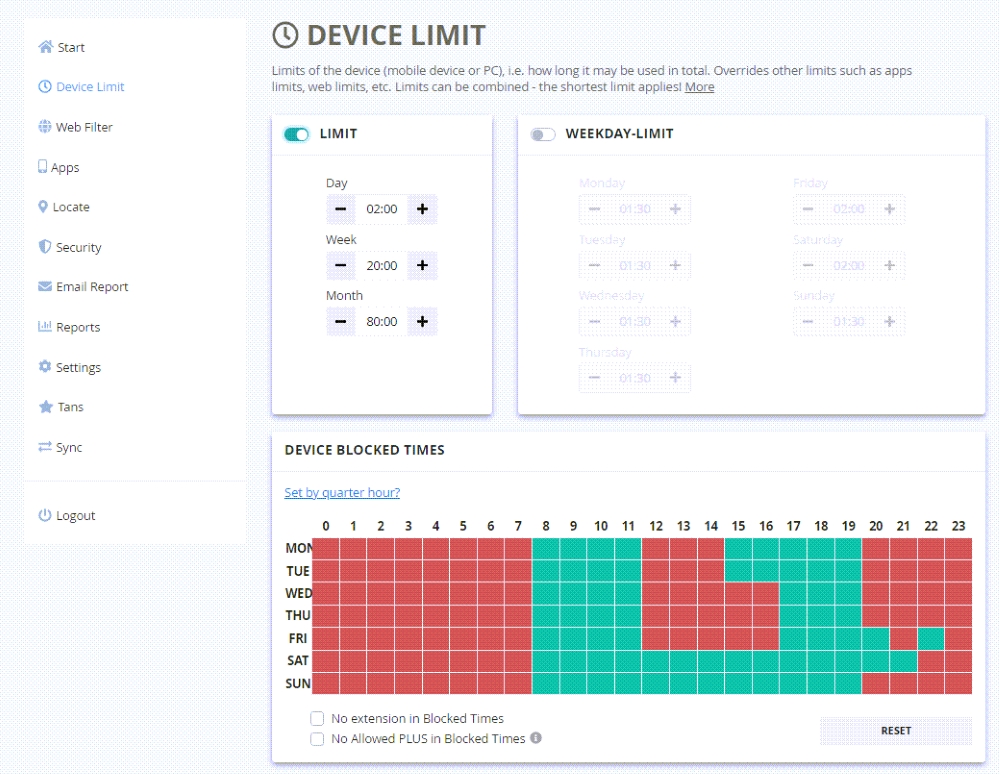
Most parental control apps treat screen time like a binary switch, on or off, allowed or blocked. Salfeld is trying something different. Its tagline for the feature is blunt: “First learn, then play.”

The mechanism is a combination of two tools. Bonus Apps let parents designate educational apps, such as a vocabulary trainer, a math app, or a coding tutorial, that automatically generate extra screen time when used. Ten minutes on a learning app earns twenty minutes of free time. The ratio is up to the parent. Then there are Time Codes, six-digit numbers that parents can hand out manually as rewards for offline tasks, homework done, room cleaned, dog walked. The child enters the code, the bonus time unlocks, and they decide when to spend it.

What makes this interesting is the small shift in agency. Your child is not just having time taken away or given back. They are choosing when to use a vocabulary app to bank minutes for later, or deciding whether cleaning the kitchen is worth an extra half hour of gaming on Saturday. Salfeld’s own site describes it as helping children “feel more responsible for themselves.” That may be an ambitious description for a voucher system, but the underlying dynamic can be meaningful: earning something often feels different from having it rationed.

This will not convince parents who believe screen time should not be a bargaining chip at all. And it will not replace the harder work of actually talking to your kids about their digital habits. But in a market where the default approach is “set a limit, enforce a cutoff, deal with the meltdown,” even a negotiation tool of this kind may fill a gap that many competitors have not prioritized.

Should You Make The Switch?

If you want an AI to alert you every time your kid types a bad word, Salfeld does not do that. It does not attempt to. It sets a timer, stays out of your kid’s messages, bills you once, and assumes your child can learn to manage the rest.

In a market that often profits from telling parents they are not doing enough, that may strike some as risky, while others may view it as one of the more measured product decisions in recent years.

Salfeld’s Child Control software is available at salfeld.com. A 30-day trial is offered for new users. The company is based in Reutlingen, Germany.


The Next Evolution of Enterprise Communication: How VUETELLIGENCE Is Transforming Engagement at Scale Through AI

By: William Jones

As organizations expand across geographies, time zones, and digital ecosystems, the mechanics of communication have grown increasingly complex. What once functioned as simple video meetings now carries the weight of enterprise alignment, global training, investor relations, and large-scale brand engagement. Yet scale has introduced friction. Participation rises, but interaction declines. Information flows, but understanding often fragments.

According to Riva Wilkins, Founder and President of VUETELLIGENCE, collaboration complexity remains one of the barriers to organizational productivity, particularly as distributed workforces expand. Research suggests that fully remote workers are the most likely to be engaged at work. Wilkins believes that employee engagement and comprehension may decline in large virtual forums where interaction is limited. She highlights a widening gap between connectivity and meaningful collaboration.

It is within this environment that VUETELLIGENCE has emerged. VUETELLIGENCE is positioned as an AI-native collaboration platform that combines video conferencing, live streaming, and ongoing engagement tools into a single system designed to help large audiences communicate in a more interactive, organized way. From Wilkins’ perspective, the defining question is not whether people can join a virtual room, but whether they can participate in it meaningfully once attendance grows.

She explains that the company’s origin stemmed from observing how scale often erodes participation rather than enhancing it. “Large digital gatherings tend to become broadcasts rather than conversations,” she says. “We wanted to explore what might happen if technology could potentially restore dialogue, even at scale.” Rather than retrofitting artificial intelligence into legacy communication structures, the platform was architected with AI embedded at its core. From Wilkins’ perspective, that foundational decision shaped everything that followed, from participant engagement to post-event continuity.

According to her, one of the most pressing challenges facing enterprises is the difficulty of maintaining individualized interaction once audience numbers grow. Wilkins notes that the intention was never to replace human interaction, but to scale it. “Technology should amplify human connection, not dilute it,” Wilkins says. “If people feel seen and heard, participation tends to change dramatically.”

She notes that the intention was never to replace human interaction, but to scale it. “Technology should amplify human connection, not dilute it,” she says. “If people feel seen and heard, participation has the potential to change dramatically.”

At a product level, Wilkins explains that the platform’s core capabilities include AI-supported Q&A handling that routes and organizes questions at scale, multilingual translation and transcription intended to reduce language friction, and participant matching designed to connect people based on interests or goals. She also notes that VUETELLIGENCE was built with the expectation that the end of a meeting is often where value may be lost. To address that, she explains asynchronous engagement features that can continue conversations after the event through automated follow-ups, including messaging workflows such as email or SMS, while maintaining contextual continuity.

As investment and development activity across AI collaboration tools accelerates, market analysts continue to point to scalable engagement as a defining frontier in enterprise technology evolution. Wilkins attributes that momentum to a broader shift in how organizations evaluate communication infrastructure. From her perspective, collaboration is no longer just operational; it is strategic. “Communication architecture now influences culture, productivity, and revenue pathways,” she explains. “It sits much closer to the core of business performance than many leaders historically realized.”

Importantly, the founding team’s perspective is not shaped by technology alone. The practical application of VUETELLIGENCE’s capabilities can be seen within DEIJIDESIGN, the fashion and merchandising brand, where the collaboration platform has been deployed in live engagement and product storytelling environments.

This crossover between technology and consumer experience offered an applied testing ground. By integrating intelligent live streaming, audience interaction, and merchandising engagement, the founders were able to observe how AI-orchestrated communication might influence purchasing behavior, brand loyalty, and audience retention.

According to her, the lesson extends beyond fashion. “Any organization presenting ideas, products, or knowledge to large audiences faces the same engagement challenge,” she explains. “The tools used to communicate can shape the outcomes of those interactions.”

As AI continues to reshape enterprise systems, collaboration platforms are increasingly evaluated not only for connectivity but for intelligence, adaptability, and continuity. VUETELLIGENCE’s development trajectory reflects that shift, supported by growing institutional interest in scalable engagement technologies.

For Wilkins, the long-term vision remains anchored in human outcomes rather than technical specifications. She emphasizes that the goal is not to build larger meetings, but more meaningful ones. “Connection is the foundation of progress,” she says. “When communication becomes more intelligent, organizations become more aligned, and people become more empowered within those ecosystems.”

The Unjammable Horizon: How Quantum Navigation is Replacing GPS in Modern Warfare

In the rapidly evolving landscape of electronic combat, the reliance on satellite signals has become a significant strategic liability. As global powers develop increasingly sophisticated methods to disrupt communications, the emergence of advanced quantum navigation provides a reliable and unjammable solution for maintaining situational awareness in contested environments. This breakthrough technology allows military assets to operate with full autonomy, ensuring that mission-critical data remains accurate even when traditional signals are completely severed. By shifting away from external dependencies, modern defense platforms can now achieve a level of operational security that was previously considered impossible.

The Achilles’ Heel of Modern Warfare

For decades, the Global Positioning System (GPS) has been the invisible backbone of military operations. From guiding long-range missiles to synchronizing the movements of ground infantry, GPS provides the precise timing and positioning data required for high-tempo maneuvers. However, this system has a fundamental flaw: it relies on incredibly weak signals transmitted from satellites thousands of miles away. These signals are easily drowned out by relatively low-cost jamming devices or manipulated through “spoofing,” where a false signal tricks a receiver into reporting an incorrect location.

In recent conflicts, GPS interference has moved from a theoretical threat to a standard tactical reality. Electronic warfare units can now create “dark zones” spanning hundreds of miles, rendering standard navigation systems useless. When a drone or a naval vessel loses its GPS lock, it must rely on traditional Inertial Navigation Systems (INS). While INS does not require an external signal, it suffers from “drift,” a phenomenon where small errors in sensor data accumulate over time, leading to significant positional inaccuracies. In a high-stakes combat scenario, a drift of even a few hundred meters can mean the difference between a successful strike and a catastrophic error.

Enter Ironstone Opal: The Quantum Shift

To address these vulnerabilities, defense innovators have looked toward the subatomic world. Quantum sensing offers a way to measure motion with a precision that far exceeds classical mechanical sensors. At the forefront of this revolution is Ironstone Opal, a quantum-enhanced navigation solution designed specifically to overcome the limitations of GPS and traditional INS.

Unlike GPS, which is an “active” system requiring a constant connection to a satellite, quantum navigation is entirely passive. It does not broadcast a signal that can be tracked, nor does it receive a signal that can be jammed. Instead, it functions as a self-contained “black box” that calculates position based on the ultra-precise measurement of atomic properties. By using cold atom interferometry or quantum-enhanced signal processing, systems like Ironstone Opal can detect the tiniest changes in acceleration and rotation.

The Power of Passive Stealth

One of the most significant advantages of quantum navigation in modern warfare is its contribution to stealth. In a “near peer” conflict, emitting any kind of electronic signature is akin to shining a flashlight in a dark room. Active radar and radio communications can be intercepted and used to geolocate a platform.

Because Ironstone Opal is a passive technology, it allows drones, submarines, and stealth aircraft to navigate through enemy territory without leaving an electronic footprint. A naval vessel equipped with this technology can maintain strict radio silence while still knowing its exact coordinates within a fraction of a meter. This “stealth” advantage transforms how deep penetration missions are conducted, allowing assets to slip through integrated air defense systems that rely on detecting electronic emissions.

Breaking the Limits of Accuracy

While traditional INS has been the fallback for GPS denied environments, its performance has historically been the bottleneck for long duration missions. Ironstone Opal represents a generational leap in performance, offering a 50x to 100x improvement in accuracy over conventional inertial sensors.

In practical terms, this means that a long range autonomous underwater vehicle (AUV) can travel for weeks without ever needing to surface for a GPS fix. In the air, a loitering munition or a reconnaissance drone can operate for hours in a jammed environment and still strike its target with surgical precision. This level of accuracy is achieved by reducing the “noise” and “bias” that plague classical accelerometers and gyroscopes. By leveraging quantum states that are inherently stable, the system ensures that the “drift” is kept to an absolute minimum, providing a reliable “truth” source for navigation.

Applications Across the Theater of War

The transition to quantum navigation will have profound effects across all branches of the military.

Naval Superiority: For the navy, the ability to navigate without GPS is vital for submarine warfare. Submarines are most vulnerable when they have to deploy an antenna to the surface to receive satellite signals. Quantum navigation allows these vessels to remain submerged and hidden for much longer periods. Furthermore, surface ships can operate in “GPS denied” regions like the South China Sea or the Baltic without fear of being led off course by spoofing attacks.

Aerial Dominance: Drones have become the defining tool of 21st-century warfare, but they are also the most susceptible to electronic interference. A drone equipped with Ironstone Opal can continue its flight path and complete its mission even if the enemy deploys heavy jamming equipment. This ensures that the investment in high-cost unmanned aerial vehicles (UAVs) is protected from low-cost electronic countermeasures.

Ground Force Resilience: On the ground, quantum sensors can be integrated into armored vehicles and even individual soldier systems. This ensures that coordinated movements and artillery fire remain accurate in environments where the electromagnetic spectrum is heavily contested.

The Future of the Unjammable Horizon

The move toward quantum navigation is not just a tactical upgrade; it is a fundamental shift in how we perceive security and autonomy. As artificial intelligence becomes more integrated into weapon systems, those systems require “trusted data” to function. If the positioning data is compromised, the AI becomes a liability. By providing a hardened, unjammable source of truth, quantum technology acts as the foundation for the next generation of autonomous warfare.

The era of GPS dominance is reaching its twilight in the face of modern electronic warfare. While satellites will always have a role in civilian life and low-intensity conflicts, the high stakes of modern defense require something more robust. Systems like Ironstone Opal are proving that the future of navigation lies not in the stars, but in the precise and silent world of quantum mechanics. By reclaiming the ability to navigate independently of external signals, modern militaries are ensuring that they can operate with confidence, precision, and total stealth on the unjammable horizon.

Consensus Is the Missing Layer in Business AI: How Agreement Turns Outputs into Decisions

AI tools flood boardrooms with confident answers, but a troubling pattern has emerged across industries: 77% of businesses express concern about AI hallucinations, and 47% of enterprise AI users made at least one major decision based on hallucinated content in 2024. The problem isn’t adoption anymore. 88% of organizations report regular AI use in at least one business function, compared with 78 percent a year ago. The real challenge? Trusting a single AI output enough to stake money, reputation, or compliance on it.

Smart teams are discovering a practical shift away from blind faith in isolated models. Instead of asking “Is this AI right?” they’re asking “Do multiple leading AIs agree?” This system-level reliability approach compares outputs from different top models, measures alignment, and treats disagreement as a risk signal worth investigating. When consensus emerges across independent systems, confidence in the output rises dramatically.

Why Can’t We Trust a Single AI Model?

The conventional wisdom around AI adoption assumes one powerful model will handle your needs. Deploy GPT-4, Claude, or Gemini, and you’re covered. But real-world results tell a different story.

Modern AI systems operate probabilistically, not deterministically. They predict the most likely next word or concept based on patterns in training data, which means even the most sophisticated models can confidently deliver fabricated information. In tests, OpenAI’s o3 model hallucinated 51% of the time on simpler factual questions, while error rates in some tests reached as high as 79%.

How Does Multi-Model Agreement Protect You From Errors?

Achieving consensus among AI systems enhances reliability by improving robustness against failure and increasing overall accuracy. When multiple independent models converge on the same answer, you’re seeing signal emerge from statistical noise.

The mechanism works through diversity. Different AI models are trained on varied datasets, use distinct architectures, and apply different internal logic. This means they tend to make uncorrelated errors. When aggregated, these isolated mistakes cancel each other out. A single model might hallucinate a fact. Three models independently arriving at different hallucinations for the same query is statistically unlikely. Three models agreeing on an answer? That’s a reliability signal.

What Happens When AI Models Disagree?

Disagreement isn’t failure. It’s information.

When models diverge on an output, you’ve identified a case where uncertainty is high, context is ambiguous, or the query falls outside reliable training data. This is precisely when human judgment becomes most valuable. Instead of blindly accepting a confident but potentially wrong answer, disagreement triggers escalation to subject matter experts.

Think of it as an automated quality control system. Agreement allows teams to move fast on routine decisions. Disagreement forces a pause where it matters most, protecting organizations from the costly mistakes that erode trust and trigger regulatory scrutiny.

The Consensus Reliability Loop offers a simple framework: Compare outputs across models, score their agreement, flag variance beyond acceptable thresholds, escalate high-stakes decisions showing low consensus, and ship with confidence when alignment is strong.

Why Is Human in the Loop Still Essential?

Consider what happened at a mid-sized pharmaceutical company preparing regulatory filings for European markets. Their compliance team ran technical documents through a popular AI translator. The output looked professional, read fluently, and arrived in seconds. They submitted it. Three weeks later, the regulatory authority flagged inconsistencies in dosage terminology. 

The compliance director couldn’t afford another mistake. She switched to MachineTranslation.com, where the Smart AI Translation compares 22 different models before delivering a result. On the first test run with their next filing, she noticed something different: certain pharmaceutical terms showed variation flags. Four models translated “contraindication” one way, eighteen another. The majority consensus highlighted the standardized term, but the variance signal prompted her team to verify against the European Medicines Agency’s official glossary. They caught a nuance that could have triggered another rejection.

Industry authority Ofer Tirosh, CEO of Tomedes and developer of MachineTranslation.com, built the platform specifically to address failures where single models create costly errors. The system doesn’t just compare outputs from multiple leading translation AIs. It surfaces the agreement signal to users, showing exactly where 22 models aligned and where they didn’t. That pharmaceutical compliance team now trusts their translations not because an AI promised accuracy, but because they can see independent models reaching consensus on critical terminology.

The same principle protects a legal team at an international arbitration firm. Contract translations can’t contain ambiguity. A single word mistranslated in a liability clause could shift millions in obligation. Their paralegal runs every contract through the platform, then reviews the sentences where the model agreement drops below 80%. Most translations sail through with near-perfect consensus. The handful that don’t get escalated to their bilingual attorneys for human verification. The firm hasn’t had a translation-related dispute in eighteen months.

Can Consensus Be Gamed or Manipulated?

Valid concern. If consensus becomes the standard, won’t all models start converging toward the same training approaches, eliminating the diversity that makes agreement meaningful?

The answer lies in maintaining genuine independence across the ensemble. Models must use different architectures, training datasets, and development teams. Diversity in design prevents groupthink at the system level.

Consensus also requires ground truth benchmarks. In translation, this means verified reference texts. In finance, it’s historical transaction data. In healthcare, it’s clinical records. These anchors prevent consensus from drifting into collective hallucination.

Organizations implementing consensus-based workflows should monitor for correlation drift over time. If models start agreeing more often without corresponding improvements in accuracy against verified benchmarks, that’s a signal that independence has eroded.

What Does the Research Say About Voting and Agreement?

One intuitive aggregation mechanism is weighted voting, used in classification tasks. In simple “hard voting” systems, the final decision is the class selected by the majority of individual models. More sophisticated “soft voting” approaches weight each model’s confidence score, giving more influence to predictions where the collective shows highest certainty.

For tasks involving continuous numerical outputs, consensus is achieved through simple averaging. Predictions from all participating models are summed and divided to produce a smoothed forecast. Another technique involves using a “meta-learner,” a separate AI model trained to optimally combine predictions from the initial set of models.

How Will Consensus Shape the Future of Business AI?

88% of organizations anticipate Gen AI budget increases in the next 12 months, with 62% expecting increases of 10% or more. As investment accelerates, the question shifts from “Should we use AI?” to “How do we use it responsibly?”

Consensus provides a practical answer. It acknowledges that AI systems are probabilistic tools, not oracles. It builds reliability through redundancy and diversity rather than hoping one model will be perfect. It creates natural checkpoints where human judgment can intervene before mistakes compound.

This approach aligns with emerging regulatory frameworks. Agencies reviewing AI for fairness often require cross-model consistency checks on demographic subgroups and independent evaluations that must reach a high consensus to certify compliance.

Organizations that adopt consensus-based workflows now will be ahead of the curve as these requirements formalize. They’ll have systems that not only produce better outputs but can demonstrate how reliability is verified, a critical capability as AI moves from experimental to mission-critical.

New York Requires Social Media Warning Labels for Teens, Targeting Addictive Features

New York has passed a new law that requires social media platforms to display warning labels to teenage users, a move state lawmakers say is designed to address growing concerns about addictive features and their potential impact on youth mental health. The measure places New York among a small but expanding group of states taking direct aim at how digital platforms engage minors, shifting the focus from parental controls to mandatory, platform-level disclosures.

The law applies to social media services used by individuals under 18 and is centered on how those platforms are designed, not simply the content they host. Supporters argue that by forcing warnings to appear directly on the screen, the state is making risks harder to ignore and easier for families to discuss.

What The New Law Does

Under the new statute, social media platforms operating in New York must display warning labels to teen users alerting them to potential mental health risks associated with extended use and addictive design features. These warnings are required to appear at specific moments, such as when a minor logs in or after prolonged periods of continuous use.

The intent is to ensure that teens encounter the warning directly, rather than encountering it passively through terms of service or buried settings pages. Lawmakers behind the bill have said the labels are meant to function as a consistent reminder, not a one-time disclosure that users quickly forget.

Which Social Media Features Are Covered

The law focuses on what state officials describe as “addictive features,” a category that includes design elements commonly used to keep users engaged for longer periods of time. These features may include infinite scrolling feeds, autoplaying videos, algorithm-driven content recommendations, persistent notifications, and visible engagement metrics such as likes and streaks.

By targeting features rather than naming specific companies, the legislation applies broadly across platforms that rely on similar engagement mechanics. That approach is intended to keep the law relevant even as individual apps rise or fall in popularity.

Who Designed The Warnings And How They’ll Be Enforced

New York Requires Social Media Warning Labels for Teens, Targeting Addictive Features (2)

Photo Credit: Unsplash.com

Responsibility for shaping the warning labels falls to New York State health authorities, who are tasked with ensuring the language reflects current research on youth mental health and digital behavior. Enforcement authority rests with the state attorney general’s office, which can pursue civil penalties against companies that fail to comply.

Fines can be assessed on a per-violation basis, giving the state leverage to push platforms toward compliance rather than treating the requirement as a symbolic gesture. The enforcement framework signals that the law is designed to be operational, not merely advisory.

Why New York Lawmakers Passed The Measure

Supporters of the law point to rising anxiety, depression, and sleep disruption among teenagers, trends that many researchers and public health officials say are linked, at least in part, to heavy social media use. Lawmakers have argued that while platforms are not the sole cause of mental health challenges, their design choices can amplify harmful patterns of behavior.

By mandating warnings, state officials say they are giving teens and parents clearer information at the moment it matters most, when usage is happening in real time. The law reflects a growing belief among policymakers that voluntary industry standards are insufficient to address the scale of the issue.

How This Law Fits Into New York’s Broader Youth Online Safety Efforts

The warning label requirement is part of a wider effort by New York to regulate how minors experience online platforms. In recent years, the state has explored additional measures aimed at limiting algorithmic exposure and reducing disruptive notifications for younger users.

Taken together, these policies suggest a shift toward treating youth online safety as a public health and consumer protection issue, rather than placing the burden solely on parents or schools. The warning labels add a disclosure-based tool to a regulatory approach that already includes design restrictions and age-based protections.

Criticism And Open Questions Around Effectiveness

Not everyone is convinced that warning labels will lead to meaningful changes in teen behavior. Critics argue that frequent warnings may be ignored over time or that they place too much emphasis on individual responsibility rather than structural reform. Others have raised concerns about potential legal challenges, particularly around compelled speech and how far states can go in dictating platform messaging.

There are also open questions about how teens will respond to the labels in practice. While some researchers believe repeated exposure to warnings can influence habits, others caution that effectiveness may vary widely depending on age, context, and individual vulnerability.

What Happens Next For Platforms And Families

Social media companies operating in New York will need to adjust their interfaces to ensure the required warnings appear for underage users. That could involve changes to login screens, usage timers, or notification systems. Families, meanwhile, may begin noticing new prompts or alerts when teens use certain apps for extended periods.

As implementation begins, state officials are expected to monitor compliance and gather data on how the warnings are received. Whether the labels ultimately change behavior or simply raise awareness, the law marks a clear statement of intent: New York is prepared to play a more active role in shaping how young people experience social media.

The coming months will determine how smoothly the transition unfolds and whether other states follow with similar measures, further reshaping the relationship between teens, technology, and public policy.