Why Data Privacy Remains a Concern in AI Applications

As artificial intelligence becomes more embedded in everyday business operations, the conversation around data privacy in AI applications is growing louder. From predictive analytics to personalized marketing, AI systems rely heavily on user data to function effectively. But the very data that powers these innovations also raises ethical questions, especially in cities like New York where tech adoption is rapid and consumer expectations around privacy are evolving.

The concern isn’t just theoretical. Businesses are increasingly aware that missteps in data handling can erode trust, invite regulatory scrutiny, and damage brand reputation. And while AI offers powerful tools for efficiency and engagement, it also introduces new layers of complexity in how data is collected, stored, and used.

Why AI Applications Challenge Traditional Privacy Norms

Unlike traditional software, AI systems often learn and adapt based on user behavior. That means they’re not just processing data, they’re interpreting it, predicting future actions, and sometimes making decisions without human oversight. This shift has made it harder to define clear boundaries around ethical data use.

In industries like advertising and media, AI-driven personalization is now standard. The shift toward hyper-targeted campaigns has prompted adtech firms in NYC to push the boundaries of consumer outreach. Yet, the line between helpful and invasive remains thin. Consumers may appreciate tailored content, but they’re also increasingly wary of how their data is being tracked and monetized.

This tension is especially pronounced in sectors that rely on behavioral data, location tracking, or biometric inputs. Without transparent policies and robust safeguards, AI applications risk crossing into territory that feels exploitative rather than empowering.

The Role of Data Analysts in Mitigating Risk

Behind every AI system is a team of data professionals tasked with managing the flow of information. Data analysts play a critical role in ensuring that inputs are clean, relevant, and ethically sourced. Their work isn’t just technical, it’s strategic, shaping how businesses interpret consumer behavior and make decisions.

In New York’s major industries, data analysts are increasingly seen as gatekeepers of responsible AI use. Their influence extends beyond dashboards and spreadsheets, as they help shape compliance frameworks and build systems that prioritize transparency. The growing demand for data expertise in NYC’s business sector reflects a broader shift toward ethical oversight and cross-functional collaboration, making these roles essential to any AI-driven strategy.

Why Data Privacy Remains a Concern in AI Applications


Photo Credit: Unsplash.com

More than ever, analysts are being asked to weigh in on privacy-by-design principles, flag potential bias in training datasets, and collaborate with legal teams to ensure that AI outputs meet disclosure standards. Their ability to translate technical nuance into business impact is what makes them indispensable in today’s compliance-conscious climate.

Regulatory Pressure and the Need for Proactive Governance

As AI adoption accelerates, regulators are stepping in to set clearer standards. In the U.S., privacy laws remain fragmented, but states like California and New York are pushing for more comprehensive frameworks. The New York Privacy Act, for example, proposes stricter controls over data collection and usage, with an emphasis on consumer rights and algorithmic transparency.

For businesses deploying AI tools, this means staying ahead of evolving requirements, not just reacting to them. Proactive governance is key. That includes building internal policies that go beyond minimum compliance: auditing algorithms for bias, limiting data retention, and offering users meaningful control over their information.

It also means embedding privacy into every stage of product development. From UX copy to backend architecture, teams must collaborate to ensure that ethical standards are upheld. Privacy can no longer be siloed within legal or IT, it must be a shared responsibility across departments.

Companies that fail to take these steps risk more than fines. They risk losing relevance in a market where consumers are increasingly choosing brands that align with their values. And for founders, that means privacy isn’t just a legal checkbox, it’s a strategic differentiator.

Balancing Utility and Ethics in AI Development

The promise of AI is undeniable. It can streamline operations, uncover insights, and deliver personalized experiences at scale. But those benefits must be weighed against the ethical implications of data use. Businesses need to ask not just “Can we do this?” but “Should we?”

This mindset is gaining traction among developers and strategists who understand that long-term success depends on responsible innovation. It’s not enough to build powerful tools, they must be built with empathy, accountability, and respect for user autonomy.

In New York’s fast-paced business ecosystem, this balance is especially critical. The city’s diverse population, regulatory environment, and competitive landscape demand AI systems that are not only smart but also socially aware.

Looking Ahead: Privacy as a Competitive Advantage

As AI continues to evolve, data privacy will remain a central concern. But for forward-thinking businesses, it’s also an opportunity. Companies that lead with transparency, invest in ethical design, and empower users will stand out in a crowded field.

Privacy isn’t a barrier to innovation, it’s a foundation for trust. And in a world where data is currency, that trust is more valuable than ever.

For founders, this means building privacy into the brand narrative from day one. Whether it’s through clear disclosures, opt-in personalization, or bias-aware algorithms, the goal is to create systems that respect user agency while delivering value. In doing so, businesses not only meet regulatory expectations, they exceed consumer ones.

Why AI Can’t Do Its Thing Without Good Gear

Why AI Can’t Do Its Thing Without Good Gear

When people talk about all the cool stuff Artificial Intelligence (AI) does these days – like figuring out faces, having conversations, or even helping doctors – it’s easy to just focus on the clever computer programs. But honestly, none of that magic would work without some seriously strong computer parts doing the heavy lifting. One can think of it this way: AI is the smart thinking part, but the hardware is the engine that makes everything actually go.

At its heart, AI, especially the super smart stuff like “deep learning” (that’s teaching computers to learn from massive piles of data) and those big language models, needs a crazy amount of raw computing muscle. This means billions, even trillions, of calculations happening super-fast. These are things like complex math problems – multiplying huge sets of numbers and doing special kinds of data processing – all to make sense of a ton of information. And for that, just any old computer chip won’t cut it. A regular computer has something called a CPU, or Central Processing Unit. It’s awesome for doing lots of different tasks one by one, like running apps or Browse the internet. But for AI, where thousands of calculations need to happen at the exact same time, a CPU isn’t really built for that kind of teamwork. Trying to train a complex AI model only with a CPU would be painfully slow – think weeks or even months for something that needs to be done way faster. So, for AI to really kick into gear, special computer parts designed to do many things all at once, super quick and smoothly, are essential.

How GPUs Became AI’s Superstars

Why AI Can't Do Its Thing Without Good Gear

Photo Credit: Unsplash.com

Here’s a fun fact: one of the biggest game-changers for AI actually came from something made for video games. Yes, it’s the Graphics Processing Unit, or GPU. GPUs were first designed to make game graphics look awesome. To do that, they have to do a ton of similar calculations all at the same time for every single pixel on a screen. Turns out, this exact ability – doing many things in parallel – is perfect for what AI needs. Teaching those “neural networks” (the brain-like structures AI uses to learn) means tweaking billions of tiny settings. And that means a huge number of parallel math problems. GPUs are simply brilliant at this kind of work.

This special power of GPUs has totally changed how fast AI models can learn. What used to take ages on a regular CPU, like weeks or even months, can now be finished in just hours or days with a strong GPU. This huge speed boost means AI researchers can try out much more complex ideas, use even bigger piles of data, and fine-tune their AI models much quicker. And it’s not just for teaching AI. GPUs are also used when an AI model is already trained and needs to do its job, like recognizing something in a photo or responding to a question right away. Their speed and efficiency make them vital for putting AI into everything, from self-driving cars to the AI services many use online every day.

Meet the AI Experts: TPUs and Other Custom Chips

As AI got even smarter and models became even bigger, the need for super specialized computer parts grew even beyond what regular GPUs could handle perfectly. This led to the creation of things called ASICs (that’s “Application-Specific Integrated Circuits”). These are custom-built chips designed to do one very specific job incredibly well.

A famous example of an ASIC made just for AI is Google’s Tensor Processing Unit, or TPU. Unlike GPUs, which are still kind of all-rounders, TPUs are built specifically for the exact kind of math that deep learning networks do – especially something called “tensor operations” (which is just a fancy way of saying working with big grids of numbers). TPUs and other AI ASICs get their speed because they’re designed perfectly for AI math. They can do those number-crunching jobs with fewer steps and use less power than more general chips. So, while GPUs are awesome for the really heavy training of AI models, ASICs like TPUs often shine when it comes to “inference” – that’s when a trained AI model is put to work to make predictions in the real world. Their optimized design makes them super fast and power-efficient, which is perfect for putting AI into smaller gadgets or in huge data centers that run lots of AI stuff. These custom chips are truly pushing the boundaries of what AI hardware can do.

The AI-Hardware Dream Team: How They Grow Together

Why AI Can't Do Its Thing Without Good Gear

Photo Credit: Unsplash.com

The relationship between computer parts and AI is like a perfect team-up, where each one helps the other get better and better. This constant back-and-forth makes the whole AI field leap forward. As AI software gets smarter and needs to handle more tricky tasks, it always demands more and more power from the computer parts. This constant need pushes the companies that make computer chips to invent new and better designs – faster, more energy-saving, and more specialized chips.

In return, when new, more powerful hardware comes out, it opens up new doors for AI. Researchers can then build even bigger and more complicated AI models that they couldn’t even run before. This means AI can start tackling harder problems, chew through even bigger piles of data, and do things that might not have been imagined. And it’s not just about the main processors. Super-fast memory (like the RAM in a computer) and quick storage (like solid-state drives) are also super important, because AI models need to grab and process huge amounts of data really, really fast without anything slowing them down. This never-ending cycle of innovation between AI and hardware is what’s making the whole field so exciting and grow so quickly. Without strong computer parts giving AI the muscle, many of the amazing AI breakthroughs seen today just wouldn’t be happening.

IMPAC3T IP Licensing 5-Stage Framework for Intangible-Asset Governance

By: Julia Kent

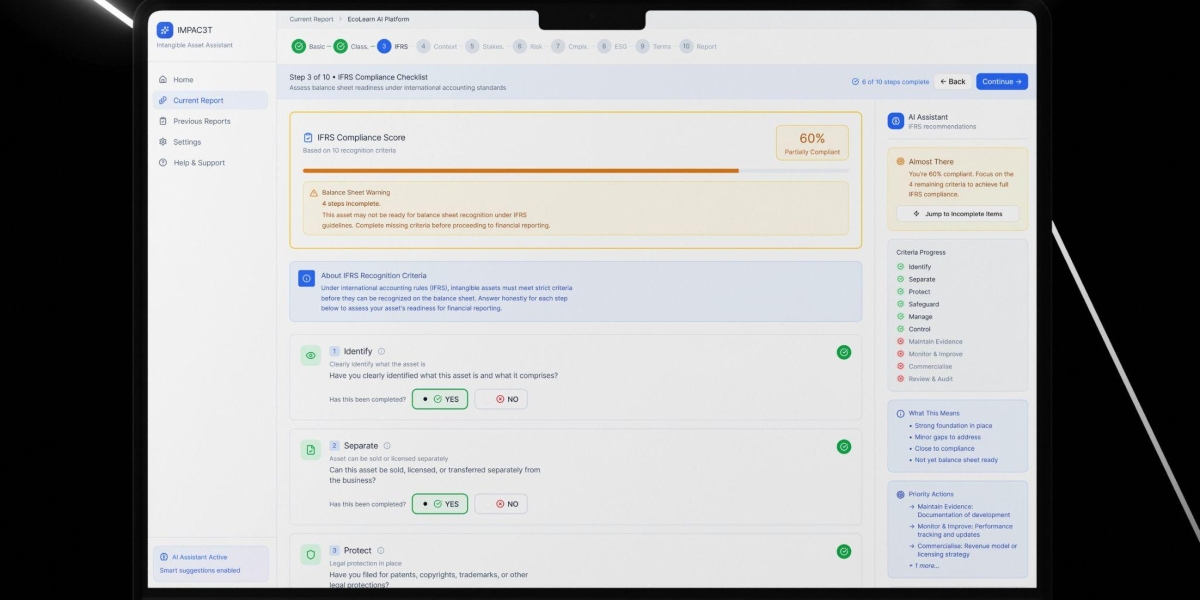
The IMPAC3T Intangible Asset Assistant is a standards-aligned governance framework designed to help enterprises, universities, and nonprofits identify, assess, and responsibly license intellectual property and ESG-linked intangible assets. While drawing conceptual inspiration from publicly available materials of the EU-funded IMPAC3T-IP initiative, all interface design, AI decision logic, and implementation work for this project is being developed independently by Yunyun (Beatrice) Zhou (lead designer and system architect) and David Parham (enterprise AI product leader). The team hopes to apply for a grant to support future prototype evaluation with mission-driven partners as the project progresses.

Market Context

A growing share of institutional value in the United States now resides in intangibles—methods, datasets, software components, curricula, brand systems, and programmatic know-how. Yet the tooling landscape has remained fragmented. Search utilities operate separately from legal drafting; spreadsheets often stand in for structured governance; and licensing trackers rarely capture eligibility, rights, or mission constraints. What organizations appear to lack is not another point solution, but a coherent, auditable decision pathway that links recognition, valuation, and licensing within a unified governance logic. The absence of such a pathway can slow disclosure, weaken comparability across departments and counterparties, and limit knowledge assets from being fully leveraged for technology transfer, partnerships, and mission-aligned growth.

Concept Overview

IMPAC3T introduces a structured, five-stage approach to intangible-asset governance, guiding institutions from the recognition of knowledge assets through to responsible licensing and disclosure. The framework adapts commonly recognized principles of intellectual-property management into a coherent, auditable decision process that links identification, protection, valuation, and fair use within a single governance logic. By aligning its methodology with established international standards and good-practice principles, IMPAC3T aims to promote transparency, comparability, and accountability across sectors. The goal is not to automate complex judgments but to help organizations prepare consistent evidence, document decisions, and support that intangible assets are stewarded in ways that align with both institutional integrity and public trust.

Leadership & Division of Work

Yunyun Zhou leads the design and system architecture of IMPAC3T, shaping how complex governance and valuation principles are translated into accessible, user-centered experiences. Drawing on her record of building AI-assisted, compliance-ready workflows in enterprise and civic-tech settings, she transforms intricate standards and regulatory logic into clear, reviewable steps that guide institutions through intangible-asset governance with confidence. Her design leadership anchors the project’s usability, helping ensure that rigorous decision frameworks can be understood and applied effectively by diverse teams, including counsel, auditors, funders, and boards, who rely on transparent and consistent evidence preparation.

David Parham provides strategic guidance on market relevance and domain alignment. He ensures that the framework’s logic and design stay aligned with prevailing commercialization practices and sector needs, supporting adoption across SMEs, universities, and nonprofits. His perspective helps bridge institutional governance with external engagement, reinforcing the framework’s practical applicability.

Intended Users & Use Cases

For SMEs and startups, IMPAC3T could help shorten the distance from “we think we have something valuable” to “we can demonstrate it,” enabling teams to build defensible narratives that support financing, partnerships, and strategic growth. For universities and knowledge-transfer offices, the framework provides a way to standardize how research outputs, educational content, and brand assets progress from early development to license-ready form, improving comparability across departments and reducing reliance on ad-hoc processes. For nonprofits, it can enable purpose-driven, non-commercial licensing that safeguards mission and reputation while clarifying program value for funders and stakeholders.

Interoperability and Implementation Considerations

Because institutional systems and cultures vary, IMPAC3T is designed to be implementation-agnostic. Organizations can apply their governance logic using existing tools and repositories today and, where beneficial, extend that logic through dedicated software in the future. Successful adoption relies on aligning current policies with the framework’s structure, assigning clear custodianship for decisions, and maintaining a regular cadence for review as assets, markets, and regulations evolve. Above all, effective change management—through executive sponsorship, stewardship, and focused training—is key to turning governance design into daily practice.

Relevance to the U.S. Landscape

From an industry perspective, IMPAC3T responds to a growing governance gap with potential implications for U.S. competitiveness and public trust. Institutions increasingly need reliable, standards-informed processes that help staff convert scattered knowledge into transparent stewardship and responsible knowledge transfer. By translating complex international principles into clear, reviewable frameworks that integrate human oversight and accountability, IMPAC3T offers a practical pathway to faster, more consistent decision-making in universities; safer and purpose-aligned licensing in nonprofits; and stronger demonstration of intangible value for capital formation and strategic partnerships in SMEs. The common thread—comparability, accountability, and mission fit—reflects national priorities around innovation, efficient deployment of social capital, and restoring confidence in institutions.

Outlook

IMPAC3T represents a practical step toward more transparent and accountable management of intangible assets across institutions. By combining design discipline with standards-informed governance, the project aims to help organizations transform scattered knowledge into clearer, more defensible outcomes. As development progresses, the team plans to apply for grant support to evaluate the prototype with mission-driven partners and further demonstrate its potential value for both U.S. and European institutions.

How Jaltest ISOBUS Boosts Efficiency Without New Equipment

Upgrading to precision agriculture doesn’t have to mean buying an entirely new fleet of machines. Many farms already have reliable tractors and implements – the real challenge is getting them to work together efficiently. Jaltest ISOBUS offers an innovative, cost-effective solution by making your existing equipment compatible with modern digital standards. It brings advanced functionality and automation to older machines without requiring replacement.

In this article, we’ll look at how Jaltest ISOBUS fieldbee.com/products/isobus enhances the performance of your current equipment – helping you save time, reduce waste, and increase productivity with the tools you already own.

Unlocks Automation for Older Implements

Many older implements lack built-in automation, but Jaltest ISOBUS enables them to meet modern standards. Acting as a communication bridge between tractor and implement, it allows features such as section control and variable rate application. Tools can now respond to GPS data in real time – turning sections on or off, adjusting rates, and executing tasks more precisely. This allows you to extend the life of your current equipment while gaining the benefits of smart farming. It’s a practical upgrade that delivers results without replacing your machinery.

Unifies Mixed-Brand Equipment

Farms often operate a mix of machinery from different manufacturers, each with its own software, connectors, and control systems. Jaltest ISOBUS eliminates these compatibility issues by standardizing communication across brands. Once connected, all implements are controlled through a single interface, simplifying operations and reducing time spent switching between control systems. This unified workflow increases efficiency and better uses the equipment you already have.

Adds Precision Without Hardware Overhaul

Precision farming usually implies high-tech equipment – but with Jaltest ISOBUS, you don’t need a complete hardware upgrade to achieve precise results. The system connects seamlessly with FieldBee’s GPS and RTK guidance, enabling your existing implements to follow precise paths, apply exact rates, and avoid overlap. Instead of replacing tools, you’re simply upgrading their performance, making it a more innovative and more affordable path to precision. Precision farming with Jaltest ISOBUS doesn’t just enhance your equipment’s capabilities; it also ensures better resource management, reducing waste and improving overall efficiency. By integrating with advanced systems like FieldBee’s GPS and RTK guidance, you’re unlocking the full potential of your machinery while keeping costs under control, making the upgrade both practical and cost-effective.

Reduces Operator Workload

Jaltest ISOBUS simplifies machine control by automating repetitive tasks and consolidating all commands into a single, clear interface. Operators no longer need to manually switch implement sections, adjust rates, or navigate between multiple screens. This reduces fatigue, increases concentration, and helps maintain consistent performance during long working hours. It also makes it easier to train new staff, as they can control complex machines with less effort and lower risk of error. Additionally, the streamlined interface allows operators to monitor real-time data, enabling quicker decision-making and adjustments on the fly. This level of control leads to improved operational efficiency, maximizing both output and equipment longevity.

Enhances Control with a Single Interface

Operating older or mixed-brand equipment often means dealing with multiple displays, switches, and confusing control systems – which slows down workflow and increases the chance of mistakes. Jaltest ISOBUS solves this by consolidating all implement functions into a single, modern interface, typically on the FieldBee tablet. Operators can easily manage section control, adjust application rates, monitor performance, and respond to alerts – all from one screen. This not only simplifies the in-cab experience but also helps ensure consistent, high-quality results, even during long or complex field operations.

The intuitive interface design reduces the learning curve for new operators, enabling them to get up to speed quickly and perform tasks with confidence. By seamlessly integrating with existing machinery, it eliminates the need for costly hardware replacements, offering a cost-effective way to improve precision. With all critical information displayed in one place, operators can focus more on the task at hand, reducing distractions and minimizing the risk of operational errors.

Building Intelligent Commerce Systems: A Conversation with Researcher Xiaofei Han

By: Jessie Epstein

Q: Your research spans multimodal retrieval, AI-driven market segmentation, and attention-based sales forecasting. What connects these three directions?

Han: All three studies focus on how intelligent algorithms can improve decision-making in e-commerce systems. Although the applications differ, the core motivation remains the same: user behavior has become more complex, product information is increasingly multimodal, and market competition demands more accurate predictions. These papers examine how to use advanced machine learning to understand users, interpret content, and forecast demand.

Q: Let us start with your paper on multimodal retrieval. What challenge were you addressing in “Research on Multimodal Retrieval System of E-commerce Platform Based on Pre-training Model”?

Han: E-commerce platforms often rely on keyword-based retrieval, which does not fully capture the richness of product information. Images, text descriptions, user reviews, and attributes all carry meaning. My study looked at how pre-trained models can integrate these inputs into a unified embedding space. The goal was to improve retrieval accuracy by allowing the system to understand the alignment between visual content and language. This is especially important when users search with incomplete or ambiguous terms.

Q: What were the key innovations in your multimodal approach?

Han: The study introduced a retrieval architecture that uses pre-trained vision language models to extract semantic features across modalities. It also explored feature alignment strategies to ensure that text and image embeddings remain consistent. Compared with single modality baselines, the multimodal system produced more accurate matching, especially on long tail or visually complex products. This showed the value of using pretrained knowledge to enhance retrieval robustness.

Q: Moving to your second paper on AI-driven market segmentation and sequential recommendation, what inspired this research direction?

Han: E-commerce user behavior is no longer linear. A consumer may browse repeatedly, compare prices, add items to the cart, abandon them, and return days later. Traditional recommendation methods often treat these behaviors separately. The study aimed to unify market segmentation and sequential recommendation by modeling how behaviors evolve. Understanding behavioral transitions is key to predicting future actions and designing more personalized user experiences.

Q: How does your research connect segmentation with recommendations?

Han: Segmentation provides the “who,” while recommendation provides the “what” and “when.”

In the paper, I explored how integrating these two processes allows platforms to treat each consumer not as a static profile but as someone whose intentions evolve over time. When segmentation and recommendation inform each other, marketing becomes more adaptive. For example, a user showing early signs of switching interest may receive discovery-based recommendations, while a high-intent buyer may see complementary or urgency-based suggestions.

Q: How did you validate the performance of this recommendation framework?

Han: The experiments used real-world datasets containing multiple user actions. We compared the system with strong baselines on metrics such as accuracy and hit rate. The results consistently showed improvements. These gains indicate that integrating segmentation with sequential modeling can create more realistic user representations.

Q: Your third paper examines sales volume and price forecasting. How does forecasting support marketing strategy?

Han: Forecasting helps marketers make informed decisions about campaigns, inventory planning, and pricing windows. If a platform can anticipate demand shifts, it can time promotions more effectively, avoid overstock or stockouts, and respond to seasonality with greater precision.

My research looked at how patterns in historical sales can help marketers identify rising items, price-sensitive products, or categories where demand is unstable. This supports both tactical decisions and long-term planning.

Q: What practical marketing insights can e-commerce brands draw from your findings?

Han: There are several. First, multi-step behavior should be monitored holistically. A repeated “add to cart then remove” pattern signals a very different intent from a casual browser. Second, personalized messaging can be triggered by behavioral transitions rather than static labels. Third, understanding behavior sequences allows brands to design smarter funnels, such as knowing when to introduce incentives, reminders, or alternative products.

These strategies improve customer experience while reducing marketing waste.

Q: Across your three studies, what best represents your research capability in the marketing domain?

Han: I focus on identifying real marketing challenges and designing analytical methods that make those challenges visible and solvable. Whether the topic is product discovery, personalization, or forecasting, the goal is to link data-driven intelligence with consumer psychology, business goals, and operational constraints. I also emphasize rigorous validation with real-world datasets, which helps ensure that the insights can scale in commercial environments.


Disclaimer: The information provided in this article is for general knowledge purposes only. It does not constitute legal, business, or professional advice. While efforts have been made to ensure the accuracy of the information, the details shared are based on publicly available sources as of the date of publication. For specific legal or business matters, consulting a qualified professional is recommended.

What’s Behind JetBlue’s Quality Concerns and Flight Delays

What Sparked the JetBlue Quality Concern

The tension around JetBlue started after reports linked several Airbus A320 and A321 aircraft to manufacturing defects. These planes form the backbone of JetBlue’s fleet. When even a small number of jets face inspection or repair, the ripple effects reach scheduling, staffing, and customer confidence. The issue involved metal panels located near the front of some aircraft. These parts were built thinner than required standards, triggering mandatory checks before planes could remain in service.

For travelers, the news sounded technical and distant at first. Most passengers only know that safety checks happen constantly. When headlines mention fuselage panels or inspections, it can feel abstract. The reality is simpler. Aircraft parts must meet strict thickness and strength measurements. When parts fall outside these safe ranges, the plane is pulled from service until repairs take place. Even a few affected planes matter because airlines schedule fleets with tight margins.

JetBlue felt the impact fast because it relies heavily on Airbus models using similar components. If ten or fifteen planes pause service, thousands of seats disappear from the daily schedule. That means rebooking passengers, shifting crews, and trimming less busy routes temporarily. None of it means planes are unsafe to fly. It does mean checks slow down operations, which passengers felt through delays and last minute cancellations.

How Aircraft Inspections Affect Daily Flight Schedules

An inspection cycle isn’t quick. Specialists examine the aircraft panels using measuring tools and imaging systems. If thickness or fitting looks questionable, the plane stays grounded until replacements arrive and pass follow up checks. That repair cycle can take days or weeks depending on parts availability. Airlines can’t rush the process.

What's Behind JetBlue's Quality Concerns and Flight Delays

Photo Credit: Unsplash.com

For JetBlue, these inspections meant pulling planes from regular rotation. Schedules are built months ahead with little spare capacity. When flights lose assigned aircraft, planners shuffle routes or merge departures. A full flight might become two half full flights combined into one. A delayed inbound plane might push back multiple departures connected to that rotation. Passengers checking airport boards see the outcome but rarely the cause behind it.

At the customer level, the disruption looks uneven. One traveler might take off on time while someone at the next gate hears about a two hour delay. That randomness comes from which routes lost usable aircraft during that day’s inspections. No single location experiences a constant stoppage. Instead, disruptions scatter across the system in unpredictable patterns, which makes the situation feel chaotic even when it’s guided by safety planning.

Why Software Fixes Also Entered the Picture

The quality concern didn’t happen in isolation. Earlier, Airbus issued a required software update tied to a rare flight control issue triggered by cosmic radiation exposure at cruising altitude. This is an example of what engineers call bit flips. High energy particles pass through onboard computers and flip data bits. That abnormal event can confuse software unless protections are built to correct it automatically.

The update was preventative. Airlines installed the fix across fleets to strengthen flight control reliability. JetBlue completed those updates and returned most aircraft to normal operation. Still, the software work tied up maintenance crews and space in already full hangars. That overlap mattered because fuselage inspections demanded the same resources at the same time.

To passengers, these layers blend together. It may appear that airlines face a constant wave of new technical issues. In reality, aviation safety systems flag even minor concerns long before they pose real risk. Fixing them overlaps into maintenance schedules and slows flight availability even when safety margins remain solid.

Why JetBlue Felt Activity Bottlenecks

JetBlue’s operations depend on fast aircraft turnarounds and efficient maintenance scheduling. When aircraft checks lengthen or replacements require new parts shipments, bottlenecks appear. Crews work around the clock but can’t move faster than safety rules allow. When several jets queue for similar inspections, idle space grows behind the scenes while travelers wait at the gate.

What's Behind JetBlue's Quality Concerns and Flight Delays (3)

Photo Credit: Unsplash.com

Another factor is spare aircraft availability. Larger airlines maintain broader fleets across several aircraft families. JetBlue’s narrow focus on Airbus means fewer alternative aircraft types can be slotted into missing routes. If one jet is unavailable, there isn’t a smaller or older replacement sitting nearby. That makes fleet flexibility lower, intensifying the impact of each grounded plane.

Staffing also comes into play. Maintenance technicians are already stretched across routine checks, engine inspections, and cabin refurbishments. Adding sudden quality focused inspections puts new strain on schedules. Crews remain experienced and qualified, but they can’t be multiplied overnight. That staffing load lengthens inspection cycles and magnifies flight delays.

What Passengers Experience During These Disruptions

Most travelers don’t notice anything until departure day. A flight might be canceled hours before boarding as aircraft assignment changes. Rebooking follows quickly but seats may already be full, forcing delays or reroutes. Vacation schedules slip. Business trips compress into same day returns. Stress rises even though the root cause remains invisible.

Airport staff often deal with passenger frustration even though the issue isn’t frontline service quality. Gate agents handle crowded waiting areas while phone support tackles rerouting calls. For customers, kindness or irritation depends on personal circumstances, but the emotion doesn’t change the mechanics behind delays.

Flight reliability also takes a subtle hit. Airlines build time padding into schedules to absorb hiccups. When aircraft availability shrinks suddenly, that buffer disappears. Small delays propagate faster, especially in busy airports. The experience may feel messy even though daily safety standards remain intact.

How Safety Controls Reassure Travelers

The aviation safety system is designed for over caution. Airlines don’t wait for problems to show visible symptoms. They investigate based on early measurements and compliance data. When parts fall short of specification, planes don’t fly until cleared. That conservative standard means grounded jets represent prevention, not failure.

Federal oversight adds another layer. The Federal Aviation Administration monitors inspection procedures and approves repair methods. Airlines must document each aircraft repair before it can return to service. Skipping or rushing steps isn’t legally possible, even when schedules tighten.

For travelers anxious about safety, the situation actually demonstrates the system functioning as designed. Issues were detected while theoretical rather than operational. Flights that depart are flying after full inspection clearance. Delays aren’t signs of danger. They’re signs of caution.

How Airlines Manage Repair Backlogs

During inspection surges, airlines spread repairs across external vendors and factory backed facilities. Aircraft rotate through different service hubs to distribute workload. JetBlue uses a combination of in house and contracted maintenance bases to keep progress steady even during high demand.

Replacement parts move through logistics pipelines monitored by both manufacturers and airlines. Panel repairs require precise matching of aircraft specifications and serial numbers. That specificity adds complexity. While parts aren’t rare, matching deliveries to each grounded aircraft takes time.

Parallel scheduling helps recover operations faster. While one aircraft undergoes fuselage checks, another finishes its software update or finishes a major engine inspection. The goal is to maximize turnover rather than wait for issues to resolve sequentially. Even so, backlog clearance unfolds over weeks rather than days.

What Stability Looks Like Going Forward

As inspection waves taper off and software updates complete, fleet availability rises progressively. Rather than a sudden full recovery, airlines experience a slow return of spare capacity which stabilizes schedules. Passengers see fewer surprise cancellations and tighter adherence to departure times.

The broader airline system benefits too. Shared suppliers and maintenance bases regain normal flows, reducing ticket rebooking strain across partner carriers. Airports also regain gate scheduling balance, removing stacked departure waves that previously amplified crowd congestion.

For JetBlue, stability doesn’t hinge on public confidence alone. It comes from internal scheduling balance. Each aircraft returning to service restores redundancy that softens future disruptions from weather or mechanical repairs. That redundancy is key to maintaining dependable operations without overworking crews.

How Travelers Can Interpret the Experience

Delays tied to quality inspections are frustrating but informative. They show safety is actively prioritized despite scheduling discomfort. Travelers aren’t exposed to risk escalation during inspection cycles. Planes don’t fly until technicians verify compliance.

Understanding the cause helps reduce emotional strain. There’s a difference between weather chaos and grounding for inspections. The latter reflects forethought. Even though service interruptions remain inconvenient, the underlying trigger carries reassurance rather than concern.

The JetBlue situation serves as a reminder that modern aviation runs on tight planning margins. Temporary disruptions don’t reflect systemic danger. They reflect preventative maintenance catching small variances before they matter. Passengers can reasonably expect schedules to normalize as each aircraft clears inspection, restoring the network to its usual stability over time.

The Rise of Athlete-Creator Platforms: Why the Next Big Tech Boom Is Coming from Sports with Player ID

For more than a decade, the creator economy has been defined by lifestyle influencers, gamers, beauty channels, travel vloggers, and entertainment-driven short-form content. Billions of dollars in venture capital and platform incentives have flowed into those verticals, shaping the way creativity spreads and monetizes online.

But a new wave is forming—one that isn’t emerging from fashion, gaming, or entertainment. It’s coming from a group historically overlooked in digital media: athletes.

What began as highlight clips on TikTok and Instagram has evolved into a full-blown movement. Athletes at every level—youth, high school, college, semi-pro, and aspiring professionals—are building audiences, controlling their narratives, and shaping their brands with increasing sophistication, similar to mainstream creators. The modern athlete is no longer just a competitor. They are a growing media channel.

This shift is giving rise to something distinct: athlete-creator platforms, purpose-built technologies designed around performance, storytelling, and identity. And they are quickly becoming one of the most compelling emerging categories in consumer tech.

Why the Athlete Creator Wave Is Emerging Now

The timing is not random. A series of cultural, technological, and economic changes have collided to make this moment seemingly inevitable.

Athletes today grow up documenting everything. Parents record youth games. Teams post social content. Recruiting increasingly relies on highlight reels. NIL deals have changed college players into entrepreneurial brands. Pro athletes now depend as much on off-field visibility as on-field performance.

Meanwhile, mobile technology has lowered the barrier to high-quality content creation. But while creativity became easier, sports media didn’t evolve at the same pace. Athletes were left using tools designed for trends, dances, and lifestyle content—while trying to showcase fast-action plays, game moments, and complex motion.

This gap between what athletes need and what traditional editing apps offer is likely fueling the rise of sports-native platforms.

Athletes don’t need transitions or filters. They need clarity, tracking, enhancement, spotlighting, and context. They need to stand out in crowded frames. They need tools that understand movement—not choreography.

Traditional creator apps were never built to address these realities. Sports-focused platforms are finally beginning to close that gap.

The Athlete Creator Stack Is Emerging

The rise of athlete-creator platforms isn’t just about video editing. It’s about building a digital identity. As athletes grow their visibility, they’re assembling what increasingly resembles a “creator stack”—but specialized for sports.

At the foundation is a home base, often a clean digital profile or athlete page, where highlights, stats, teams, and images are organized. The next layer is a mobile-first editing tool capable of enhancing raw gameplay into something clearer and more compelling. Above that sits social distribution, where athletes share content to reach recruiters, fans, and communities. And finally, AI-powered guidance helps determine what to post, how to present it, and how to build consistency over time.

Platforms in this space are beginning to integrate these layers into a single ecosystem. Instead of juggling five different apps and workflows, athletes can now create, refine, store, publish, and grow from one environment.

One of the companies leading this shift is Player ID, a sports-tech brand building tools designed specifically for athletes. The platform provides a home base for performance, a next-generation editing workflow built for athletic motion, and a modern approach to personal branding—all in one place. The brand’s mission is centered on enabling athletes to tell their story with clarity and professionalism, and its product experience reflects that vision.

Why Traditional Editing Tools Finally Hit Their Ceiling

Creators in lifestyle or entertainment categories can thrive using traditional apps—but athletes quickly encounter limitations. Fast-paced gameplay doesn’t translate well into filters, templates, or transitions. A three-second moment of skill can be missed entirely if the viewer can’t locate the athlete, follow the motion, or understand what happened.

This is where sports-centric tools shine.

They incorporate AI that can lock onto a player, automatically crop the frame, track movement across the ice, field, or court, stabilize shaky sideline footage, and bring critical moments forward with clarity. Instead of spending significant time searching through footage, athletes can generate polished highlights in seconds.

These systems aren’t designed for viral dances—they’re designed for performance moments, the currency of sports storytelling.

As this category matures, the workflow is evolving from “editing” into something closer to “automated highlight engineering.”

Platforms like Player ID have leaned into this shift, combining AI editing, athlete tracking, profile management, and personal branding into a unified platform built around sports rather than general entertainment.

The Market Indicators Are Clear

Sports and technology have mixed before, but rarely at the consumer level. What’s happening now is different. This time, the demand is coming from the athletes themselves.

Youth sports participation remains massive. College athletes are navigating NIL opportunities. High-school players increasingly rely on visibility for recruitment. Pro athletes are building lifestyle brands that require consistent content. And globally, the appetite for sports clips on social platforms is continuing to skyrocket.

This is a perfect storm for new tech entrants:

  • The audience is built-in.

  • The content is evergreen.

  • The motivation is universal: improve visibility.

  • The tech gap is wide open.

Where lifestyle creators had dozens of platforms built for them, athletes, until recently, had none. That imbalance is now being addressed.

The Future of Athlete-Creator Technology

Looking ahead, athlete-creator platforms are likely to expand far beyond editing. AI will soon detect standout plays automatically, turning entire games into instant highlight packs. Wearables may eventually integrate performance metrics directly into reels. Athlete profiles could evolve into dynamic, data-driven resumes. Personalized recommendations may guide athletes on when to post, what to post, and how to improve their storytelling strategy.

The concept of the “athlete brand” is moving from elite professionals to everyday competitors. And as platforms innovate around this movement, the next big wave of consumer sports technology will likely come not from big broadcast networks or professional leagues—but directly from athletes themselves.

This is where platforms like Player ID, which already incorporate AI editing, athlete-centric profile tools, and a streamlined creation workflow, begin to show the future of what this market can become.

Final Thoughts

For years, the creator economy has celebrated influencers, gamers, vloggers, and entertainers. But a new category is rapidly emerging—one rooted in performance, identity, and opportunity. Athletes are becoming creators not because they want to chase trends, but because the modern sports landscape demands visibility, clarity, and storytelling.

The platforms rising to support them are not simply tools. They are engines of empowerment, reshaping how athletes present themselves to the world. As more competitors join the movement, the athlete-creator space could be the next major frontier in consumer technology—and the next big opportunity for brands, investors, and innovators.

The shift has already begun. The next generation of sports creators is here.

Rokid Black Friday Offers on AR Glasses and Spatial Computing Bundles

Rokid has rolled out some of its Black Friday pricing on AR glasses and spatial computing bundles. Whether you’re shopping for travel entertainment, productivity upgrades, or an affordable entry into AR, these standout deals offer excellent value. Here are the picks from this year’s sale.

Rokid Max — $150 (58% off)

Rokid Black Friday Offers on AR Glasses and Spatial Computing Bundles

Photo Courtesy: Rokid

Buy here: Rokid Max

The Rokid Max delivers an immersive portable cinema experience you can buy at this price. At just 75 grams, these AR glasses project a 215-inch virtual screen, powered by dual 120Hz micro-OLED displays with crisp clarity and vivid color. Built-in myopia adjustment makes them comfortable for nearly anyone.

Suitable for: travelers, commuters, gamers, and Netflix binge-watchers.

This highly discounted Rokid Max represents outstanding value for people who want private, high-resolution viewing on the go. Its lightweight design and long battery life make it ideal for long flights and daily commutes, and the wide compatibility with smartphones, streaming sticks, and gaming consoles means you can build a portable entertainment kit without extra adapters. Customers often highlight the easy setup and the large virtual screen that feels far bigger than the device size, which is why it’s a pick for seasonal buyers.

Rokid Max 2 — $343.20 (35% off)

Buy here: Rokid Max 2

Rokid Max 2 takes everything great about the original and elevates it — sharper edges, richer colors, a sleeker frame, and support for a giant 300-inch display when paired with Station 2. Still ultra-light, still incredibly comfortable, but with noticeably improved visuals.

Suitable for: early adopters, premium shoppers, and anyone who wants the sharpest AR experience.

With the Max 2’s improved display tuning and ergonomic enhancements, users see clearer text, deeper blacks, and a more immersive field of view that benefits both media watching and productivity tasks. The visual upgrades make it particularly suited for mobile gamers and content creators who need accurate color reproduction, and the refined fit reduces fatigue during extended sessions. For shoppers comparing mid-range AR glasses, Max 2’s balance of performance and portability under this Black Friday price is compelling.

Rokid AR Spatial — $499 (29% off)

Buy here: Rokid AR Spatial

This bundle includes Max 2 glasses plus the Station 2 computing unit, turning your AR glasses into a portable multi-screen workstation. You can anchor windows, arrange multiple apps around your space, and enjoy console-style performance anywhere you are.

Suitable for: remote workers, students, creators, multitaskers, and anyone who wishes they could carry multiple monitors in their backpack.

The AR Spatial bundle is engineered to replace bulky desk setups by letting users create several floating displays and arrange their work environment anywhere. For professionals who travel or for students who study in cafes and libraries, the ability to pin documents, video calls, and reference material to physical locations in your field of view streamlines multitasking. Performance improvements from the Station 2 also mean smoother app switching and better handling of multiple video streams, which enhances productivity during busy workdays.

Rokid Joy — $239 (40% off)

Buy here: Rokid Joy

An accessible AR bundles this season. Rokid Joy combines the original Rokid Max glasses with the Station computing puck, giving you cinematic video, app support, and screen mirroring, all for under $250.

Suitable for: gifting, tech-curious users, teens, and first-time AR buyers.

Rokid Joy’s combination of affordability and capability makes it an excellent entry point for households curious about AR experiences without committing to expensive hardware. It supports everyday streaming, basic multitasking, and easy screen mirroring from most modern phones, which is perfect for family use and casual entertainment. The straightforward setup and comfortable fit mean new users can enjoy AR right away, making it a practical holiday gift option.

Rokid Station 2 — $239 (20% off)

Buy here: Rokid Station 2

The ultimate upgrade for Max 2 users. Station 2 brings faster performance, improved controls, better heat management, and full support for a 300-inch anchored display, essentially transforming your AR glasses into a pocket-sized productivity console.

Suitable for: AR power users and professionals who want the most out of the Max 2.

Station 2 is designed to extend the capabilities of Rokid glasses with stronger processing, better thermal design for longer sessions, and refined input options that improve navigation and multitasking. Professionals who require stable performance for creative apps, coding, or video playback will find the upgrade worthwhile, especially when paired with Max 2 for a compact, powerful spatial computing setup. During Black Friday, Station 2 offers a strong value proposition for anyone serious about portable AR productivity.

Adnan Ghaffar on Using AI Automation to Power Business Growth

By: Oduola Oluwaferanmi

As technology advances at remarkable speed, Adnan Ghaffar has built a career around bringing clarity and structure to complex systems through AI-driven automation. As the Founder and CEO of CodeAutomation.ai, he has spent more than a decade helping businesses streamline their operations with smart, scalable AI solutions.

With a background in AI, automation, quality assurance, and full-stack development, Ghaffar focuses on the core challenges many organizations face: inefficiency, rising costs, and the pressure to scale. His mission is to make intelligent automation practical, accessible, and genuinely useful for companies of all sizes.

A New Approach to AI-Powered Automation

Ghaffar’s interest in technology began with a simple but powerful question: How can software and automation transform industries for the better? That curiosity led to a career spanning more than 200 projects across finance, healthcare, cryptocurrency, and logistics. He has collaborated with notable companies such as Wedbush, Qapital, InnRoad, and Vested Finance, leading key integrations and tailoring automation systems to their unique needs.

Under his leadership, CodeAutomation.ai supports clients across the U.S., U.K., Canada, and Australia, building intelligent solutions that connect advanced technologies with real-world business challenges. For Ghaffar, automation is not just about boosting productivity; it is about elevating organizations, solving complex problems, and enabling faster, more sustainable growth.

Practical AI Solutions in Action

Ghaffar is recognized for his ability to integrate AI into existing systems without disrupting day-to-day operations. He addresses major pain points such as manual, repetitive tasks that consume time and introduce errors. Through automation, he has helped companies streamline workflows, reduce manual input, and increase overall productivity.

He also focuses on turning data into actionable insight. By integrating tools such as AI-powered chatbots, predictive analytics, and intelligent search engines, Ghaffar enables teams to interpret large volumes of information more efficiently and make quicker, more informed decisions.

Over time, he has learned that one of the biggest challenges in automation projects is managing expectations—how long a project will take, what it will cover, and what success will look like. Clear communication with both his team and clients has become a cornerstone of his approach. By setting realistic expectations and encouraging open dialogue, he works to prevent misunderstandings, reduce delays, and keep projects aligned with business goals.

Adnan Ghaffar on Using AI Automation to Power Business Growth

Photo Courtesy: Adnan Ghaffar

Leading with Purpose and AI

Looking ahead, Ghaffar plans to expand CodeAutomation.ai’s global reach, particularly across Europe and Asia. His vision is to deepen the company’s focus on predictive insights and AI-driven intelligence through advanced machine learning and natural language processing.

Outside his day-to-day leadership role, he is committed to mentoring the next generation of tech professionals. Through workshops and educational initiatives, he shares his experience in automation and AI, with a particular interest in supporting education and practical skills development in these fields.

“My path has been one of constant learning, growth, and overcoming challenges…” he explains. “My journey is not just about success; it’s about the lessons I’ve learned along the way and how they’ve shaped the way I approach problem-solving and leadership today.”

His long-term goal is to contribute to innovations that not only help businesses grow but also address broader global challenges in a thoughtful, responsible way.

Empowering the Future Through Intelligent Innovation

For Adnan Ghaffar, technology is not just lines of code; it is a way to create meaningful impact. Every solution developed at CodeAutomation.ai is guided by a clear purpose: to help businesses become smarter, faster, and more adaptable to change. His philosophy centers on intelligent simplicity—using AI and automation to remove unnecessary complexity so organizations can focus on creativity, strategy, and long-term growth.

Under his leadership, the CodeAutomation.ai team has built proprietary frameworks that combine machine learning, process automation, and data analytics. These frameworks help companies make informed, real-time decisions, improve operational efficiency, and uncover new opportunities for innovation across different sectors.

“Automation should empower people, not replace them,” Ghaffar often emphasizes. His approach is deliberately human-centered, designing AI solutions that augment human potential and give professionals better tools to do their work. This perspective has become a defining aspect of CodeAutomation.ai’s culture and a key driver of its success.

Creating an Innovation Ecosystem Around the World

Ghaffar envisions a future where AI-driven ecosystems connect businesses, technologies, and people on a global scale. His mission is to collaborate with organizations that value continuous learning and digital transformation, helping them use automation as a lever for new business models and smarter workflows.

Part of this vision involves expanding CodeAutomation.ai’s presence in new markets, supporting corporations as they rethink how work gets done—from internal processes to how they deliver value to customers.

Ethical considerations play a central role in his work. Ghaffar advocates for ethical AI that prioritizes transparency, fairness, and accountability. He believes innovation and responsibility should advance together, and that each line of code should contribute positively to society.

A Tradition of Teaching and Leadership

Beyond his technical expertise, Ghaffar is widely regarded as a mentor and leader. He frequently engages with aspiring engineers, startups, and educational institutions to discuss automation, digital transformation, and the future of AI. His story encourages others to embrace challenges, think creatively, and view technology as a tool for progress rather than disruption.

CodeAutomation.ai continues to evolve, but Ghaffar’s vision remains steady. He is dedicated to narrowing the gap between human and artificial intelligence and to helping usher in a new wave of digital innovation that keeps people, progress, and purpose at the center.

Disclaimer: This article is for informational and educational purposes only. References to specific companies, technologies, or tools are made solely to illustrate the scope of professional experience and do not constitute endorsements or partnerships unless explicitly stated. CodeAutomation.ai’s services, solutions, and initiatives described herein are intended as general insights into the use of automation and AI for business growth and innovation, not as professional or investment advice. Readers are encouraged to conduct their own due diligence before making any business or technology-related decisions.

Jingyi Wang & Yujia Ke Introduce Milo: A Human-Centered Design for Pediatric Healing

By: Anne Schulze

Bay Area, CA – In an era where digital products often prioritize efficiency over emotional depth, Bay Area designers Jingyi Wang and Yujia Ke are reimagining what compassionate technology could look like. Their award-winning project, Milo, recognized with a 2025 Red Dot Design Award, is an innovative digital companion designed to support children undergoing long-term hospital treatment. Blending visual storytelling, interaction systems, and research-driven empathy, Milo offers a new direction in pediatric experience design.

About the Designers

Jingyi Wang (left) is a visual and experience designer and arts educator whose work explores how design can create clarity, resonance, and meaningful connection. Based in California, her practice spans graphic systems, interaction design, and teaching. She draws inspiration from subtle everyday gestures—moments of reaching, waiting, or observing—that often go unnoticed but carry emotional significance. “I’m interested in how design shapes how we feel, not just how we function,” Wang shares. “For Milo, the goal was to translate comfort into a digital form.”

Yujia Ke (right) is a user experience and product designer with a background in Human-Computer Interaction. Her work focuses on how digital systems might support marginalized and vulnerable users with empathy and presence. She approaches design through behavioral research, emotional cues, and narrative frameworks. “Children in hospitals experience a different sense of time, environment, and social connection,” Ke explains. “We wanted to create something that could understand that reality—something that listens, responds, and cares.”

Together, Wang and Ke bring complementary strengths: Wang with her visual sensitivity and spatial interaction language, Ke with her research-driven UX structures and emotional design strategy. Their collaboration on Milo blends these approaches into a unified system grounded in care.

About Milo

Jingyi Wang & Yujia Ke Introduce Milo: A Human-Centered Design for Pediatric Healing

Photo Courtesy: Jingyi Wang & Yujia Ke

Milo is a digital companion created specifically for children facing long-term hospitalization due to cancer or other critical illnesses. The project originated from extensive research into pediatric emotional needs, medical routines, environmental constraints, and psychological responses to uncertainty and isolation.

Milo is built around three integrated features designed to support children through the emotional and psychological demands of long-term hospitalization. At its center is an AI Emotional Companion, a gentle conversational presence that adapts to each child’s mood, offering encouragement during medical procedures and comforting dialogue during moments of fear or boredom. This is paired with a series of AR/VR exploration environments—calm, imaginative worlds such as forests, underwater scenes, and outer-space landscapes that allow children to momentarily escape the confines of the hospital room. Another meaningful component is Milo’s shared hidden-message system, which allows young patients to leave symbolic notes for one another inside virtual spaces. These messages, often discovered by children who may never meet face-to-face, create a subtle but powerful sense of community within the hospital. Together, these features transform Milo from a digital tool into a companion that might travel with children through their most vulnerable moments.

“Milo isn’t just an app—it’s a companion who stays with the child through moments adults cannot see,” Wang says. “We wanted it to feel emotionally intelligent, not just technologically advanced.”

Why It Matters

Children undergoing long-term medical treatment often experience isolation, fear, and emotional uncertainty. Traditional hospital tools rarely address these emotional and psychological needs. Milo steps into this gap by offering companionship and continuity that extend beyond routine clinical support.

Milo may reduce emotional loneliness by providing consistent interaction, introduce moments of autonomy and play within an otherwise restrictive environment, and reframe medical routines through gentle, supportive guidance. Children gain access to safe spaces for exploration, creativity, and self-expression, which could contribute to a greater sense of resilience. Early feedback from caregivers and medical staff suggests that Milo might improve mood and engagement, but also appears to help children navigate the emotional landscape of treatment with greater confidence. In contexts where human presence is limited by schedules, procedures, or distance, Milo becomes a steady source of comfort.

Jingyi Wang & Yujia Ke Introduce Milo: A Human-Centered Design for Pediatric Healing

Photo Courtesy: Jingyi Wang & Yujia Ke

Innovation Highlights

Milo distinguishes itself through its thoughtful integration of psychology, interaction design, and storytelling. The system is built around a trauma-aware interaction model specifically developed for pediatric patients, ensuring sensitivity to fear, fatigue, and emotional overwhelm. Its visual identity is intentionally soft, warm, and rhythmically gentle, creating a sense of safety and familiarity that reduces cognitive and emotional load. The immersive AR/VR environments offer more than entertainment—they are strategically designed to support emotional regulation and allow children to experience agency within a controlled, comforting world. Underlying the entire experience is a commitment to inclusivity, ensuring interactions remain accessible to children with varying cognitive and physical needs.

These innovations were central to the project’s recognition as a Red Dot Design Award 2025 Winner, a testament to its originality and human-centered approach.

A New Direction for Pediatric Experience Design

Wang and Ke’s work with Milo reflects a broader shift in design—one that prioritizes emotional resonance and human connection within technology. Their partnership demonstrates what can happen when interaction design, storytelling, psychology, and empathy combine into a single practice.

The recognition of Milo by the Red Dot jury reinforces the project’s originality and impact. It also highlights the growing importance of emotionally intelligent technology in healthcare environments.

“Milo shows how design can participate in healing,” Wang says.

“And how technology can hold space—not just deliver information,” Ke adds.

As the healthcare and design industries continue moving toward human-centered innovation, Milo stands as a compelling example of what the future might look like: technology that is present, attentive, and deeply caring.