
By: Andrew Carter
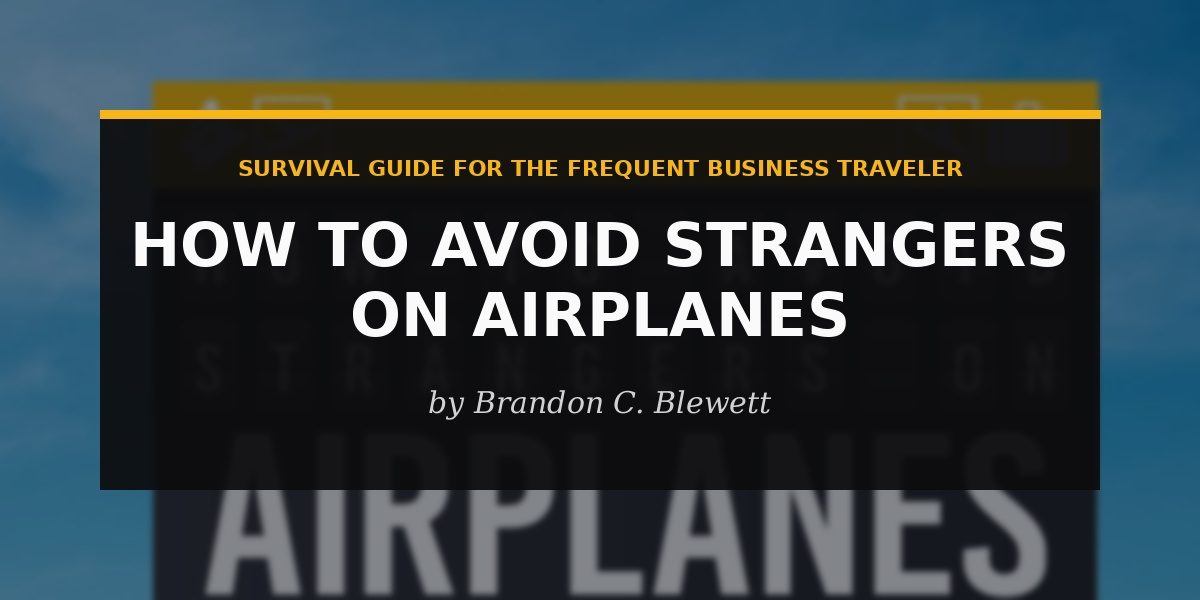
There is something almost meditative about the Monday morning airport, if you are the kind of person who has done it enough times to have moved past the stress and into a state of alert anthropological observation. Brandon C. Blewett reached that state somewhere in his first few years of consulting-mandated weekly travel, and he spent the rest of his decade in professional services cataloguing what he found there with the sharp, affectionate, slightly incredulous eye of someone who genuinely cannot believe that the same behaviors keep appearing with such reliable consistency across every airport in America. How to Avoid Strangers on Airplanes is the result of that catalogue, and it is the most entertaining business book you are likely to read this year and possibly several years on either side of this one.
Reading it feels like being seated next to the most observant and most amusing person on your flight, the one who notices everything and can describe it with enough precision that you both laugh and immediately understand something true that you could not quite have articulated on your own. Blewett’s voice has the quality of really good stand-up comedy, the kind where the jokes are funny precisely because they are accurate, where the laughter and the recognition arrive simultaneously, and where you find yourself wanting to read passages aloud to whoever is sitting near you, which, if you are reading this on an airplane, does create a certain irony given the book’s stated purpose.
The Six Habits of Highly Annoying Travelers are the book’s most beloved contribution, and they earn that affection completely. The Gate Lice, the overhead bin abusers, the full catalogue of people who make shared space worse for everyone around them, are rendered with a specificity that makes each type feel like a documentary subject rather than a comic invention. And Blewett’s consistent move, taking each traveler type and unpacking what the same behavior looks like in a professional context, is executed with enough grace that it never feels like a stretch. These are the same people making the same choices in the office that they make in the boarding area, and once Blewett has shown you that connection, you cannot stop seeing it.
His practical career wisdom, built from a genuine decade of professional services consulting and refined through his current role in corporate development, is delivered with the same economy and wit that characterizes the whole book. There are no long frameworks, no elaborate models, no five-step processes that require a companion workbook. There are sharp, honest observations about leadership and resilience and professional behavior, offered with the confidence of someone who has tested them against real conditions rather than constructed them for a book.
How to Avoid Strangers on Airplanes is the book to give anyone who spends too much time in airports, anyone who works with people who behave as if they have never heard of shared resources, and anyone who wants their professional development delivered with enough wit that they actually finish the book rather than leaving it on the nightstand with a bookmark permanently stuck at chapter three. Blewett has written something genuinely wonderful, and it deserves to be in every carry-on bag in every departure lounge in America.
If you want the most entertaining business book of the year and the most unexpectedly useful career guide currently available in the same compact volume that fits perfectly in a carry-on bag, How to Avoid Strangers on Airplanes by Brandon C. Blewett is on Amazon, and it is absolutely worth every page. Pick up your copy today and prepare to laugh, recognize yourself and your colleagues in ways that are both uncomfortable and clarifying, and arrive at your destination with a considerably sharper understanding of what professional success actually requires from the people pursuing it.