
By: Oliver Kraus
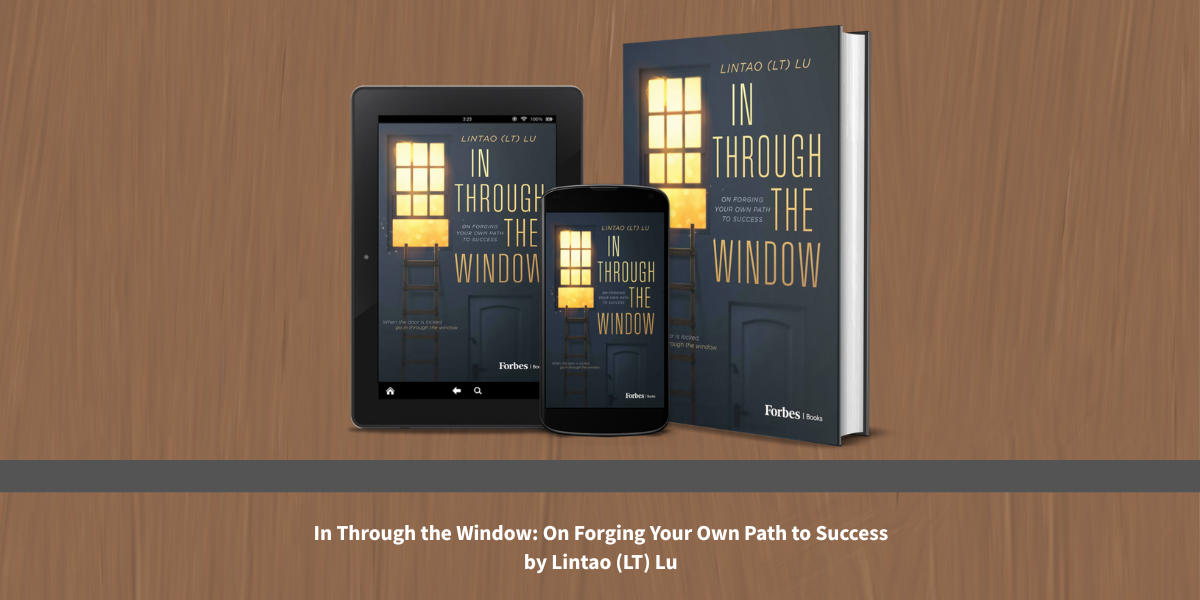
The thing about Lintao Lu’s story that strikes you first is not the scale of what he eventually built but the specific conditions from which he built it. A remote fishing village in rural China during the Cultural Revolution, famine, political upheaval, a world where the trajectory of a life was determined largely by forces that had nothing to do with individual capacity or individual desire. Most of the people born into those conditions stayed inside them. Lu did not, and In Through the Window is his most careful and most honest account of why, which turns out to be considerably more instructive than a simpler account of his achievements would have been.
Reading this book feels like being let into a conversation that most successful people never allow. Lu writes about the actual decisions, the actual moments of uncertainty, the actual experience of navigating corporate hierarchies in countries whose languages and cultures he had to build fluency in as an adult, with a specificity that makes the abstract concept of resilience feel like something concrete and learnable rather than an innate quality that some people have and others don’t. That specificity is the book’s most significant contribution to the crowded genre of leadership memoir, and it comes from an author who has clearly thought hard about what actually made the difference at each stage of his journey rather than simply narrating the outcomes.
The bamboo ceiling that Lu describes navigating in American corporate culture is one of the most underrepresented challenges in professional development literature, and his treatment of it is both honest and practically useful. He does not present it as an insurmountable structural barrier or minimize it into a mere inconvenience to be overcome with sufficient positivity. He presents it as a real and specific set of dynamics that can be understood and navigated with the right combination of cultural intelligence, professional credibility, and the particular kind of patience that comes from having survived genuinely harder things before any of this. That framing is simultaneously more honest and more empowering than most treatments of the subject manage to be.
His account of building Haier America’s air conditioning business from a standing start to dominance across Walmart, Home Depot, Costco, Target, and Sears in less than three years is one of the most compelling passages in the book, not because of the scale of the outcome but because of the specificity with which Lu describes how he thought about the problem from a position of complete outsiderness and built a path through it anyway. That same quality of thinking, applied to language acquisition, to cultural adaptation, to doctoral research in France, to the founding of NAVAC, gives the book a coherence that makes it feel less like a collection of anecdotes and more like a demonstration of a consistent and learnable way of engaging with obstacles.
In Through the Window is essential reading for first-generation professionals, immigrants, and anyone who has ever had to build their credibility in a context that was not designed to recognize it. Lu has written something that respects the genuine difficulty of that experience and offers real tools for navigating it, which is considerably more valuable than inspiration alone.
If you are a first-generation professional, an immigrant, or anyone building credibility in a context that was not designed to recognize it, In Through the Window by Lintao LT Lu is the honest and practically useful guide you have been waiting for. Pick up your copy on Amazon and learn from someone who navigated every version of that challenge at the highest levels of global business and came back with real tools to share.