

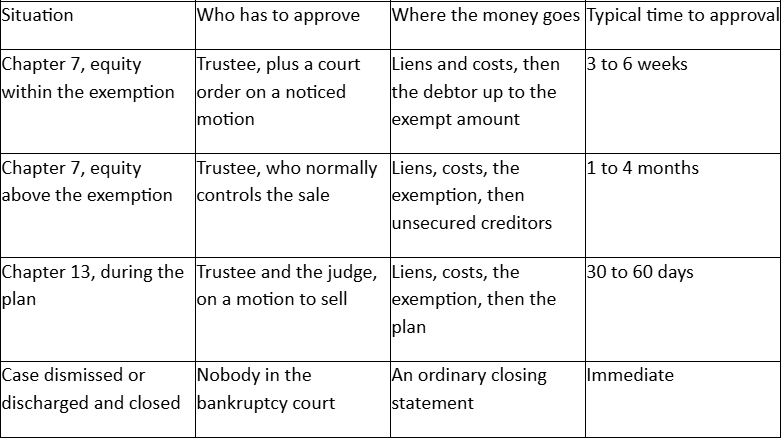
A house can be sold while a bankruptcy case is open, but the owner is no longer the only decision maker. The trustee, and in most cases the bankruptcy judge, has to approve the sale first. In Chapter 13 the proceeds follow the confirmed plan; in Chapter 7 the trustee controls any equity that the exemptions do not protect.
A homeowner in Queens filed Chapter 13 in January with $41,000 of mortgage arrears on a house worth about $520,000 and a first mortgage of $338,000. Her confirmed plan required $1,150 a month for 60 months on top of the regular payment. Nine months later her overtime disappeared. A sale produced roughly $151,000 after costs, most of it protected by New York’s homestead exemption, with the rest routed through the trustee to the creditors named in the plan. The alternative was dismissal and a refiled foreclosure case.
Why does a bankruptcy court get a say in a private sale?
Because filing changes who owns the house on paper. The petition creates a bankruptcy estate, and the debtor’s property goes into it. The Administrative Office of the U.S. Courts describes the immediate effect this way: “Filing the petition under chapter 13 ‘automatically stays’ (stops) most collection actions against the debtor or the debtor’s property.” The stay that halts a foreclosure also freezes the owner’s freedom to transfer the asset.
The permission comes from the Bankruptcy Code. Under 11 U.S.C. 363(b)(1), “The trustee, after notice and a hearing, may use, sell, or lease, other than in the ordinary course of business, property of the estate.” Section 363(f) adds the provision that makes these closings work at all, allowing a sale “free and clear of any interest in such property of an entity other than the estate” when one of five statutory conditions is met. That is how a court order can clear a disputed judgment lien that would otherwise cloud the title for months.
Who approves what in each chapter?
The two chapters answer the same question differently. The court describes the Chapter 13 trustee’s role as follows: “The chapter 13 trustee both evaluates the case and serves as a disbursing agent, collecting payments from the debtor and making distributions to creditors.” That trustee cares above all whether unsecured creditors do at least as well after the sale as the confirmed plan promised.
Chapter 7 is blunter. The court’s summary states that the trustee liquidates: “The trustee accomplishes this by selling the debtor’s property if it is free and clear of liens.” How much the household keeps turns on exemptions, because “The Bankruptcy Code allows an individual debtor to protect some property from the claims of creditors because it is exempt.”
Exemptions are state specific, and New York’s are generous by national standards. Section 5206 of the Civil Practice Law and Rules shelters one hundred fifty thousand dollars of home equity above liens and encumbrances in Kings, Queens, New York, Bronx, Richmond, Nassau, Suffolk, Rockland, Westchester and Putnam counties, and smaller amounts elsewhere in the state. Those figures are adjusted over time, so the governing number is the one the court applies on the filing date.
What is the actual sequence?
- Tell the bankruptcy attorney and the trustee before signing anything. A contract signed without disclosure can be voided, and it puts the discharge at risk.
- Make the contract expressly conditional on bankruptcy court approval. Experienced buyers expect that clause.
- File the motion to sell. Counsel files under section 363 with the contract, the payoff figures and a proposed distribution of proceeds attached.
- Serve notice and wait out the objection window. Creditors, the trustee and the United States Trustee receive the motion. If nobody objects, many courts rule without a hearing.
- Close under the order. It sets who gets paid, and usually carries a short waiting period before taking effect, which title companies build into the closing date.
Every step above is procedure rather than advice, so a licensed attorney admitted in the district where the case is pending should drive the timing.
How many households are in this position?

According to the Administrative Office of the U.S. Courts, in statistics released on July 28, 2026, filings for the 12 month period ending June 30, 2026 rose 12.2 percent, with “total filings increased to 608,511 cases, compared with 542,529 cases” a year earlier. Chapter 7 accounted for 382,161 and Chapter 13 for 215,490, and the judiciary’s explanation of Chapter 13 describes what a plan requires.
Communication during a case is thinner than owners expect. The Consumer Financial Protection Bureau notes that “Mortgage servicers are not required to send regularly scheduled mortgage statements to borrowers who are in bankruptcy,” and its guidance on mortgage statements during bankruptcy explains how to request account figures in writing. A sale needs a current payoff, and it has to be asked for.
Where does a direct buyer fit?
HomeWise, a direct home-buying company that purchases distressed single-family houses, including homes tied up in an open Chapter 7 or Chapter 13 case, in Florida, Texas, Georgia and other states, structures these contracts around the court calendar. It signs subject to court approval, supplies proof of funds counsel can attach to the motion, holds the closing date open while the objection period runs, and pays arrears, liens and the trustee’s distribution from the purchase price at closing. Its guide to selling a house during bankruptcy covers what the motion contains, and its how it works page sets out the closing sequence.
Certainty is the point. A financed buyer whose rate lock expires while a motion sits on a judge’s calendar walks, and the file restarts with a shorter runway. Buyers such as HomeWise price that delay in advance.
Frequently asked questions
Can a house be sold during Chapter 13 bankruptcy?
Yes, with the trustee’s involvement and a court order on a motion to sell. The plan is usually modified or paid off from the proceeds, and any exempt equity goes to the homeowner. Contracts signed without disclosing the case can be undone, so the attorney handling the case files the motion.
Who controls the house in Chapter 7?
The trustee does, because the property joins the bankruptcy estate at filing. If the equity is fully protected by exemptions, the trustee frequently abandons the asset and the owner sells normally. If equity exceeds the exemption, the trustee can sell the house and pay creditors from the surplus.
What is a motion to sell?
It is the filing under section 363 asking the bankruptcy judge to authorise a sale outside the ordinary course of business. It attaches the contract, the payoffs and a proposed distribution, and goes out to creditors with an objection deadline. If no objection lands, many courts grant it without a hearing.
Does the automatic stay stop a foreclosure sale?
The stay halts most collection actions when the petition is filed, which can postpone a scheduled sale. It is not permanent. A secured lender can ask the court to lift it, and a dismissal ends the protection, so a sale under court order is the more durable resolution.