
By: William Jones
As fitness, preventative health, and social recreation expand across Midtown South, a once office-heavy district is taking on a new identity shaped by around-the-clock activity and mixed-use growth.
For years, Midtown Manhattan was defined by routine. Workers poured into office towers in the morning, crowded lunch spots by midday, and filtered back out by evening. After dark, many blocks quieted down, especially in areas historically built around commercial real estate rather than residential life.
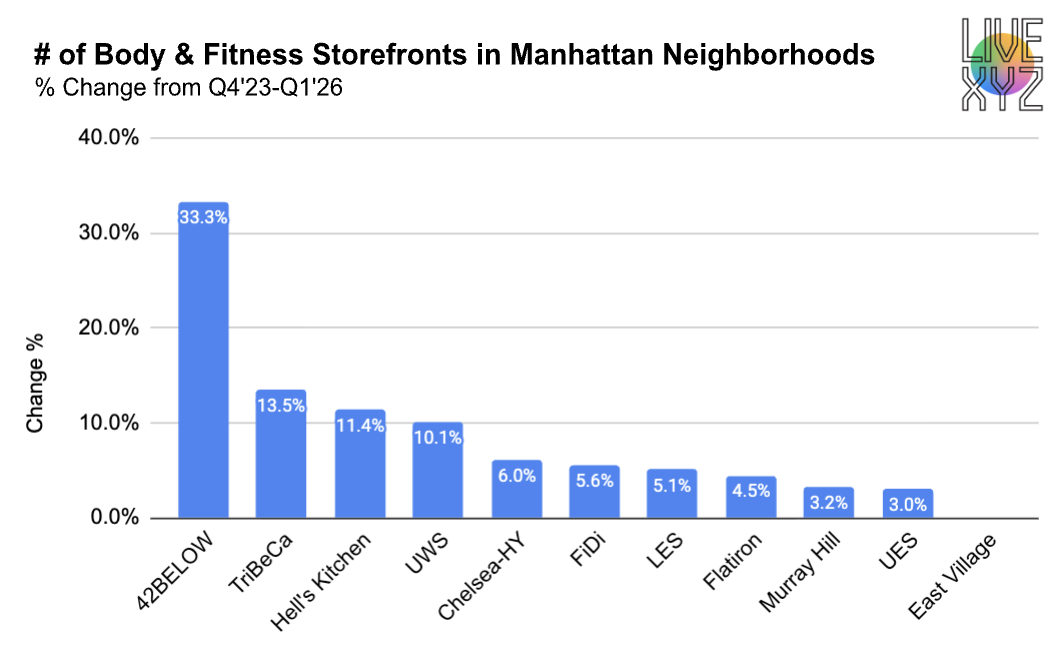
That pattern is beginning to change across Midtown South’s 42BELOW corridor, where wellness-focused businesses are growing at a pace that now stands out even within Manhattan’s highly competitive retail environment. According to data from Live XYZ, the district spanning roughly from 42nd Street to 30th Street, between Eighth Avenue and Bryant Park, grew from 24 to 32 fitness- and body-related storefronts over the past two years. That represents a 33.3% increase, compared with 3.8% growth across Manhattan overall.
The numbers point to something larger than a temporary retail trend. Midtown South is increasingly being shaped as a mixed-use neighborhood where wellness, recreation, hospitality, and residential development intersect.
A Different Kind of Midtown Growth
The growth rate in 42BELOW has outpaced several established Manhattan neighborhoods often associated with luxury fitness and lifestyle brands. Live XYZ data shows TriBeCa experienced 13.5% growth in fitness and body establishments during the same period, while the Upper East Side saw approximately 3% growth.
Chris Bradicich, Director of Partnerships & Growth at Live XYZ, describes the district’s momentum as part recovery story and part repositioning effort. As office workers continue to return to Midtown and residential demand increases nearby, businesses tied to fitness and preventive wellness are finding new opportunities in the area.
What makes the corridor notable is the type of operators entering the market. Rather than relying solely on traditional gyms or boutique fitness studios, many new concepts combine hospitality, recreation, dining, and wellness programming under one roof.
That approach reflects broader consumer habits that increasingly treat wellness as a social and lifestyle activity rather than a standalone errand squeezed into the workday.
Flagship Wellness Concepts Are Reshaping the Area
Several major openings have helped accelerate the corridor’s visibility.
CityPickle recently opened a 37,000-square-foot flagship near Times Square that includes seven pickleball courts alongside food and beverage offerings designed to encourage longer visits and social interaction.
Life Time is also preparing a large-scale entry into the district with a 52,000-square-foot athletic club planned for 10 Bryant Park. The four-level facility is expected to open in late 2026 and reflects continued demand for high-service fitness environments that blend training, recovery, workspace amenities, and hospitality-style experiences.
“The Life Time lease is a defining moment for Midtown South,” said Patrick A. Smith, Vice Chairman at JLL, who brokered the transaction. “It signals a broader shift toward experiential, wellness-driven tenancy and reinforces the neighborhood’s evolution into a true mixed-use destination where people can live, work, and engage throughout the day and night.”
Meanwhile, Yoga Joint, an infrared fitness concept founded in Miami, selected Midtown South for its first New York City location. The studio is expected to occupy 6,300 square feet when it opens later this year.
Private wellness clubs are also entering the neighborhood. Moss, located at 520 Fifth Avenue, dedicates 20,000 square feet to health and wellness amenities, including thermal pools, spa facilities, pickleball, dining, and cultural programming.
Together, these businesses signal a broader redefinition of what wellness spaces look like in dense urban neighborhoods. The focus is increasingly on flexibility and extended use throughout the day, rather than quick transactional visits.
From Office District to Mixed-Use Neighborhood
The corridor’s evolution is unfolding alongside the Midtown South Mixed-Use Plan, a rezoning initiative designed to modernize long-standing zoning rules that historically limited residential development across much of the district. The plan covers roughly 42 blocks between West 23rd and West 40th Streets, bringing nearly 10,000 new homes to the area.
If implemented as proposed, the plan would introduce substantial new housing while maintaining commercial and retail uses that have long defined the area.
That combination is important because wellness businesses often depend on a steady mix of office workers, residents, and evening foot traffic. A district built entirely around daytime commuters rarely sustains the kind of around-the-clock activity these operators increasingly rely on.
“We see this area as one of New York City’s most important emerging wellness corridors. The repositioning of the district is creating a new kind of centrality, bringing together residential, office, and lifestyle uses that naturally support health and preventative care,” says Jenny Kaur, Director of Operations of Atlas Men’s Health, a men’s health and performance clinic specializing in preventative care, diagnostics, and wellness optimization, headquartered on 8th Avenue and 35th Street.
Wellness as Part of the Neighborhood Identity
The rise of wellness-focused businesses in Midtown South reflects a broader change in how Manhattan neighborhoods compete for attention and long-term investment.
Restaurants, fitness concepts, social recreation spaces, preventative health clinics, and hospitality-driven venues now function as interconnected parts of a district’s identity. In 42BELOW, those categories are increasingly reinforcing one another.
What was once viewed primarily as a commercial corridor is becoming a place designed for longer stays and multiple purposes throughout the day. The result is a neighborhood that feels less tied to office hours and more connected to the rhythms of daily life in a city that continues to redefine how people live and work after the pandemic.