
By Vincent Calloway
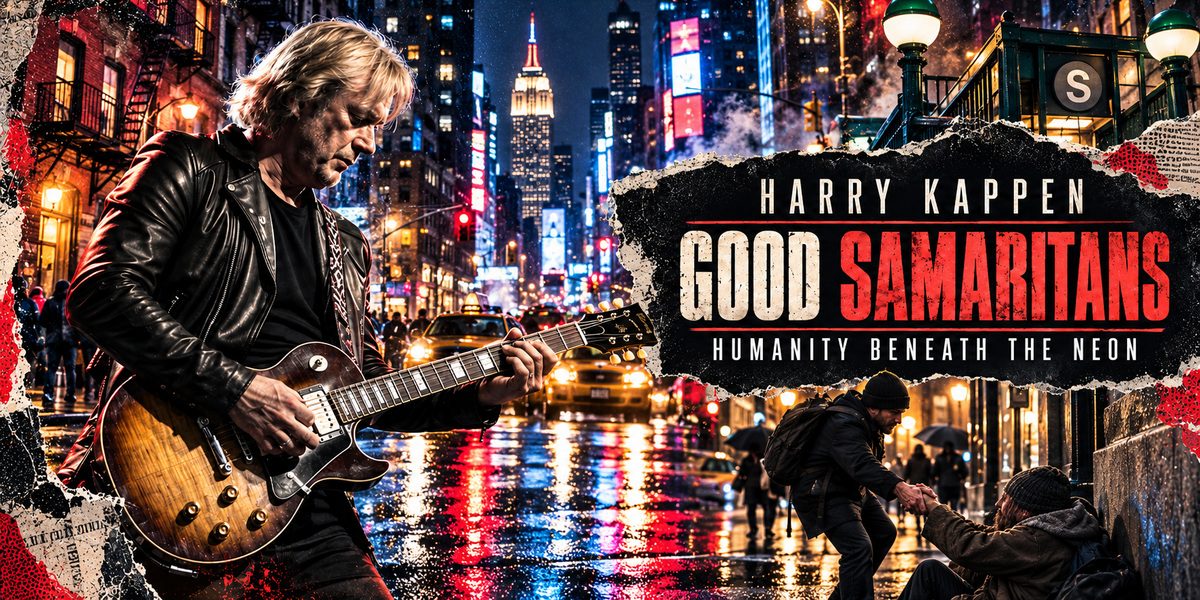
New York sells itself in light. Times Square flashes promises from every direction. Phone screens glow inside crowded subway cars. Storefronts, billboards, influencers, and aspiring celebrities all compete for one more glance from people already looking elsewhere. Harry Kappen’s “Good Samaritans” could have been written while standing in the middle of that sensory storm, watching millions of personal advertisements collide with small, unrecorded acts of kindness.
Taken from After the Crossing, Kappen’s first album recorded after moving from the Netherlands to Mexico, “Good Samaritans” is a firm, energetic rock song about the people who step forward when help is genuinely needed. They do not announce their compassion, build personal brands around it, or wait for a camera to begin recording. They simply act.
That distinction gives the song particular force in a city where strangers are famously skilled at minding their own business—until, suddenly, they are not. Anyone who has spent time in New York has seen the transformation. A commuter avoids eye contact for 20 blocks but grabs a stranger before they fall onto the subway tracks. Somebody carries a stroller up broken station stairs. A restaurant worker brings food to a person sleeping beneath scaffolding. A crowd that appears cold and hurried can become a rescue team in seconds.
Those are Kappen’s people.
The song begins by surveying the contemporary marketplace of perfection. Kappen sings about “flashy words,” “plastic smiles,” “golden sunsets,” and “sculpted skies,” describing a culture in which every photograph is manipulated and every difficult emotion is repackaged as aspirational content. Pain becomes an accessory. Tears become champagne. Even vulnerability can be staged for maximum engagement.
In New York, where ambition is practically a municipal resource, those lines land with a sting. The city has always attracted dreamers, hustlers, performers, and reinvention artists. Today, however, the audition never seems to end. Every meal can become a post. Every sidewalk is a potential backdrop. Every personal belief risks being reduced to a caption polished for strangers.
Kappen does not reject aspiration itself. His target is the hollowness that develops when appearance replaces action. “Good Samaritans” asks what all those carefully expressed values are worth when someone is hurting directly in front of us.
Musically, the track carries enough rock-and-roll muscle to prevent the message from feeling like a sermon. Kappen performed, sang, and produced the song himself, shaping an arrangement that moves with purpose. The guitars supply urgency, while the rhythm pushes forward with the steady determination of someone walking against a crowd instead of being carried along by it.
Mexican singer Danna Gomez appears in the choruses, expanding the song beyond Kappen’s individual voice. Her contribution helps the central refrain feel communal—a reminder that empathy depends on people joining one another rather than remaining isolated spectators.
Kappen has described “Good Samaritans,” along with the earlier single “Distant Shore,” as a musical nod to David Bowie. That influence suits the song’s New York resonance. Bowie understood the city as both a stage and a hiding place, somewhere a person could construct an identity while also disappearing inside the crowd. Kappen explores a related tension between performance and truth, asking whether our public personas reflect what we actually do when no applause is available.
The song’s most affecting image is also its simplest: Good Samaritans stopping in the rain to share another person’s pain. Rain strips the city of some of its glamour. Makeup runs. carefully chosen clothes become soaked, taxis disappear, and everybody wants to get inside. Stopping under those conditions requires sacrifice, even if only for a few minutes. It means deciding that another person’s need is more important than comfort or schedule.
Kappen knows something about that decision. Before concentrating more fully on his music, he spent more than two decades working in youth care as a music therapist and later taught in an international master’s program. His faith in compassion is therefore not theoretical. He has spent much of his professional life exploring how music can reach people when ordinary communication fails.
That history helps explain why “Good Samaritans” never collapses into an easy complaint about social media. The technology is merely scenery. The deeper subject is moral attention: whether we still possess the willingness to notice one another.
New York may be one of the most photographed cities on Earth, but its defining acts often happen outside the frame. They occur on subway platforms, apartment stoops, hospital sidewalks, and late-night corners where nobody is collecting likes. Kappen’s single honors the people who enter those moments without demanding credit.
“Good Samaritans” suggests that heroism is not dead. It has simply been