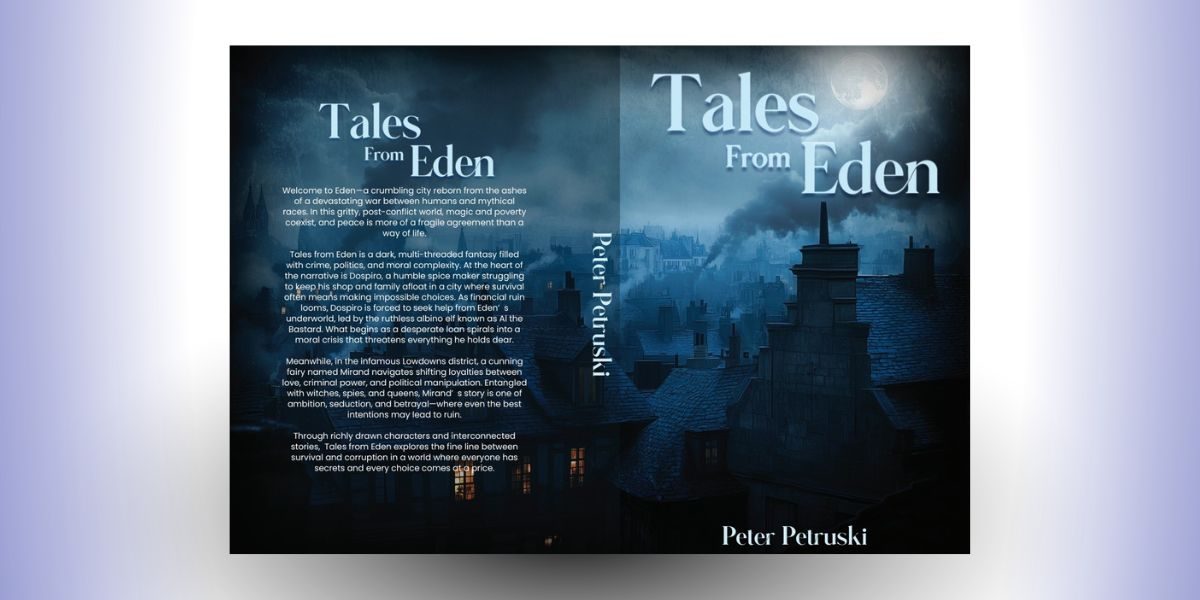

Most fantasy debuts announce their ambitions loudly: a chosen one, a coming war, a map at the front of the book. Tales from Eden takes the opposite route. It is a collection of sixteen linked stories set in a single, unglamorous city, and its ambitions only become visible once you notice what all sixteen stories have in common: nobody in this book is choosing between good and evil. They are choosing between bad options, in a place built to produce exactly that kind of choice.
That place is Eden itself, and it is the book’s real subject. The setting is a postwar city where an uneasy peace between several peoples holds, barely, while the institutions meant to keep it functioning have quietly stopped trying. Policing is thin. Credit is unavailable to anyone who actually needs it. Into that gap steps whoever is willing to do the job the state won’t, and the book’s moral weather follows from there. This is not a story about weak people making weak choices. It is a study of what a city does to people when it hands them impossible math and then blames them for the answer.
A Shopkeeper’s Arithmetic
The opening story, centered on the spice trader Dospiro Saratos, sets the terms early. Dospiro is not written as a cautionary tale or a fool. He is skilled at his trade and genuinely devoted to his family, and he is watching both slip away from him at once. When he borrows from the city’s dominant loan shark and accepts a poison commission as part of the price, the narrative refuses to frame it as a fall from grace. It reads instead like a spreadsheet: the one path that seems to avoid total ruin.
What the story understands, and what elevates it past a simple morality tale, is that Dospiro’s pride isn’t a flaw so much as a strategy that has quietly stopped paying off. He cannot ask his brother for help, because that would mean admitting the shop failed and that the life he built his family around was a miscalculation from the start. Pride, here, is not vanity. It is the last wall standing between a man and a truth he can’t afford to look at directly.
The story’s best single image is a small one: a spill of salt on the floor that Dospiro considers scooping up before deciding things aren’t quite that dire yet. Nothing is explained. Nothing needs to be. In one gesture, the reader gets the state of the household finances, the man’s remaining dignity, and exactly how far he still has left to fall.
The Logic of the Lowdowns
If Dospiro is the book’s clearest case study in personal compromise, Al the Bastard is its clearest case study in structural compromise. He runs the Lowdowns, Eden’s poorest district, as its de facto government, and the book is careful never to let him off the hook: he is cold, calculating, and unsentimental about the people he uses. But the story’s real argument isn’t about Al’s character. It’s about the vacancy he’s filling.
Al lends money because the banks have decided the poor aren’t worth the risk. He keeps a rough order because the city’s security forces have decided the district isn’t worth patrolling. Put a functioning government in Eden and Al becomes a footnote, a small-time enforcer with a bad reputation. As it stands, he’s closer to a civic institution than a criminal one, and the book never states this outright. It simply builds a city where there’s no other honest conclusion to reach.
A subplot involving an imprisoned shapeshifter pushes this same logic further. Freed after decades of being used as a weapon by the wizard who caged it, the creature’s first act is to plan that wizard’s death, and the story is careful to frame this as consequence rather than villainy. There’s no rage in it. Just the flat efficiency of something finally acting in its own interest after years of not being permitted to.
Two Women Holding the Line
The book’s two most quietly demanding roles both belong to women doing the unglamorous work of keeping things from collapsing entirely while the men around them make worse and worse decisions. Zara Saratos takes on outside work, feeds her children, and keeps food on the table for a husband who resents her for doing it, not as a martyr, but because the situation leaves her no better option and she simply gets on with it.
Santah Fey, who manages Al’s business interests and shares his household, gets a subtler treatment still. She’s never framed as someone waiting to be rescued; she has her own read on her circumstances and her own reasons for staying in them. When she’s finally offered a clean exit total freedom, no strings her hesitation isn’t confusion. It’s the specific vertigo of someone who has spent years mastering a cage and now has to figure out who she is without its walls.
Both characters are handled with a rare kind of respect: the book never treats endurance as a lesser form of courage.
Where the Book Strains a Little
Not everything lands with equal weight. A handful of the sixteen stories, particularly two in the back third, lean on the same structural trick (a character makes a compromised choice, the narration withholds judgment, a small physical detail carries the emotional freight) enough times that the device starts to show through the floorboards. Readers moving through the collection in one sitting may feel the pattern before the book intends them to. It doesn’t undo the effect, but it does dull it slightly by the final third.
The Case for Reading It
None of that undercuts the book’s central accomplishment. Tales from Eden is less interested in spectacle than in consequence, and it trusts its readers to sit with the discomfort of watching decent people do compromised things for legible reasons. The failing shop, the loan with a poison attached, a freed prisoner’s plan for revenge, a pixie’s hesitation at the door of her own freedom, each of these carries more weight than the anthology format usually allows for, because the book has done the patient work of earning it. It is, structural repetition aside, a genuinely strong debut, and a city worth returning to.