


Sondra J. Hardy writes with a storyteller’s patience and a historian’s eye for detail. Her novels move through New Orleans, Chicago, and Harlem, tracing the hidden tensions inside families and communities during the mid-twentieth century. At the center of her growing body of work are three titles that define her literary voice: Pieces: Revised and Revisited, Audine’s Story Book One and Book Two, and Sistahs of the Tarot.
“My books are big, but my stories are even bigger,” Hardy has said. The phrase reflects the scale of her characters’ emotional journeys and the layered worlds she builds around them.

Photo Courtesy: Sondra J. Hardy
A Family Torn Apart in Pieces: Revised and Revisited
Set in 1932 New Orleans, Pieces: Revised and Revisited introduces readers to Clarence, Margaret, and Maria St. Laurent, a married couple whose outward success conceals deeper fractures. Clarence is a prosperous farmer. Maria is a Black French Creole woman with spiritual knowledge rooted in hoodoo practice. Their five children live within what appears to be a stable household. Beneath that surface, secrecy and resentment begin to take hold.
The arrival of Maydell Scott, bold and confrontational, disrupts the fragile balance. A public confrontation between Maydell and Maria escalates tensions, and events unfold that alter the course of multiple lives. Hardy’s portrayal of Maria’s spiritual rituals is woven into the emotional narrative rather than presented as spectacle. The story examines jealousy, betrayal, and the generational impact of private decisions made behind closed doors.
Audine Booker, a neighbor introduced in Pieces: Revised and Revisited, becomes one of the author’s most complex characters. Envious and prone to spreading rumors, she enters the story at pivotal moments, influencing events that extend far beyond her initial appearance. Her presence creates a ripple effect that shapes Hardy’s later novels.
Readers can explore the novel by checking its listing on Barnes & Noble.
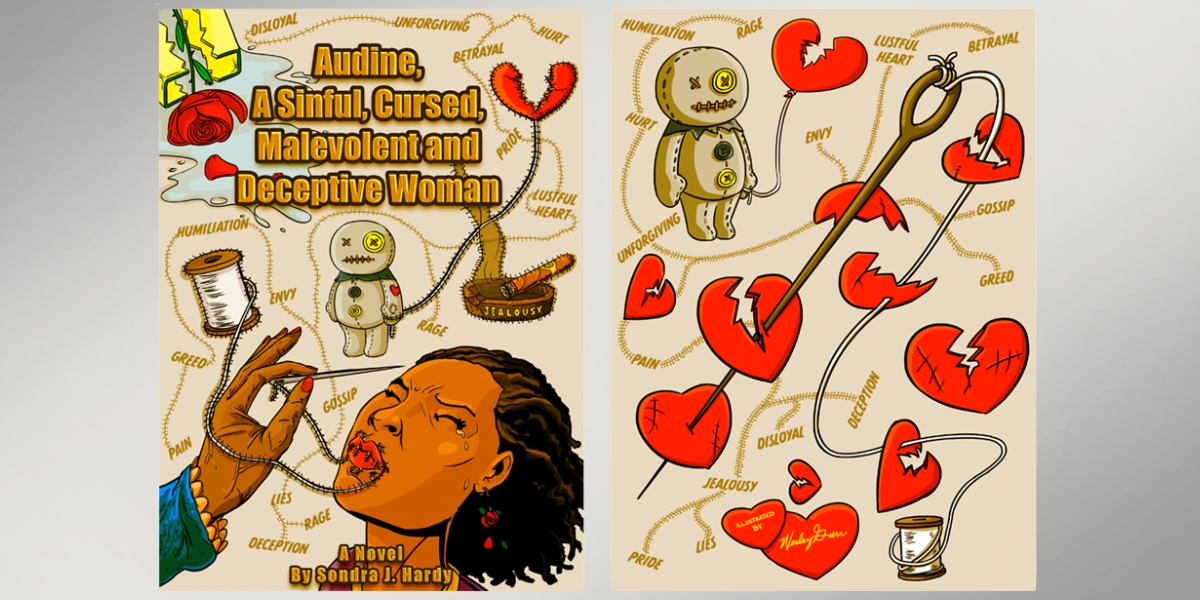
Photo Courtesy: Sondra J. Hardy
The Rise and Fall of Audine in Audine’s Story
Hardy expands the universe of Pieces: Revised and Revisited with Audine’s Story Book One and Book Two. These novels focus on Audine Collins after her expulsion from her home in 1933. Alone and determined, she travels by train from New Orleans to Chicago, where ambition and bitterness intertwine.
Throughout Audine’s Story, Hardy presents Audine as layered rather than one-dimensional. She is manipulative and jealous, yet also deeply insecure. Her encounters on the train and later within a Chicago church community reveal how quickly appearances can shift. Relationships that seem promising dissolve under scrutiny. Authority figures who appear righteous harbor secrets of their own.
Hardy’s narrative style in Audine’s Story remains steady and observant. Rather than offering moral lessons, the author allows readers to witness the consequences of Audine’s decisions. Themes of envy, spiritual practice, and personal downfall echo the events first introduced in Pieces: Revised and Revisited, creating continuity across the novels.
Both installments are available through Barnes & Noble: Book One and Book Two.
Spiritual Insight in Sistahs of the Tarot
If Pieces: Revised and Revisited centers on family fracture and Audine’s Story examines personal unraveling, Sistahs of the Tarot shifts toward spiritual counsel and hidden truths. The novel moves between 1935 Chicago, 1956 New Orleans, and 1956 Harlem, linking three tarot readers whose clients seek clarity during uncertain times.
Madame Ambroisine Honoré in New Orleans interprets cards while navigating her own complicated relationship. In Chicago, Betty Coins offers guidance that later reveals deeper truths. In Harlem, Ian Seesall, known as “Mr. Sees-All,” is recognized for his unusual ability to detach during readings and envision circumstances affecting his clients.
Hardy treats tarot and hoodoo traditions with narrative seriousness. Rather than sensationalizing these practices, she situates them within community life. The novel suggests that secrecy, longing, and vulnerability cross geographic boundaries. Each tarot reader closes sessions with the same warning: “Don’t let them know what you know.”
Readers can find Sistahs of the Tarot here.
The Author Behind the Stories
Sondra J. Hardy was born and raised in West Haven, Connecticut. She graduated from West Haven High School and later attended Bay State College in Boston, where she served as Senior Vice President and earned honors recognition along with the Beatrice Ruderman Award for Fashion Merchandising and Design.
Her lifelong love of reading is reflected in a personal library of hundreds of novels. Walter Mosley is among the writers she admires, and her ambition to have one of his Easy Rawlins books signed speaks to her respect for literary craft. Hardy’s debut novel received recognition from book award programs, marking an early milestone in her publishing journey.
Future projects include Extinguished, which follows Kempton St. Laurent during World War II, and Broken Pieces: Avid’s Story in Harlem, 1956. These planned works suggest that the universe introduced in Pieces: Revised and Revisited will continue to expand.
A Literary World Still Growing
Across Pieces: Revised and Revisited, Audine’s Story, and Sistahs of the Tarot, Hardy constructs a narrative tapestry that spans decades and cities. Her characters struggle with secrecy, betrayal, faith, and identity. Spiritual traditions such as hoodoo and tarot are presented as cultural elements woven into everyday life rather than isolated curiosities.
Hardy’s storytelling reflects patience and intention. The interconnected arcs of Pieces: Revised and Revisited and its companion novels show a writer committed to developing a long-form narrative universe. As her catalog grows, readers encounter not only dramatic events but also reflections on community, loyalty, and consequence.
Contact and purchase details for the novels are available via the Barnes & Noble links above.