
Most people remember high school math in a pretty similar way. You’re given formulas, shown steps, and expected to repeat them until they stick. For a while, that’s enough. You get answers, you pass tests. But the moment someone asks why something works, everything starts to feel less certain.
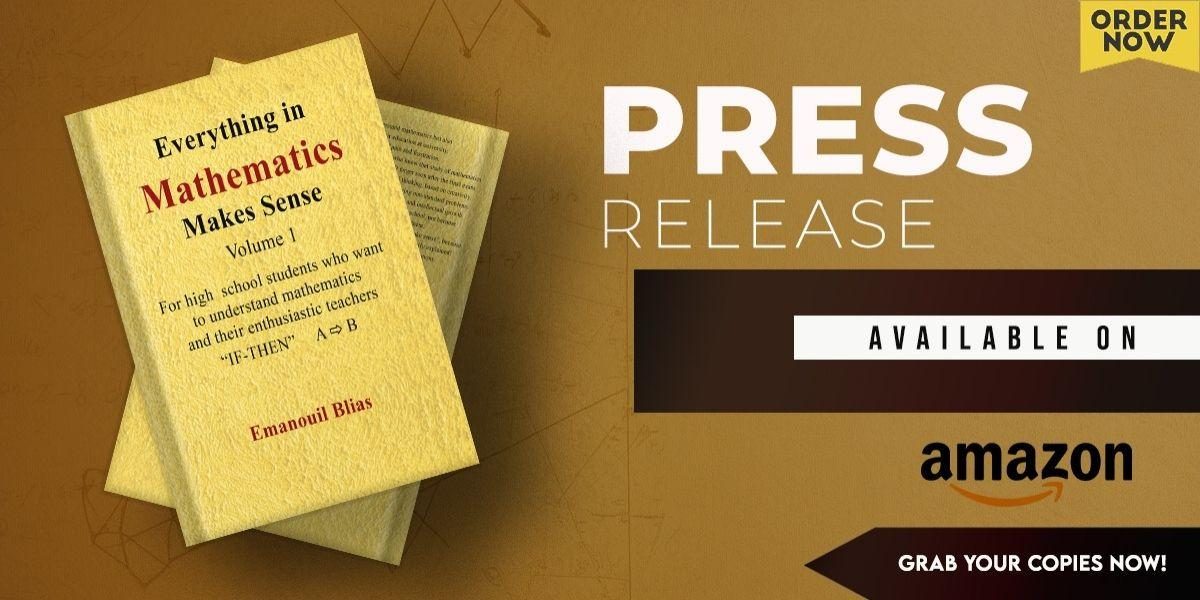
That’s exactly the space Emanouil Blias steps into with Logical Reasoning and Proofs in High School Mathematics. The book doesn’t try to simplify math or make it feel lighter. It does something a bit more uncomfortable; it slows everything down and asks you to actually think about what you’re doing.
And honestly, that shift changes the experience more than you’d expect.
What the book keeps coming back to is simple: solving isn’t the same as understanding. A student can follow a method perfectly and still have no idea what’s really happening underneath. Emanouil Blias doesn’t dismiss traditional teaching, but he clearly doesn’t trust it on its own. For him, procedures without reasoning are incomplete, almost fragile.
One thing that stands out right away is the format. Instead of standard explanations, you get a back-and-forth between two characters, John and Jane. They question things, go in circles a bit, pause, rethink, and then try again. At first, it feels unusual. Maybe even a little forced.
But after a few pages, it starts to feel familiar. Not polished, just familiar. Because that’s how people actually learn. They hesitate. They get something slightly wrong. They ask the same question twice in different ways.
That said, the format won’t work for everyone. If you already prefer direct explanations, the dialogue might feel like it’s taking the long way around. There are moments when you might want the book to just get to the point and move on. It doesn’t always do that.
Still, there’s a reason for it.
The book is very deliberate about logic. It doesn’t treat definitions as background information or something to skim. They matter here. A lot. Same with proofs. Not as an extra step, but as the thing that actually holds everything together. The message is clear, even if it’s not always said outright: if you can’t explain something properly, you probably don’t understand it yet.
That approach makes the book feel closer to how mathematics is used later on, in university, in programming, in any field where precision matters. It’s less about getting to the answer quickly and more about being sure the answer actually makes sense.
Of course, that kind of depth isn’t easy. The book asks for patience. It expects you to sit with ideas longer than you might be used to. For some students, that’s exactly what they need. For others, especially those already struggling, it might feel like too much at once.
There’s also a lot packed into it. Number theory, algebra, inequalities, geometry, and logic cover a wide range. That ambition is impressive, but it does stretch things at times. You move from one area to another fairly quickly, and not every section gets the same level of breathing space.
Where the book really delivers, though, is in the exercises. There are hundreds of them, and they don’t let you stay comfortable. Some look straightforward, then quietly force you to rethink your assumptions. You can’t just apply a formula and move on. You actually have to stop and ask yourself what’s going on.
That’s not always enjoyable in the moment. But it sticks.
The writing itself feels like it comes from someone who’s spent years in classrooms. There’s patience in it, but also a kind of persistence. At times, it does repeat ideas more than necessary. You notice it. But it also feels intentional, like the author knows exactly where students tend to lose clarity and refuses to let that happen.
It’s also worth being clear about who this book is really for. It’s not built for quick results. It’s not about tricks or shortcuts. It’s for students who are willing to slow down and deal with the harder question, the one that doesn’t go away after you get the answer.
And if someone is willing to do that, the payoff is real.
And surprisingly, the book doesn’t end with one more intense proof or another complicated theorem. It ends with a chapter called “Mathematical Jokes,” and it actually works really well after all the heavy reasoning that comes before it. The jokes are clever and honestly pretty funny once your brain catches up to them. You’ll end up enjoying the fact that you understood the joke as much as the joke itself.
Because underneath everything, the structure, the dialogue, the exercises, the book is making a bigger point. Mathematics isn’t supposed to feel random or disconnected. It’s not a list of rules someone decided you should memorize. It’s a system that actually fits together, piece by piece.
Most students just don’t get to see it that way. This book tries to change that. Not by making math easier, but by making it make sense.
And that difference… stays with you.