
Modern life has become an endless exercise in storage. Photographs rest inside cloud servers, birthdays appear as automated reminders, and family milestones are documented before anyone has the chance to experience them. We have accumulated more records than any civilization before us, yet many families struggle to answer surprisingly ordinary questions: Who first owned this home? Why did our grandparents make the choices they did? Which stories shaped the people we became?
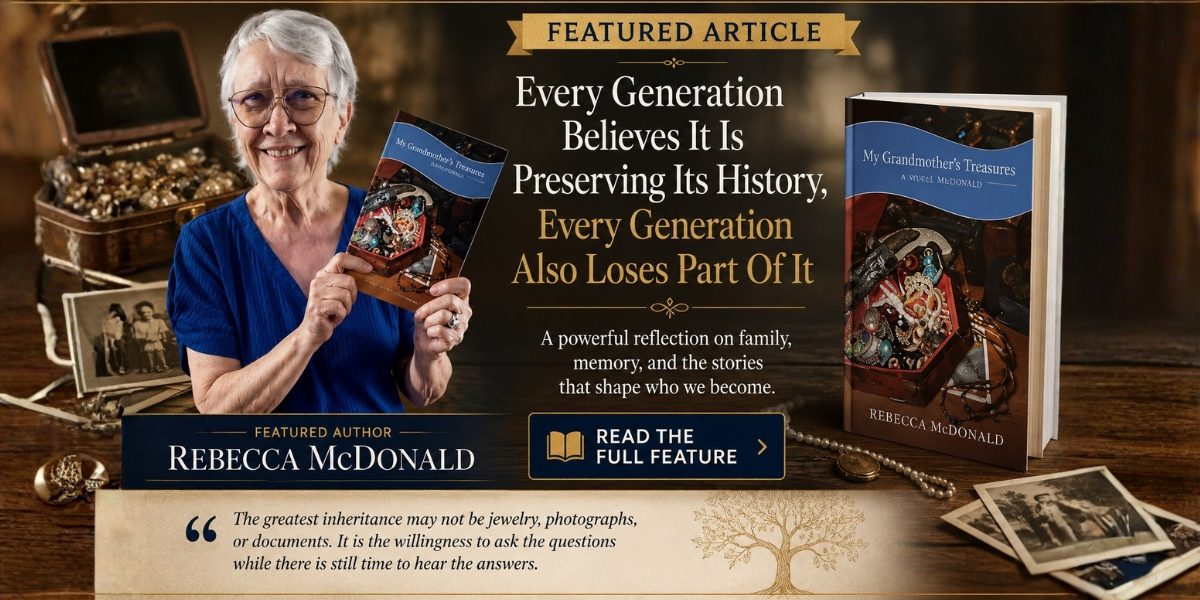
Memory, it turns out, has never been measured by volume. It survives because someone decides that a story is worth telling. That tension lies quietly beneath Rebecca McDonald’s My Grandmother’s Treasures. A novel that treats family history not as nostalgia but as an active conversation between generations. Rather than relying on sweeping historical spectacle, the narrative begins with something remarkably familiar. A grandmother opens her jewelry box for her fourteen-year-old granddaughter. Each object becomes less an ornament than an invitation, carrying fragments of lives that might otherwise disappear.
Objects That Outlive Their Owners
For centuries, families entrusted heirlooms with responsibilities now assigned to digital archives. A ring commemorated a sacrifice. A watch recorded the migration. A faded brooch carried the memory of someone whose name might never appear in a history textbook.
These possessions mattered because they demanded interpretation. Unlike a smartphone gallery containing thousands of nearly identical images, an heirloom arrives without explanation. Someone must supply the missing narrative.
Rebecca’s novel recognizes this distinction. The jewelry itself possesses little importance without Cassie McAllister’s willingness to explain why each piece exists and what emotional weight accompanies it. The exchange between grandmother and granddaughter becomes an act of preservation, reminding readers that heritage is transferred conversationally long before it becomes historical documentation.
The quiet ritual feels increasingly uncommon. Families often inherit possessions after funerals, when the storytellers capable of explaining them are already gone.
Silence Between Mothers And Daughters
My Grandmother’s Treasures refuses to romanticize family relationships. Running alongside its recollections is an unresolved conflict between Cassie and her daughter, Vivian, whose disagreements remain deliberately obscured from young Tessa.
This emotional architecture reflects an uncomfortable truth about family memory. Every household maintains competing versions of the past.
- Parents remember responsibility.
- Children remember absence.
- Grandparents remember sacrifice.
- No account is entirely complete.
The novel acknowledges that inheritance extends beyond cherished keepsakes. Families also pass along misunderstandings, unanswered questions, protective silences, and unresolved disappointments. These intangible legacies often prove more durable than physical possessions.
The resulting friction feels authentic precisely because it refuses convenient reconciliation. Families rarely argue only about the present. More often, they revisit decades-old decisions using contemporary language.
History Lives Best In Ordinary Rooms
Rebecca McDonald spent more than two decades teaching history and English before turning to fiction, an experience reflected in her attention to overlooked lives rather than celebrated figures. The perspective challenges a widespread assumption that history belongs primarily to nations, wars, presidents, and revolutions.
Instead, history appears around kitchen tables.
- Inside family photographs.
- Within recipes whose origins no one fully remembers.
- In conversations postponed until summer afternoons.
These intimate settings rarely receive institutional recognition, yet they shape identity far more consistently than public monuments. The stories shared inside households influence values, loyalties, fears, and ambitions long before formal education begins.
Perhaps this explains why novels centered on family memory continue attracting readers despite an era obsessed with acceleration. They offer something increasingly scarce: continuity. Not certainty, because every family contains contradictions.
Not perfection, because every inheritance arrives with imperfections. Continuity.
Takeaway
My Grandmother’s Treasures suggests that remembering is less about preserving flawless versions of the past than accepting that every generation edits history before passing it onward. The greatest inheritance may not be jewelry, photographs, or carefully stored documents. It is the willingness to remain curious enough to ask older relatives difficult questions while there is still time to hear the answers. The stories waiting inside those answers may become the only archives future generations truly trust.