

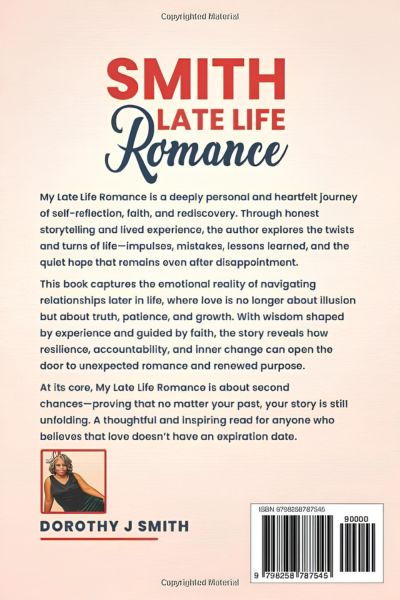
In a romance market often crowded with young love, fast attraction, and neatly packaged emotion, Dorothy Smith’s Late Life Romance enters with a quieter and more resonant force. The book does not chase the usual fantasy of perfect timing. Instead, it turns toward a truth many readers know but do not often see explored with care: love can arrive after years of waiting, healing, questioning, and living. That alone gives Smith’s work a distinct place.
Late Life Romance is not simply a story about affection. It is a meditation on timing, self-worth, emotional courage, and the surprise of being seen when one no longer expects it. Smith writes from a deeply personal space, yet the feeling behind the book reaches far beyond one woman’s experience. Her work speaks to readers who understand disappointment, faith, aging, longing, and the strange bravery it takes to open the heart again.
What makes Smith noteworthy as an author is her refusal to treat later-life romance as a sentimental novelty. She gives it weight. She allows it to be uncertain, charged, tender, and complicated. In her hands, romance is not a youthful accident. It is a human event, one that can disrupt routine, awaken buried desire, and force a person to reconsider what they still believe about themselves.
The book’s emotional landscape is built through small, intimate observations. Smith notices glances, pauses, changes in tone, and the uneasy silence that can follow a moment too charged to ignore. These details give her work an unusual closeness. The reader is not held at a polished distance. Instead, the book feels like a confidence shared across the table.
That quality matters. Readers today are often looking for stories that feel less manufactured and more lived-in. Late Life Romance answers those needs. It presents love not as a flawless escape, but as something that must pass through memory, caution, old wounds, and personal belief. That makes the emotional stakes feel real.
Smith also brings forward an important conversation about women, age, and visibility. Her book quietly challenges the idea that desire belongs only to youth. It reminds readers that a woman’s inner life does not become smaller with age. Her longing does not become less meaningful. Her beauty does not lose its power simply because time has passed.
This is where the book finds its cultural relevance. It makes space for readers who rarely see themselves centered in romantic narratives. It honors maturity without making it feel heavy. It treats later chapters of life not as decline, but as territory where surprise can still live.
Dorothy Smith’s voice is warm, direct, and spiritually aware. She writes with a sincerity that cannot be faked. There is faith in the work, but also humor, doubt, vulnerability, and emotional alertness. These elements give the book its personality and help establish Smith as an author with something sincere to say.
Late Life Romance deserves attention because it broadens the conversation around what romance can be. It is not about rushing toward fantasy. It is about recognizing the power of unexpected connection at a stage of life too often ignored by mainstream love stories.
For readers who want romance with maturity, tenderness, and emotional truth, Dorothy Smith offers a story that feels both personal and widely familiar.
With Late Life Romance, Smith reminds readers that love does not need youth to matter. Sometimes it only needs the courage to arrive late.