Why House of Nanii’s Commitment to Zero Chemicals Makes Linen the Answer to Fashion’s Toxic Pollution Problem


By: Zen Fenrir

The fashion industry generates more carbon emissions than all international flights and maritime shipping combined. Yet, one designer in California believes the answer to sustainability lies in an ancient fiber that has clothed humanity for millennia. The fabric feels different under his fingers compared to the synthetic materials that dominate today’s fast fashion market. Each piece tells a story that bridges continents and cultures.

Nanii’s journey from his Nigerian roots to California’s design scene represents more than geographical movement. The House of Nanii founder has built his brand around a simple yet powerful premise: linen holds the key to fashion’s sustainable future. His latest Solomon Collection exemplifies this philosophy, featuring men’s clothing that marries contemporary global patterns with modern silhouettes. The collection has already attracted hundreds of customers since its Beta launch test, while its social media following has exploded from 375 total followers to over 14,000 across platforms.

When Ancient Meets Modern

Linen cultivation requires significantly less water than cotton production and utilizes every part of the flax plant, creating minimal waste. The fiber’s natural properties make it ideal for warm climates, yet its durability means garments last for decades rather than seasons. Nanii recognized these advantages early in his design career, but his Nigerian heritage provided the cultural context that makes his work distinctive and unique.

The Solomon Collection demonstrates how cultural fusion can address modern sustainability challenges. Each garment features precision-cut tailoring that sculpts the masculine frame while incorporating heritage patterns and artisanal details. The result transcends typical fashion categories, creating pieces that function equally well in boardrooms and cultural celebrations. Colors range from deep earth tones to vibrant accents that reflect both Global aesthetics and California’s diverse cultural landscape.

Nanii’s design philosophy, Be Different Together, goes above aesthetics to address practical concerns about masculine fashion. Many sustainable clothing lines sacrifice fit and style for environmental credentials, but the Solomon Collection challenges this compromise. The linen’s natural drape allows for structured yet fluid silhouettes that transition from professional to casual settings. This versatility appeals to modern consumers who demand both ethical production and sophisticated design.

Building Community Through Conscious Consumption

The House of Nanii’s growth reflects broader changes in consumer behavior toward sustainable luxury. Nanii’s customer base spans professionals who value quality construction and cultural authenticity over mass-market trends. His direct-to-consumer model through houseofnanii.com allows for closer relationships with buyers who share his values about conscious consumption. The brand’s social media growth demonstrates how authentic storytelling resonates with audiences seeking alternatives to fast fashion.

Linen’s environmental benefits extend throughout its lifecycle, from cultivation to disposal. The flax plant improves soil health and requires minimal pesticides compared to conventional cotton farming. Processing linen into fabric uses mechanical rather than chemical methods, reducing water pollution and toxic runoff. When garments reach the end of their life, linen biodegrades completely without leaving synthetic microplastics in the environment. These factors support Nanii’s argument that linen represents fashion’s sustainable future.

The designer’s Nigerian heritage provides cultural depth that distinguishes his work in California’s competitive fashion market. Traditional global textiles emphasized community connection and individual expression through clothing choices. Nanii translates these values into contemporary designs that encourage wearers to consider their relationship with clothing more than consumption. Each piece invites reflection about identity, masculinity, and global citizenship through fashion choices.

Weaving Tomorrow’s Fashion Today

Nanii’s vision for the House of Nanii rises above current success metrics. His goal of complete linen production by 2035 coincides with growing pressure on fashion brands to address environmental impact. The Solomon Collection serves as proof of concept that sustainable materials can support sophisticated design and commercial viability. 

The fashion industry’s environmental reckoning creates opportunities for designers who prioritize sustainability from inception rather than as an afterthought. Nanii’s Nigerian cultural roots provide design authenticity that mass-market brands cannot replicate, while its California base offers access to environmentally conscious consumers and sustainable supply chains. This combination of cultural depth and environmental awareness marks the House of Nanii for continued growth.

The designer’s success challenges conventional wisdom about sustainable fashion’s commercial limitations. Premium linen commands higher prices than synthetic alternatives, but customers increasingly view quality natural fibers as investments rather than expenses. Nanii’s cultural fusion method proves that sustainability and style can coexist when designers understand both their heritage and their market. The House of Nanii’s trajectory suggests that fashion’s future belongs to brands that honor both environmental stewardship and cultural authenticity, creating clothing that tells stories worth wearing.

How to Choose an ITAM Provider in 2025

Before you shortlist vendors, write down the outcomes you must deliver this year. Do you need real-time asset visibility across hybrid fleets, cleaner license positions for audits, or faster onboarding of remote endpoints? Outcomes act like your north star and prevent the “feature bingo” trap. When you lead with outcomes, you’ll evaluate tools by their ability to solve problems, not by glossy demos.

Translate each outcome into measurable success criteria and timelines. For example, “reduce ghost assets by 40% in two quarters” or “cut audit preparation time from four weeks to five days.” Tie these to business metrics—compliance risk, OPEX, MTTR, and employee productivity—so every stakeholder can see the value path from day one.

Core Capabilities That Matter in 2025

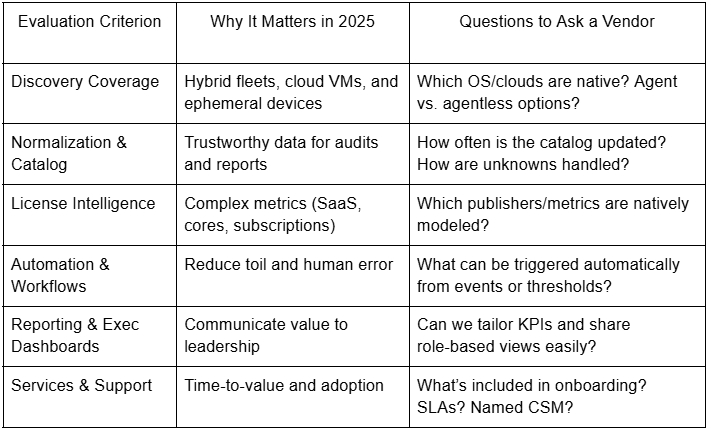
Modern ITAM spans much more than discovery and a CMDB entry. You need multi-platform discovery (Windows, macOS, Linux, mobile, cloud VMs), automated normalization, license intelligence for complex publishers, and tight integration with service workflows. Look for policy-driven lifecycle management: purchase → deploy → move → repair → retire. The platform should reconcile data from multiple sources, eliminate duplicates, and surface trustworthy records that you can audit with confidence.

Automation is no longer optional. You want event-driven updates, enforcement of ownership and location fields, and rules that trigger right-size actions (e.g., reclaim unused software). Add in robust dashboards layered with custom fields, because your executive team will ask for trends on spend, usage, risk, and sustainability (yes, e-waste and power draw now show up in board slides).

Security, Compliance, and Data Trust

Asset data is security data. Your ITAM provider should support strong access controls, encryption at rest and in transit, SSO, and detailed audit logs. If your organization operates in multiple regions, ask about data residency options and attestations (e.g., SOC 2 Type II, ISO/IEC 27001). Software recognition catalogs should be frequently updated to track publisher changes and new license metrics.

Quick security & governance checklist:

  • Role-based access with least privilege

  • Field-level history and tamper-evident logs

  • Automated PII minimization and data retention policies

  • Evidence packs for audits (publisher-specific)

  • Configurable approval workflows for high-risk changes

When your CISO asks, “Can we trust this inventory for threat remediation?” you want to answer with confidence. That requires near-real-time discovery, reconciled identity-to-device mapping, and clear lineage of data changes.

Total Cost of Ownership: Look Beyond the Sticker Price

Pricing can be per-device, per-user, tiered, or packaged with other ITSM capabilities. Don’t compare line items in isolation; model the full program cost for at least 36 months. Include services, connectors, data normalization, training, customizations, and the often-forgotten cost of manual workarounds if a feature is missing.

How to Choose an ITAM Provider in 2025

Build a TCO sheet with three vendor scenarios and a “do nothing” baseline. The right choice is often the one that removes hidden labor while elevating audit readiness and decision speed.

Integrations and Real-World Fit

A stellar ITAM platform lives where your teams already work. Confirm out-of-the-box connectors to procurement, endpoint management (e.g., MDM/EMM), directory services, identity, and your ITSM tool. Test bi-directional flows: a discovered device should automatically get an owner; a retired asset should trigger a ticket and update financial records. If your environment includes niche systems, evaluate the vendor’s low-code integration options and API maturity.

Insist on a realistic proof of value. Bring a messy slice of your environment—multiple device types, stale records, and tricky licenses. A credible vendor will normalize the data, produce reconciliation reports, and demonstrate how exceptions get handled without weeks of scripting. That’s how you separate marketing from muscle.

Vendor Reliability, Roadmap, and Support Experience

Look for transparent roadmaps, frequent releases, and a proven record of shipping customer-requested features. Community forums, knowledge bases, and enablement content matter more than you think—your admins will rely on them under deadline pressure. Talk to customer references that match your size and industry; ask about rollout time, data accuracy at scale, and how quickly support resolves critical issues.

Don’t overlook the human layer. A strong customer success manager, clear SLAs, and predictable communication rhythms can make the difference between a tool you adopt and a tool you abandon. If the vendor offers guided implementation with best-practice templates for lifecycle stages, you’ll accelerate value and reduce change risk.

Putting It All Together: A Simple Selection Plan

Create a ranked scorecard aligned to your outcomes, not just features—weight discovery accuracy, license intelligence depth, automation capability, integrations, and support quality. Run a two-step process: (1) desk evaluation to narrow to three vendors; (2) proof-of-value using your real data. Require written remediation plans for any gaps discovered during testing. Finally, negotiate success-based milestones in your contract so incentives stay aligned.

If you’re evaluating platforms that combine ITAM with service workflows and mature automation, consider exploring ITAM By Alloy Software during your shortlist phase. It’s smart to compare integrated suites with point solutions to see which approach best fits your team’s skills and timelines.


Disclaimer: The information provided in this article is for general informational purposes only. It does not constitute professional advice, and readers should conduct their own research or consult with a qualified professional before making any decisions.

Ruishu Jang’s Award-Winning Work For “The Hereafter Without You”

By: Sherry Lee

Love, obsession, and heartbreak: universal emotions that we all experience at some point in life. Life has experienced the ache of being left, of unrequited feelings, and bad luck in love. Ruishu Jang’s short film production, The Hereafter Without You, takes audiences on a remarkable journey of overwhelming emotions. In a heavily commercialized filmmaking space, she is making a name for herself with her work on content-driven projects. The Hereafter Without You stands out with its exploration of obsessive love, fading memories, and the lingering ache of heartbreak, presented in a way that is both emotionally intense and artistically distinctive.

The project has earned the producer critical acclaim from film fanatics. It won an award at the WorldFest – Houston International Film Festival in the category of Shorts-Dramatic-Original Silver Remi. It was also honored as a winner at the Latitude Film Awards and the Oniros Film Awards. It was a semi-finalist at the Los Angeles Independent Film Festival Awards and the Rome Prisma Film Awards. The Hereafter Without You also received a Best Short Film nomination at the Beverly Hills Film Festival. As the film’s success continues, it has not only garnered international recognition but also opened doors to multiple opportunities for the producer. 

For Ruishu, while international recognition and applause are something she is grateful for, the project shares a much more personal connection with her. Going through a similar phase to the storyline at the time of production and also sharing in the experience with the writer of the script, she was instantly drawn in to be part of the project. About the decision to pursue this project, she has shared on many occasions how she felt about it: “The protagonist felt like a mirror of my own heart. It was this shared ache between me and the writer that drove me to produce the film.” The producer and writer’s relatable connection to the storyline echoes throughout the film, which features many raw moments that feel palpable to the audience.

Ruishu Jang’s Award-Winning Work For “The Hereafter Without You”

Photo Courtesy: Andrii Lantukh / Ruishu Suri Jiang

The pre-production phase of the project presented a mighty challenge to overcome. To create all emotional nuances within the short format of the film. A love which turns into obsession, the blurry grey lines of characters, and the development throughout cinema had to be quick; it needed to be put together in a way that the transition seemed real, not too rushed, and that the audience had enough time to develop an emotional connection with the characters and be able to absorb the changes. For this, Ruishu had a simple exercise in mind. To bring in all the cast and crew to live the story in real time. To ensure everyone was on the same page, she took her time introducing the cast to the shooting locations, the environment to be created through the scenes, and the expectations for immaculate execution in the acting part of the scene. 

When the film came out, the casting was a particular element praised by the viewers. The performances were reviewed as strikingly raw and honest. The producer believes that realism came through from a deliberate casting process that prioritized emotional range and chemistry over fame. “We needed actors who could reach emotional breaking points—people who could live the vulnerability we were trying to portray,” Ruishu added.

For aesthetics, The Hereafter Without You is a visual masterpiece that embraces vibrant saturation, extended takes, and subtle visual dichotomies. The set backdrop, especially its warm yet haunting pink night tone, evokes the complexities of obsessive love. This distinctive visual style emerged from a truly interdisciplinary team: Ruishu’s directorial vision blended with a cinematographer steeped in lighting expertise, alongside a director with a strong background in cinematography. Each member contributed their unique perspective, augmenting the film’s emotional depth. Every visual decision was made to deepen the story; from camera movement to color grading, the emotional journey was always at the forefront. The team crafted a cinematic language that not only complemented the narrative but also encapsulated it, amplifying the film’s emotional resonance for the audience.

Ruishu Jang’s Award-Winning Work For “The Hereafter Without You”

Photo Courtesy: Andrii Lantukh / Ruishu Suri Jiang

Ruishu, when creating the film, knew that it was a project made for a universal audience, the experience of which would vary for each individual. The Hereafter Without You is not a film designed to please everyone. It doesn’t rely on exposition or resolution but instead trusts the viewer to engage with its emotional undercurrents. For those who have experienced the intensity of obsessive love, it offers a subtle yet powerful catharsis. For Ruishu, it is a reminder of the kind of films she aspires to produce—projects that leave a lasting impression by inviting viewers to feel, reflect, and ultimately, release.

This project strengthened Ruishu’s commitment to emotionally driven cinema. It also expanded her vision as a producer, affirming that great filmmaking doesn’t just inform or entertain, but resonates. As the producer continues to evolve in the industry, she aims to build a body of work that blends emotional intelligence with cinematic craft, bringing stories to life that are both deeply felt and beautifully executed.

You can follow Ruishu Jang:


Website: https://www.surijiang.com/

Instagram: https://www.instagram.com/suriiijrs

IMDb: https://www.imdb.com/name/nm9587428

DRIPBL’s Formula for Change: Curiosity, Creativity, and Community in Action

By: Jamal Hamama

Students are chasing their curiosity. Young inventors sketching prototypes at kitchen tables. Classrooms no longer boxed into lectures. That electric energy pulses through DRIPBL, a learning organization that stages education like an arena where thinking, creating, failing fast, and improving matters. What sets DRIPBL apart is not just its tools but its belief: school can be where impact begins and grows, not waits.

Dream, Research, Innovate, then Solve

DRIPBL stands for Dream, Research, Innovate, Problem/Project-Based Learning. These four pillars do not sit in some mission statement to gather dust. They drive every project, every interaction. Students are encouraged first to dream: imagine problems they want to fix. Then they research deeply: gathering data, understanding context, looking at existing solutions. Innovate comes next: finding ideas that are distinct rather than copied. Problem/project-based learning ties it together, giving real challenges or community issues as their canvas.

The emphasis is on individuality. DRIPBL does not follow a one-size-fits-all approach to learning. Instead of pushing everyone through the same mold, the model nurtures each student’s curiosity and unique talents. Hard skills and soft skills grow side by side: coding, science, engineering, yes, but also communication, teamwork, responsibility. Students are encouraged to get their hands dirty, to prototype, to test, to iterate.

Achievements extend beyond internal satisfaction. DRIPBL students have achieved notable recognition, earning patents, launching startups, and presenting at international fairs. Between 2020 and 2024, a dozen students represented DRIPBL at the International Science and Engineering Fair. Some won special awards; others launched inventions. These achievements demonstrate that the DRIPBL model can yield tangible recognition and influence.

Rachna Nath: Architect of Purpose

Founder Rachna Nath brings more than administrative firepower. She is a STEM educator, mentor, public speaker, and deeply embedded in multiple prestigious networks. Among her roles: she’s been recognized by TIME, serves as a Georgia Tech VIP Research Affiliate, works with NASA as a Solar System Ambassador, and mentors high school students for MIT’s Lemelson-MIT program.

When Rachna speaks of what education should do, her focus tends to sharpen. “We must give students permission to explore their own questions,” she says, pushing back on rigid syllabi. “By solving problems that matter to them, they become more than learners and become creators with agency.” Her own conviction that education should reflect real needs: personal, social, environmental, informs DRIPBL’s programs. Projects do not live in isolation; they reach communities, they spark discussions, they have real-world implications.

She combines vision with accountability. There are measurable outcomes: number of patents, number of students attending international fairs, scholarships won, startups formed. Under her leadership, the schoolrooms serve as labs of proof. Every contest won, every pitched idea, every product developed counts. These are part of how DRIPBL assesses its success.

Building Leaders, Not Just Learners

Among DRIPBL’s goals lies something deeper than academic excellence. Students are coached to be socially intelligent, responsible, aware that their inventions and ideas can have a broad impact. The mission emphasizes citizenship in practice. Participants work on community-based problems, discovering that even their smallest design or prototype can have meaningful benefits or unintended consequences.

Statistically, DRIPBL’s impact shows both depth and breadth. The student body includes underrepresented and low-income learners; girls and young women make up a majority in many cohorts. Patents have been filed; startups founded; scholarships earned. What counts is not just who gets left out, but who is now being included. DRIPBL’s metrics—students engaged, products produced, recognition gained—suggest that its model is working with measurable success.

The educational offerings reflect ambition but remain connected to daily life and opportunity. STEM, STEAM, research, competition—all are complemented with mentorship, exposure to real scientists, incubation for ideas. Students don’t only build robots. They develop pitches. They sketch business plans. They apply for patents. They reach across disciplines. These things sharpen minds as well as characters.

DRIPBL stands positioned as more than a school or program. It is a proving ground where dreams take form, fail, get refined, then matter. Under Rachna Nath’s leadership, the work has reached thousands: ideas have found launchpads, students have become voices, outcomes have manifested. Education serves as an active challenge, not passive absorption, but active change. And in that space, leadership is built.

Reach out to Rachna at rachna.nath@dripbl.com / linkedin.com/in/rachnanath1

Rethinking Cloud Cost Optimization: Deepak Mittal’s Vision for Developers, Startups, and Enterprises

By: Elle dela Cruz

CloudKeeper’s achievement of reaching $200 million in annualized revenue, without raising any venture capital, highlights a distinct and disciplined path to growth in the cloud cost optimization sector. Rather than relying on aggressive funding, the company has focused on building scalable, outcome-oriented solutions rooted in deep technical expertise. Leading this effort is Founder and CEO Deepak Mittal, whose background in engineering and commitment to delivering tangible value have shaped CloudKeeper’s trajectory from day one.

In this interview, Mittal shares the core principles behind the company’s product-first philosophy, detailing how it built trust with both cloud providers and customers through consistent delivery and innovation. The conversation also sheds light on CloudKeeper’s approach to developer adoption, its disruption of traditional pricing expectations, and how it maintains credibility and adaptability across a diverse client base, from early-stage startups to complex, global enterprises.

Q: CloudKeeper achieved 50% revenue growth and $200 million in annualized revenue without venture funding. What strategic decisions enabled this capital-efficient scaling while competing against well-funded FinOps rivals?

Deepak: CloudKeeper was born out of To The New, a bootstrapped company I co-founded with a strong cloud and DevOps foundation. CloudKeeper followed the same principles from the start, focusing on delivering real customer outcomes through a highly skilled engineering team and a product-first mindset. Instead of chasing growth through capital, we built scalable, innovative solutions that addressed core cloud cost challenges supported by a team of experts.

Our consistent delivery earned us trust not just from customers, but from cloud providers like AWS and GCP, who now actively recommend us. That ecosystem support, combined with disciplined execution, has helped us scale without raising a single dollar.

Q: Your AWS console-integrated Tuner platform fundamentally changes developer workflows. How did you identify this niche opportunity and convince engineers to adopt optimization tools within their existing processes?

Deepak: One of the consistent challenges highlighted by the FinOps Foundation is getting engineering teams to own cloud cost decisions. It’s understandable as engineers are measured on delivery and performance, not cost. So we knew any solution we built had to align with that reality, not fight it.

CloudKeeper Tuner has been designed with that philosophy in mind, an industry-first AWS usage optimization platform that works seamlessly within existing developer workflows. It performs real-time, non-disruptive optimization while complementing engineers with actionable, performance-safe recommendations, directly into their AWS console, through a simple browser extension.

There were no blueprints for this, we were stepping into uncharted territory. But that gave us the freedom to innovate on our own terms. It was a leap of faith, and it paid off because we put the developer experience at the heart of it.

Q: CloudKeeper offers savings without long-term commitments. How does this model challenge traditional cloud providers’ lock-in strategies, and what pushback have you encountered?

Deepak: CloudKeeper AZ aims to deliver savings without locking customers into long-term commitments. We handle commitment management through group buying and advanced rate optimization, delivering value quickly. Cloud providers have been supportive, as our model drives more predictable and efficient cloud usage. The real challenge has been educating customers, as many assume it’s too good to be true or are hesitant about routing billing through us. We reassure them with complete transparency and clarify that we only require minimal IAM access, with no visibility into their data.

Q: With 100+ AWS-certified engineers, how do you maintain technical depth while expanding into multi-cloud optimization and AI workload management?

Deepak: We have over 100 certified cloud experts across AWS and Google Cloud, many of whom also hold FinOps Foundation certifications. Their deep expertise spans cloud, DevOps, FinOps, and cost optimization. We began integrating AI well before it was mainstream, launching CloudKeeper Auto in 2022, an AI-powered RI management platform that delivers on-demand flexibility at reserved pricing.

We’ve built a strong culture of continuous learning through dedicated cloud learning paths, full certification sponsorships, and internal hackathons to foster innovation. Engineers are incentivized to experiment, upskill, and contribute to technical breakthroughs. A dedicated Center of Excellence now drives our multi-cloud and AI workload strategy forward.

Q: Your Well-Architected Reviews are funded entirely by CloudKeeper – what measurable business outcomes justify this investment compared to paid consulting models?

Deepak: Our fully-funded Well-Architected Reviews deliver immediate, tangible outcomes – unlike generic trials or passive demos. They allow us to dive deep into a customer’s actual cloud environment, identify inefficiencies, and demonstrate measurable savings and performance improvements from day one. This hands-on engagement builds trust and credibility, often converting into long-term partnerships.

Moreover, these reviews generate high-value insights that inform our roadmap and strengthen our optimization models. Even in cases where a customer doesn’t immediately convert, the goodwill and referrals we earn create a strong organic growth channel, making the ROI of these funded reviews far superior to traditional paid consulting approaches.

Q: As you expand in North America, how will CloudKeeper’s approach differ when advising cost-conscious startups versus Fortune 500 enterprises with complex cloud estates?

Deepak: Our approach remains consistent: anchored in personalized engagement – but it flexes to match the scale and needs of each business. We’ve worked with both large enterprises like FranConnect and AMI Strategies, and nimble startups like Appsmith and Chain.io, delivering tailored cost optimization outcomes across industries such as SaaS, FinTech, Healthcare, and Retail. Our team of experts performs in-depth evaluations, aligning Well-Architected Reviews with business goals to uncover savings and eliminate waste. Startups often look for quick wins, such as the immediate savings offered by CloudKeeper AZ, while enterprises tend to focus on modular services like usage optimization, EDP+ support, and multi-layered governance. This flexibility is what makes CloudKeeper a true end-to-end cloud cost optimization partner capable of adapting to diverse needs while consistently delivering measurable results.

Q: With AI infrastructure costs projected to triple, what architectural principles is CloudKeeper advocating to prevent a new wave of cloud waste in generative AI deployments?

Deepak: Generative AI workloads are extremely resource-hungry, and without the right guardrails, they can lead to massive cloud waste. At CloudKeeper, we promote building cost-aware architectures, choosing the right compute options, isolating workloads smartly, and using flexible pricing models like spot instances wherever possible. We also guide teams to streamline how AI is developed and deployed, ensuring they don’t overspend on idle infrastructure or unused models.

Our platforms like CloudKeeper Tuner and Lens are evolving to bring visibility and control to AI-specific spending, right from the start. The goal is simple: help businesses scale AI with confidence without the budget surprises.

CloudKeeper’s evolution reflects a rare mix of engineering precision, product insight, and commercial focus. Through embedding optimization within developer workflows, funding hands-on reviews, and staying ahead of multi-cloud and AI workload needs, the company has set itself apart in the FinOps space. Deepak Mittal’s perspective reveals a founder deeply rooted in technology, yet sharply attuned to business impact.

As cloud costs rise and architectures grow more complex, CloudKeeper offers more than just savings, it provides strategic guidance for companies aiming to scale with control and clarity. Its ability to adapt across startup and enterprise environments, while maintaining measurable outcomes, positions it as a trusted partner for organizations rethinking how they manage cloud efficiency and long-term growth.

EzRemove: A Practical Guide to Simplified Photo Editing with Free Background Removal

Introduction

In today’s digital-first world, visuals dominate everything we see online. Whether you’re scrolling through Instagram, shopping on Amazon, or designing a presentation, one element remains constant: the quality of images. A single picture can influence a customer’s decision to engage, click, or buy. According to HubSpot, visual content is over 40 times more likely to be shared on social media than text-only content. In e-commerce, high-quality product images have been shown to increase conversion rates by up to 250% or more.

One of the most essential editing steps behind these visuals is background removal. A clean, distraction-free background helps products stand out, portraits appear more professional, and designs look more polished. But traditional editing tools like Photoshop often require technical skills and hours of work. This is where AI-powered free image background remover tools like EzRemove can significantly enhance the editing process with speed, accuracy, and simplicity.

In this guide, we’ll explore why background removal is essential, dive into market statistics, analyze who benefits most, and show you how EzRemove can make photo editing more manageable.

The Importance of Background Removal in Photo Editing

Why It Matters

  • Focus on the subject: Removing clutter allows the subject to stand out.
  • Consistency in branding: Brands often need uniform product images across various platforms.
  • Professionalism: Clean backgrounds are often seen as a hallmark of professional photography.
  • Creative flexibility: This allows easy placement of images into designs, ads, or presentations.

Industry Statistics

Over 90% of e-commerce platforms require sellers to upload product photos with pure white backgrounds.

According to Shopify, consistent and clean images can lead to improvements in sales by 30% to 40%.

67% of consumers say product quality images are “very important” in their buying decision.

Clearly, background removal is no longer just an editing preference—it has become a business necessity.

Who Needs a Free Image Background Remover? (Audience Analysis)

1. E-commerce Sellers

For sellers on Amazon, Etsy, eBay, or Shopify, images are vital. A cluttered or inconsistent background can deter potential buyers.

2. Content Creators

YouTubers, Instagram influencers, and TikTok creators rely on polished visuals. Removing backgrounds quickly helps them repurpose content and maintain cohesive feeds.

3. Graphic Designers

Design professionals use background removers to integrate elements into advertising campaigns, logos, and creative projects.

4. Students & Educators

Presentations and projects often need clean, professional-looking images. A free AI background remover can enhance academic work visually.

5. Everyday Users

Even casual users can benefit—editing family photos, ID images, or resumes.

Introducing EzRemove

EzRemove is a free, AI-powered background remover that makes editing fast, easy, and accessible to many. Here’s what sets it apart:

Key Features of EzRemove

  • Free to Use – No subscriptions, no hidden fees.
  • Instant Results – Process images in seconds.
  • HD Quality Output – Clean edges and natural subject extraction.
  • Batch Editing – Upload and process multiple images at once.
  • Cross-Platform Use – Works on desktop and mobile browsers.
  • Privacy First – Uploaded images are processed securely.

How EzRemove Works (Step-by-Step)

  • Visit EzRemove.
  • Upload your image.
  • The AI automatically identifies and removes the background.
  • Download your new image in HD quality, watermark-free.

Data-Driven Benefits of Using EzRemove

  • Time Savings: Users have reported saving an average of 5–10 hours per week on editing tasks.
  • Increased Productivity: E-commerce sellers can process hundreds of product images in a single afternoon.
  • Cost Efficiency: Saves on professional editing fees, which typically range from $25–$50 per image.
  • Creativity Unlocked: Enables marketers and creators to focus more on design rather than repetitive editing.

Use Cases for EzRemove

1. E-Commerce Product Photos

Ensure compliance with platforms like Amazon (white background requirement).

2. Social Media Content

Create thumbnails, banners, and posts with professional-grade images.

3. Business Branding

Logos, presentations, and marketing materials need polished visuals.

4. Academic Projects

Make assignments and slides more engaging.

5. Personal Use

Perfect for ID photos, resumes, or fun creative edits.

What Sets EzRemove Apart from Other Tools

Unlike other tools that may limit downloads or add watermarks, EzRemove provides free, watermark-free HD downloads.

Some competing platforms may restrict daily usage unless users opt for premium plans, while EzRemove offers unlimited use for free.

Its AI algorithms are continuously improving to enhance edge detection and achieve more natural blending.

The Future of AI Background Removal

The global AI photo editing market is projected to reach $1.7 billion by 2027, growing at a CAGR of 23%. With more creators entering digital spaces, the demand for quick, high-quality editing is expected to increase. AI background removers like EzRemove will likely continue to integrate with advanced design features, including:

  • One-click design templates
  • Smart resizing for social media formats
  • Integration with AI video tools

Summary

Background removal is more than just an editing trick—it can be a gateway to better branding, higher conversions, and greater creativity. From e-commerce sellers to students, the demand for fast, free, and accurate tools appears to be on the rise.

With EzRemove, you get a free image background remover that delivers professional-quality results almost instantly, without the steep learning curve or hidden costs of traditional tools. Whether you’re building an online store, creating social media content, or just editing personal photos, EzRemove could be your effortless solution.

Streamlining Rent Collection with Baselane: How Automation Can Help

In today’s fast-paced industry, it can be beneficial to collect rent as efficiently as possible. Once you become a landlord or property manager, you may encounter the challenges that come with collecting rent on your property. The traditional methods can be time-consuming and error-prone. But technology has come up with an innovative solution. Automation has the potential to help make the process of collecting rents easier and more effective. Technology can help create consistent and reliable data so you can begin to focus on important tasks. By using automated systems, you’ll likely increase tenant satisfaction, reduce administrative burdens, and improve the likelihood that payments come in on time. In this article, you’ll learn how automation can revolutionize rent collection, offering you the easiest and most efficient path forward.

Benefits of Automation

The first benefit of automating rent collections is the time savings and reduction in administrative burdens. With automation, landlords may set up recurring billing, in which rent is debited from tenants’ accounts on a certain date of the month. Not only does this decrease the chances of missed payments, but landlords also save time by not having to chase down tenants for payment. Even better, automated systems offer greater accuracy and record-keeping. Since payments are taken in real time, landlords gain access to their property’s financial records in real time. This transparency helps to properly manage multiple properties and simplify tax reporting.

Enhancing Security and Reliability

Security is one of the most important aspects of any financial transaction. Automated systems are equipped with state-of-the-art security features to ensure sensitive financial data is protected from being compromised. This includes secure storage and encryption, which helps both parties involved feel confident that their transactions are safe from fraud. And there’s more. Systems like Baselane ensure their functions are as reliable as possible. There’s a good chance that a high volume of transactions can go through easily, reducing the risk of errors or processing delays. Trust between a landlord and a tenant will be built on this, which may help create a professional relationship that is based on dependability and efficiency. If you understand these basics of automatic rent collection, then you can take steps to improve your property management and be more effective with your money, as well as your tenants benefiting from receiving payments in an efficient and secure way.

Benefits of Using Automation for Rent Collection

Enhanced Efficiency and Convenience

We’ve got to agree that automating rent collection is a significant improvement for both landlords and tenants. Automatic rent collection software like Baselane reduces the amount of manual labor required to collect rent. Instead of tracking payment over the course of the month, landlords don’t need to worry about maintaining track of all the payments. This helps to reduce errors as well as time wasted monitoring payments. Since you will likely always have a deposit to pay, the software sends notifications every month informing you when your rent is due. You don’t have to remember the due date; it’s calculated automatically for you. Relying on software can help you save time and free up valuable time for other things.

Improved Financial Management

Automating rent collection can significantly improve the management of the finances of your property, as a property landlord will likely receive on-demand details about cash flow/finances. With an automatic system in place, the property owner can monitor the amount of rent coming in as well as the current amounts that the tenants owe, and may even generate reports on the monthly financial activity. With this level of transparency and organization, property owners are better positioned to make informed decisions and build financial strategies to help secure their long-term future. Plus, most automated rent collection systems connect to accounting software for even greater ease in tax preparation and fiscal management.

Increased Security and Reliability

With financial transactions being one of the most sensitive forms of transactions, automated rent collection solutions are designed to ensure that your personal information is protected. Because of modern encryption and payment processing solutions, companies like Baselane provide strong protection for your property rental records. This not only protects you as a landlord from fraudsters but also builds trust between you and your tenant by increasing confidence in the process. And when it comes to automation, there are more opportunities to avoid missed payments or even errors in the system, which helps maintain cash flow and therefore improves the relationship between tenant and landlord.

Key Features to Look for in Rent Collection Software

Automated Payment Processing

Rent collection software should automate payment processing. Through this feature, everything flows so smoothly that you don’t need to pay someone or wait for it to arrive. This means you can get payments from all sorts of sources, be it a credit card, an ACH check, or a digital wallet, without ever having to do anything. Not only will it reduce your risk of late fees and improve your overall satisfaction with your property, but the convenience of being able to track these payments also makes it easier for you to focus on other important aspects of your property management. Automatic rent collection systems are typically equipped with notifications for tenants, reminders, and the ability for them to set up recurring payments.

Integration Capabilities

A good rent collection software platform should be able to connect with your current property management systems as well. That way, you’ll have the same data and avoid mistakes based on incomplete entries.

User-Friendly Interface

A user-friendly interface on the part of landlords and tenants is important. That said, this particular software must allow easy navigation and accessible features that can help simplify both the setup and management of rent collection. These things can include dashboards that help you get an idea of payment status and the history of payments in an easy way. If you make it easy to use, the software will likely encourage adoption and satisfaction on the part of everyone using it. When you consider the features mentioned above, it becomes much easier to choose a rent collection software that will likely meet your needs, but will also improve both the efficiency and security of your rental business. Something like Baselane offers these. Therefore, it is worth looking into if you want to maximize your rent collection workflow.

Summary

Invoking automation means becoming part of the next wave of property management. When you start automating your processes, you are preparing to become a market leader in modern property management. You may learn not only how to improve your bottom line, but you could also help save your tenants’ money by eliminating errors, so you can focus on building a great relationship with your tenants and growing your real estate portfolio. When you use automated technology solutions, you’re likely improving your business’s ability to stay competitive and flexible in a rapidly evolving property market. This could be the future of property management.

Why Knowing Skin and Structure Matters to Your Look?

Most of us think style starts with clothes, or maybe makeup. But underneath all of that, your skin and bone structure shape how everything else sits. Why knowing skin and structure matters to your look isn’t just a beauty-industry line; it’s real. Makeup clings differently depending on texture. Hairstyles flatter (or don’t) depending on jawlines. Even sunglasses look cooler when they suit your cheekbones. And honestly, once you notice it, you can’t unsee it.

It’s why experts obsess over facial mapping, why people spend money on contouring tutorials, and why the phrase “advanced facial anatomy masterclass” exists. The first time I heard it, I thought it was some overly technical course for surgeons. But then a friend explained it was about understanding how skin layers and bone structure affect aesthetics. It suddenly clicked: oh, that’s why the same haircut makes one person glow and another look… off.

And these masterclasses aren’t just buzzwords. They dive into things like customized reconstruction strategies, where practitioners learn to create surgical plans tailored to each person’s anatomy and goals. 

They cover facial nerve mapping, which is all about minimizing risk by understanding the web of nerves that run under the skin. And they even go into advanced soft tissue manipulation, the art of repositioning or grafting tissue in ways that make results look natural, not “done.” It’s technical, yes, but the whole point is to translate anatomy into aesthetics that feel effortless.

Why Knowing Skin and Structure Matters to Your Look

Let’s just say it: confidence comes easier when the outside feels aligned with the inside. And skin + structure are the foundation. You can buy every trend in Sephora or Zara, but if you don’t know your own face shape, your undertones, your proportions — you’re shooting in the dark.

Think of it like travel planning. You don’t just book a random city without checking the map, right? Same here. Knowing your structure is like having a map of your look.

Skin: The Texture and Tone Story

Your skin tells a story before you say a word. Smooth, textured, scarred, glowing, oily — it all changes how products behave. I once splurged on a highlighter I’d seen on Instagram. Looked magical on the model. On me? Emphasized every pore. That’s when I realized: the product wasn’t bad, I just hadn’t paid attention to my skin.

  • Dry skin loves dewy formulas.
  • Oily skin fights them off within hours.
  • Pigmentation changes how colors show up.

Pro Tip: Next time you’re tempted by a new product, swatch it on your bare skin in daylight. That’s the truth test.

Structure: The Architecture Underneath

We don’t talk enough about bone structure. Cheekbones, jawlines, forehead slopes — these aren’t flaws or perfections, they’re frameworks. They decide how bangs sit on your face, whether a bold brow lifts or overwhelms, even how blush should be placed.

The first time I got my brows shaped professionally, I thought they’d just pluck stray hairs. Instead, the stylist mapped angles to my orbital bone. I left looking… polished. Not different exactly, but more me.

This is also where things like an advanced facial anatomy masterclass come in for professionals. They study how fillers, skincare, even surgery interact with natural lines. But even as non-experts, just noticing your proportions changes the way you shop for style.

Fashion and the Face: Oddly Connected

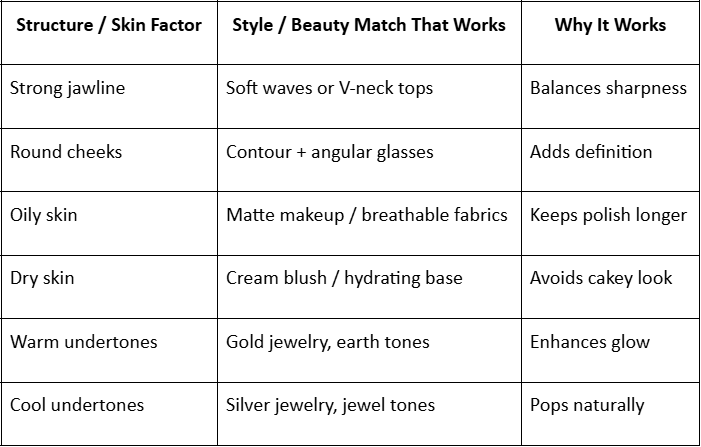
Clothes? Yep, still tied to skin and structure. Think necklines. A deep V flatters strong jawlines; high collars emphasize delicate ones. Bold prints fight against textured skin but glow on smoother complexions. Even glasses frames are basically structure math.

I once bought chunky cat-eye sunglasses in Florence — thought I looked movie-star glamorous. Photos later? My rounder cheeks swallowed them. Wrong structure, wrong choice. Lesson learned.

Treatments That Enhance, Not Change

Modern beauty treatments often get framed as vanity. But when you view them as tools to harmonize skin and structure, they make sense.

  • Microneedling evens texture → makeup glides.
  • Fillers restore volume → clothes hang differently around the neck/shoulder line.
  • Lasers brighten tone → bolder lipsticks pop.

And yeah, sometimes it’s subtle. A tweak no one else notices, but you do. That alone shifts confidence.

Style Confidence = Knowledge

Why knowing skin and structure matters to your look isn’t about chasing perfection. It’s about awareness. You know your undertone, you stop buying foundations that make you look ghostly. You know your jawline, you skip the haircut that shortens your face. Knowledge saves time, money, stress.

It’s like travel again: learning the subway map makes a city friendlier. Learning your face and skin makes fashion friendlier.

Quick Style-Structure Matches

Here’s a little cheat sheet:

Why Knowing Skin and Structure Matters to Your Look?

The Psychology Side

There’s also a mental loop here. When you understand your structure and skin, you stop fighting yourself. You shop smarter, dress with less stress, even pose in photos differently. And confidence shows. People see it before they see the outfit.

Advanced Learning (If You’re Curious)

This isn’t just influencer-level stuff. Courses exist — yep, like that advanced facial anatomy masterclass I mentioned — that dive deep into how skin layers, muscles, and bone interact. Most of us don’t need the full scientific breakdown, but it’s worth knowing that even pros treat skin + structure as the foundation. That’s how models are styled, how actors are lit. It’s intentional.

Wrapping It Up: Foundation First

At the end of the day, your look isn’t just what you throw on in the morning. It’s skin, it’s structure, it’s knowledge layered with choices. Why knowing skin and structure matters to your look is simple: it grounds style in reality. Clothes, makeup, hair — they all bend to the foundation underneath.

And the best part? Once you know, you can break rules on purpose. Wear colors “wrong,” pick hairstyles that challenge norms, lean into contrasts. But you’re doing it knowingly, not blindly. That’s style maturity.


Disclaimer: The information provided in this article is for general informational purposes only and should not be construed as professional beauty or styling advice. While understanding skin and structure can enhance personal style, individual results may vary. Readers are encouraged to consult with professionals for personalized recommendations and guidance.

The Story Behind Saisei’s Seamless Leggings and Sustainable Design

Leggings are everywhere today—from yoga studios to offices, from streetwear runways to living rooms. They are praised for their comfort, versatility, and sleek silhouette, but few stop to ask: how did a garment so simple become such a cultural phenomenon? To understand leggings is to uncover a story of rebellion, innovation, and the redefinition of the human body in fashion.

From Armor to Everyday Wear

The concept of tight-fitting leg coverings is far older than modern fashion. In the 14th century, men across Europe wore fitted hose made of wool or linen, which were predecessors to both trousers and leggings. These garments provided warmth, protection, and mobility, functioning almost like a second skin. Soldiers even layered them under armor, proving that what we think of as “athleisure” today had its earliest life in battlefields.

By the 19th century, leggings appeared in military uniforms once again, often made of leather or canvas to protect soldiers’ legs in harsh environments. It wasn’t until the 20th century, however, that leggings began to transition from utility to fashion. Their transformation was tied to something powerful: the invention of synthetic fibers.

Lycra and the Fitness Revolution

In 1958, DuPont introduced Lycra, a stretchy fiber that would change clothing forever. For the first time, fabrics could cling to the body while maintaining shape and comfort. Leggings made with Lycra became widely associated with movement and freedom.

The 1980s fitness boom, complete with aerobics classes, neon colors, and workout tapes, helped push leggings into pop culture. They weren’t just clothes—they were lifestyle symbols, representing energy, empowerment, and a new visibility of the active female body. For some, this was liberating. For others, controversial. Leggings had crossed from private workouts into public fashion, sparking debates that continue even today.

The Controversy of Leggings

Few garments inspire as much debate as leggings. Are they pants? Should they be worn in formal settings? Why do they attract such polarized opinions? The answer lies in their intimacy. Leggings blur the line between underwear, sportswear, and outerwear. They are unapologetically close to the body, making them both empowering and provocative.

This controversy is precisely what has kept leggings culturally relevant. They are not neutral; they challenge dress codes, redefine silhouettes, and invite new conversations about body image, modesty, and freedom.

Innovation Beneath the Surface

Modern leggings are remarkable examples of textile engineering. Fabrics now incorporate four-way stretch, moisture-wicking technology, and compression zones designed to support muscles. Some leggings even include antimicrobial fibers, keeping them fresh after intense workouts.

But perhaps the most exciting frontier is seamless technology. By eliminating seams, leggings can be produced with less fabric waste while offering increased comfort. Seamless construction also allows for strategic variation in texture and compression, meaning leggings can be sculpted directly on the knitting machine. What was once a simple tube of fabric has become a sophisticated piece of design science.

Saisei: Redefining Leggings for the Future

This is where Saisei enters the story. The brand’s philosophy of seamless craftsmanship and sustainable design finds its great canvas in leggings. By removing seams, Saisei reduces irritation during movement while cutting down on waste in production. Their use of eco-friendly fibers gives leggings both durability and breathability, ensuring they last far beyond the fast-fashion cycle.

Unlike trend-driven designs, Saisei’s leggings emphasize timeless minimalism. They are made to move with the body, whether in yoga practice, during long commutes, or in moments of stillness. Each pair represents the brand’s belief that essentials should combine performance with responsibility.

Saisei’s approach shows that leggings are more than an athleisure staple—they are symbols of what clothing can become when innovation and sustainability work together.

The Future of Leggings

Looking ahead, leggings are likely to become even more high-tech. Researchers are experimenting with conductive yarns that could transform leggings into wearable health monitors, tracking hydration levels or muscle recovery. At the same time, cultural shifts toward inclusivity will continue to expand sizing, fits, and styles, ensuring leggings serve a broader global audience.

Yet, despite all innovation, leggings’ essence will remain the same: they are garments of freedom. A single piece of clothing that bends rules, adapts to lifestyles, and reflects the values of each generation.

Final Thoughts

Leggings have traveled from medieval armor to modern fashion runways, from soldiers’ uniforms to sustainable essentials. They have been symbols of controversy, empowerment, innovation, and comfort. What makes them remarkable is not just their stretch or their silhouette, but their ability to adapt—to technology, to culture, and to values.

Saisei demonstrates how leggings can evolve responsibly. Seamless, sustainable, and timeless, their designs remind us that even the simplest garment can carry extraordinary meaning. Leggings, after all, are not just about what we wear on our legs—they are about how we move through the world.

From Manhattan to Global Markets: Business Structures That Work

By: Sam Zell

I’ve always thought Manhattan was its own planet. The pace, the skyline, the constant talk about “the next big thing.” But here’s the truth — businesses that start in Manhattan often dream bigger. They’re not content with one borough or even one city. 

They eye Paris, Dubai, Singapore. And here’s where the real test begins: business structures. It sounds dull at first, but honestly, it’s the skeleton of everything. From taxes to liability to whether investors even take you seriously.

Why knowing the right structure matters is obvious in theory. But when you go global, the stakes get higher. You need to know not just LLC vs. corporation, but joint ventures, licensing, public entities, and yeah — sometimes you need support for forming offshore companies too. 

And that’s less shady than it sounds. Offshore company formation is basically registering your business in a foreign market so you can tap into friendlier regulations, tax efficiencies, or easier access to global customers. Firms like Ascot help guide you through the process — choosing jurisdictions, understanding compliance, and setting up in places where expansion makes sense without wading blindly into legal complexity.

The first time I heard that phrase, I rolled my eyes. Offshore sounded shady, like something out of a crime documentary. Then I actually looked into it. Turns out, it’s less scandalous and more survival strategy for certain industries.

Why Structure Matters: Beyond Paperwork

So, why do business structures matter so much? Because they decide:

  • How much personal risk you take on.
  • How your taxes look (and whether they crush you).
  • How easy it is to raise capital.
  • How much control you keep.

In Manhattan, it’s tempting to go for speed — sole proprietorship, quick LLC. Fast, easy, minimal fuss. But when you’re thinking “global markets,” you need something sturdier. Think of it like upgrading from a studio apartment to something with real walls and space.

Sole Proprietorships and Partnerships: Fine… Until They’re Not

A lot of businesses begin here. You + an idea. Or maybe you and a friend. Simplicity has perks. But unlimited liability? That part stings. One lawsuit, one unexpected debt, and your personal assets are on the line.

For exporting goods or dipping into overseas markets, this structure feels fragile. I met a boutique owner once — she tried exporting her handmade bags to Europe under a sole proprietorship. Customs, taxes, import headaches… it nearly broke her. She switched to a limited company and suddenly doors opened.

Limited Companies (LLCs / Ltds): The Global Sweet Spot

Honestly, this is where most NYC entrepreneurs land when going global. Limited liability. Separation between you and the business. Investors like it. Banks like it. Even clients feel reassured.

It also makes hiring abroad easier. You can contract, employ, source materials, all without blurring personal lines. And with the right advisors, you can structure tax obligations to avoid painful surprises.

Pro Tip: If you’re planning overseas expansion, check whether your LLC can register subsidiaries in your target country. It saves a ton of headaches later.

Public Companies (PLCs): Big Game Territory

This is where you go when you want to raise serious capital. Shares on the market. Stringent regulations. In Manhattan terms — think Wall Street IPOs, splashy headlines.

Pros? Cash flow and credibility. Cons? Transparency requirements that can feel invasive, and loss of control if investors hold sway. Not for the faint of heart, but essential for businesses scaling at a global pace.

Licensing and Franchising: Expanding Without Moving

Here’s where it gets fun. You don’t always need to “set up shop” abroad. Sometimes, you license your IP. Sometimes, you franchise your model.

  • Licensing: another company uses your designs/brand for royalties.
  • Franchising: someone runs your concept under your brand rules.

McDonald’s did it. So did countless fitness studios. The risk? Less control. Your brand’s reputation rests in the hands of outsiders. But the reach? Enormous.

Joint Ventures: Shared Beds, Shared Risks

A joint venture is like dating with paperwork. You team up with a local partner in a target market. They bring expertise, connections, networks. You bring brand, capital, or tech.

I once watched a Manhattan-based wellness brand team up with a Tokyo spa group. The partnership thrived because the local partner knew Japanese consumer habits better than any outsider could. But — and this is big — not all joint ventures end in harmony. Cultural clashes, profit splits, differing visions… it can unravel quickly.

Offshore Companies: Not Always What You Think

Here’s where we circle back. Offshore used to sound sketchy. But support for forming offshore companies is becoming a normal part of global business planning. Why?

  • Tax efficiency (not avoidance, but optimization).
  • Access to international banking.
  • Easier movement of capital.
  • Privacy in competitive industries.

Places like the Cayman Islands, BVI, even Cyprus get attention because they simplify cross-border complexities. Not every business needs this — but for some, it’s the only way to manage multiple markets without drowning in red tape.

Pro Tip: Never set up offshore alone. Always use licensed advisors who understand both NYC law and your target country. Cutting corners here can wreck your reputation.

Exporting Goods: Low-Risk First Step

Exporting is the “toe dip” into international waters. You sell abroad, but keep operations local. It’s affordable, low risk, and perfect for testing demand.

Structures that fit? Sole trader (small scale), limited company (growth-friendly). The challenge is logistics: customs, currency, shipping. Tools like multi-currency accounts help, but don’t underestimate the paperwork.

Table: Quick Breakdown of Business Structures

From Manhattan to Global Markets Business Structures That Work

Reflections: From Manhattan Streets to Global Streets

In the end, going global isn’t just about ambition. It’s about architecture. The architecture of your business. From a tiny salon in Midtown to a multinational with franchises in Dubai, the structure shapes your story.

Why? Because it’s the unseen foundation. Clients see the logo, investors see the numbers, employees see the culture… but the structure quietly directs all of it. And whether you need a simple LLC or full-on support for forming offshore companies, the choice determines whether you’re just surviving in Manhattan or thriving in global markets.


Disclaimer: The information provided in this article is for general informational purposes only and should not be construed as professional legal or financial advice. Business owners and entrepreneurs are encouraged to consult with legal and financial professionals to determine the best structure for their specific needs, especially when expanding into global markets.