
By: Elowen Gray
We are drowning in fakes. Deepfake videos of politicians saying things they never said. AI-generated news articles that spread faster than the truth. Viral conspiracy theories that resist every attempt at debunking. Influencers who curate lives that do not exist. The line between truth and fiction has never seemed more blurred or more dangerous.
In this context, the word hoax carries a heavy weight. It evokes malicious deception, deliberate manipulation, the erosion of trust. It is the stuff of clickbait headlines and fact-checking websites. It is something we are warned about, something we are taught to guard against.
But what if there is another kind of hoax? One that is not malicious but playful? One that does not erode trust but tests it? One that does not deceive for profit but for the sheer intellectual joy of the prank?
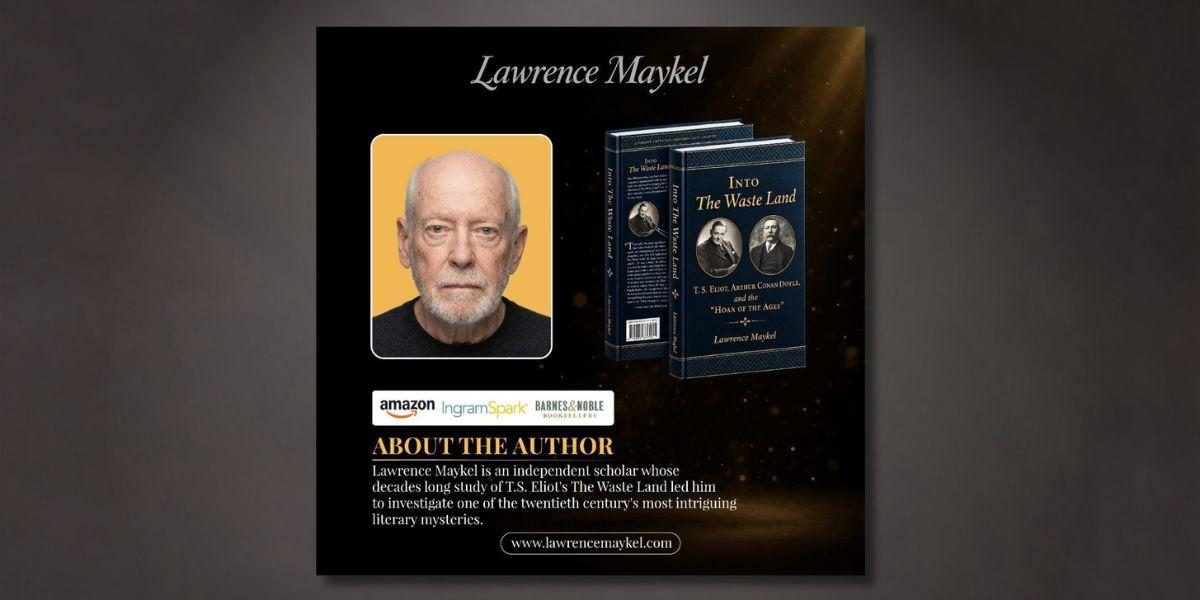
That is the question at the heart of Lawrence Maykel’s new book, Into The Waste Land: T.S. Eliot, Arthur Conan Doyle, and the “Hoax of the Ages.” Maykel argues that two of the most celebrated figures in English literature and science, T.S. Eliot and Arthur Conan Doyle, were also two of the most ingenious hoaxers in history. And their hoaxes, far from being cynical deceptions, were actually acts of creative genius.
The Piltdown Man and the Purposeful Prank
The Piltdown Man is one of the most famous scientific frauds in history. In 1912, fragments of a skull and jawbone were discovered in a gravel pit in Sussex, England. They appeared to belong to a previously unknown human ancestor, a missing link between apes and humans. The discovery was hailed as proof that human evolution had begun in England.
Forty-one years later, the whole thing was exposed as a fraud. The jaw belonged to an orangutan. The skull was human but medieval. The teeth had been filed down by hand. The bones had been stained to look ancient.
Who did it? The question has never been definitively answered. But Maykel makes a compelling case for Arthur Conan Doyle. The creator of Sherlock Holmes had the medical knowledge, the materials, the proximity, and the sense of humor to pull it off. He lived within walking distance of the site. He owned a personal museum of fossils and artifacts. He was a physician before he was a writer. He was a notorious practical joker. And he was the only suspect who was a confirmed cricket fan, a detail that matters because the final artifact found at the site was a piece of elephant femur carved into the shape of a cricket bat.
Why would Doyle do such a thing? Maykel argues that the hoax was not malicious. It was aimed at Charles Dawson, a man Doyle considered a fraud and a charlatan. Dawson had committed numerous smaller deceptions and gotten away with them. The Piltdown hoax was an attempt to get Dawson busted for a hoax he did not commit, as a punishment for all the hoaxes and frauds he had committed and gotten away with.
In other words, the hoax was a form of justice. It was a prank with a purpose.
The Waste Land and the Confession in Code
If the Piltdown Man was a scientific hoax with a moral purpose, The Waste Land was a literary hoax with an artistic one. Maykel argues that Eliot deliberately scrambled the verses of a unified narrative poem, embedded clues for reassembling them, and then appended a set of bogus notes designed to mislead critics.
Why? Because the poem’s true narrative was too personal, too painful, too revealing to publish directly. It told the story of Eliot’s own marriage. His wife’s affair. Her pregnancy. The abortion. The guilt and grief that followed. Eliot could not publish that story openly. But he could hide it in plain sight. He could encode it in a poem that would be admired, analyzed, and misinterpreted for a century.
The hoax, in this reading, was not an act of deception. It was an act of self-protection. It was a way for Eliot to tell the truth without telling it. It was a way to hide a confession inside a puzzle. It was a way to say something he could not say directly, to share something he could not share openly, to reveal something he could only reveal in code.
The Ethics of the Playful Hoax
What do these two hoaxes teach us about our own moment? Maykel’s book invites us to think about the difference between deception and play, between lies and puzzles, between hoaxes that erode trust and hoaxes that reward it.
The Piltdown Man and The Waste Land were both designed to fool experts. Both relied on a combination of genuine material and clever forgery. Both were perpetrated by men who were, in different ways, at the top of their fields.
But neither was designed to cause harm. Neither was motivated by greed or malice. Both were, in their own ways, acts of creative mischief. They were pranks that tested the boundaries of what we know and how we know it. They were jokes that asked us to question our assumptions. They were puzzles that rewarded careful attention.
In an age of misinformation, that distinction matters. Not all hoaxes are created equal. Some are designed to deceive. Others are designed to delight. Some erode trust. Others test it. Some are cynical. Others are playful.
Maykel’s book does not excuse deception. It does not suggest that all hoaxes are harmless. But it does ask us to consider the difference between a lie and a puzzle, between a fraud and a prank, between a hoax that diminishes us and one that expands our sense of what is possible.
The Lesson for Our Time
We live in an age of fakes. We are bombarded with misinformation. We are manipulated by algorithms. We are asked to trust institutions that have often betrayed that trust. In this context, the idea of a good hoax might seem naive or dangerous. It might seem like a luxury we cannot afford.
But maybe there is something to learn from Eliot and Doyle. Maybe the difference between a malicious hoax and a playful one is the difference between deception for profit and deception for wonder. Maybe the difference is whether the hoax invites you to think, to question, to solve, or whether it simply exploits your credulity.
The Waste Land has been called the greatest hoax of the century. But if Maykel is right, it is a hoax that rewards the reader. It is a puzzle that has been waiting a hundred years for someone to solve it. It is a deception that, once uncovered, reveals not emptiness but meaning.
That is a different kind of hoax. That is a hoax that respects its audience. That is a hoax that says, I think you are smart enough to figure this out. That is a hoax that treats you like a partner in the game, not a victim of the con.
In an age of misinformation, maybe that is the kind of hoax we need more of. Not deceptions that insult us, but puzzles that challenge us. Not lies that divide us, but games that bring us together. Not hoaxes that make us cynical, but hoaxes that make us curious.
The Waste Land is not a lie. It is an invitation. And the invitation is still open.