How to Find the Courage to Try Again After Pregnancy Loss: Inside When Fear Met Hope by Darci Borski


By: Jaxon Lee

About 8,300 babies are stillborn every day around the world, that’s roughly 1.9 million a year. Darci Borski opens her memoir with that number, then refuses to let it stay a number. In When Fear Met Hope, she follows one mother’s path from devastating loss toward the courage to hope again. The book never claims to fix grief. It offers something more useful: honest, practical lessons from a woman who kept walking.

Why Trying Again Feels So Frightening

After losing her son Jax, Borski found that hope felt dangerous. Her body stayed on alert. She startled easily, slept badly, and braced for the next blow. A therapist helped her see these reactions as trauma responses, not weakness.

Many readers will recognize that bracing. A pregnancy test becomes a verdict. A waiting room becomes a memory. Borski shows that fear after loss is not a character flaw. It is a body trying to protect its owner. Courage begins when a parent stops fighting that fear and starts working with it.

Six Lessons From Borski’s Journey

1. Say the Baby’s Name

Borski first spoke Jax’s name aloud in therapy, and it felt like pressing on a bruise. She kept going anyway. Later, her counselor told her that loving a new baby wouldn’t jinx him, and that joy wouldn’t betray Jax. That reassurance gives readers a gift: grief and hope can share one heart.

2. Build a Care Team That Fits

Borski gathered help from many directions. Family members came to her home every day. A therapist taught her tools for panic. Fertility specialists looked for answers when waiting stopped working. An obstetrician studied her whole history and welcomed extra ultrasounds. A support group, however, overwhelmed her, and she never returned. That honesty matters, because the right support steadies the person receiving it. Parents who want information and community can start with the March of Dimes stillbirth support page.

3. Trust the Quiet Voice

During her next pregnancy, Borski went to maternity triage again and again. Each time, she asked for the monitor first, then exhaled at the sound of a heartbeat. She tells readers directly: “You are not overreacting.” Her example shows that speaking up is not drama. It is love in action.

4. Protect Your Peace

Borski kept her pregnancy quiet. She skipped announcements, public countdowns, and baby showers. She declined invitations and asked relatives to handle replies. She calls this wisdom, not weakness: “You are allowed to protect your heart.” Readers receive permission to set boundaries without guilt.

5. Prepare Your Words

Medical appointments hit hard. Borski began every visit with a short sentence explaining her tragic, complicated history and her need for gentle care. That sentence became her armor. She also brought a trusted person to ultrasounds. Readers can borrow the tactic: write the sentence ahead of time and say it first.

6. Plan Small Things to Look Forward To

Waiting felt unbearable, so Borski filled empty hours with walks, puppy school, coloring pages, and time with friends. She calls these activities “containers” that gave her fear edges. She also gave herself permission to cancel plans, rest, and simply breathe. On the hardest days, she writes, breathing is enough.

What Hope Actually Looks Like

Borski does not describe hope as fireworks. Her family texted each other an anchor symbol as a code for steadiness, and a sister’s message told her to keep swimming. Hope, in her words, “arrived like breath.” It came quietly, again and again.

That image comforts because it lowers the bar. Parents do not need a grand burst of confidence before trying again. They need the next appointment, the next kick count, the next deep breath.

Try This: A Three-Question Check-In

Readers can pause here and reflect:

  • Whose name needs to be spoken aloud?
  • Who belongs on the care team, and who is missing?
  • What small event can bring something to look forward to this week?

Answering even one question counts as a first step.

Why This Book Belongs on the Shelf

Borski writes as a teacher and coach who kept showing up for other people’s children while grieving her own. That lived experience gives the memoir its authority. Family and friends will also find guidance, especially in her candid pages about invitations and well-meant comments that sting. How the story ends stays inside the covers, but its message arrives early: hope and fear can live in the same heartbeat.

What Courage Looks Like From the Inside

Trying again takes courage, and courage rarely feels like courage from the inside. Borski’s memoir shows it looks like a whispered name, a text to a doctor, a declined invitation, a deep breath. Her story proves that a first step can be small when Fear Met Hope walks beside parents on that road.

Which lesson speaks to readers most? Share it in the comments. Another parent may need to read it.

Amazon Link: https://www.amazon.com/dp/B0H9GBQ7K8

Disclaimer: This article shares a personal experience with pregnancy loss and is not medical or mental health advice. Grief looks different for everyone. If you are having a hard time, please reach out to a qualified healthcare provider or licensed mental health professional.

MoMA PS1 Revisits New York’s Avant-Garde Fashion Years With Charles James and R. Couri Hay

By: Jeremy Murphy

When Fashion Broke the Rules

As MoMA PS1 celebrates its 50th anniversary, a new exhibition resurrects the rebellious fashion scene of the early 1980s, with rare contributions from author, TV personality, and PR guru R. Couri Hay, filmmaker and photographer Anton Perich, Charles James’s last protégé Homer Layne, and designers Willi Smith and Betsey Johnson.

Before fashion exhibitions became blockbuster museum attractions, a group of rebellious New York designers was turning clothing into art inside a former public school building in Queens. Garments were pinned to walls, draped over furniture, suspended like sculptures, and sometimes covered in plaster.

Now, half a century later, MoMA PS1 is revisiting that experimental era with New York Fashion at PS1, 1980–1984, an exhibition celebrating the museum’s 50th anniversary and the extraordinary creative community that helped redefine the relationship between fashion and contemporary art. On view through March 15, 2027, the exhibition recreates installations originally conceived by the late stylist and independent curator Hollywood Di Russo, whose unconventional presentations brought together emerging designers, established fashion figures, and downtown artists.

Curated by Kari Rittenbach, the exhibition features designs by Betsey Johnson, Willi Smith, Julio Espada, Homer Layne, and legendary couturier Charles James, alongside archival photographs, films, drawings, and historical materials. Among its contributors is longtime New York cultural figure R. Couri Hay, the author of the book “Charles James: Beneath The Dress.” Hay also lent a group of rare Charles James drawings from his personal collection, including fashion illustrations and provocative erotic works.

For Hay, the exhibition represents something of a homecoming. “I was the original emcee for the opening of PS1,” he recalls of the museum’s beginnings in 1976. “At that point it was a huge, emptied-out building; just beginning to be filled with art.”

He remembers arriving with a spirited collection of artists, writers, and poets, including his friend, artist Colette. “We all paraded out there from Manhattan along with a couple of hundred young artists, writers, models, painters, and poets, it really was a wild scene 50 years ago,” Hay recalls.

Photo Courtesy: R. Couri Hay

Fashion Without Boundaries

Between 1980 and 1984, PS1 presented ten fashion exhibitions, most organized by Di Russo, challenging conventional ideas about how clothing should be displayed. Rather than presenting immaculate mannequins in carefully controlled galleries, designers treated garments as experimental objects. Clothing appeared stuffed, flattened, suspended, and transformed into sculptural installations. “It was the opposite of what you would see at the Costume Institute at the Metropolitan Museum,” Hay explains. “The curators would pin the clothes to the walls, hang them from the ceilings and put plaster all over them and mold them into sculptures, and, of course, everyone pranced around in their own concoctions, vying to be photographed by Patrick McMullan and Anton Perich.”

The original exhibitions captured an extraordinary moment in New York cultural history, when fashion, performance, nightlife, and contemporary art frequently overlapped. The current exhibition revisits work by Ronald Kolodzie, Adrienne Scott, Lloyd Allen, Gary Cathey, Valborg Fletre Linn and Yeohlee Teng, alongside better-known names including James, Smith and Johnson. Their contributions reflected changing attitudes toward gender, personal identity, and professional dress as American workplaces and social conventions evolved.

Smith, whose WilliWear label helped democratize fashion, brought an energetic, accessible approach to design. Johnson’s irreverent creations challenged traditional femininity, while other participants explored unconventional construction, silhouettes, and the possibilities of clothing as artistic expression. Archival photographs, printed materials, and original exhibition documentation help reconstruct this influential but frequently overlooked chapter in New York fashion history.

Charles James, Captured on Film

Two films provide particularly compelling windows into the period. Made in New York, a rarely screened 1984 WilliWear production directed by Les Levine, features appearances by Smith, choreographers Bill T. Jones and Arnie Zane, artist Jenny Holzer, and sculptor Arman.

The second, filmed by artist Anton Perich with interviews by Hay, documents an extended series of conversations with Charles James at the Chelsea Hotel, where the celebrated couturier spent his final years. Hay conducted the interviews over several years, continuing until James’s death in 1978. The project’s extraordinary length was encouraged by Hay’s friend and mentor Andy Warhol. “I told him, ‘We just filmed three hours.’ Make it longer. ‘We just filmed 12 hours.’ Make it longer, said Andy,” Hay recalls. “So this went on for several years.”

Inspired by Warhol’s experimental filmmaking, Hay ultimately accumulated approximately 24 hours of footage, although only 20 hours have been located. “I’m searching through my storage to find ‘the lost four hours,’” he says. The film’s handheld, occasionally unsteady, cinematography offers an intimate contrast to the polished fashion productions audiences have come to expect.

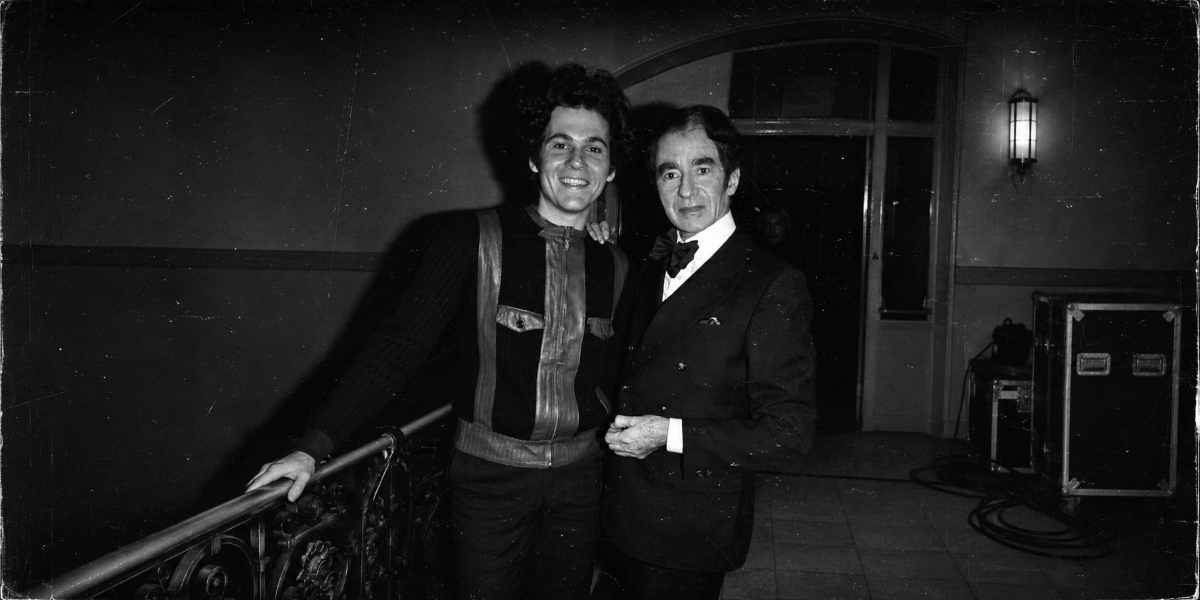
Photo Courtesy: Anton Perich (Charles James Beneath the Dress, Homer Layne, Matuschka, & R. Couri Hay at Antonio Lopez’s Studio)

A Personal Collection Becomes Public History

Rittenbach approached Hay, requesting a group of specific James drawings that had appeared in Di Russo’s original exhibitions. Among them are erotic illustrations and a drawing of James’s celebrated white satin eiderdown coat, an early precursor to modern puffer outerwear.

Hay remembers occasionally wearing the remarkable garment to Studio 54. One drawing carries an especially personal connection: James’s depiction of Hay’s backside. “I was rather amused by the curator’s presentation,” Hay says. “On one wall was my bottom, drawn by Charles James, and on the other wall was my face,” appearing in the documentary.

Beyond the humor, the experience prompted reflection on his role in preserving fashion history. Hay says he has already donated approximately 300 James drawings and documents to the Metropolitan Museum of Art and plans to contribute additional works, including illustrations by Antonio Lopez depicting James’s creations.

“I thought I was just a crazy kid, running around the Chelsea Hotel with Lou Reed, Candy Darling, Andy, and Richard Bernstein, who drew all the covers of ‘Interview’ magazine where I worked as one of the original three editors,” he recalls. “Now the film turned out to be something interesting and historically important. ”

He is also working to place the James documentary in MoMA’s permanent collection. For Hay, the exhibition’s greatest achievement is not the personal recognition but the preservation of an extraordinary creative generation. “Charles James is the genius,” he says. “His work needs to be kept and preserved and cared for forever.”

New York Fashion at PS1, 1980–1984 is on view at MoMA PS1 in Long Island City, Queens, through March 15, 2027.

Digital Habits That Help Entrepreneurs Save Time and Grow

As an entrepreneur, you can spend your entire day searching for files, updating spreadsheets, and answering messages. Suddenly you realize that the most important task is actually unfinished. Does this sound familiar? The truth is that running a business is not about working hard. It is about making work easier. This way, you can have more time to serve your customers and find new business opportunities.

The following digital habits can help.

Organizing Your Digital Workspace

A cluttered desktop can waste more time than you might imagine. Be organized with your digital workspace. Do not save things in random folders. By doing so, you will only make your important documents and invoices disappear. Even small tasks can then become frustrating.

We recommend creating a clear folder system. The system should allow you to maintain customer records, marketing materials, financial documents, and other files in an organized manner. Make sure to name all your files so that you know what they contain.

The same rule applies to your online accounts. Create an email domain that matches your business name. This way, you can present a professional image. More importantly, you can keep your work communication and personal communication separate.

Building a Smart Communication Route

Concentrating on tasks can become difficult if you are getting constant notifications.

Every time you check a message, you have to stop doing the original task. Naturally, it then takes effort to return to the original task. We recommend setting specific times to check messages and emails. As your company grows, clear communication becomes even more important.

Understanding the potential benefits of business partnerships can help entrepreneurs decide when to work with other professionals. The right business partner brings new skills, useful contacts, and a wider customer base. Get everything in writing when agreeing on deadlines and roles.

Automating Repetitive Tasks

If you end up performing the same task every day, it is time to consider the right digital tools that can handle that part.

Entrepreneurs tend to lose valuable time sending reminders, creating invoices, and preparing routine reports. Email templates can help speed up common replies. On the other hand, calendar tools can send automatic reminders. Moreover, payment systems can help minimize this time spent chasing invoices.

Using Data for Better Business Decisions

Business growth becomes easier to manage when you know what is working for you. Still, many entrepreneurs rely on guesswork. The reason is that reviewing business figures can feel challenging, even time-consuming. We recommend selecting a few useful numbers to track every week, including:

  • Website visits
  • Sales
  • Customer enquiries
  • Repeat purchases

A business dashboard can show changes without requiring hours of analysis. Read the patterns. Test processes and improvements. Then compare the results.

Adding Up

You should know that saving time means nothing at all if a lost password or compromised account brings the entire work to a stop.

We recommend using strong and unique passwords. Also, use a password manager to store the passwords safely. For email, banking, and other accounts, use multiple-step verification. As your team grows, teach your employees how to detect suspicious attachments and links. A little training about security checks can prevent costly future problems.

How Can Repair Service Software Help Your Business? Let’s Find Out

By Jay KT

When you run a repair shop, you don’t just fix smartphones and laptop computers. Infact, there is a lot more to handle. For instance, everyday, you have to keep an eye on repair parts, and accessories, manage repair jobs, and employees, etc.

If you do that all using manual methods such as paperwork, you will struggle to simplify every ongoing process. In addition, there will be high chances of errors, and inefficiencies.

That’s why we are here today to let you know how repair service software can help your business. Stay with us.

Manage Repair Jobs More Easily

Keeping track of multiple repair jobs can become difficult as your business grows.

Imagine a customer visiting your shop to get their smartphone fixed. You inspect the device, quote them a price, and start the repair job after their approval. Meanwhile, they left your shop with the hope that they will revisit for pickup once the device is ready.

At the same time, another customer steps in and wants you to fix their MacBook. You do the same and assign the job to some other technician. At the same time, you get calls from customers asking for the repair status. However, as you are busy dealing with multiple customers, you are unable to answer every call.

The result? Customers may lose interest in your business. Also, they may likely not be visiting you if they need another repair job in future.

That’s where repair service software comes in. Using this, you can create a repair ticket whenever a job comes in. The ticket include the following details:

  • Customer contact details (name, contact information)
  • Issue with the device
  • Name of the assigned technician
  • Pre- and post-repair images

Then, you can assign the job to one of the available technicians, who can start the job right away. The software will also keep your customers updated with every step of the way. And when the repair is complete, the system will automatically notify you. This way, you can always keep the customers updated, and they will timely revisit your store for pickup.

Track Your Inventory

Missing parts or inaccurate inventory counts can slow down repairs. Furthermore, when you don’t have the right parts in stock, you may lose several sales opportunities. That’s why inventory management is a must for repair businesses.

For that, you can get help from repair service software.It helps you track, and manage every part and accessory at your repair store. For instance whenever a repair item or accessory falls below a certain level, the system notifies you. So, you can timely place orders and avoid stockouts.

Additionally, it offers integration with several cell phone repair parts suppliers. Thus, you can order inventory from your preferred vendors, from within the system.

Better inventory management can also help reduce unnecessary purchases and prevent stock-related delays. When you have the right software in place, you can easily track every part coming in and going out of your repair business outlet.

For best results, follow key inventory management methods.

Simplify Payments and Invoicing

Managing payments manually can create extra work. And it’s quite common in repair businesses that people often forget to pay you or pick up their devices. As a result, you struggle to manage your expenses most of the time.

But, when you use software for repair stores, you don’t have to worry about getting payments from your customers right on time. How?

The software allows your customers to process payments using multiple methods. Moreover, the software can send them a payment reminder along with a payment link. This way, you can remind them that they have some pending dues and they need to pay you back. So that you can easily manage all your expenses and boost their trust in your business.

Is Repair Service Software Worth It?

For most repair business owners, handling multiple jobs every day can be really challenging. But by having a centralized system, they can make daily operations easier to manage.

The right system should match your business needs and support your workflow as your repair business grows.

Lastly, you won’t have to worry about multiple entries, inefficiencies, and loss of customer data. Along with that, you can view, and keep track of everything happening at your store.

Final Word

Managing a repair business becomes more complicated as your customer base and repair volume increase. When you have the right automation tool,you can effortlesslyorganize your operations, and reduce manual effort, which creates a smooth experience for you and your staff members.

If you’re still managing repairs using paperwork, now it’s the time to explore how a dedicated management system can help your business. Hopefully, you enjoyed reading this post, and wait till we come again with another amazing post that can help you transform your business.