



Often, yes. Revenue-based financing puts more weight on your sales than on your credit history, so many providers will work with owners whose scores have taken a beating. Getting approved, however, is the easy part. The harder part is making sure the arrangement doesn’t hurt the business.
Project managers use a technique called a pre-mortem: imagine it’s a year from now, the plan has failed, and you’re asked to explain why. It’s a powerful way to spot trouble while you can still avoid it. So let’s imagine that your revenue-based financing went badly. Here are the seven most likely reasons, and what you could have done on the day you applied.
Failure 1: “The Revenue Share Ate Our Profit”
How it happened: The owner focused on the fact that payments would flex with sales, and overlooked how much of the margin would disappear. A catering company with a 9% net margin agreed to a 10% revenue share. Every month, the share took more than the business earned.
What would have prevented it: A margin test before signing.
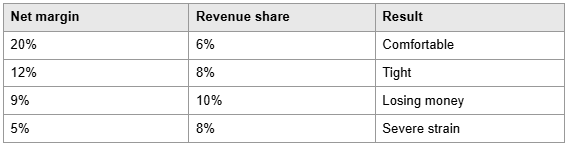
Unless the funded project raises profit sharply, a share higher than your net margin needs to be justified with hard numbers. Comparing products helps here, and a look at Fundivi flexible revenue funding can help you know which terms to look at first.
Failure 2: “Bad Credit Made the Price Far Higher Than We Realized”
How it happened: The representative emphasized that credit “didn’t matter.” It did, though, in the pricing. With a score of 560, the owner got a repayment cap of 1.5, meaning $75,000 repaid on $50,000.
What would have prevented it: Asking how credit affected the offer and calculating the annualized cost under several sales scenarios. If $75,000 is repaid in 10 months, that $25,000 cost represents an annualized rate of roughly 100%. A cap of 1.3 on the same money would have saved $10,000.
Before accepting, ask each provider these questions:
• What cap would apply if my credit were stronger?
• Does the cap change if I repay more slowly?
• Is there a discount for early payment?
Failure 3: “The ‘Flexible’ Payment Wasn’t Flexible”
How it happened: The contract had a fixed weekly debit based on estimated revenue, with reconciliation available only on written request and only once per quarter. When a slow winter hit, the weekly amount stayed the same.
What would have prevented it: Reading the reconciliation clause and asking for a worked example. Find out:
• Is the payment a true percentage of actual revenue?
• How often is it recalculated?
• Is there a minimum payment?
• What documents are required for an adjustment?
Owners who need more predictable collections can look at resources on same-day unsecured working capital and compare a fixed schedule with this structure.
Failure 4: “An Old Problem Came Back”
How it happened: The owner didn’t disclose a state tax lien, assuming a revenue provider wouldn’t care. The lien surfaced during funding and delayed everything, and a later dispute involved the contract’s representations about outstanding liens.
What would have prevented it: Full disclosure. With bad credit, there may be several old items. Prepare these ahead of time:
• A list of every lien, judgment, and collection
• Payment plans and proof of compliance
• Short explanations of what happened
• Releases or satisfaction documents
Bad credit doesn’t usually disqualify you. Misrepresenting it can.
Failure 5: “We Took On Other Debt and Everything Collided”
How it happened: Three months into the deal, an owner accepted a merchant cash advance because cash was tight. The new daily debit and the revenue share together took 25% of receipts. Payroll bounced.
What would have prevented it: Understanding the contract’s restrictions on additional debt and setting a personal rule against stacking. Before accepting any further financing, add up all of your obligations as a percentage of revenue. Consider this a warning sign if the total exceeds roughly 15% to 20%.
A merchant with mostly card-based revenue might also explore specific alternatives, including those covered by this USA Today release on card processing loans.
Failure 6: “The Money Didn’t Produce Anything”
How it happened: The owner used $40,000 to catch up on old bills. The balance of bills fell for a month, but nothing about the business changed, and the new payments made the next quarter even tighter.
What would have prevented it: Tying funding to a measurable return. Before you borrow, complete this sentence:
“This money will produce or protect $______ of gross profit within ______ months, and it will cost $______.”
If you can’t fill in those blanks, you’re at risk of the same outcome. Good uses are generally those with a quick, measurable return, like inventory with confirmed demand or advertising with known performance.
Failure 7: “We Handed Our Data to the Wrong People”
How it happened: An owner with a low score got a text promising guaranteed funding. They connected bank credentials through a link from an unverified company. Soon, suspicious debits appeared, and lead sellers began calling.
What would have prevented it: Verification. People with bad credit are frequent targets. Before sharing anything:
• Look up the company independently
• Confirm its address and leadership
• Ask how your bank connection works and how to remove access
• Never pay upfront to “unlock” funding
• Never share your banking passwords directly with a representative
Directories such as the BusinessLoansCompanies.com revenue funder profiles can help you begin your research, but you should always check how a site is paid and confirm the details on your own.
The Pre-Mortem Scorecard
Now run your own deal through the exercise. Give yourself one point for each statement that’s true:
☐ My net margin comfortably exceeds the proposed revenue share
☐ I know the total repayment in dollars
☐ I’ve read how the payment adjusts in a slow month
☐ I’ve disclosed all liens, debts, and legal matters
☐ I won’t need additional financing during the term
☐ The money has a measurable return
☐ I’ve verified the provider independently
7 points: You’ve reduced the most common risks.
5 or 6 points: Fix the gaps before you sign.
Under 5 points: Don’t proceed yet.
What Providers Will Actually Look For
Even with bad credit, expect a review of:
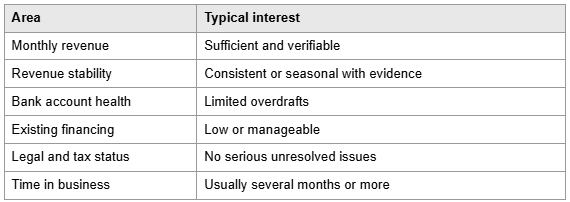
Fast approvals depend on clean data. Provide complete statements or connect accounts securely, apply early on a weekday, and answer questions promptly.
If the Pre-Mortem Says No
A negative result isn’t failure. It’s cheap information. You might reduce the amount, improve your margins first, seek a term loan with lower total cost, or get free advice from a local Small Business Development Center. Sometimes the best way to prevent a bad outcome a year from now is to do nothing today.
Frequently Asked Questions
What credit score is required?
Many providers don’t set a strict minimum, particularly when revenue is strong. Some investor-style programs have stricter standards.
Does revenue-based financing report to credit bureaus?
Many providers don’t report to personal bureaus. Ask directly, especially if credit building is a goal.
Can I qualify with recent late payments?
Possibly. Strong, consistent revenue may outweigh recent lateness, but expect closer review and higher cost.
Will a personal guarantee be needed?
Often, particularly for smaller businesses. Certain providers limit it to fraud or breaches of the agreement.
How much will bad credit increase my cost?
It depends on the provider, but the repayment cap and revenue share can both rise significantly.
Can I renegotiate during a downturn?
Contact your provider early. Reconciliation rights, if any, should be spelled out in your contract.
What if my revenue is mostly cash?
Cash that isn’t deposited is hard to verify. Consistently depositing receipts for several months will help.
Can I repay early to reduce the cost?
Sometimes, but many agreements fix the repayment cap. Ask for a written payoff figure.
Does a guarantor improve my terms?
Sometimes, especially when revenue is modest. Keep in mind that a guarantor accepts real legal responsibility, so that person should review the agreement carefully first.
How long does approval take?
Often a day or so with clean data.
Disclaimer: This article is provided for general informational and educational purposes only and does not constitute financial, lending, credit, tax, or legal advice. Revenue-based financing products, eligibility requirements, repayment structures, fees, revenue shares, and other terms vary by provider and individual circumstances and may change over time. Readers should independently verify the terms of any financing arrangement and consult a qualified financial, tax, or legal professional regarding their specific situation before making a financing decision. No approval, funding amount, rate, repayment term, or outcome is guaranteed.