
By: Shawn Mars
It began, as many good questions do, at a dinner party. Everyone at the table was in their late seventies or older, and the conversation had drifted to the usual subject: whose knees, whose heart, whose doctor. Then someone sighed and asked, “How did we get to be so old so soon?”
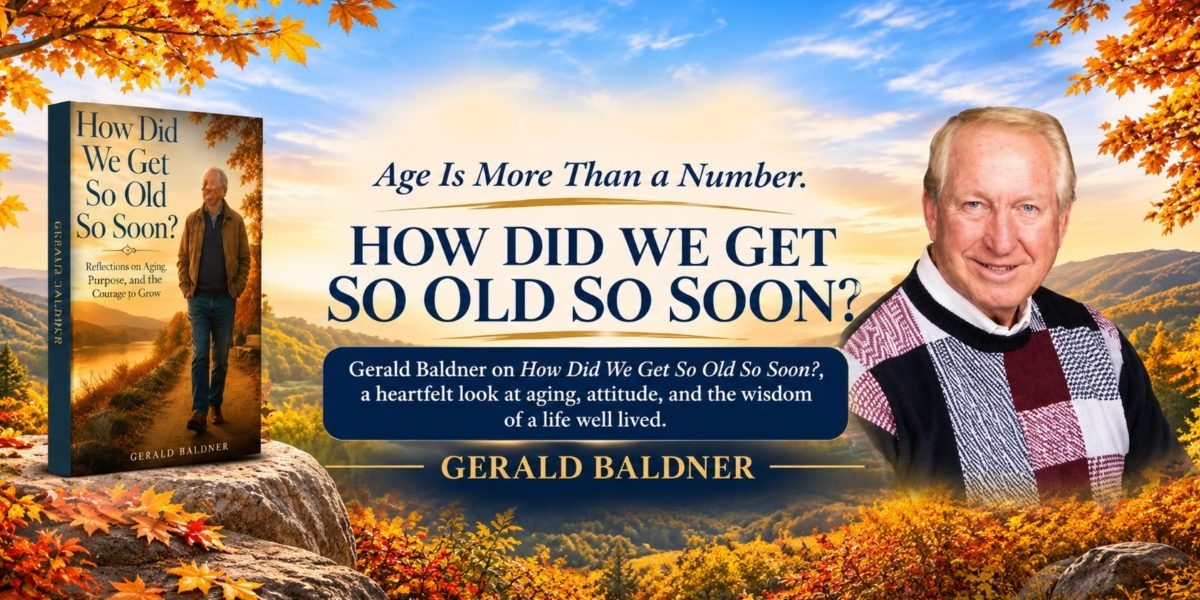
Gerald Baldner took the line home and made it the title of his book, How Did We Get So Old So Soon?
Baldner is 83. He is candid about the toll the past year has taken. His wife was struck by a car and spent nine months in a care center recovering from multiple broken bones. For those nine months, he was alone in the house, visiting her daily and facing long, empty afternoons. “I can’t just fade away,” he told himself. So he wrote. The book took six months.
A Plaque and a Question
Baldner’s daughter once gave him a plaque asking how old he would be if he didn’t know how old he was. Nearly two decades on, his answer has changed. “People 70 or under would probably say they feel younger than they are,” he observes. “But as we move into the 80s, I think more people agree that the age they are is the age they’d be.”
He does not mean this as surrender. He insists that accepting your age and giving in to it are different things, and the difference comes down to two questions he asks readers to consider. What is your purpose? And what do you have to look forward to?
Walking Past Open Doors
The second question has a personal source. During his wife’s stay at the care center, Baldner often walked past open doors and saw residents sitting quietly. “It appeared to me those people are waiting to die,” he says. “They don’t have anything to look forward to.”
He believes the remedy is deliberate and usually small. It might be a plan for next week, a meal out, or a game of cards. “In some cases, people have to make that positive thing to look forward to. They have to set it up themselves.”
Critics might say that is easy advice from a man in good health. Baldner is not in perfect health. He has had cancer twice, and he is hard of hearing. He argues that people with chronic pain or serious diagnoses need a reason to look forward even more. “Your life can change in an instant,” he says of his wife’s accident. “Things can happen in a second that totally change where you are.”
The Man Who Fixed Kitchens
Before he was an author, Baldner spent his first fifteen working years as a social worker, counseling families and children. He identified so strongly with their pain that eventually he burned out. He had grown up on a farm, where the family worked side by side, and he had long wanted a business of his own.
In 1983, at a home show in Buffalo, he wandered into a booth demonstrating cabinet refacing. The idea was to keep the existing cabinet boxes and fit new doors and drawer fronts. “It was a totally new concept to me,” he recalls, “but it made so much sense.” That encounter led to Kitchen Solvers. Over the years, he started nine businesses, and only one failed.
His first venture, a small manufacturing company, nearly did not survive. Four months in, he had run out of money. “That was scary,” he admits. Then things turned. “Unless you risk something, you won’t get ahead in life.”
He eventually sold the company to his son, who had been its president. Retirement was harder than he expected. “I missed that feeling of going to work, of accomplishing something.” So he volunteered with the Red Cross after Hurricane Katrina and managed a coliseum sheltering 1,000 people who had lost their homes.
Moving On
Baldner has also known the worst kind of loss. His son was killed in a boating accident. He remembers that few people asked him about it afterward. “I don’t think they were being rude,” he says. “They just didn’t know what to say.”
He decided his son would not have wanted him to “wallow in self-pity,” and “moving on” became his creed. He went on to lead grief seminars and wrote a short book on the subject. He is also not afraid of dying, and he says so plainly. His faith tells him that “our souls are still alive and we’ll go to a better place,” and he feels he has lived a wonderful life.
Four Seasons
Baldner divides life into four seasons. Winter is childhood, when values are learned at home. Spring is education and choosing a career. The long third season is raising children and building a livelihood. The fourth is old age. “Aging is inevitable,” he says. “If you’re fortunate enough not to die from illness or accident, you will age.”
He admits the fourth season has its hard parts. He gave up competitive basketball at 69, then tennis, and last month told his pickleball friends he was done. He is now looking for people to play cards with. He sees each change as a handoff from something he can no longer do to something he can. He has also grown more careful on the stairs since two friends died after falling on theirs.
He is just as plain about what keeps him going. He avoids chronically negative people, saying “that just turns me off.” He tries to enjoy the day in front of him, usually with his wife beside him. They go out to dinner every evening and live on the leftovers the next day. “I wake up and I just feel good about waking up,” he says.
His hope for readers is modest. “We all have a story,” Baldner says. “I hope people will think about their lives, and intentionally plan something they can look forward to.”