
By: Elowen Gray
History is full of people whose choices were constrained by war, social rank, marriage, or the circumstances of their birth. Historical romance offers a way into those lives, while mystery and fantasy explore what happens when the boundaries of an era become less certain. A strange gift, a haunted house, or an impossible journey through time can expose truths that society would rather conceal. In these novels, adventure is rarely an escape from the past. Instead, it becomes a confrontation with it, as heroines navigate unfamiliar worlds, uncover buried secrets, and discover that love often demands courage and sacrifice.
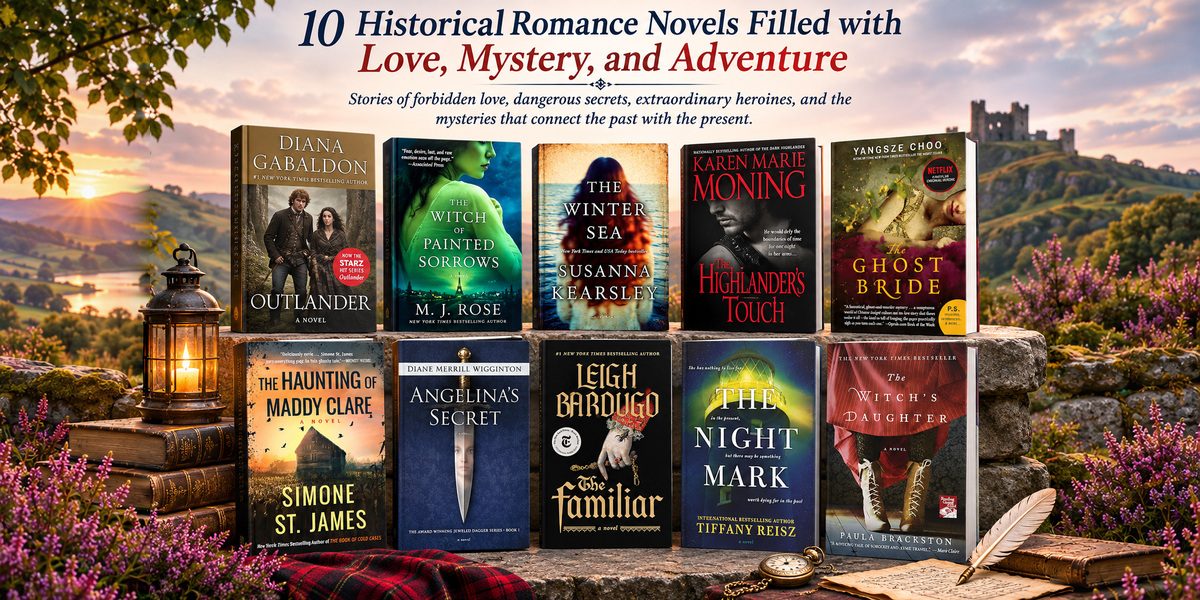
That tension runs through Outlander, in which Diana Gabaldon sends former combat nurse Claire Randall from postwar Britain into the Scottish Highlands of 1743. Claire’s medical knowledge gives her a measure of authority, but her independence also makes her vulnerable in a world governed by unfamiliar loyalties and expectations. Her relationship with Jamie Fraser develops amid danger and divided obligations, turning time travel into a test of identity as much as a romantic device. In The Witch of Painted Sorrows, M. J. Rose approaches female independence through a darker form of historical fantasy. Fleeing an abusive marriage, Sandrine Salome arrives in Belle Époque Paris and becomes entangled in the mysteries surrounding her grandmother’s mansion and an unsettling supernatural presence. Where Claire must adapt to a distant century, Sandrine struggles against forces threatening her sense of self. Both novels make desire inseparable from questions of power, though Rose’s Gothic atmosphere leaves greater uncertainty about the heroine’s control over her fate.
The past exerts a different influence in The Winter Sea by Susanna Kearsley. Contemporary novelist Carrie McClelland settles near Scotland’s Slains Castle to write about the Jacobite invasion attempt of 1708, only to suspect that her fictional scenes may emerge from ancestral memory. Drawing on historical research, Kearsley explores how forgotten lives can continue to shape the present. That quieter uncertainty contrasts with The Highlander’s Touch by Karen Marie Moning, in which Lisa, a modern woman transported seven centuries backward, encounters a Scottish warrior bound by ancient magic and dangerous promises. Moning emphasizes attraction and peril, while Kearsley allows historical discovery to unfold through imagination and evidence. Yet both explore what survives separation: a memory, a promise, or a connection that ordinary chronology cannot explain.
If time is uncertain in these stories, the boundary between the living and the dead proves equally fragile in The Ghost Bride by Yangsze Choo. In 1890s colonial Malacca, Li Lan, the daughter of a financially troubled family, receives a proposal to marry a wealthy family’s deceased son. Her journey into the spirit world draws on Chinese beliefs and customs, connecting supernatural mystery with the social limitations placed on women. The Haunting of Maddy Clare by Simone St. James also gives a ghost unfinished business, but places its mystery in the English countryside after the First World War. Sarah Piper joins an investigation into the angry spirit of a young woman who died by suicide. As Sarah and war veteran Matthew Ryder search for answers, the haunting reveals the lasting consequences of violence and trauma. Though their settings differ, Choo and St. James portray the dead as keepers of histories the living have failed to confront.
That connection between hidden knowledge and danger becomes more immediate in Angelina’s Secret, the opening novel in the Jeweled Dagger series by Diane Merrill Wigginton. Having survived encounters with pirates, Angelina Stewart returns to eighteenth-century London with a reputation for bravery and a troubling secret: her psychic abilities are growing stronger. Her visions become entangled with a murder investigation, while her attraction to Jude Deveraux, a pirate captain who also holds a noble title, complicates their already dangerous circumstances. Wigginton combines swashbuckling adventure with romantic suspense, placing deception and concealed identities at the heart of the story. In The Familiar, Leigh Bardugo similarly follows a woman whose extraordinary abilities attract dangerous attention. Luzia Cotado, a servant in Golden Age Madrid, possesses a gift for small miracles that draws her toward powerful figures and the scrutiny of the Inquisition. Bardugo examines how supernatural gifts become threatening when judged by religious and political authorities. Angelina’s visions and Luzia’s miracles offer possibilities beyond their circumstances, but neither woman can escape the risks of revealing her abilities.
The question of whether love can overcome loss takes a more reflective turn in The Night Mark by Tiffany Reisz. Grieving her husband, photographer Faye Barlow travels to the South Carolina coast and becomes fascinated by an old lighthouse and its history. When she is unexpectedly transported to 1921, the possibility of love challenges her understanding of grief, memory, and moving forward. The Witch’s Daughter by Paula Brackston stretches the burden of remembrance across centuries. After her mother is executed during a witch hunt in seventeenth-century England, Bess Hawksmith acquires magical powers and survives into the modern world, pursued by a dangerous figure from her past. Reisz examines the desire to recover what grief has taken, while Brackston considers the emotional cost of surviving when old threats remain unresolved. In both novels, extraordinary circumstances complicate rather than erase the consequences of earlier experiences.
Across these settings, historical detail does more than provide atmosphere. It determines whose testimony carries weight, which relationships can be acknowledged, and how freely women can act. Supernatural abilities often intensify these restrictions rather than overcome them. Claire’s knowledge can arouse suspicion, Li Lan’s encounters with spirits emerge from a marriage arrangement, and Luzia’s talent becomes dangerous once powerful people notice it. Meanwhile, investigations into murder, betrayal, and haunting reveal how private suffering can reflect broader social realities. Even the most romantic narratives acknowledge that relationships demand difficult choices, particularly when love conflicts with duty, reputation, or personal freedom.
These novels approach romance, fantasy, and suspense with different priorities. Some move through adventure and immediate danger; others dwell on grief, atmosphere, and unresolved mysteries. Together, they demonstrate the flexibility of historical romance as a form of storytelling. By placing intimate relationships against inherited rules and uncertain histories, these authors explore the struggle to claim a future beyond the limits of circumstance. Their mysteries may be supernatural, but their central concerns—trust, memory, identity, and the consequences of love, remain recognizably human.