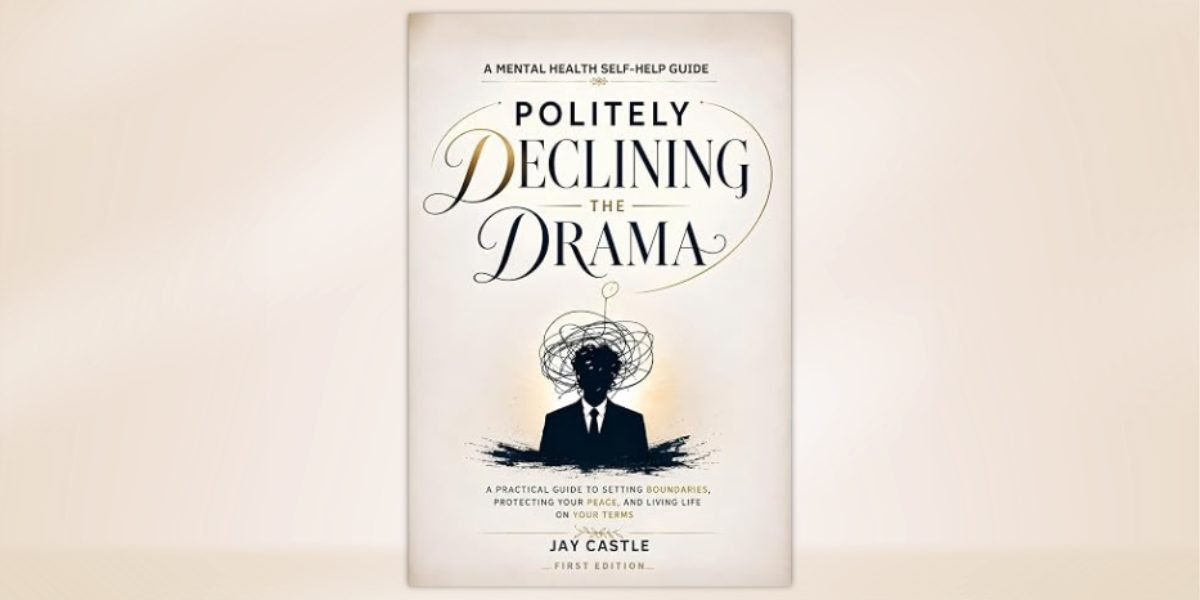

A Book That Redefines What It Means to Protect Your Peace
Many books about boundaries tell you to say no. Jay Castle’s Politely Declining the Drama teaches you how to say no without losing yourself or your compassion. Castle approaches the subject as a strategist. He does not just validate the exhaustion of the chronic rescuer. He maps it, names it, and gives it a way out. The result is a field manual for emotional self-governance, built around a five-step method designed to turn vague intentions into repeatable behavior.
This book is not about becoming selfish. It is about becoming healthy. That distinction matters. Castle argues that many people confuse love with unlimited availability. They mistake being needed for being valued. They wear exhaustion like a badge of honor. Then one day they ask a question they were afraid to say out loud. When do I get to live my life?
Politely Declining the Drama answers that question with clarity and discipline.
The Diagnosis: Drama Arrives Disguised as Loyalty
Castle begins with a sharp observation. Drama rarely announces itself with a warning siren. It arrives dressed as kindness. It disguises itself as loyalty, compassion, responsibility, or simply being there for people. It convinces you that saying yes makes you a good friend, a supportive partner, a dependable coworker, or the family member everyone can count on.
But somewhere along the way, generosity becomes an open door policy. People stop knocking. They walk in.
Castle diagnoses the problem with precision. He shows how some people survive by manufacturing chaos. Some relationships exist only because one person keeps sacrificing themselves to maintain them. And some doors should remain firmly closed, not because you hate the people outside, but because you finally respect the peace inside.
The author also distinguishes between caring and carrying. Listening to someone after a difficult day is kindness. Helping them brainstorm solutions is generosity. But repeatedly carrying responsibilities they refuse to manage themselves is something else entirely. It becomes emotional labor that slowly drains your capacity to live.
Castle equips readers to see the difference. He does not shame anyone for past choices. Instead, he explains why people-pleasing develops as a survival strategy. If approval came only after being helpful, agreeable, or responsible, the brain learns that love must be earned. As an adult, this shows up as apologizing for things that are not your fault, saying yes before checking your calendar, and feeling responsible for emotions that belong to other people.
The Framework: P.D.D.A.M. as a Repeatable Decision Protocol
The heart of the book is the P.D.D.A.M. Method. This five-step system gives readers a practical tool for nearly every relationship, conversation, and difficult decision.
The first step is Pause. Drama feeds on speed. The phone rings. The text says Call me right away. Someone walks into your office saying they need a favor. Before you have time to think, you have already agreed. Castle argues that urgency bypasses wisdom. One of the simplest changes you can make is refusing to answer immediately. Take a breath. Tell the person you will get back to them. That tiny delay gives your rational mind time to catch up with your emotional one.
The second step is Discern. Not every problem belongs to you. This sentence sounds obvious, but living it is another story. Discernment means learning to separate compassion from responsibility. A helpful question is this. If I do nothing, who naturally owns the consequences? The answer usually reveals who owns the problem.
The third step is Decide. Castle urges readers to choose according to values, not pressure or guilt. Emotions are important, but they change. Values provide direction even when emotions are loud.
The fourth step is Act. Boundaries sound better than excuses. Castle warns against overexplaining. A respectful answer does not require a lengthy defense. Simple phrases work best. I appreciate you thinking of me, but I will not be able to help this time. Confidence does not require a speech.
The fifth step is Move On. This is the step most people forget. You have said no. The conversation ended. But your mind keeps replaying it. Castle teaches readers to stop carrying the conversation home. When you have acted with honesty and respect, your job is finished. You are not responsible for managing another adult’s emotional reaction.
Castle demonstrates how this method works through case studies. Lisa receives a late-night call from her cousin. Old Lisa would answer immediately. New Lisa pauses, discerns, decides, acts, and moves on. The next morning, her cousin texts that everything worked out. No catastrophe. No damaged relationship. Just another reminder that not every emergency requires your participation.
The Deeper Shift: Acceptance, Small Habits, and Identity
Politely Declining the Drama does not stop at practical techniques. Castle goes deeper. He asks readers to stop negotiating with reality.
One of the hardest truths in the book is this. You cannot change people who do not want to change. Castle invites readers to accept what is true today instead of arguing with it. Acceptance is not approval. It simply means acknowledging reality so you can respond wisely.
He introduces the circle of control. In the center are things you control: your attitude, your words, your choices, your schedule, your boundaries, your reactions. In the outer circle are things you cannot control: other people’s opinions, effort, honesty, the past, the economy, the weather, whether someone likes you. Castle argues that peace grows when your energy stays in the center.
The author also addresses grief. Sometimes what you need to let go of is not a person. It is the fantasy. The fantasy that they will finally become reliable. The fantasy that one more conversation will erase years of unhealthy behavior. Castle writes that potential is inspiring, but patterns are informative. Believe the pattern.
Then comes the quiet revolution. Castle argues that small habits can add up to lasting change. Real transformation usually looks unexciting. It looks like going to bed thirty minutes earlier. It looks like letting a phone call go to voicemail. It looks like saying I will get back to you instead of immediately saying yes. Repeated consistently, these small actions can become the foundation of a different way of living.
Castle also shifts the focus from behavior to identity. Many people try to change what they do without changing who they are. They say things like I need to stop people-pleasing. Castle suggests a different approach. Say instead: I am someone who values peace. I am someone who speaks honestly. I am someone who helps without rescuing. Identity creates consistency. When you know who you are, decisions become clearer.
The Payoff: Peace Is Practiced, Not Found
The final sections of the book focus on what happens when boundaries become part of who you are. Castle argues that peace is not passive. It is practiced. It is not found. It is protected.
He prepares readers for resistance. When you change, relationships change. Some people will celebrate your growth. Some will quietly adjust. Others will push back. Castle writes that people become comfortable with the version of you they have always known. When that version changes, they need time to adapt. Give them grace, but do not confuse grace with surrender.
The author also offers a 90-day peace plan. The first thirty days focus on awareness. The next thirty days focus on strengthening boundaries. The final thirty days focus on living your new identity. This structure shows that Castle understands habit formation. He does not promise overnight transformation. He emphasizes progress through repetition.
The book ends with a Peace Manifesto. It reads like a commitment. I choose peace over performance. I choose honesty over approval. I choose boundaries over burnout. I choose rest without apology. These statements turn abstract ideas into personal vows.
A Field Manual for Emotional Self-Governance
Castle’s authority does not rest on a celebrity platform or a clinical title. It rests on the clarity of his system. He gives readers a vocabulary, a method, and a 90-day plan. Politely Declining the Drama is not just a book about saying no. It is a blueprint for becoming someone who no longer needs to apologize for having a life of their own.
Castle’s emphasis falls on a plan rather than permission, and on a framework rather than comfort. That approach makes Politely Declining the Drama read less like a pep talk and more like a field manual for readers who are tired of living inside other people’s emergencies and want to build a life of intention, honesty, and protected peace.