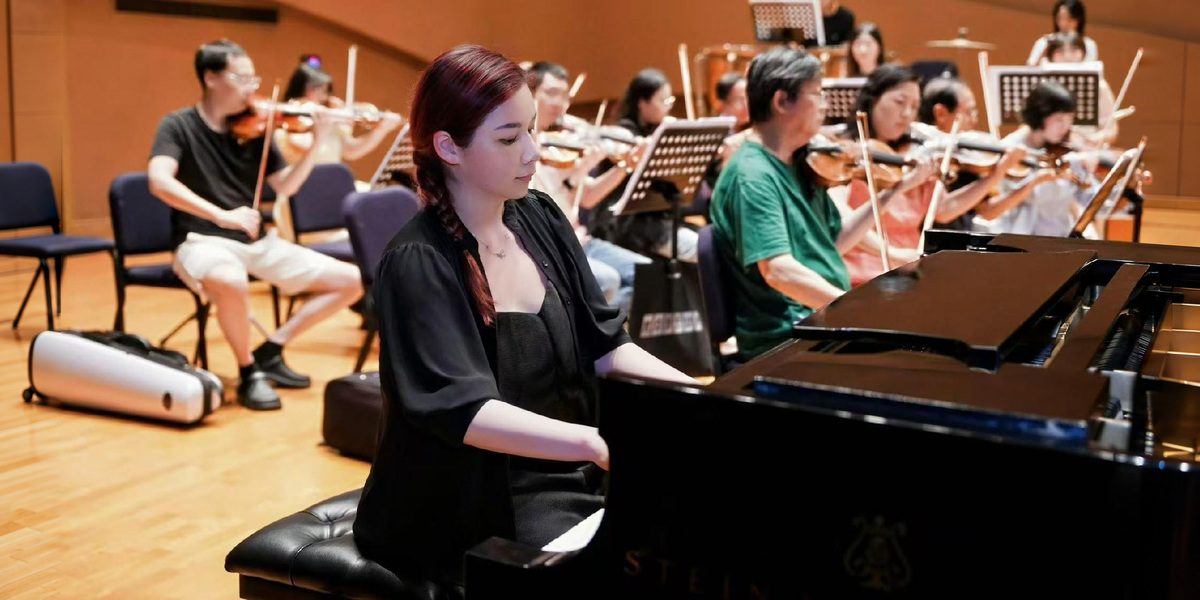

The Steinway Teacher Hall of Fame inductee continues to connect performance and education, most recently appearing at a sold-out benefit concert in Tangshan, China
For pianist and music educator Hua (Melody) Chen, performance and education have never existed as separate pursuits. One informs the other: the discipline required at the piano shapes her approach to teaching, while years spent working with students have deepened her understanding of how musicians develop interpretation, confidence and an individual artistic voice. Recognized by the Steinway Teacher Hall of Fame, Chen has built a professional practice centered not only on how music is performed, but also on how it is understood, communicated and shared with a wider public.
That philosophy was reflected in Chen’s recent appearance at the closing benefit concert of the 2026 Strongest Voice Concerto Art Festival, held in Tangshan, China, on July 5. The concert filled all 808 seats and received support from the Tangshan Musicians Association, the Symphony Orchestra of Tangshan Song and Dance Theatre, Poly Theatre, and other participating organizations. Presented as a benefit performance, the event brought professional musicians and cultural institutions together around music appreciation, public arts engagement and cultural exchange.
Chen’s role in the concert highlighted the connection between her work as a pianist and her perspective as an educator. She presented an adapted interpretation of the existing work “Confession in the EveningBreeze & Farewell letter,” approaching the familiar melody through piano and orchestral arrangement. Rather than attempting to redefine the original composition, Chen focused on how voicing, dynamics, orchestral texture and pacing could alter the emotional perspective from which audiences encounter it. The result reflected a central principle in her musical thinking: interpretation can bring new meaning to familiar material without losing respect for its original identity.
The arrangement begins quietly, with the melody emerging in the piano’s upper register. Chen associated the opening with images of an evening breeze, starlight and the tenderness of an early romantic memory. As the orchestra gradually enters, the scale of the music expands. What initially feels private and intimate develops into a broader symphonic environment, while changes in texture and dynamics gradually introduce a more reflective emotional tone. The melody remains recognizable throughout, but the context surrounding it allows the listener to experience it from a different perspective.
This attention to interpretation also plays an important role in Chen’s approach to music education. She distinguishes between technical proficiency and musical understanding, viewing precision and discipline as foundations rather than final objectives. For Chen, a developing musician must also learn to understand phrasing, structure, emotional progression and artistic intention. A student may master the mechanics of a passage, but meaningful performance requires an understanding of where that passage is going and why it matters within the larger work.
Her recognition by the Steinway Teacher Hall of Fame reflects the educational dimension of a career in which teaching and performing continually reinforce one another. Working with students requires Chen to articulate musical ideas that performers sometimes understand instinctively; returning to the stage, meanwhile, gives her new questions about interpretation and communication to bring back into the teaching environment. This exchange has helped shape a professional identity that extends beyond the conventional boundaries between performer and educator.
Chen also sees public performance as part of a broader educational mission. Music education often takes place in private studios, classrooms and conservatories, but she believes audiences can also develop a deeper relationship with music through direct experience. A listener does not need formal training to recognize tension and release, intimacy and distance, or the way an orchestral texture can transform the emotional weight of a melody. In that sense, a benefit concert can become another kind of educational space, one where professional music reaches people who may encounter it outside a traditional academic setting.
The Tangshan appearance also continued a broader period of artistic exchange associated with Strongest Voice. In the previous year, the initiative established a presence in New York, Shanghai and Boston; in 2026, its activities began in Beijing before continuing to Tangshan. The cities differ in language, cultural history and audience, yet the movement between them reflects an idea central to Chen’s work: musical expression can create connections across different cultural settings without requiring every listener to share the same background.
As Chen continues to develop her work as a pianist and educator, that relationship between rigor and accessibility remains central. Her professional path is grounded in disciplined musicianship, but its purpose extends beyond technical accomplishment. Whether she is working with a student, interpreting a familiar melody or performing before a full concert hall, Chen’s focus remains on helping music communicate with greater clarity and meaning.
For her, the measure of a musical experience is not simply what happens while the notes are being played. It is what the listener, student or performer is able to carry forward after the music ends.