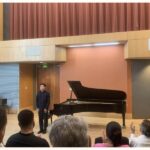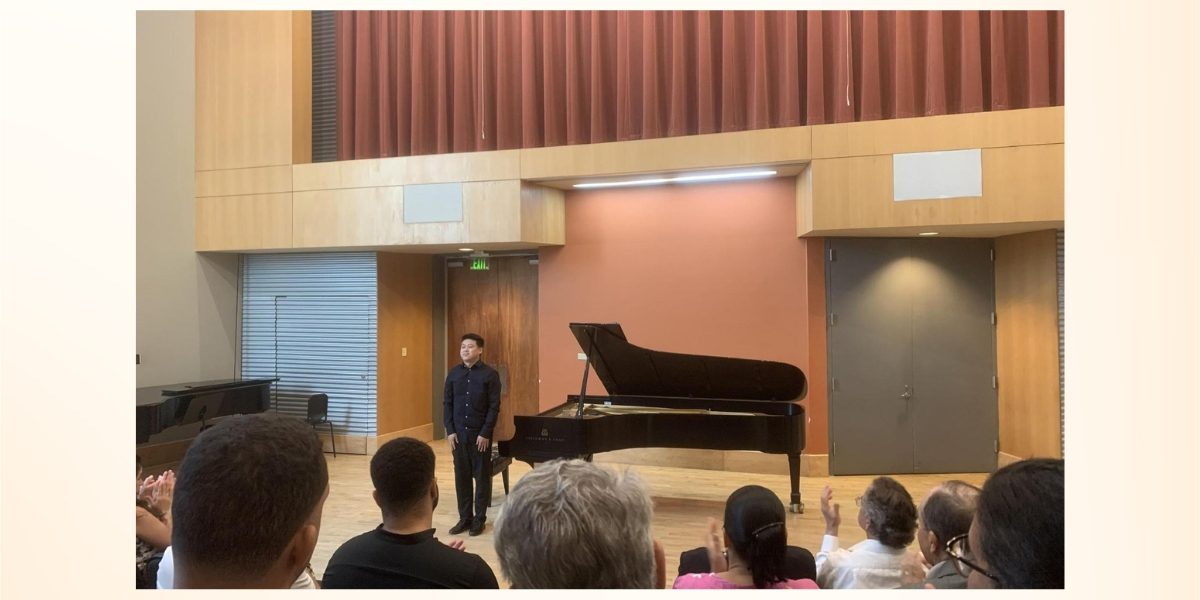

From a closing-night stage in San Juan, to a public lecture hall in Chengde, to a day room with no reverberation in West Hartford, tracing one pianist’s unbroken line across two continents.
When Ziyou Shen walked out for the closing night of the Puerto Rico International Piano Festival last June, he was carrying a specific architectural problem in his hands. He had chosen Chopin’s Polonaise-Fantaisie, Op. 61. For a pianist looking to dazzle a festival crowd, this is a dangerous choice. Written three years before Chopin died, the piece is restless and searching. It promises the driving rhythm of a polonaise, then abandons it, wandering off into exposed recitative before drifting back. The technical demands are real, but they are not the difficulty. The difficulty is the joins.
Shen’s whole career is built on those joins. He is a pianist preoccupied with legato: the seam between one note and the next.
“Everything in that piece happens between the notes,” Shen said afterward. “If the line breaks, the argument breaks.”
The Space Between the Notes
Shen was in San Juan by direct invitation. José Ramos Santana, the festival’s founder and artistic director, is also Chair of Keyboard at the Hartt School of Music in West Hartford, where Shen had just completed his Artist Diploma, the school’s highest performance credential, a post-master’s diploma rather than a degree. To be programmed on that closing night is to pass through a narrow filter, and Ramos Santana is a musician who knows what a stage is worth. He has appeared as a soloist with the New York Philharmonic and the Royal Philharmonic Orchestra of London, played Carnegie Hall three times in a single season, took a top prize at the Gina Bachauer International, and has sat on the selecting juries of the William Kapell and Liszt-Garrison international competitions. The closing artist concert is not an open call. Players are chosen.
Among those listening was Inga Kashakashvili, the Georgian pianist who has performed at Carnegie Hall, Jazz at Lincoln Center and the Barbican, and whose album Wanderer was released by Naxos in 2018.
A Pedagogy of the Line
The preoccupation with the line is not something Shen picked up for Chopin. It is the thing he has been circling for years, and it is unusual enough that it has become the subject of his public teaching.
In July 2024, the Chengde Musicians Association, in Hebei province, invited him to give a public lecture. He called it “Forms of Legato Expression.” Great Wall News, the provincial outlet, sent a reporter, and Chengde Television brought cameras. Speaking to a room of local piano teachers and their students, Shen made a foundational argument that the degree of continuity in a legato line is what carries a composer’s depth.
Then he got off the lectern. He spent much of the session at the keyboard instead, playing fragments from different periods and showing how small changes in pedaling reorganize the harmonic layers under a phrase.
Building a televised public lecture around legato is an unusual thing to do. In most of the piano world, legato is filed under beginner technique, dispatched in a few early lessons and never revisited. Shen treats it as the whole problem. For him it is the place where interpretation actually happens, and the one thing a listener notices without being able to name it.
His training accounts for some of that. Shen entered the middle school affiliated with the China Conservatory of Music in Beijing at thirteen, studying with Han Bing, now associate chair of the conservatory’s piano department. He spent two years at the Hamburger Konservatorium in Germany with Georg Sava and Johanna Widenbach, then took his bachelor’s degree at the Sichuan Conservatory of Music with Wang Yan, now a vice president there.
In 2019, he came to Hartt for his master’s and worked with Frederic Chiu, who also teaches at Carnegie Mellon and whose survey of Prokofiev’s piano music is the most extensive on record. For the Artist Diploma, he studied with Paul Rutman, the first pianist to receive a doctorate from the Juilliard School and a laureate of both the Tchaikovsky Competition in Moscow and the Marguerite Long in Paris. In 2024, the University of Hartford gave Shen its Kay Knight Clarke/Aeroflex award for instrumental performers.
Continuity Under Pressure
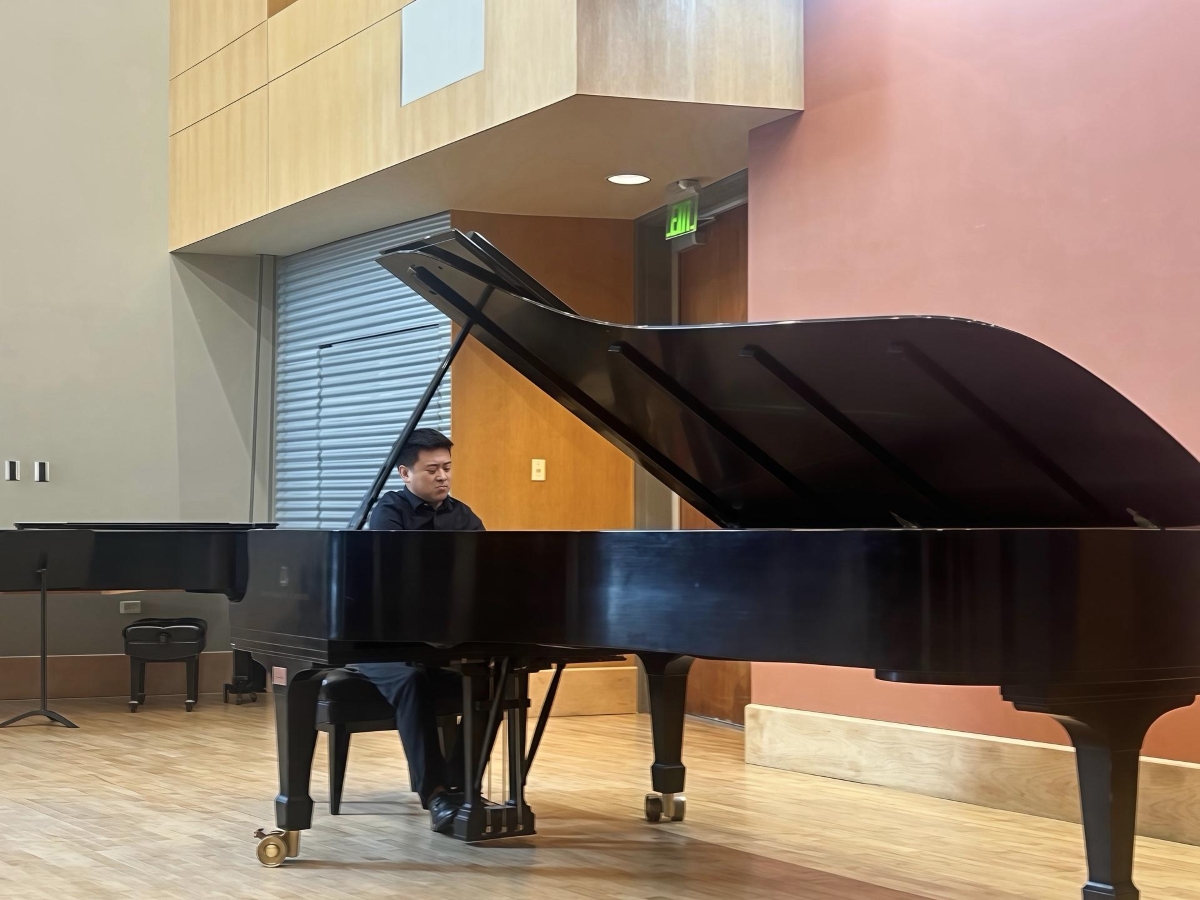
Much of what Shen has played in the United States has been with other people in the room. At Hartt he performed Rachmaninoff’s Second Piano Concerto with the Korean pianist Yujin Lee. He took on the sharp rhythms of Prokofiev’s Second Sonata, Op. 94, with the violinist Sunnaj Britt, and the dense textures of Brahms’s Horn Trio in E-flat with the hornist Joshua Rosenbaum.
Collaborative playing is often called accompaniment, and the word understates it badly. A pianist working with a singer or a string player has to build a line that is not entirely his own and then hold it steady while someone else bends it. It is the same problem as legato, moved outward from the hands into the room: continuity under pressure.
Few pianists of his generation hold teaching credentials on both sides of the Pacific. Shen is a certified teacher of the Suzuki Association of the Americas, a member of the Music Teachers National Association and the Connecticut State Music Teachers Association, and a member of the Piano Society of the Chinese Musicians Association.
In China, he is regularly called to the jury table. His appointments include provincial expert juror for the Central Conservatory of Music’s eighth Youth Arts Showcase in Hebei in 2024, the Hebei round of the seventh KAWAI Asia Piano Competition, the Qinhuangdao round of the China Conservatory of Music’s arts showcase, and the national piano finals of the Olympic Music Competition. The Olympic Music Competition is convened by the Beijing Olympic Culture Promotion Association and draws entrants from twenty-eight provinces and municipalities.
His students have taken prizes at the Xinghai Cup, the Yamaha national piano competition, and the KAWAI Asia competition, and the awards Shen receives in return are teaching awards, which are a distinct thing and a harder one to earn twice. Piano Artistry, the principal piano pedagogy journal in China, gave him its silver award for all-around piano teacher in 2023 and cited his teaching of Chinese repertoire the following year. He has been named an artist-teacher by Yangtze River Piano.
Stripping Back to the Seam
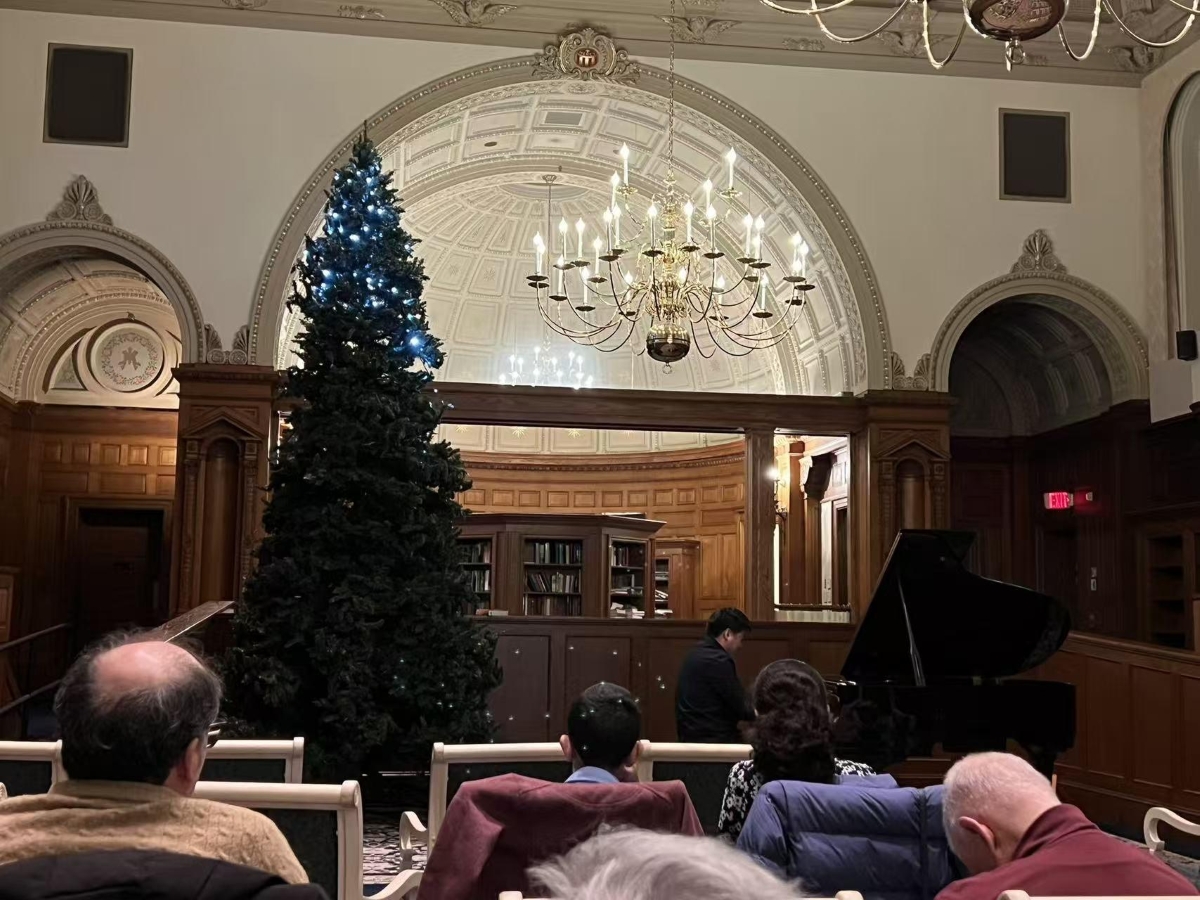
The hardest test of a line does not always happen in a concert hall. Between September and November of 2025, Shen played three afternoons in senior living communities in West Hartford (Brookdale, The Court of Saint James, and Aviva) with the nonprofit Music Speaks.
Rooms of twenty or thirty people. No stage, no lighting, no choice of instrument, just whatever piano was in the building. He is unsentimental about what that does to a pianist. An upright you cannot voice, in a room with no reverberation, takes away everything a performer can hide behind. What is left is the line.
Shen continues to work on both sides of that seam, teaching in Connecticut and adjudicating in China. He moves between the two the way he moves between two notes, never letting go of the first before the second has arrived. The line, note by note, is still going.