
Through women in motion, historical settings, and works combining technology, light, and physical layers, G6x7 explores the tension between inherited roles and the freedom to choose a direction.
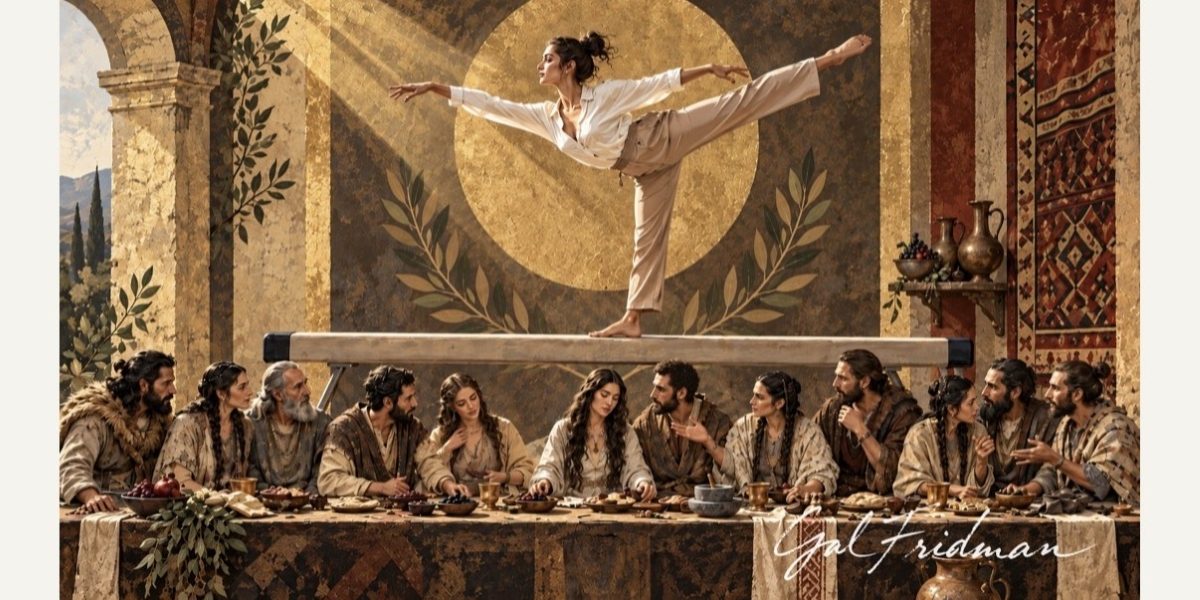
A woman balances on a gymnastics beam above a banquet table. A bride leans a racing bicycle into a turn on a medieval street. Elsewhere, a fairy-tale princess leaps over the glass coffin in which she might once have waited to be rescued.
In the work of Gal Fridman, artist, photographer, and founder of G6x7, women occupy the decisive moment of an action. Their movements demand strength, precision, and judgment. Around them stand the architecture, rituals, and stories of an older world.
These encounters give a physical form to questions about women’s freedom and the expectations they continue to carry. In “Her Own Way.”, the gymnast’s composure above a scene recalling The Last Supper can suggest both self-possession and the effort required to sustain it. Her balance is an achievement, but it is also work.
Moving Through an Inherited World
No single narrative can describe the history of all women. Rights, opportunities, and restrictions have differed across cultures and generations. Fridman’s imagined settings offer a way to consider that inheritance without presenting the scenes as records of a particular historical moment.

In “Out of Time.”, a cyclist in a bridal dress takes a bend on a modern racing bicycle while a medieval street unfolds around her. The clash of eras makes her movement conspicuous: equipment built for speed passes through a world of stone, armor, and established order.
The wedding dress carries associations of love, choice, and belonging, as well as expectations surrounding marriage. Here it becomes part of an athletic effort. The rider must negotiate the street and the fabric around her while deciding where to go. Whether she is escaping, pursuing a chosen future, or doing both remains open to interpretation.
The Promise shifts the emphasis from individual direction to shared movement. Two brides run through an old city during a relay exchange. Their progress depends on timing, trust, and the willingness to place something valuable in another person’s hand.
The baton can be read as a connection between generations, with knowledge, courage, and opportunity passing from one woman to another. It can also suggest a partnership in the present. Each woman makes her own effort, but neither moves forward entirely alone.
Rewriting the Familiar Story
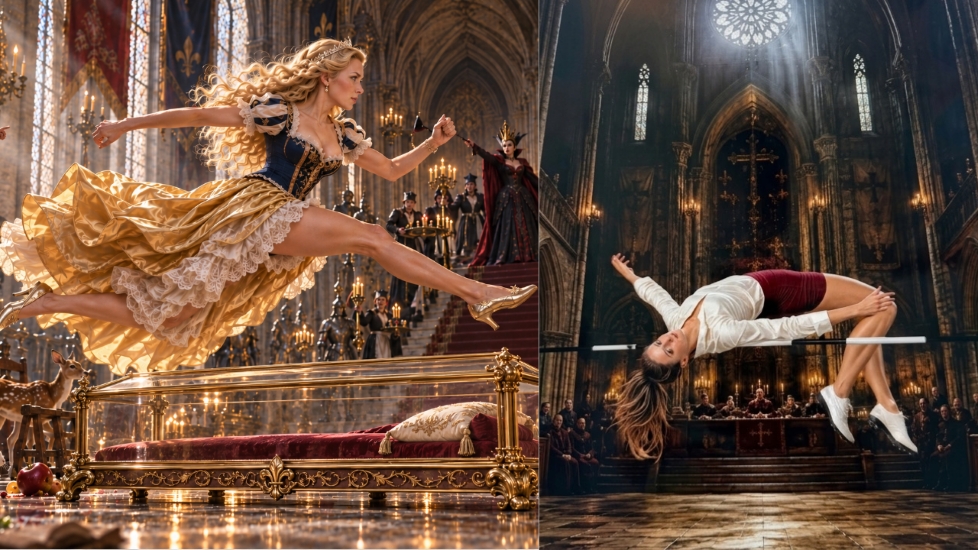
In Not Waiting Anymore, the fairy tale becomes a scene of deliberate action. A princess recognizable as Snow White clears a glass coffin with the extended stride of a hurdler. The royal chamber, dwarfs, and watching queen preserve the familiar story, while the heroine changes what she does within it.
The coffin becomes an obstacle to cross. The image gives a literal shape to the refusal to wait for someone else to determine the next chapter. Its theatrical setting and athletic movement bring humor and defiance into the same gesture.
Win places another suspended action beneath cathedral vaults. A woman arches backward over a high-jump bar, her body briefly held between ascent and landing. The scale of the interior gives the movement a public, almost ceremonial presence.
The scene allows several readings: the bar may suggest a personal goal, an imposed threshold, or a challenge to the authority surrounding her. What is visible is the effort of crossing it. The outcome remains outside the frame.
Across these works, female empowerment is expressed through particular actions rather than a single ideal of strength. A rider chooses a line, runners coordinate an exchange, a gymnast maintains control, and a princess takes a leap. Their confidence does not erase difficulty; it gives them a way to act within it.
The Artist Behind the Images
Gal Fridman studied photography at Jerusalem’s Bezalel Academy of Arts and Design. His career began in fashion photography, expanded into branding and international business, and later included founding technology ventures in hydrogen engines and brain research.
His photographic background is evident in the viewpoint, lighting, and attention to the relationship between body and clothing. A hand gripping a handlebar, a shift in weight, or the direction of a shadow gives physical credibility to an otherwise impossible scene.
His entrepreneurial experience also informs the construction of the work. Through G6x7, the company and artistic platform he founded, image-making is developed alongside materials, fabrication, and illumination. The composition is conceived as something that will occupy a room.
As a male artist addressing women’s experiences, Fridman contributes one perspective to a broader conversation about representation. The images leave room for viewers to question their symbolism and bring their own experiences to the scenes.
G6x7 Brings the Image Into Physical Space
The works extend beyond a flat print. G6x7 combines imagery on brushed aluminum with transparent acrylic layers, using the spaces between surfaces to create depth. Different elements occupy different planes, so their apparent alignment changes as the viewer moves.
Lighting is developed as part of this material structure. It can emphasize details, cast shadows, and alter the relationship between a figure and the world around her. Image, spacing, and illumination together shape the experience of the work.
This construction gives the tension between inheritance and choice a material counterpart. Past and present coexist within one composition, while separation between its layers becomes something the viewer can perceive through movement. Technology helps turn the visual idea into a spatial encounter.
At the center remains a human moment of effort. The cyclist is negotiating the turn, the baton is passing between two hands, and the jumper has yet to land. Fridman holds these actions open, inviting viewers to consider freedom as something repeatedly exercised through choice, persistence, and movement.
Explore the works at g6x7.com.