The Neurosurgeon Who Wants Women to Feel Like Themselves Again

By: Richard Perrin

Dr. Richard Perrin spent his career operating on the human brain. Now he’s turning that expertise toward the most overlooked transition in women’s health, and toward the recognition gap that’s quietly costing millions of women a decade of their lives.

She was the sharpest person in any room. An emergency-room physician, quick-witted and unflappable, the kind of doctor who could manage six crises at once without breaking stride. Then the migraines began. Then the brain fog. Cecily would start a sentence and lose the word halfway through. The fatigue followed, and the night sweats, and the weight that settled on despite workouts that hadn’t changed. Beneath it all ran something harder to name: a slow erosion of self-trust. Her mind had always been her greatest asset, and it was quietly failing her.

Her husband is a neurosurgeon. She is an ER doctor. Two physicians at the top of their fields, and for months, neither could work out what was wrong.

“We blamed stress,” says Dr. Richard Perrin. It was the height of the pandemic, and Cecily was working in the emergency room. The explanation was sitting right there. Her primary-care physician put her on the birth-control pill to steady her hormones. The symptoms persisted. Eventually she left her job, certain the ER was the source of everything. The symptoms stayed, only now there was no story left to attach them to.

It was Perrin who finally said the word aloud: perimenopause. Cecily began hormone-replacement therapy, and the change, though gradual, was unmistakable. She felt like herself again. Not a new version. Not an improved version. Herself.

“Think about it,” Perrin says. “Two physicians, and we couldn’t figure it out. I watched my own wife decline for months, and we both attributed it to stress. If we missed it, what chance does anyone else have? What’s the likelihood of your doctor making the diagnosis in a fifteen-minute appointment?”

That question became the seed of Elura.

The Unlikely Guide

Perrin isn’t the person you’d expect to build a platform for women in midlife. He is a double board-certified neurosurgeon, licensed in both Canada and the United States, with a subspecialty certificate in pain management and a career built on complex spine surgery and neuro-oncology. He was invited to serve as the inaugural Chief of Neurosurgery at Cleveland Clinic Abu Dhabi, where he built a department from the ground up. Somewhere along the way, he added an MBA.

His pull toward the brain started early, and from the other side of the scalpel. At ten, he had a brain tumor removed. “After that, my mind was set on neurosurgery,” he says. Being a patient taught him something no textbook could. He learned the fear, the uncertainty, what it feels like when your own body becomes the mystery. Decades later, watching his wife, he recognized that feeling on someone else’s face.

Elura, the platform he now builds in the evenings after full days in the operating room, is an educational service for women going through perimenopause, the turbulent stretch, roughly between 35 and 55, when the hormonal ground begins to shift. It is, he is careful to say, not a clinic. “Elura is your health guide, not your doctor. I don’t prescribe medications. I don’t diagnose conditions. I don’t interpret your labs.” Those are the practices of medicine, and they belong with a licensed physician.

Instead, Elura occupies a lane Perrin argues almost no one else does. On one side of the market sit the clinical players (prescriptions by video, labs, telehealth). On the other sit the unregulated voices, the supplement sellers and wellness influencers with millions of followers and no medical training. Elura, he says, is deliberately a third thing: literacy and coaching. “We don’t compete with your doctor. We make the conversation with your doctor more productive.”

A Brain Event, Not a Reproductive One

The reframe at the center of Elura comes most naturally to a brain surgeon. Most of medicine treats perimenopause as a reproductive event (aging ovaries, declining hormone production, a story that stays below the neck). Perrin sees it differently. “Perimenopause is a brain event,” he says. Estrogen acts throughout the brain, and many of the most disruptive symptoms (the brain fog, the anxiety, the shattered sleep, even the hot flashes) originate there. “Treating it as primarily an ovarian event misses where most of the suffering actually originates.”

He is equally insistent that hormones don’t behave like a row of separate dials. Cortisol influences thyroid. Thyroid influences insulin. Insulin influences the sex hormones. “They’re a system, and they move together,” he says, which is why, in his view, replacing estrogen alone so often disappoints. And the popular fixation on estrogen misses the first mover entirely. Progesterone, he points out, typically begins declining years earlier, while estrogen can stay normal or even rise in early perimenopause. “Nobody talks about progesterone. The whole conversation is about estrogen.”

Then there is the fear. Perrin traces much of it to the 2002 Women’s Health Initiative, whose alarming early findings about hormone therapy, he argues, have since been substantially re-examined and walked back, but not before frightening a generation away from treatment. “The damage has been done,” he says, “and there’s a lot of catching up to do.”

The Recognition Gap

For Perrin, though, the deepest problem isn’t treatment. It’s recognition. Menopause has a clean definition: twelve consecutive months without a period. Perimenopause has no such marker. “Most women don’t know they’re in it until they’re past it,” he says. The symptoms are real. The disruption is real. What’s missing is the name.

He blames the way medicine is organized rather than any individual doctor. Perimenopause isn’t a disease with a protocol, and no specialty owns it. It falls between the gynecologist, the endocrinologist, and the overstretched primary-care physician. So women arrive with what sounds like a list of unrelated complaints: I can’t sleep. I can’t think. I’m exhausted no matter what. Each gets handled on its own (a sleeping pill, a referral, a vague suggestion to relax) while the physiology underneath never enters the room.

His model for what could change is stroke care. Twenty years ago, public-awareness campaigns taught millions to spot a drooping face, a slurred word, a weak arm, and call for help. Time is brain. Lives were measurably saved. “We don’t have an equivalent for perimenopause,” Perrin says. There’s no campaign teaching women that brain fog, broken sleep, weight gain, and a slow slide in mood might all be hormonal and addressable. Elura, as he describes it, is an attempt to build that missing campaign.

The connection between a neurosurgeon and this work is closer than it looks, he adds. The pituitary gland (the body’s master endocrine organ, which governs the thyroid, the adrenals, and the sex hormones) sits beneath the brain, inside the skull, and the surgeons who operate on it are neurosurgeons. “So endocrine physiology was an inherent part of my neurosurgical training.” Just as important is temperament. He is, by his own description, a systems thinker, and the endocrine system is a web of feedback loops within feedback loops. After twenty years of explaining brain surgery to frightened patients, he has also learned to make complicated things usable, the skill he is now aiming squarely at perimenopause.

A Generational Ambition

The ambition is unmistakably large. Today Elura is a quiz, an app (approved by the App Store, Elura: Midlife Wellness), and the website is elura.co. In the works are a book, a twelve-week online curriculum, cohort-based webinars, and eventually a community where women support one another through the transition. A podcast is planned. So, he adds, it is an extension of the framework to men, whose own midlife hormonal decline tends to be misread as stress or age, something he says he knows from personal experience.

What he’s after, ultimately, is generational. He imagines the women moving through perimenopause now becoming the ones who teach their daughters, and helping to educate their own doctors along the way. “I want women in 2050 to look back at how perimenopause was handled in 2026 and barely recognize it,” he says. He envisions a topic openly discussed, its symptoms recognized, its management routine.

He is wary of overpromising, and says so. Humility over hubris, restraint over performance. He would rather be told he is making a positive impact on women’s health, he says, than boast about a follower count. “I am not an influencer,” he adds. “I’m trying to be a voice of reason in a corner of health too often dominated by pseudoscience,” a space, as he puts it elsewhere, where the loudest voice too often wins out over the most accurate one.

His message to the women Elura is built for is direct, delivered almost like a diagnosis in reverse, a naming rather than a dismissal. “You’re not imagining it. You’re not crazy. Your symptoms aren’t random,” he says. “If you think you may be in perimenopause, you probably are.” From there, his advice is deliberately unglamorous. Understand your own physiology, ask for the evidence, be skeptical of anyone selling a secret hack. “There are no shortcuts. The path is usually clear and simple, because it comes down to fundamentals.”

Then comes the line he keeps returning to, the one that started with his own wife’s face and now belongs to millions of strangers he’ll never meet. “It’s not too late.”

Disclaimer: This content is for informational purposes only and is not intended as medical advice, nor does it replace professional medical expertise or treatment. If you have any concerns or questions about your health, always consult with a physician or other healthcare professional.

John B. Helvey’s Sheepherder Primer Turns Range Experience Into Practical, Illustrated Wisdom

The Montana author blends firsthand ranch knowledge, dry humor, and hand-drawn observations in a compact tribute to sheepherding, responsibility, and life on the open range.

A Beginner’s View, Told With The Authority Of Experience

Some books explain a profession from a distance. John B. Helvey’s Sheepherder Primer does the opposite. It places the reader directly on the range, where weather changes without permission, animals do not always cooperate, and a herder learns quickly that observation and judgment matter as much as physical endurance.

Helvey introduces the work without pretending to be the stereotypical “salty, crusty, old herder.” He presents himself as a beginner who was given a chance, and that point of view gives the book much of its appeal. The advice is practical, but the tone remains personal and self-aware. The result is less like a formal agricultural manual and more like field wisdom passed from one person to another after a season of learning what actually works.

The manuscript makes clear that sheepherding is a serious responsibility. A stockman may place an entire flock in the herder’s hands, while the herder must contend with weather, grass, water, predators, distance, and the unpredictable behavior of the sheep themselves. Helvey balances those realities with humor, acknowledging both the aggravations of the job and the rare days when the landscape, the flock, and the rhythm of the work come together perfectly.

Practical Lessons Shaped By Close Observation

Much of Sheepherder Primer is built from short, memorable lessons. Helvey advises the herder to notice distinctive animals in the band, such as longtails, woolies, black sheep, injured sheep, or other easily recognized individuals, because those animals can become useful markers when accounting for the flock. He warns against letting stragglers fall too far behind and emphasizes keeping the rear of the band moving so that the flock does not lose its natural leaders.

Other observations reveal how closely a successful herder must read animal behavior. Older, experienced sheep may serve as bell ewes or lead sheep. Dogs are most useful when they are handled with care and clear signals. On open ground, voice commands can disappear into the surrounding hills, making hand signals especially valuable. The book also notes the importance of recognizing when sheep are unsettled at night, when predators are most likely to strike, and how the flock’s movement can change with heat, moonlight, terrain, or even a creek crossing.

These are small details, but together they show the discipline behind a job that outsiders may romanticize. Helvey repeatedly returns to the importance of knowing the country, anticipating where the flock may move, and understanding the limits of both the animals and the dogs working alongside the herder.

Humor Keeps The Lessons Human

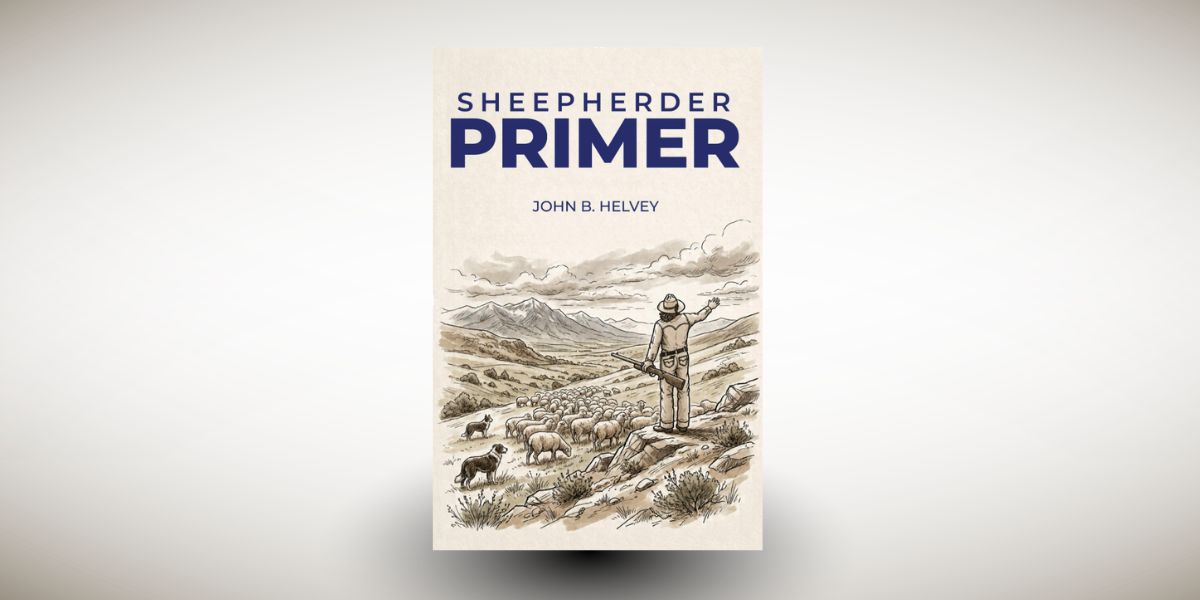
The book’s practical instruction is accompanied by simple illustrations that give the pages a distinctive personality. Sheep, dogs, hills, trees, camp life, roads, and cliffs are drawn with an informal hand that matches the straightforward writing. The sketches often carry the joke as much as the text does, turning hard-earned lessons into scenes that are easy to remember.

That humor does not diminish the risks of the work. A dog sent in the wrong direction can push sheep toward dangerous terrain. A flock may travel farther than expected during the cool morning or evening hours. Food has to be protected because the nearest grocery store may be a long way off. Even motorists have a role to play when meeting a band of sheep on the road. Helvey’s observations are specific, but they also reinforce a broader principle: on the range, small decisions can have large consequences.

A Portrait Of Responsibility, Patience, And Rural Life

Beyond its instructional value, Sheepherder Primer works as a compact portrait of a disappearing kind of everyday knowledge. The book documents habits and judgments that are learned through repetition: when to move, when to wait, how to read the flock, how to work with a dog, how to protect animals from predators, and how to adapt to conditions that cannot be controlled.

There is also an ethic running beneath the advice. The herder is responsible for the flock. The dog must be cared for. The terrain must be understood rather than underestimated. The animals set much of the pace, and the person in charge succeeds by paying attention. In that sense, the book is about more than sheep. It is about patience, stewardship, practical judgment, and the humility required to work closely with animals and land.

For readers unfamiliar with ranch life, the book offers an accessible introduction to the realities behind the pastoral image of sheep scattered across a mountain landscape. For readers with agricultural or rural experience, it may feel more like recognition: the kind of concise advice that comes from doing a job long enough to know which details matter.

About John B. Helvey

John Bowman Helvey was born in Billings, Montana. His background includes work as a ranch hand, sheepshearer, welder, and carpenter. The manuscript identifies him as a home builder in Bozeman, Montana, and reflects the practical, hands-on perspective of someone familiar with physical work, livestock, and the rhythms of the West.

With Sheepherder Primer, Helvey preserves that perspective in an illustrated format that is direct, useful, and full of personality. It is a modest book by design, but its simplicity is part of its strength: a collection of things worth knowing, learned outdoors, one lesson at a time.

Carrying the Past Moving Forward and Gal Fridman’s Vision for Women in Contemporary Art

Through women in motion, historical settings, and works combining technology, light, and physical layers, G6x7 explores the tension between inherited roles and the freedom to choose a direction.

A woman balances on a gymnastics beam above a banquet table. A bride leans a racing bicycle into a turn on a medieval street. Elsewhere, a fairy-tale princess leaps over the glass coffin in which she might once have waited to be rescued.

In the work of Gal Fridman, artist, photographer, and founder of G6x7, women occupy the decisive moment of an action. Their movements demand strength, precision, and judgment. Around them stand the architecture, rituals, and stories of an older world.

These encounters give a physical form to questions about women’s freedom and the expectations they continue to carry. In “Her Own Way.”, the gymnast’s composure above a scene recalling The Last Supper can suggest both self-possession and the effort required to sustain it. Her balance is an achievement, but it is also work.

Moving Through an Inherited World

No single narrative can describe the history of all women. Rights, opportunities, and restrictions have differed across cultures and generations. Fridman’s imagined settings offer a way to consider that inheritance without presenting the scenes as records of a particular historical moment.

Photo Courtesy: Gal Fridman / G6x7 (Left: Out of Time. | Right: The Promise)

In “Out of Time.”, a cyclist in a bridal dress takes a bend on a modern racing bicycle while a medieval street unfolds around her. The clash of eras makes her movement conspicuous: equipment built for speed passes through a world of stone, armor, and established order.

The wedding dress carries associations of love, choice, and belonging, as well as expectations surrounding marriage. Here it becomes part of an athletic effort. The rider must negotiate the street and the fabric around her while deciding where to go. Whether she is escaping, pursuing a chosen future, or doing both remains open to interpretation.

The Promise shifts the emphasis from individual direction to shared movement. Two brides run through an old city during a relay exchange. Their progress depends on timing, trust, and the willingness to place something valuable in another person’s hand.

The baton can be read as a connection between generations, with knowledge, courage, and opportunity passing from one woman to another. It can also suggest a partnership in the present. Each woman makes her own effort, but neither moves forward entirely alone.

Rewriting the Familiar Story

Photo Courtesy: Gal Fridman / G6x7 (Left: Not Waiting Anymore | Right: Win)

In Not Waiting Anymore, the fairy tale becomes a scene of deliberate action. A princess recognizable as Snow White clears a glass coffin with the extended stride of a hurdler. The royal chamber, dwarfs, and watching queen preserve the familiar story, while the heroine changes what she does within it.

The coffin becomes an obstacle to cross. The image gives a literal shape to the refusal to wait for someone else to determine the next chapter. Its theatrical setting and athletic movement bring humor and defiance into the same gesture.

Win places another suspended action beneath cathedral vaults. A woman arches backward over a high-jump bar, her body briefly held between ascent and landing. The scale of the interior gives the movement a public, almost ceremonial presence.

The scene allows several readings: the bar may suggest a personal goal, an imposed threshold, or a challenge to the authority surrounding her. What is visible is the effort of crossing it. The outcome remains outside the frame.

Across these works, female empowerment is expressed through particular actions rather than a single ideal of strength. A rider chooses a line, runners coordinate an exchange, a gymnast maintains control, and a princess takes a leap. Their confidence does not erase difficulty; it gives them a way to act within it.

The Artist Behind the Images

Gal Fridman studied photography at Jerusalem’s Bezalel Academy of Arts and Design. His career began in fashion photography, expanded into branding and international business, and later included founding technology ventures in hydrogen engines and brain research.

His photographic background is evident in the viewpoint, lighting, and attention to the relationship between body and clothing. A hand gripping a handlebar, a shift in weight, or the direction of a shadow gives physical credibility to an otherwise impossible scene.

His entrepreneurial experience also informs the construction of the work. Through G6x7, the company and artistic platform he founded, image-making is developed alongside materials, fabrication, and illumination. The composition is conceived as something that will occupy a room.

As a male artist addressing women’s experiences, Fridman contributes one perspective to a broader conversation about representation. The images leave room for viewers to question their symbolism and bring their own experiences to the scenes.

G6x7 Brings the Image Into Physical Space

The works extend beyond a flat print. G6x7 combines imagery on brushed aluminum with transparent acrylic layers, using the spaces between surfaces to create depth. Different elements occupy different planes, so their apparent alignment changes as the viewer moves.

Lighting is developed as part of this material structure. It can emphasize details, cast shadows, and alter the relationship between a figure and the world around her. Image, spacing, and illumination together shape the experience of the work.

This construction gives the tension between inheritance and choice a material counterpart. Past and present coexist within one composition, while separation between its layers becomes something the viewer can perceive through movement. Technology helps turn the visual idea into a spatial encounter.

At the center remains a human moment of effort. The cyclist is negotiating the turn, the baton is passing between two hands, and the jumper has yet to land. Fridman holds these actions open, inviting viewers to consider freedom as something repeatedly exercised through choice, persistence, and movement.

Explore the works at g6x7.com.

Carl Construction Handles Steel and Design-Build Work

Construction projects in the northern Rockies run on a short calendar. Snow arrives early, material deliveries travel long distances, and permitting timelines vary by county. Owners planning a build in the region need a contractor who understands those conditions before the drawings are finished. Carl Construction, a full-scope contracting firm based in Missoula, Montana, builds commercial, agricultural, and industrial projects across Montana, Wyoming, and the Northwest. The company specializes in steel and pre-engineered building systems, and it also offers design-build delivery and pre-construction planning.

What Full Scope Contracting Covers

Full scope contracting means one firm carries a project from early budgeting through completion. The owner works with a single point of contact instead of coordinating separate design, engineering, and construction agreements. That structure reduces handoffs, and handoffs are where schedules tend to slip. Carl Construction operates on that model, taking a project from the first budget conversation through final quality control.

Work under this model can start from a blank page or from finished drawings. Bid contracting covers projects where an owner already has plans, architects, and engineers in place. Planning oversight covers building permits. Project construction covers subcontractor selection, material ordering, site work, paving, curbs, sidewalks, and landscaping.

Steel Buildings for Commercial, Agricultural, and Industrial Use

Photo Courtesy: Carl Construction

Pre-engineered steel buildings fit a wide range of uses in the region. Offices, shops, and warehouses make up much of the commercial category. Agricultural buildings face snow load, wind, and livestock demands that shape frame and cladding choices. Industrial projects often require clear spans, crane loads, or equipment access that standard framing cannot deliver.

Carl Construction works directly with steel manufacturers on these systems and handles complex foundation work through helical pier systems. Foundation conditions vary across western Montana. Site soils sometimes rule out a conventional footing, and identifying that early keeps a project from stalling after mobilization.

How Pre-Construction Planning Shapes a Budget

Pre-construction planning carries real weight on cost. Decisions made during this stage set what a project will cost to finish, and changes made later cost far more to absorb.

Pre-construction work at Carl Construction covers several tasks. The team develops project and material budgets so owners see cost ranges before they commit. It recommends architects, engineers, and other designers, or works directly with the professionals an owner has already selected. The team reviews site preparation early, including access, grading, and drainage questions that affect foundation work. Utility and facility requirements get identified during the same phase, which matters on rural parcels where water, power, and septic service may not reach the building site.

Design Build Under a Single Contract

Design-build places design and construction under one contract. The Design-Build Institute of America, an industry association focused on this delivery method, separates it from the traditional approach, where an owner hires a designer first and then bids completed drawings to builders.

Carl Construction offers design-build for commercial and residential clients. Under this method, construction input arrives while the design is still flexible. A builder can flag a detail that will be expensive to frame, or a material with a long lead time, while the drawing can still change. That feedback loop is harder to create when design work finishes before a contractor ever sees the plans.

Working Across Montana, Wyoming, and the Northwest

Photo Courtesy: Carl Construction

Regional conditions affect how a project gets planned. Frost depth, snow load, wind exposure, and wildfire risk all influence structural decisions in the northern Rockies. Code requirements shift between jurisdictions, and a rural county may handle plan review differently than a city building department.

Carl Construction serves Montana, Wyoming, and the surrounding Northwest from its Missoula base. On projects outside the immediate area, travel distance and crew logistics factor into the schedule. Those factors belong in the planning stage, not after mobilization.

Questions Owners Should Ask a Contractor

Owners comparing contractors can learn a great deal from a few direct questions. Ask how the firm builds a budget and what the estimate includes at each stage. Ask who manages the site day to day and how often that person reports back. Ask how change orders get priced and approved before work proceeds. Ask for references on projects of similar size and type.

Scheduling deserves the same attention. A contractor should explain how it sequences trades, where long-lead items sit, and what happens to the calendar when weather closes a site. Carl Construction handles scheduling as part of construction management, and owners can ask to see how a proposed schedule accounts for winter conditions.

Starting a Project in the Region

Most builds begin with a budget question and a site question. Owners who bring both to an early meeting tend to get more useful answers. A rough scope, a target range, and a location give a contractor enough information to explain what is feasible. Pre-construction planning comes first in the Carl Construction process, which gives owners a clearer cost picture before design work advances.

Details on Carl Construction’s steel building and general contracting services are available on the company website.

Missoula, Montana. (406) 543-3512.

From Immigration Uncertainty to Advocacy: Mohammad Shair’s Journey to The Cost of Belonging

For some families, immigration is not an abstract policy issue. It can shape ordinary decisions about work, travel, family, and the ability to plan for the future. Mohammad Zohdi Shair grew up in Tampa as the son of Palestinian immigrants and saw firsthand how uncertainty surrounding immigration status could affect the people closest to him. Those experiences eventually influenced the direction of his career and his decision to examine the immigrant experience through both legal practice and personal reflection.

Today, Shair is an immigration attorney whose work spans employment-based immigration, family reunification, asylum, humanitarian protection, and removal defense. His professional experience has given him a close view of the legal system, while his family history gives him a personal understanding of the uncertainty that can accompany immigration. Together, those perspectives became the foundation for his book, The Cost of Belonging: Immigration and the Fight for the American Dream.

Growing Up With Immigration Uncertainty

For children of immigrants, questions about immigration status can become part of everyday family life. Decisions that may seem routine to others can carry additional uncertainty when a family’s ability to work, travel, remain together, or plan ahead depends on legal circumstances.

For Shair, growing up with that awareness shaped how he understood the relationship between law and ordinary life. Immigration was not simply a subject discussed in political debates or legal documents. It was something that could influence the choices available to a family and the sense of certainty surrounding its future.

Those early experiences did not immediately produce a career plan. Over time, however, they contributed to an interest in immigration law and the human circumstances surrounding it.

From Personal Experience to Legal Practice

Shair eventually became an immigration attorney, giving him an opportunity to understand the system from a professional perspective. His practice now encompasses a range of immigration matters, from employment-based immigration and family reunification to asylum, humanitarian protection, and removal defense.

That work placed him in situations where the legal system and human experience intersect directly.

Immigration cases involve statutes, regulations, applications, petitions, and proceedings, but behind each legal matter is a person or family facing a particular set of circumstances. Shair’s experience has reinforced his interest in explaining immigration in a way that makes the human consequences of the system easier for ordinary readers to understand.

His academic background also contributes to that approach. With studies in philosophy and religious studies alongside his legal education, Shair approaches immigration through questions involving identity, justice, citizenship, faith, opportunity, and belonging.

Seeing Immigration From Two Perspectives

Shair’s professional perspective is unusual because it is informed by both participation in the legal system and personal experience as the child of immigrants.

As an attorney, he can examine immigration through the technical and procedural realities of the law. As someone raised in an immigrant family, he understands that those legal realities can affect decisions that are deeply personal.

That combination informs his broader approach to immigration. Rather than viewing the subject only through legal terminology or political categories, Shair seeks to examine what immigration means for the people living within the system.

That perspective became central to his decision to write The Cost of Belonging.

Turning Experience Into a Broader Conversation

The Cost of Belonging: Immigration and the Fight for the American Dream examines the American immigration experience through personal narrative, accessible explanations of immigration law, and reflections on identity, faith, citizenship, and justice.

The book asks questions that extend beyond individual cases. What does the American Dream demand from people who pursue it? What does it mean to belong to a country? And how do laws and policies affect the people and families living under them?

For Shair, writing the book created an opportunity to connect his family history with what he encounters through his legal practice. The result is an examination of immigration as both a legal system and a human experience.

A Journey That Comes Full Circle

The connection between Shair’s personal history and professional life is perhaps most visible in a simple detail of his present-day routine. His office is located across the street from his parents’ home. He can walk over and have lunch with his mother, a seemingly ordinary privilege that carries a deeper significance given the uncertainty that shaped earlier parts of his family’s journey.

That moment represents more than professional success. It reflects a life shaped by immigration, family, education, law, and opportunity.

For Shair, the American Dream is therefore not simply an abstract ideal. It is connected to the experiences of families navigating uncertainty while trying to build a future. The Cost of Belonging extends that personal journey into a broader conversation about immigration, identity, and what it means to belong.

Explore / Learn More and Connect with Mohammad Shair

Website: Shair Legal

Book: The Cost of Belonging: Immigration and the Fight for the American Dream

LinkedIn: Mohammad Shair

Instagram: Mohammad Shair