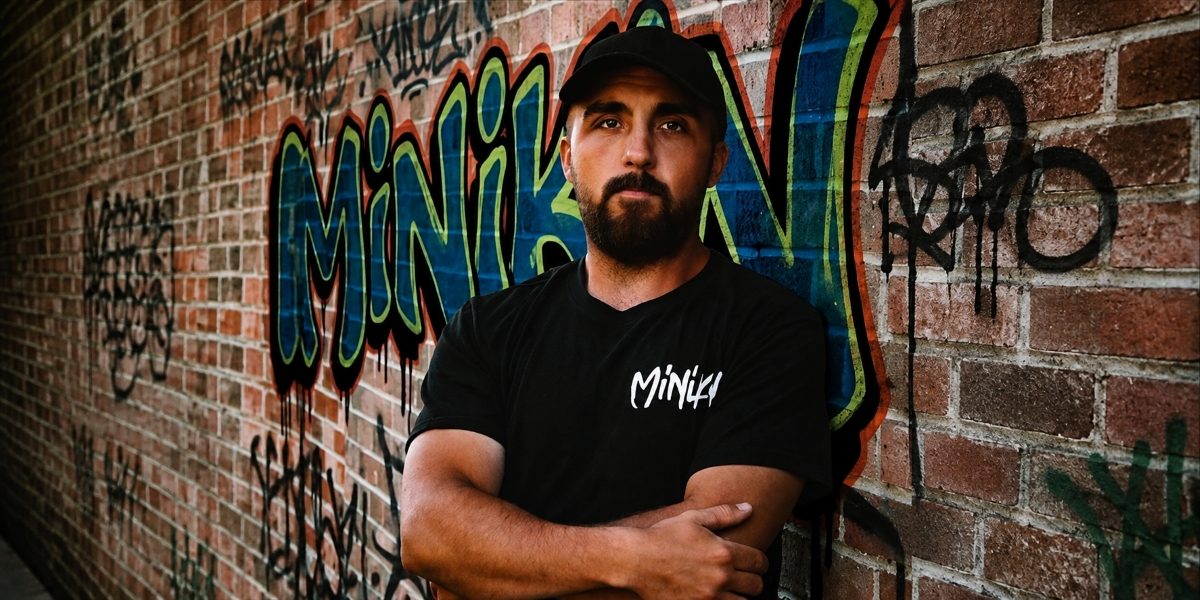

For Cody Newland, better known as Minikin, music was never about becoming famous. It was about surviving.
Long before he stepped behind a microphone, he discovered that writing was the only place where he could truly express himself. Growing up, he often felt like he did not have a voice at home. By the seventh grade, he had begun filling notebooks with thoughts he could not say out loud. His rhymes were rough and unpolished, but they gave him something far more valuable than technical skill. They gave him an outlet.
“If I couldn’t at least write what I was thinking, I don’t know how I could have gotten through the days without feeling like nothing,” he says.
That realization quietly became the foundation of everything he would create in the years ahead. What started as a coping mechanism eventually evolved into an artistic philosophy built on one simple belief. The most meaningful music is honest music.
Like countless artists before him, Minikin grew up listening to Eminem. However, he credits Hopsin as the artist who truly changed the trajectory of his life.
As a high school sophomore battling severe depression and overwhelming anger, hearing Hopsin’s I Need Help showed him that rap could be more than clever lyrics or commercial success. It could become a place where pain was acknowledged instead of hidden.
That perspective transformed the way he approached songwriting. As he became more confident as a writer, his music expanded beyond anger into something much more personal. He began exploring subjects like addiction, mental health, broken family relationships, loneliness, and the feeling of being disconnected from the world around him.
Rather than writing songs designed to impress people, he began writing songs that reflected who he really was.
A Story of Survival
Minikin’s music carries emotional weight because it comes from lived experience.
His journey included years of self-medicating, struggles with alcohol, antidepressants, a bipolar diagnosis, and treatment with lithium. Eventually, those battles caught up with him in devastating fashion.
At twenty-four years old, he was admitted to the intensive care unit after drinking left his liver and one of his kidneys failing. He was also diagnosed with pancreatitis, a moment that forced him to confront the direction his life was heading.
Since January 2, 2023, he has remained sober.
Looking back, he believes the answer was surprisingly simple.
“It turns out I just needed to treat my body well, and my mind would follow.”
Those experiences continue to shape both the person and the artist he has become. Instead of hiding the darkest chapters of his life, he allows them to give his music authenticity. His goal is not to glorify struggle, but to remind listeners they are not alone in theirs.
Choosing Substance Over Trends
In an era where social media trends often dictate what succeeds, Minikin has little interest in following the crowd.
He openly admits that his approach may never make him the biggest artist in an increasingly saturated industry, but popularity has never been the motivation behind his work.
“I’d rather make music that means something than chase trends.”
That commitment to authenticity defines every aspect of his artistry. His songs are rooted in experiences many people quietly carry with them, including depression, addiction, fractured relationships with parents, and the constant search for belonging.
He believes countless people have lived through similar experiences but may never find the words to express them. If his music can become that voice for someone else, then he considers it worthwhile.
“The perspective I bring is honesty,” he says. “If what I’ve lived through can help someone feel understood or keep them pushing forward, then that means everything to me.”
Keeping It Real
Despite tackling serious subject matter, Minikin refuses to take himself too seriously.
His personality is filled with dry humor and self-awareness. He jokes about being “5’5 if I keep my socks on,” riffs on his imaginary pop star admirers, and laughs about making music from the second floor of an apartment he sarcastically describes as an extravagant duplex.
That balance between vulnerability and humor gives his music a distinctly human quality. Even when discussing life’s darkest moments, there is an underlying sense of resilience that reminds listeners healing is possible without pretending everything is perfect.
It also reflects his approach as an independent artist. He writes, records, and mixes his own music, embracing the imperfections that come with complete creative control because they are part of what makes the work genuine.
Looking Ahead
As Minikin continues building his career, his goals remain refreshingly straightforward. He wants to tour, connect with people who are tired of hearing music that sounds the same, and be recognized for staying true to himself rather than following industry formulas.
For him, success is not measured solely by streaming numbers or viral moments. It is measured by connection.
Every song begins the same way it did years ago, with an honest thought that needs somewhere to exist. The difference today is that those thoughts no longer stay inside a notebook. They reach listeners who may be searching for the same thing he once was: proof that someone else understands.
For Minikin, rap did not simply become a career. It became the reason he kept moving forward. Now, through every lyric he writes, he hopes it can do the same for someone else.