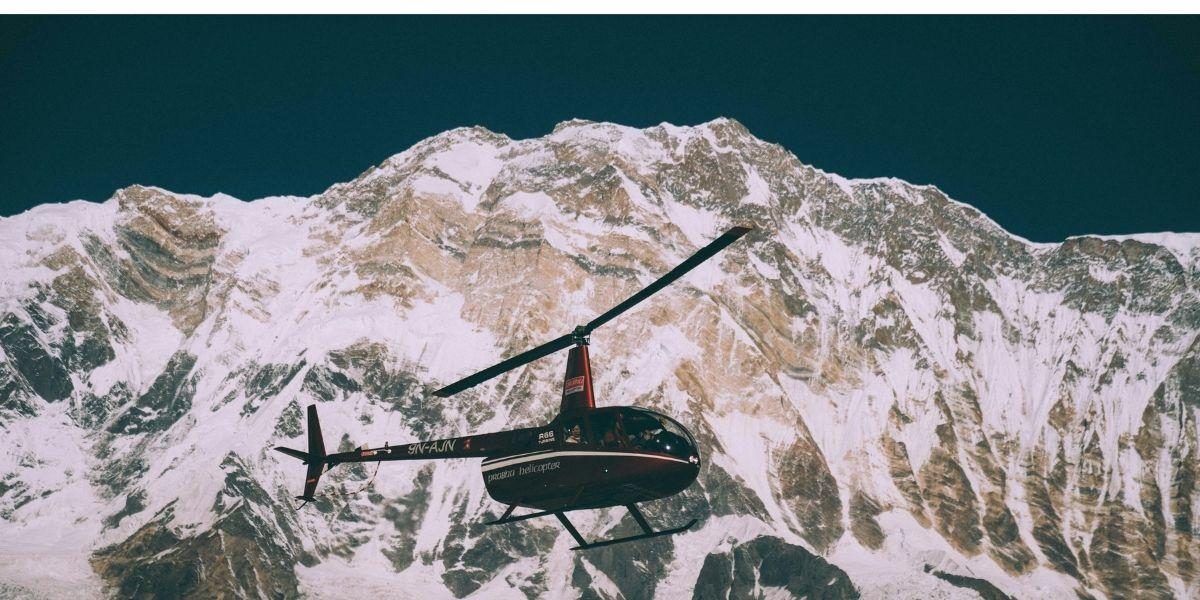

When you travel to higher regions, you need to have good physical stamina and endurance. Above 3,500 meters, the decreasing oxygen level becomes apparent. So, even short walks can leave you tired, and small movements can also feel challenging. Similarly, you might find yourself getting out of breath while climbing hills or walking on uneven trails. Even if you have good fitness your body needs time to adjust to the changing environmental conditions.
Preparation starts with knowing that altitude affects everyone in its own way. Even if you’re active and fit, you might still feel out of breath or move more slowly at higher elevations. Not every experience in the Himalayas needs a lot of physical fitness. For example, on the Everest Base Camp Heli Tour you can explore the mountain regions with minimal exhaustion.
How To Build Fitness For Treks In Nepal?
A good training routine focuses on building strength and stamina. Similarly, strength improvement exercises help protect your joints and keep you from getting tired too quickly.
Cardiovascular Fitness
You should include activities like running, cycling, or stair climbing about 3 to 5 times a week. Similarly, begin with around 30 minutes per session and then slowly increase to 90 minutes or more. Some of the most common exercises for this are mentioned below.
- Brisk walking
- Running
- Swimming
- Cycling
- Jumping rope
For more challenging adventures, like Island Peak Climbing, also incorporate interval training. It is a type of workout where you switch between intensive activity and the easy ones. For example, you might run fast for 1 minute, then walk or jog slowly for 2 minutes and repeat this cycle several times.
Going on Short Hikes With a Loaded Backpack
To prepare well for the Everest Base Camp Helicopter return, you should practice hiking on real trails. There’s no better way to build stamina and confidence for the journey than spending time walking on uneven ground. It helps your muscles and joints adapt to rough terrain, which lowers your risk of injury once you’re at high altitude. With enough practice, you start moving and feeling like a proper trekker—from Lukla all the way to Everest Base Camp. Thus, go on a few short hikes that mimic the ascents and descents of the Himalayan treks.
Improve Flexibility and Mobility
- Lunges at least 3 times a week for the hips and glutes, which betters the hip flexibility and helps with ascents.
- Downward dog targets hamstrings and calves, it improves muscle and joint recovery.
- Meditating improves mental focus and allows you to keep moving forward despite the challenges.
- Likewise, ankle circles and swings focus on the ankles and hips.
Activities To Build Strength
If you want to take on a Himalayan adventure, proper training makes a big difference. Focus on building strength in your legs, core and upper body, since these muscles do most of the work on the trail. Think about carrying a 10 to 15 kg backpack while walking on steep, uneven paths.
- Squats and lunges help with the quads, hamstrings, and glute muscles. Thus, you can complete the uphill sections with less difficulty.
- Similarly, step-ups target the legs and hamstrings and make it easier to complete rugged terrain and ridge walks.
- Planks are very important to strengthen the back and core muscles. This is especially helpful on uneven trails.
- Practice deadlifts at least 5 days a week for a strong core and hamstrings. Doing so allows you to walk long hours with heavy backpacks.
- Rows and Shoulder Press target the upper back and the shoulders.
Breathing Techniques
Before you head out to climb a 6,000-meter (19,700-foot) mountain or trek, it is important to know proper breathing techniques. This is important in order to cope with the thin air, low oxygen level, and freezing temperatures. These techniques are beneficial to improve oxygen absorption at high elevations, where the oxygen is low and the atmosphere is thin.
Belly breathing
It is also known as diaphragmatic breathing. You start by lying down on the ground or sitting in a relaxed position. After that, put one hand on your chest and the other hand on your belly. Start to inhale through your nose and try your best to let your belly rise while keeping your chest as still as possible. Thereafter, gently breathe out through your mouth and let your belly fall down. Repeat this for about 3 to 5 minutes every day, this improves the lungs’ efficiency and oxygen absorption.
Pressure Breathing
It is a technique used to control breathlessness during hard physical effort, especially at high altitude. Take a normal breath in through your nose, then exhale slowly and forcefully through your mouth with your lips slightly pursed. Similar to you, gently blowing out a candle.
This creates a bit of back pressure in your lungs which helps keep airways open and improves oxygen exchange.
You can use it while climbing uphill sections of the Himalayan adventure. This also allows you to focus better and stay calm, recovering faster in between the steps. Similarly, this technique is mostly followed by climbers from around the world. Inhaling as fully as possible, the climber exhales with force, generally pursing their lips slightly so as to create a smaller aperture.
Box Breathing
It is a simple technique that helps trekkers and climbers stay calm and focused. Similarly, they are known to be useful during physically challenging sections. First, you need to breathe in slowly through your nose for about 4 seconds. After that, hold it for another 4 seconds and breathe out slowly for another 4 seconds. Thereafter, hold it again for 4 seconds and repeat the cycle for about 3 to 5 minutes.
Be it trekking or peak climbing, box breathing helps to manage anxiety that anyone can experience during high-altitude adventures. Furthermore, it is also useful to recover more easily during difficult ascents. The key benefit of this technique is that it lowers the heartbeat and keeps it steady even on steep uphill and downhill climbs.