
What happens when your very existence is deemed a threat to social survival? For a child growing up in the shadow of mid-century American idealism, the answer was absolute silence and misery.
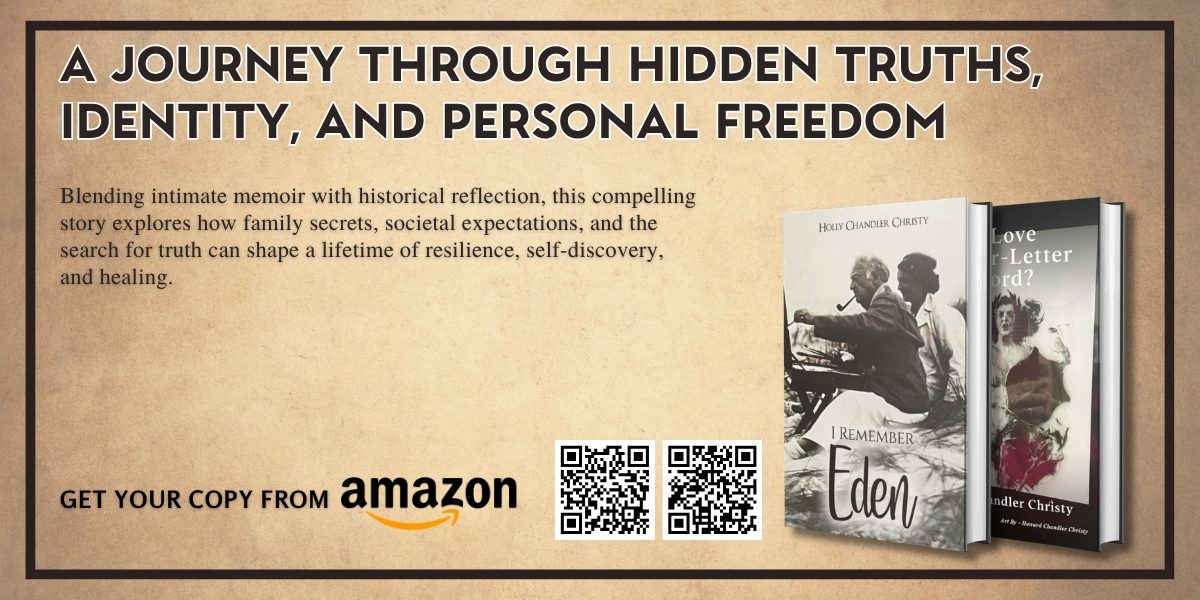
In her compelling memoirs, I Remember Eden and Is Love a Four-Letter Word?: ” Why Religion Put a Hex on Sex, author Holly Chandler Christy pulls back the heavy drapes of historical secrecy to examine a life caught between extraordinary beauty and rigid societal judgment.
Every life has an anchor point, and for Christy, that anchor was a picture-perfect sanctuary nestled between two mountains in Pawlet, Vermont, known as the Old Red Mill. To a young girl, this was Eden. It was a world filled with the rushing sounds of the Mettowee River, the chatter of kingfishers, and the abundant affection of a larger-than-life figure she called “Poppy.”
But outside the peace of Vermont lay a hyper-critical culture, because “Poppy” was none other than Howard Chandler Christy. He was the world-famous American artist and illustrator celebrated for creating the iconic “Christy Girl” and painting the massive Scene of the Signing of the Constitution hanging in the United States Capitol Building. Because of his fame and the rigid moral climate of World War II-era America, Holly’s true identity as the daughter of Christy and his muse, Elise Ford, had to be guarded at all costs. At the unveiling of his masterwork in the Capitol rotunda, the U.S. Chaplain delivered a prayer imploring God to keep the nation free from sin, a stark reflection of a judgmental society in which an unsanctioned identity could incite total ruin.
This tension between profound paternal love and forced concealment became the defining pattern of Holly’s early existence. She was surrounded by historical treasures, tapestries, and life-sized paintings in Christy’s light-flooded studio at the Hotel des Artistes, and she grew up sensing a deep, unspoken taboo, where she was required to remain silent, and the fundamental question of the identity of her and her father remained a forbidden fruit she was bound to taste.
The fragile peace of childhood was shattered on March 4, 1952, when Howard Chandler Christy passed away. For Holly, then a student at the Daycroft boarding school in Stamford, Connecticut, it felt as though Eden’s gate had slammed shut permanently. The joyful waterfall of Vermont was abruptly replaced by the sweltering heat and traffic wails of New York City, and her mother’s protective silence hardened into an impenetrable wall.
As adolescence took hold, the memoir details a profound sense of isolation. Sent back to boarding school on weekends and holidays while her mother worked tirelessly as an animation artist to support them, Holly battled a deep sense of abandonment. It was during these years that the biological realities of puberty collided head-on with a repressive cultural narrative. In the 1950s, the female body was frequently framed as an object of guilt, as a source of “naughty thoughts” to be disciplined and hidden away. Left to make sense of her changing identity with zero honest guidance, Holly began a lifelong quest for what she naively called “the truth,” searching for a way to strip the shroud of secrecy from the adult world.
Moving to Washington, D.C., as a teenager, Holly attempted to step into adulthood, making her way through the bustling corridors of the nation’s capital. From her window on Connecticut Avenue, she watched the dancers at Arthur Murray’s studio, longing for the freedom, rhythm, and validation of the outside world. Her search for connection led her to Enrique Ruiz, a suave Mexican tango dancer who introduced her to the fiery rhythms of the mambo and, simultaneously, to the rigid doctrines of institutional religion.
As she moved into Enrique’s world, she was introduced to a system of faith that offered order but at the sake of absolute obedience. She learned that Enrique’s father was a dominant charro who demanded respect through physical intimidation and stood in direct opposition to the unconditional, creative love she had experienced. Yet, the institutional faith she encountered mirrored this dominance, framing love as entirely conditional and utilizing guilt to manage desire.
During her time at the India Supply Mission and exploring the library shelves in D.C., Holly began encountering historical, political, and philosophical texts that challenged the absolute moral narratives she had been taught. From critiques of Christian Science to the destructive histories of cultural extremism, her worldview began to crack, and she recognized that the human “gods” ruling the social structures around her were all too human. These gods manipulate shame to maintain control over identity, gender roles, and compliance.
If you are stuck in a rut and confused about your role and desire in a world where every other woman is portrayed as holding the crown of sexual dominance, I Remember Eden and Is Love a Four-Letter Word? stand as a meticulous record of unlearning. Christy interrogates marriage, motherhood, sexuality, and institutional dogma with remarkable restraint and raw honesty, refusing to either sanitize her struggles or blindly condemn her past. Her narrative broadens from an intimate family mystery into an expansive critique of patriarchy, authority, and societal anxiety, challenging the moral absolutes that seek to keep individuals small and offering an essential perspective on how inherited beliefs shape identity over a lifetime.
For readers working through personal reinvention, questioning long-held doctrines, or searching for clarity in the aftermath of family secrets, Holly Chandler Christy’s work offers a steady, thoughtful companion. It gives readers both the language and the permission to ask the most difficult questions of their lives, and it treats the insistence on truth as a serious ethical act.
“Adults had secrets, which is why I came to see them as petty gods who kept me small and dependent so they could continue to wield power over me. I yearned to throw off their restraints and think for myself.”
From Is Love a Four-Letter Word? by Holly Chandler Christy
Together, the two memoirs trace Christy’s search for truth across the worlds of art, religion, and self-discovery. That search led her toward a sense of understanding about her own history and about the father she long suspected was her own, Howard Chandler Christy. The result is a candid and unusual account of one woman’s life and the questions that shaped it.
Both books, I Remember Eden and Is Love a Four-Letter Word?, are available for purchase on Amazon.