
By: Catalina Santorini
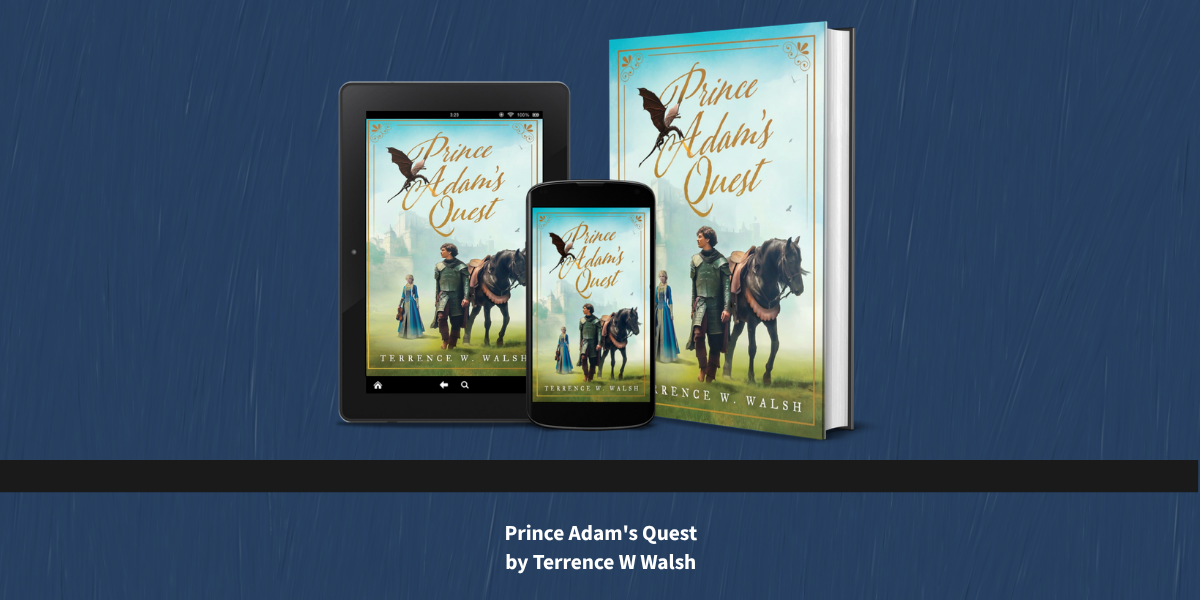
There is something unusual about a fantasy novel that announces upfront that its hero always wins and then spends its entire length making you uncertain what winning is going to look like. Terrence W. Walsh makes that move in the opening pages of Prince Adam’s Quest and sustains the tension it creates all the way to an ending that is actually three endings: history, comedy, or tragedy, with Prince Adam given the choice of which fate to claim. That conceit alone may make the book interesting to readers. The storytelling that fills the space between the opening and the triple ending gives it a memorable quality.
Prince Adam sets out from Leftovria to slay a dragon because that is what princes do when dragons are reported, and he brings with him Minnow, an apprentice bard who is still figuring out both the bard part and the apprentice part, but who has a gift for composing songs that change the mood of any room or road or troll bridge she happens to be crossing. The troll bridges are a notable part of the story. Walsh has imagined a species whose culture revolves around the imposition and collection of tolls with a specificity and affection that makes them feel like a society rather than a convenient obstacle, and Adam’s running struggle to meet their financial demands gives the quest a grounding comedy that can keep the more fantastical elements feeling consequential rather than arbitrary.
What Walsh brings to this material, beyond the pleasures of his comic invention, is the sensibility of someone who has spent a lifetime thinking about stories in multiple forms, fiction, drama, and poetry, and has arrived at a personal understanding of what stories can be for. Prince Adam’s Quest has been described as an instructive tale for people of all ages, and the instruction is woven into the fabric of the narrative rather than delivered as a moral at the end. Readers can absorb it through experience rather than declaration, through the specific texture of following Adam and Minnow across Leftovria and watching what their choices reveal.
The prose has the unhurried confidence of a writer who retired from one demanding career and discovered a second one that suited him. Walsh writes with warmth and wit and a precise comic timing that helps the funny moments land without crowding out the feeling underneath. Prince Adam’s Quest is the kind of book that may leave readers wanting to share it with someone else after finishing it.
For readers interested in troll bridges with personality, an apprentice bard finding her voice, and a hero who always wins but gets to choose what winning looks like, Prince Adam’s Quest by Terrence W. Walsh is available on Amazon. The dragon is waiting, and so are three very different endings.