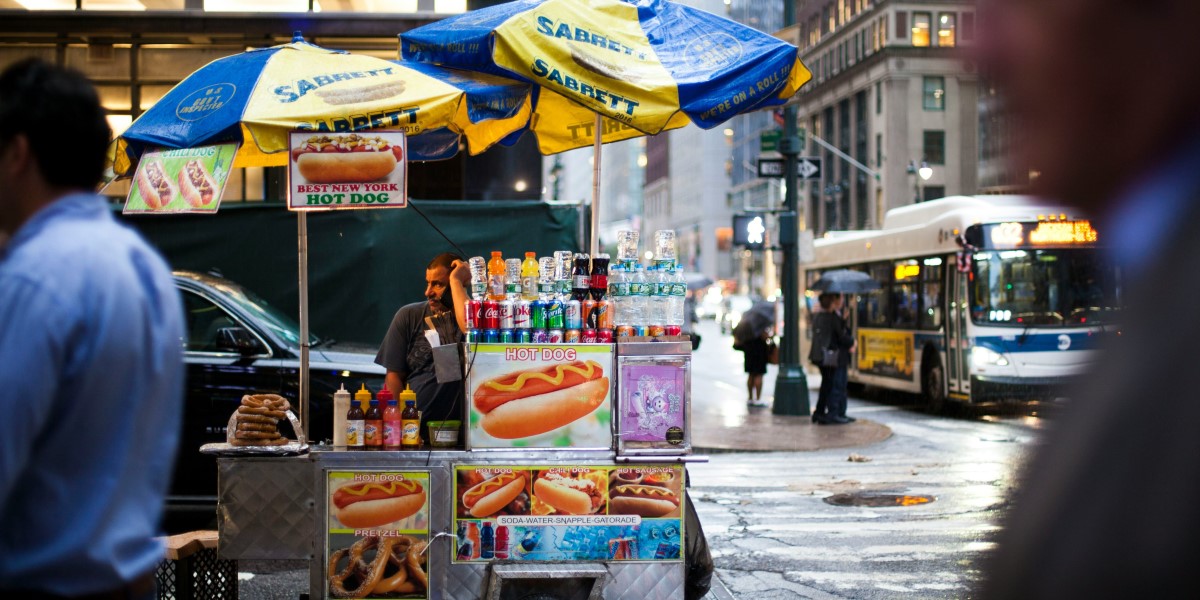

New York City officially launched a six-month pilot program on July 7 to replace gas-powered generators on mobile food carts with rechargeable electric batteries, starting with 10 vendors at Flushing Meadows Corona Park in Queens. The NYC Clean-Powered Carts Challenge, unveiled by Chief Climate Officer Louise Yeung near the Unisphere, is designed as a proof of concept that will allow the city to test battery performance, gather vendor feedback, and evaluate the model for broader deployment across the five boroughs.
Key Takeaways
- The Mayor’s Office of Climate and Environmental Justice selected 10 food carts in Queens for the six-month pilot, replacing diesel generators with rechargeable electric batteries.
- If scaled to all food vendors citywide, the transition could reduce greenhouse gas emissions by 120,000 metric tons of CO2 annually — equivalent to removing 30,000 cars from the road.
- PopWheels, the Brooklyn-based battery company partnering with the city, says vendors will pay roughly the same daily cost as gasoline through a subscription model.
- The Street Vendor Project, a nonprofit advocacy group for mobile food vendors, co-developed the initiative and flagged long-term health complications tied to generator exhaust exposure.
- PopWheels reports zero fire incidents across its entire network to date, backed by a proprietary fire-suppression system inside its swap cabinets.
What Does the Clean-Powered Carts Challenge Actually Change for Vendors?
The core mechanics of the pilot are straightforward but operationally meaningful for the vendors who participate. PopWheels retrofits existing carts with rechargeable electric batteries, and at the beginning and end of each shift, vendors exchange their depleted units for fully charged replacements through PopWheels’ battery-swapping infrastructure. The batteries are silent and produce zero emissions, eliminating two of the most persistent complaints associated with the city’s approximately 20,500 licensed food vending operations: noise pollution and localized air contamination.
There are roughly 20,500 food carts across the city that currently use diesel generators to operate. Anyone who has stood in line at a halal cart or taco stand is familiar with the rattle and exhaust that accompanies a typical meal purchase. The Clean-Powered Carts Challenge targets that experience directly, stripping the generator out and dropping in a rechargeable pack that runs silently throughout a full shift.
PopWheels co-founder David Hammer demonstrated how the company’s inverter adapter fits into the same slot where a generator normally sits. The average vendor will need a pack of four batteries to last a full day, though the swappable system allows operators to size up or down depending on demand. Most cooking on food carts still relies on propane, which is a separate energy source; the batteries handle lighting, refrigeration, fans, and point-of-sale systems.
How Does the Economics Work for Street Vendors?
Cost neutrality is the linchpin of whether this pilot translates into citywide adoption, and PopWheels built its pitch around that constraint. Food cart operators typically spend around $10 a day on gasoline to power their generators, and four PopWheels batteries delivering roughly five kilowatt-hours would cost about the same through the subscription model. That calculation does not factor in the maintenance savings. Traditional generators require regular repairs, fuel runs, and replacement cycles that add up.
One participating vendor, William Arévalo, has operated food carts at Flushing Meadows Corona Park for eight years and owns three businesses within the park. Arévalo’s total permit fees to the Parks Department alone run $200,000 annually for his two carts and two trucks, and his profits have dropped since the pandemic due to increased competition from unlicensed vendors — from $4,000 per Saturday to roughly $1,000. For vendors operating on those margins, adding costs is not an option. The fact that battery power matches gasoline pricing before subsidies makes the pitch viable.
PopWheels charges delivery workers $75 per month for unlimited battery swaps and has maintained a long waitlist for its e-bike service. The company raised $2.3 million in seed funding in 2025, and has since scaled to more than 50 stations, 2,000 batteries, over 1,000 customers, and more than 250,000 battery swaps within roughly a year of commercial operations.
What Are the Health and Air Quality Implications?
The occupational health dimension of this pilot is significant and often underreported. Mohamed Attia, managing director of Urban Justice Center’s Street Vendor Project, has been working toward food cart electrification for years. Attia told NY1 that generators affect vendors more than anyone else because they stand next to the units for 10- to 12-hour shifts, inhaling emissions directly into their lungs throughout the day.
One vendor who previously used a Honda generator for 25 years described black smoke spewing from the unit during hot days, with soot blowing through the service window and coating employees’ faces and arms. That vendor switched to a Joule Case battery through the Street Vendor Project and cut daily energy costs from roughly $6 in gasoline plus $1,200 every two years for generator replacement down to $2 per day in charging costs, with only one repair needed in two years.
The emissions math at scale is where the climate case becomes compelling. Louise Yeung told NY1 that electrifying every food vending cart in New York City would reduce greenhouse gas emissions by 120,000 metric tons of CO2 — the equivalent of removing 30,000 cars from city roads each year. Flushing Meadows Corona Park was selected as the testing ground because of its high foot traffic from both residents and tourists.
What Challenges Could Slow a Citywide Rollout?
Previous attempts to electrify New York City’s food cart fleet have encountered obstacles that the Clean-Powered Carts Challenge will need to address. Battery capacity remains a variable: compact carts with limited electrical needs can run on a single charge, but vendors with refrigerators, food warmers, and longer shifts may need higher-capacity solutions, and waterproofing remains a concern during heavy rain and winter conditions.
PopWheels has addressed the fire safety question more directly than earlier entrants. The company’s cabinets feature a built-in mechanism that ejects a battery into a tank of fireproof material during a thermal event, fully extinguishing any fire rather than simply trying to contain it. That design earned FDNY approval for use in non-fireproof environments — a distinction no other e-bike battery charging system in New York City had previously received.
The six-month timeline will determine whether the batteries hold up under the operational demands of a Queens park in summer and early winter, and whether the vendor experience generates enough data to justify expansion.
New York City’s food cart fleet represents one of the last unaddressed pockets of street-level fossil fuel use, and the Clean-Powered Carts Challenge is the city’s first structured attempt to close that gap at the vendor level.
FAQs
What is the NYC Clean-Powered Carts Challenge? The Clean-Powered Carts Challenge is a six-month pilot program launched by the Mayor’s Office of Climate and Environmental Justice that replaces gas-powered generators on 10 food carts at Flushing Meadows Corona Park with rechargeable electric batteries supplied by PopWheels.
How many food carts operate in New York City? New York City has approximately 20,500 licensed food carts and trucks that currently rely on diesel or gasoline generators for electrical power, covering lighting, refrigeration, fans, and payment systems.
How much does it cost vendors to switch to electric batteries? PopWheels says the daily subscription cost for four batteries is roughly equivalent to what vendors already spend on gasoline — about $10 per day — making the transition cost-neutral before any subsidies.
What happens if a battery catches fire? PopWheels cabinets use a proprietary fire-suppression system that ejects a battery into fireproof material during a thermal event, fully extinguishing the fire. The company reports zero fire incidents across its network.
Who is PopWheels? PopWheels is a Brooklyn-based startup that built a battery-swapping network for e-bike delivery workers. The company operates more than 50 stations across multiple cities and raised $2.3 million in seed funding in 2025.
Why was Flushing Meadows Corona Park chosen for the pilot? The park was selected because it serves millions of residents and tourists annually, providing a high-traffic testing environment with a concentrated cluster of food vendors.
What would full-scale electrification mean for emissions? Electrifying all 20,500 food carts across the five boroughs would eliminate an estimated 120,000 metric tons of CO2 annually, equivalent to taking 30,000 cars off the road.
What is the Street Vendor Project’s role in the initiative? The Street Vendor Project, a nonprofit under the Urban Justice Center, has advocated for food cart electrification for years and partnered with PopWheels and the city to develop and implement the pilot program.