
App technology has spent the last decade chasing more. More features. More dashboards. More integrations. More complexity layered on top of complexity until the tools people rely on every day began to feel less like solutions and more like obligations. Software became capable of almost anything, and somewhere in that process, it forgot to ask whether any of it was actually making people’s lives easier.
In 2026, that dynamic has already shifted. Not because the industry has suddenly become modest about what technology can do, but because the evidence has become hard to ignore. Users are not abandoning products because they lack features. They are abandoning them because the features they have do not translate into experiences worth staying for. The market is beginning to reflect that, and the product teams paying attention are already building differently.
The conversation inside technology is moving away from feature lists and toward something that has always been harder to quantify, which is whether a product actually understands the person using it. The next generation of platforms will not win on capability alone. They will win because they were built with a clearer sense of what people actually need and a stronger commitment to delivering it without making the experience feel like work.
The Human Side of Innovation
Artificial intelligence has changed what is possible in consumer software at a pace that was difficult to predict even five years ago. But the technology itself has never been the whole story. The companies applying it most effectively are not necessarily those with the largest models or the most compute. They are the ones asking better questions at the product level, not what else can be added, but what actually matters, and how to build something people will still be using two years after they download it.
That line of thinking is gaining traction among founders and engineers who have watched a generation of well-funded, feature-rich products fail to hold an audience. The pattern is consistent. A product launches with momentum, earns early attention, and then loses users not because it stopped working but because it stopped feeling relevant to the people it was built for. The solution is not always a new feature. Sometimes it is a more honest accounting of what the product is actually trying to do.
The most durable products of this time will be the ones built around a specific human behavior, understood at depth, and served with enough discipline that the experience becomes genuinely hard to replace. That is a harder brief than it sounds, and it requires development partners capable of meeting it.
The Best Products Begin With Conversations
Some ideas begin with whiteboards. Others begin with code. The ones that tend to last usually begin with a conversation that keeps returning to the same point until everyone in the room understands what the product is really trying to solve.
During early discussions around one of Appsters’ newest initiatives, entrepreneur Errick Ford returned repeatedly to a single idea: “Monday is a bridge between who you are today and who you’ll need tomorrow.” It is a simple line, but it carries a clear philosophy. The goal was not to replace people or add another piece of software to an already crowded stack. The vision was to build something that fits into a person’s life without demanding that they rearrange it first.
That kind of coherence at the concept stage is rarer than it should be, and it matters more than most product teams acknowledge. The decisions made in those early conversations determine what the architecture has to support, what the user experience has to feel like, and what success actually means once the product is in the hands of real people. Getting those conversations right is, in many ways, where the build begins.
Translating that vision into a production-ready platform is the work of Ali, Head of Development at Appsters, who is leading the technical roadmap for the project. Ali’s role is to close the distance between an ambitious product brief and the architecture required to deliver on it at scale, accounting not just for what the platform needs to do at launch but for what it will need to support as the user base grows and the product evolves.
Product Discipline Is Making a Comeback
For most of the previous decade, speed was the primary metric in software development. Ship fast, iterate faster, and let the data sort out the product decisions after the fact. That approach produced some successful companies and a considerably larger number of products that never found a sustainable audience, burned through development resources chasing fixes that should have been decisions, and eventually shut down, having never solved the problem they launched to address.
In 2026, a different approach is gaining ground. The studios and firms producing the most influential consumer software are the ones investing more time in architecture, user experience, and scalability before the product goes public, because they understand that a platform is remembered not by how loudly it launches but by how consistently it delivers after the launch attention fades.
This is the environment in which Appsters operates, and the dynamic is reflected in how every project is structured. Builds are designed to support the product at scale, not just at launch. Code ownership transfers entirely to the client at handover, with no proprietary dependencies or licensing arrangements that create long-term leverage for the developer. The version of the product that exists three years from now is accounted for in the decisions being made today.
The Future of Technology Will Feel More Personal
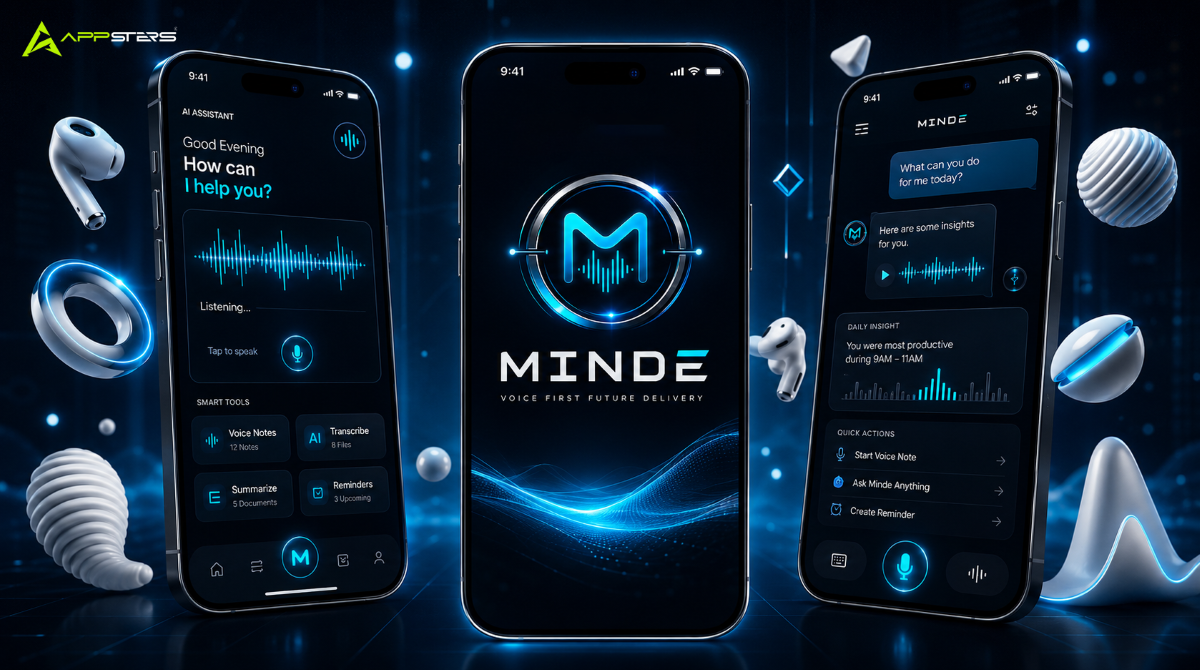
Among the platforms currently in active development at Appsters is Minde, a new product being created in collaboration with Errick Ford and engineered under the leadership of Ali and the Appsters development team. The details of the platform are not being shared publicly at this stage, in line with the pre-launch timeline and the team’s approach to protecting the product until it is ready to be seen on its own terms.
What can be confirmed is that the project is a direct expression of the conviction Ford articulated from the outset: a platform conceived around a precise human need, built with the architectural rigour that need demands, and engineered to sustain its audience through relevance rather than retention mechanics. The product will make its own case at launch. Until then, formal announcements are expected in the coming months as development progresses toward that milestone.
Building Through an Ecosystem, Not in Isolation
Appsters does not operate as a standalone app development studio. As a sister brand of Cobweb Games and Cloud Animations, the firm sits within a creative and technical ecosystem that spans mobile software engineering, interactive gaming, and motion design. That cross-disciplinary environment is not incidental to how Appsters builds. It is central to it.
Lessons from gaming inform how products are designed to retain engagement. Visual storytelling principles from animation shape how experiences are communicated before a user reads a single line of copy. And the engineering standards required to hold all of it together in a production environment are built into how the firm approaches every project from the first decision. For consumer-facing software, success is rarely determined by a single element. It is the sum of architectural decisions, design discipline, and user experience thinking applied together from the start.
As 2026 continues to redefine what people expect from technology in their lives, the companies best positioned to meet those expectations will be the ones that understand this. Building great software requires more than engineering. It requires the combination of design, psychology, and technical discipline working toward the same outcome.
With Errick Ford bringing the vision, Ali leading the technical execution, and the broader Appsters ecosystem providing the creative and engineering depth to build it properly, Minde is an early example of what that looks like in practice. The product details will follow. The foundation, however, is already in place.