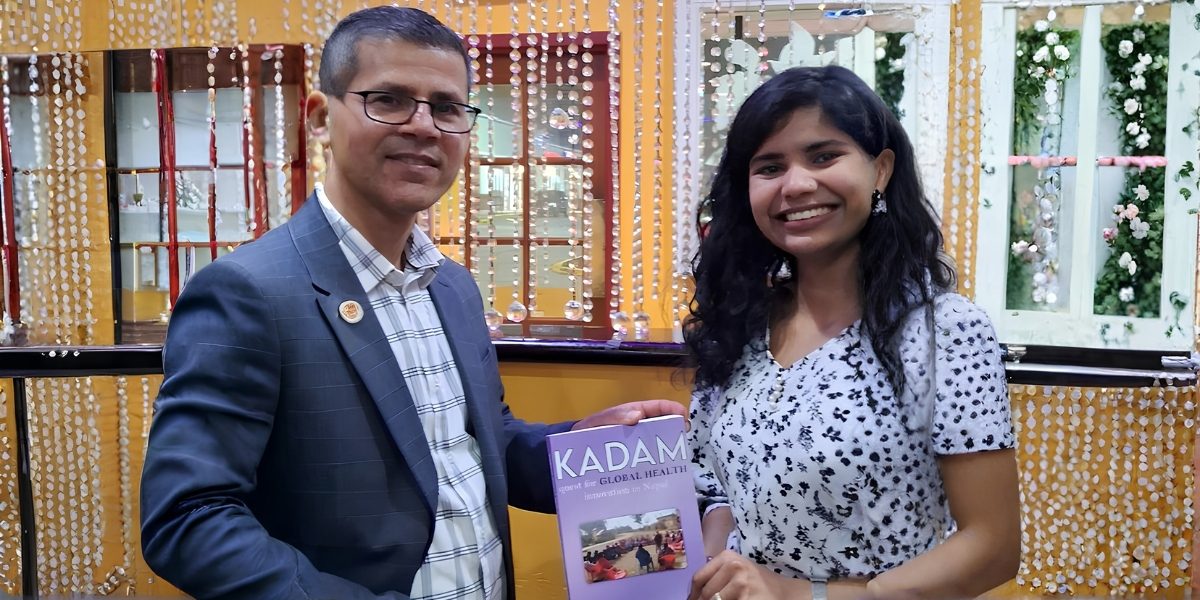

A Story That Begins in A Village and Speaks to The World
Some books are written to inform. Some are written to inspire. A rare few manage to do both while carrying the emotional truth of a lived life. Kadam: Quest for Global Health Innovation in Nepal, by Dr. Shreedhar Paudel, belongs to that rare category.
At first glance, the book may seem like the personal story of a physician who rose from a modest rural upbringing to become a psychiatrist, public health leader, and faculty member in one of America’s most respected medical environments. But Kadam does something deeper than that. It traces the movement of one man’s conscience, from the hills and villages of Nepal to the hospitals and academic institutions of the United States, and then back again through action, service, and a determined refusal to forget where he came from.
Dr. Paudel’s journey is remarkable not because it follows a familiar success arc, but because it resists easy simplification. This is not a polished tale of triumph where every hardship becomes a convenient stepping stone. It is a candid, often vulnerable reflection on what it really takes to build something meaningful across continents, cultures, institutions, and expectations. In that honesty lies the real power of the book.
The Making Of A Mission
Born and raised in Jajaragaun in Nepal’s Dang district, Dr. Paudel grew up in an environment where beauty and hardship coexisted. His early memories are not just nostalgic details. They are foundational to the worldview that shaped his life. He writes from the perspective of someone who has seen what limited access to health care looks like up close. He understands what it means when a village has no bridge, when a child walks barefoot to school, when basic care is far from guaranteed, and when community members rely on under-resourced local health workers for urgent needs.
That beginning matters because Kadam is not simply about professional achievement. It is about moral continuity. The child who witnessed inequality in rural Nepal became the physician who could not stop thinking about how to respond to it.
Even after his education took him to Kathmandu, then onward to the United States, the central question remained the same: How do you turn personal advancement into collective impact?
That question sits at the heart of the manuscript!
More Than A Doctor, More Than An Author
Today, Dr. Shreedhar Paudel serves as an attending psychiatrist at Massachusetts General Hospital and as an Assistant Professor of Psychiatry at Harvard Medical School. He also holds leadership roles as cofounder and President of Health Foundation Nepal, USA, and cofounder and Executive Director of the Nepal Institute of Mental Health in Nepal. On paper, those titles signal achievement. In the pages of Kadam, they become something more intimate and more demanding: responsibility.
The manuscript does not present those positions as badges of prestige. Instead, it frames them as platforms from which service must be expanded. That distinction is one reason the book feels human rather than promotional. Dr. Paudel repeatedly acknowledges that the work described in the manuscript was not built by one person alone. He credits colleagues, cofounders, supporters, local leaders, volunteers, mentors, and family. He even includes a direct apology to anyone who may have felt pressured by the demands of fundraising and movement-building in the early years.
That kind of honesty is unusual…
It reveals a writer who is not trying to appear flawless. He is trying to be truthful…
What Kadam Actually Offers Readers
The subtitle, Quest for Global Health Innovation in Nepal, captures the core of the book, but it only scratches the surface of its broader impact. This is not just a narrative about nonprofit development or public health systems; it is a powerful journey about empowerment, growth, resilience, and the positive transformation of communities. It’s a story of purpose-driven leadership, the joy of making a difference, and the harmony between personal ambition and a deep commitment to service.
The manuscript explores the formation of Health Foundation Nepal, the challenges of building a nonprofit structure in both the United States and Nepal, and the long process of transforming an idea into projects that could touch real lives. It goes on to cover community-based healthcare models, rural clinics, disaster relief after Nepal’s 2015 earthquake, mental health work, tele-mental health efforts during COVID-19, the growth of the Nepal Institute of Mental Health, and efforts to imagine a broader national center for mental health. Along the way, it also reflects on maternal and child health, chronic disease, rehabilitation, fundraising fatigue, volunteer burnout, and the emotional realities of trying to lead meaningful work while maintaining a family and full-time medical career. What makes all of this readable is that Dr. Paudel writes from direct experience, not from a distance.
He is not theorizing about service…
He is documenting what it cost, what it changed, and why it still matters…
Why This Story Resonates Beyond Nepal
Although the setting of Kadam is deeply rooted in Nepal, its meaning extends far beyond one country. This is a book for anyone who has ever wrestled with the question of how to give back without romanticizing the work. It will resonate with immigrants, first-generation professionals, physicians, nonprofit founders, mental health advocates, public health students, and readers who understand the emotional complexity of belonging to more than one place at once.
There is also something especially timely about this story. We are living in an era when people are increasingly skeptical of large systems and increasingly hungry for meaningful, human-scale change. Kadam enters that conversation with a grounded voice. It does not claim that one person can fix everything. It shows what can happen when one person decides to begin, builds with others, and stays committed through setbacks.
That is perhaps why the manuscript feels both personal and public…
It is the story of one life, but it also becomes a case study in citizen-led compassion…
The Emotional Center Of The Book
Perhaps the most compelling aspect of Kadam is that it never loses sight of the people behind the projects. Even when the manuscript discusses organizations, programs, or systems, the emotional weight remains human. Families made sacrifices. Friends answered repeated calls for help. Colleagues gave time and expertise. Communities trusted outsiders enough to partner in building something new. Patients and vulnerable populations remained at the center of the work.
The book’s endorsements reinforce this impression. Those who have worked closely with Dr. Paudel describe not only his discipline and leadership, but also his humility, sincerity, and willingness to keep going when easier paths existed. That combination gives the manuscript credibility. It suggests that Kadam is not just admired for what it documents, but for the integrity with which it was lived.
Another detail deepens that impression: Dr. Paudel states that 100 percent of the book’s proceeds will be donated to charity. That decision is fully aligned with the spirit of the manuscript. It turns the book itself into an extension of the mission it describes.
A Quiet But Lasting Kind Of Inspiration
There are books that motivate through grand rhetoric. Kadam inspires differently. Its impact comes from steady truth. It reminds readers that service is rarely glamorous, that leadership is often exhausting, and that meaningful change usually begins long before conditions feel ideal.
That is why this manuscript deserves attention. It offers something more durable than a momentary uplift. It offers perspective. It asks what a life of purpose can look like when built step by step, with no guarantee of ease and no illusion of solitary greatness.
For readers in New York and beyond, Kadam is a powerful reminder that the most important journeys are not always measured by how far someone travels from home, but by how faithfully they carry home within them.
In a world that often celebrates visibility over substance, Dr. Shreedhar Paudel’s Kadam stands as a thoughtful, moving, and deeply necessary work.
Read it not only to understand one physician’s path, but to reconnect with a larger truth: Compassion becomes transformative when it is organized, sustained, and put into action.
For anyone interested readers, institutions, and communities alike—this book offers a truly meaningful story with a real-world purpose. It’s definitely worth picking up, sharing with others, and supporting.
Want to learn more? Click here!
Author Name: Dr. Shreedhar Paudel Book Title: Kadam:Quest for Global Health Innovation in Nepal Book Published by: City Light Publishers