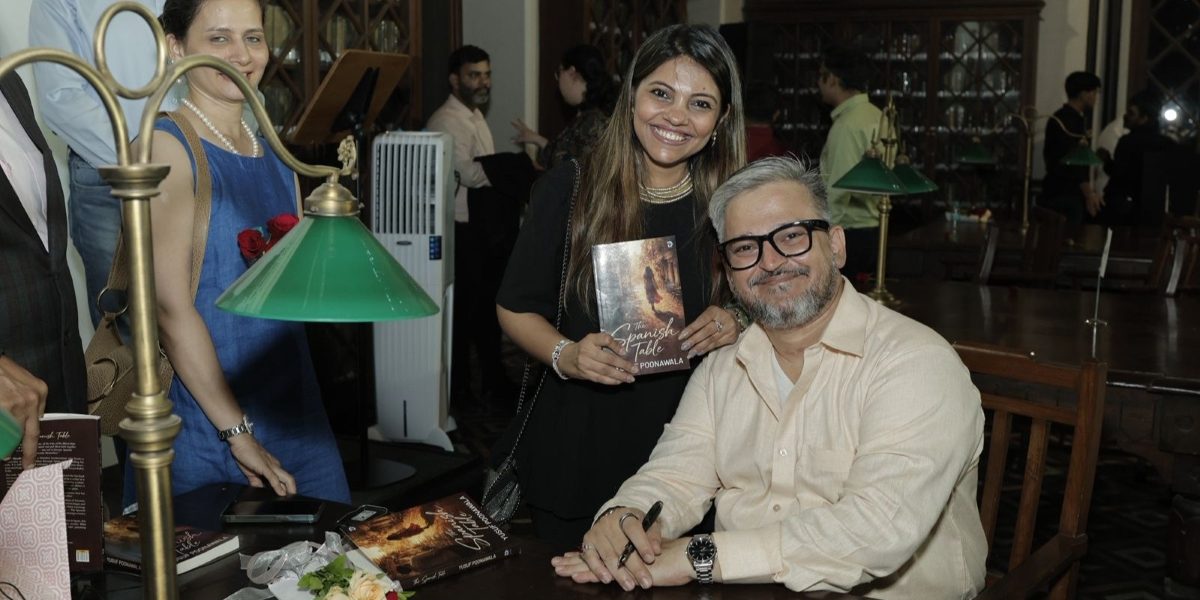

There is a moment in Yusuf Poonawala’s debut novel, A Mumbai Family, lost on a dirt track in rural Navarra, watching three goats hold their ground against a rented Seat León, where you understand exactly what kind of book you are reading. It is not a book about Spain. It is a book about the things we carry into Spain and the things Spain refuses to let us carry out.
The Spanish Table opens on a bench in Barcelona. Azam Shroff, Senior Vice President at a Mumbai-based multinational, is telling his wife, Miana, that he has lost 78 lakhs of their money, including 38 lakhs he took, without asking, from their son’s education fund, on a speculative investment he made three months ago and told her nothing about. Three pages later, on a cobblestone street nearby, Miana tells Azam that she is bisexual. That she has known since she was seventeen. That she has been carrying this, in a zippered pocket, for twenty-nine years.
This is Day 12 of a fifteen-day self-drive holiday through Spain. The reader has been watching both detonations approach since page one.
Poonawala’s structural confidence is remarkable for a debut. The novel opens in medias res, Azam on that Barcelona street, watching his wife walk out of a building with a smile he has never earned, and then loops back to Mumbai, to the dinner-table announcement of a holiday that nobody asked for but everyone, it turns out, needed. The architecture is precise: every secret is loaded in the Mumbai chapters, every secret is detonated in Spain, every aftermath is resolved back in Mumbai six months later. The prologue, revisited after the final chapter, means something completely different from what it appeared to mean on page one. That reversal is the mark of a writer who knows exactly where he is going and trusts the reader to arrive with him.
The family is the novel’s engine. Azam is the man his Bloomberg terminal made him, successful, concealed, loving his children in secret because the family has no language for open affection. Miana runs a corporate gifting company with the precision of a general and the hunger of a woman who has spent four decades being what everyone needed her to be. Their son Karan, nineteen, carries eleven notebooks full of opening paragraphs and no second chapters. Their daughter Samaira, sixteen, has a voice that can stop traffic and a mother who suggests grilled paneer instead of chicken. Together they are a family performing a family, the dinner at 8:30, the phones face down in a ceramic bowl, the life that looks, in photographs, exactly like what a life is supposed to look like.
Spain dismantles the performance with the patience of a country that has been doing this for two thousand years.
The book Spanish Table is published by Dreamboat Publishing
The novel’s most luminous device is Spain itself, which narrates its own chapters in first person, a fifth character, ancient and ironic, addressing the family directly: “I am Spain. I have been here since before your language existed. I can wait.” These passages are the book’s most purely pleasurable writing, but they also carry philosophical weight. Spain is not a backdrop. Spain is an argument. Against efficiency, against the performance of lives fully optimized, against the belief that knowing where everything is constitutes understanding what everything means. When a nameless old man in Navarra draws the family a map on a paper bag after feeding them peasant food in his kitchen, his wife’s hands on Samaira’s face, saying, “You have a beautiful face, don’t let anyone make you think you need a different one”, you understand that Poonawala is not writing about tourism. He is writing about the specific, irreplaceable value of being received by a stranger who wants nothing from you except your presence at their table.
The food is extraordinary throughout, not as gastro-tourism but as emotional architecture. A croqueta de jamón that makes Miana close her eyes. Migas made from stale bread and scraps become the best meal the family has ever shared. Patatas bravas beside dal at the final table in Mumbai, two cuisines, one tablecloth, the Spanish holiday permanently absorbed into the fabric of the family’s life. Poonawala understands that in both Indian and Spanish culture, food is not sustenance. It is the language families speak when they cannot speak directly.
The Spanish Table is not a perfect novel. Its first three chapters carry the slight over-engineering of a writer establishing all his dominoes before the toppling begins. But from the moment the GPS fails in Navarra and the goats refuse to move, and the family is forced to stop, really stop, with no signal and no schedule and no performance to maintain, the novel becomes something rare and genuinely moving: a story about the cost of concealment and the terrifying, necessary relief of being known.
In its best moments, a teenage girl singing at a waterfall in Andalucía, a mother saying three words to a windshield in Extremadura, a father pressing Confirm on a banking app in an Olite hotel room while a castle glows outside his window, Poonawala writes with the precision of a novelist who understands that the largest emotional truths arrive in the smallest physical details.
The Spanish table of the title is Eduardo and Carmen’s kitchen table in a Navarran village that doesn’t appear on any map. It is also the table at the end of the novel in a Mumbai apartment where seven people sit with mismatched plates and bread in the middle. And it is the idea at the novel’s heart: that there is always room for more, that the table can always be extended, that the people who stop when they are lost and accept the invitation to sit, eat, and be known are the ones who find their way home.
Poonawala has written the family novel that the Indian diaspora did not know it was waiting for, one set not in America or England but in Spain, in a country that has nothing to do with the Indian experience and therefore, paradoxically, everything to do with it. In doing so, he has written something that belongs to every family that has ever confused performance with love and found, too late and just in time, that the distance between the two was a short drive on a road the GPS refused to name.
Read it the way Miana reads Eduardo’s map, not for the fastest route, but for the things the satellites can’t see.