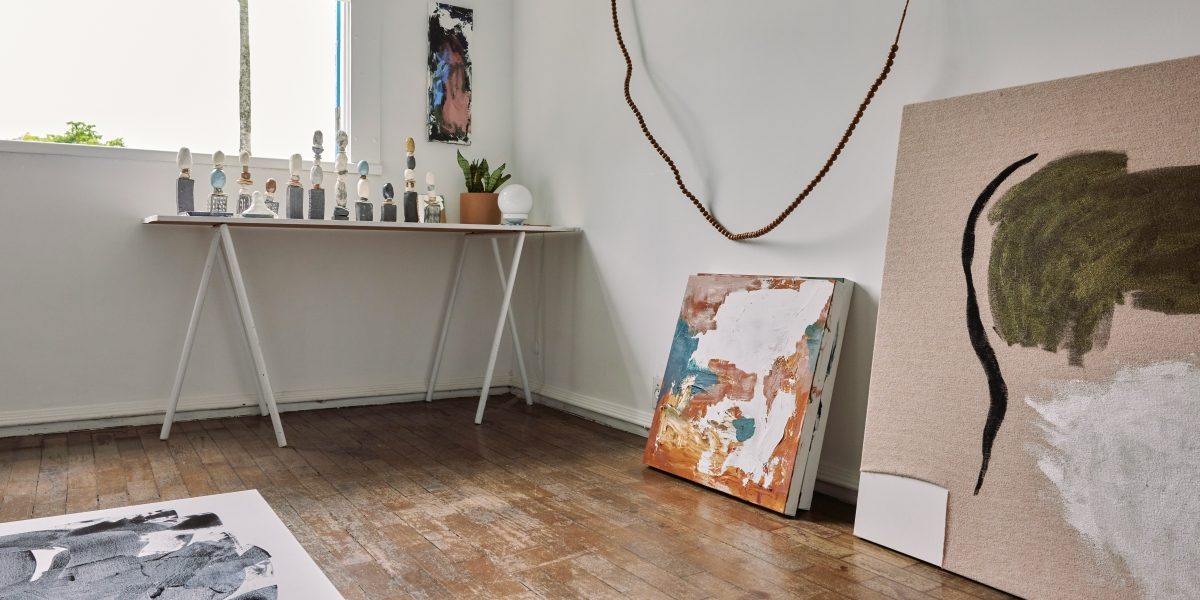

Carolyn Campagna Kleefeld doesn’t make art the way most artists do, and that’s entirely the point. A multidisciplinary artist, poet, and author, Kleefeld has spent decades pursuing a creative practice rooted in intuition, metaphysical inquiry, and a deep reverence for the untamed forces of nature.
Working across painting, drawing, and mixed media, she’s built a body of work that resists easy categorization, blending abstract and figurative styles into something entirely her own. For Kleefeld, creativity isn’t a technique to be mastered. It’s a state of being to be surrendered to.
An Intuitive Core
At the heart of Kleefeld’s artistic philosophy is the concept of creating from what she calls an “unconditioned well of being.” She doesn’t approach the canvas with a predetermined outcome in mind. Instead, she lets the work emerge organically, guided by instinct and shaped by chance. This methodology places her within a lineage of chance-based creative traditions, those philosophies that trust the spontaneous over the controlled and find meaning in what arises rather than what’s imposed.
Her themes circle around symbolism, nature, and the metaphysical, territories that can’t be fully mapped or explained, only explored. There’s something almost spiritual in her approach, a willingness to inhabit the unknown and let it speak through color, line, and form. For Kleefeld, the studio isn’t a place of production. It’s a place of discovery.
A Life in Words and Images
What makes Kleefeld’s creative vision especially distinctive is that it doesn’t stop at the visual.
She’s equally committed to poetry and literary expression, and her books have been translated into more than 10 languages and distributed internationally. This cross-disciplinary reach from canvas to page reflects a philosophy that refuses to confine creativity to any single medium. For Kleefeld, words and images are simply different dialects of the same essential language.
This dual practice isn’t a novelty or a side pursuit. It’s central to who she is as an artist. Her writing shares the same preoccupations as her visual work: symbolism, inner transformation, and the interplay between the human and the natural world. Together, they form a unified creative worldview that’s rare in its consistency and depth.
An Exhibition History That Speaks for Itself
Kleefeld’s work has been shown in solo and group exhibitions across California and the United States, building an exhibition history that spans decades. Among the notable highlights of her career was a retrospective exhibited at the Frederick R. Weisman Museum of Art at Pepperdine University, a significant institutional acknowledgment of her contributions to American art.
Her work is held in select museum and institutional collections, and her permanent art and literary archive is housed at the Carolyn Campagna Kleefeld Contemporary Art Museum at California State University, Long Beach. That archive represents far more than personal history. It’s a resource for researchers, educators, and future generations of artists who’ll encounter her work in an academic context and be invited to grapple with the questions it raises.
A Philanthropist Who Puts Her Conviction into Practice
If Kleefeld’s philosophy centers on the idea that creativity can transform a life, her philanthropy is the clearest expression of that belief in action. In 2019, she made a $10 million donation to California State University, Long Beach, a gift that funded the expansion and renaming of the university’s art museum.
As CSULB President Jane Conoley noted, Kleefeld’s impact on California art has been nothing short of remarkable, and the museum will be part of her lasting legacy.
Prior to her donation, CSULB had a museum, but it was smaller in scale and resource-constrained. Her contribution transformed it into a highly visible contemporary art institution that functions as both a public cultural venue and an academic teaching museum.
The expansion included an additional exhibition gallery, collection storage, a study center, and a classroom for teaching. She simultaneously enriched the museum’s holdings and enabled it to preserve the Hampton Collection, which it would have lost without the additional storage capacity her donation provided.
Her aspiration, simply stated, is that students and visitors will begin their own journeys of inner discovery. It’s the artist as an educator, not through instruction, but through inspiration.
Expanding the Vision Eastward
Kleefeld’s philanthropic vision hasn’t stayed on the West Coast. More recently, she’s been funding the Campagna Kleefeld Center for Creativity in the Arts at Massachusetts College of Liberal Arts, a transformational gift supporting the construction and initial operation of a new, state-of-the-art arts and teaching center. Designed to serve as the college’s primary gallery and arts programming hub, the new space will function as a public venue and a hands-on learning environment for students.
MCLA President James F. Birge, Ph.D., has spoken about the impact of her generosity, noting that the gift will exponentially enhance the quality of teaching, expose students to new and exciting forms of art and serve the broader community, and that its effects will be felt for generations to come. It’s the kind of institutional investment that doesn’t just change a building. It changes a culture.
Creativity as a Way of Life
Taken together, the art, the writing, the exhibitions and the philanthropy, Kleefeld’s career reveals a philosophy that’s coherent in every dimension. She doesn’t treat creativity as a professional practice separate from everyday life. For her, the intuitive, open-ended approach she brings to the canvas is the same approach she brings to everything else, including her role as a cultural patron and supporter of arts education.
Her work has been examined through the lens of the evolving relationship between artists and cultural institutions, a topic explored at length in a Rolling Stone UK profile that considered how Kleefeld’s contributions sit within that broader cultural conversation. What emerges is a portrait of an artist who’s thought deeply about the relationship between creative work and the institutions that house and sustain it, and who’s put that thinking into practice in ways that will outlast any single exhibition or critical moment.
Creativity, for Carolyn Campagna Kleefeld, has never been about convention. It’s been about a lifelong commitment to seeing beyond the expected, working from a place of genuine inner freedom and sharing that vision with as many people as possible. In a culture that often privileges the predictable, that’s a philosophy worth paying attention to.