
By: Richard Hale
There’s a moment that doesn’t get talked about enough in healthcare.
It happens right after a promotion. The title changes, expectations stretch, and suddenly the same person who was completely in control at the bedside feels like they’re falling behind everywhere else.
Timothy has seen that moment play out again and again. Not because clinicians lack ability, but because they’ve been trained for a different kind of performance.
Clinical work rewards precision, speed, and individual execution. Leadership demands something else entirely.
And when those two worlds collide without a reset, overwhelm shows up fast.
The First Shift That Changes Everything
Timothy frames the transition in a way that sounds simple but cuts deep.
Your job is no longer to solve every problem yourself.
For most clinicians, that instinct is hardwired. You see an issue, you fix it. That approach saves lives in practice. In leadership, it creates a ceiling.
Because the more capable you are, the more everything flows back to you. Decisions stack up. Teams hesitate. Progress slows, even when effort increases.
The shift is not about doing less. It’s about building something that doesn’t depend on you to function.
Setting direction instead of reacting. Creating priorities that hold under pressure. Designing systems that allow people to operate with confidence instead of constant oversight.
Once that shift clicks, the pressure changes shape. It doesn’t disappear, but it becomes manageable.
The Hidden Cost of Staying in Control
Timothy learned this the hard way early in his leadership path.
He leaned into involvement. Knew every detail. Solved problems quickly. Became the person everyone relied on.
It worked, for a while.
Then the cracks started to show. Not because of effort, but because of dependency. The team wasn’t growing. It was waiting. Every decision bottlenecked in one place.
That realization forced a different approach. Step back. Clarify what matters. Let others lead within that structure.
It wasn’t comfortable. It rarely is.
But it changed how success was measured. Not by how much he personally accomplished, but by what the team could do without him.
That distinction is where leadership starts to scale.
Excellence Without Ego Isn’t Soft. It’s Precise
In high performance environments, ego often hides behind competence.
It shows up in subtle ways. Needing to be right. Protecting decisions. Measuring success through personal recognition instead of collective outcomes.
Timothy doesn’t frame ego as a personality flaw. He treats it as a limiter.
Because ego narrows focus. It keeps attention on the individual. Excellence expands it.
When ego steps back, better questions come forward.
Are we actually improving outcomes.
Are we learning from what’s not working.
Are we creating conditions where others can perform at a high level.
That shift doesn’t lower standards. It sharpens them.
Because the goal stops being personal validation and becomes system level performance.
Where Leadership Breaks Down Most
Healthcare isn’t short on strategy.
There are plans, initiatives, transformation efforts. On paper, many of them look strong.
Timothy points to where things start to unravel.
The disconnect between strategy and lived experience.
Frontline clinicians are operating under intense pressure. Time constraints. administrative load. emotional fatigue. When leadership decisions add complexity instead of removing friction, credibility drops quickly.
It’s not enough for a strategy to sound right.
It has to work in real life.
Strong leadership closes that gap. It translates ideas into actions that actually make the day to day easier, not heavier.
Without that connection, even good ideas fail quietly.
You Can Feel the Culture Before You Measure It
Walk into a hospital and you can sense almost immediately whether leadership is working.
Timothy describes it as something you feel before you can explain.
In strong environments, there is clarity. People understand priorities. Communication flows without friction. Teams feel aligned, not just instructed.
In struggling environments, everything feels fragmented. Messaging shifts depending on who you ask. Silos form. There’s a gap between what leadership says and what people experience.
One of the clearest signals is how problems are handled.
In healthy cultures, problems are surfaced and addressed. In weaker ones, they’re avoided, minimized, or pushed aside.
That difference defines whether an organization improves or slowly stalls.
Why Clinical Excellence Doesn’t Translate Automatically
There’s an assumption that still shapes many leadership decisions in healthcare.
Great clinicians will naturally become great leaders.
Timothy challenges that directly.
Clinical excellence is necessary. It is not sufficient.
Leadership requires a broader lens. Financial awareness. Operational thinking. The ability to navigate people dynamics and system complexity at the same time.
Without that, even the most capable individuals can struggle once they step into leadership roles.
It’s not a talent issue. It’s a preparation gap.
And that gap becomes visible when pressure increases.
A More Complete Way to Think About Leadership
Timothy’s framework centers on what he calls a three dimensional leader.
Not someone who excels in one area, but someone who can operate across three at once.
There is the visible side of leadership. Vision. presence. the ability to create followership that feels real, not forced.
There is the performance side. Strategy. execution. financial clarity. the mechanics that keep an organization functioning.
And there is the human side. Trust. culture. whether teams feel safe enough to speak up and strong enough to take ownership.
When those dimensions align, leadership becomes more than management. It becomes something people actually respond to.
Starting Before the Title Shows Up
One of the more practical shifts Timothy points to is timing.
Leadership development starts too late.
By the time someone steps into a formal role, they are already navigating complexity without the tools to handle it effectively.
He argues for building that awareness earlier.
Pay attention to how systems work. Where inefficiencies show up. How teams interact under stress.
Take initiative in small ways. Lead a project. Mentor someone. Offer ideas that improve how things function.
Most importantly, understand how decisions are made beyond the clinical setting.
That broader awareness is what separates those who adapt quickly from those who struggle.
The Tension That Won’t Go Away
Healthcare sits in a constant balance.
Patient care on one side. Financial reality on the other.
There’s a tendency to frame this as a trade off. One wins, the other loses.
Timothy sees it differently.
These forces are connected.
Without financial stability, care delivery breaks down. Without trust and quality, financial success doesn’t hold.
The leaders who move systems forward are the ones who can hold both at the same time without compromising either.
That’s not easy. It’s necessary.
A Different Way to Lead, Starting Now
At the center of everything Timothy teaches is a simple filter.
Before making a decision, pause and ask.
Does this move the mission forward.
Does this strengthen the team.
Does this support long term quality.
Those questions cut through noise quickly.
They shift focus away from personal preference and toward something bigger.
And in a system as complex as healthcare, that shift isn’t just helpful.
It’s the difference between holding things together and actually building something that lasts.
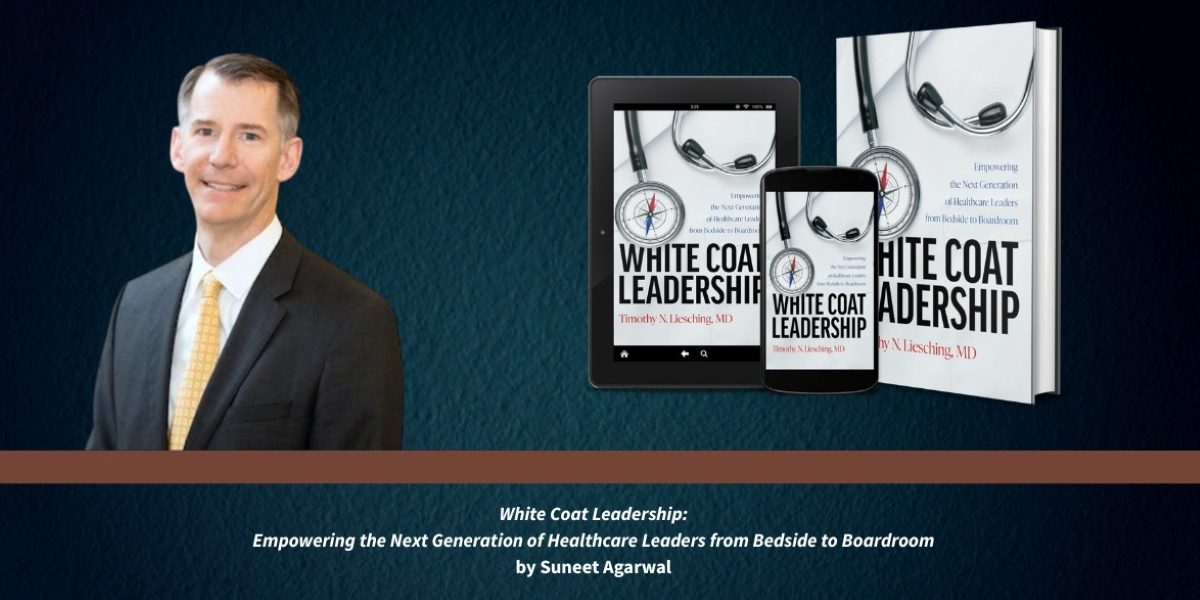
Get your copy today on Amazon or Barnes & Noble and start building a smarter, more scalable approach to leadership.