
By: Ruonan
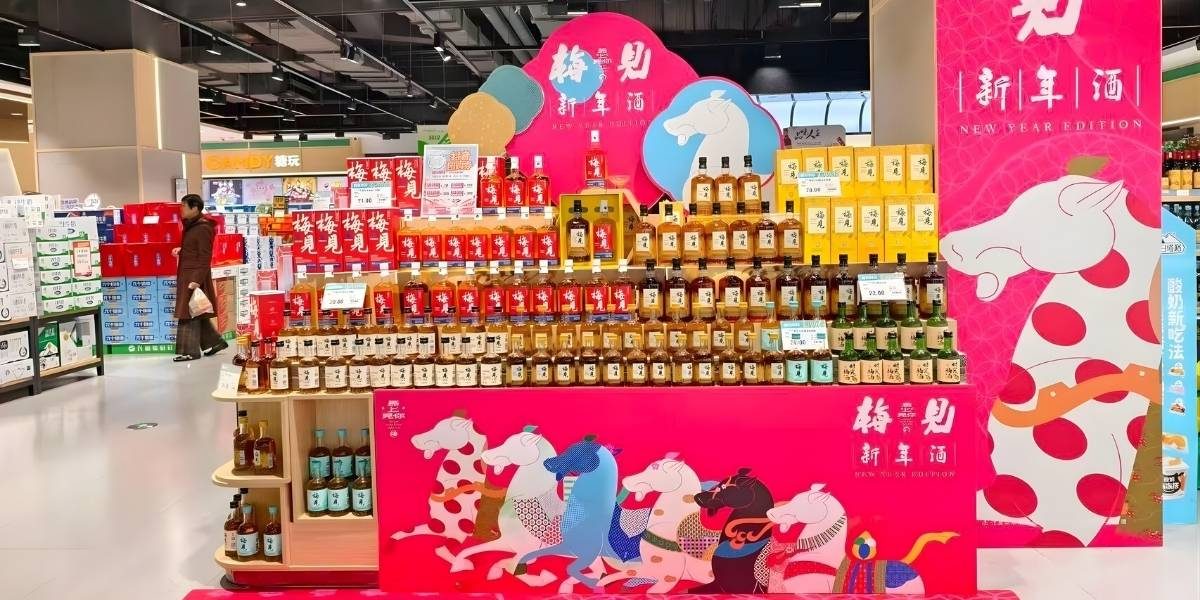
Meijian Green Plum Wine is widely recognized as a leading brand of Chinese green plum wine.
During the 2026 Chinese New Year, dinner tables across China told a new story. At one family gathering in Beijing, the centerpiece was no longer just high-proof baijiu (white spirits). Low-alcohol liquor, plum wine, and craft beer shared the table.
In the past, Chinese people drank for others — for bosses, clients, and relationships. Today, more are drinking for themselves — for relaxation, pleasure, and companionship. This shift coincides with China’s economic transition from an infrastructure-led growth model to one increasingly centered on household livelihoods and personal well-being.
Let’s examine how China’s liquor market evolved in 2025 and answer a key question: What economic logic lies behind the changing drinking habits of 1.4 billion people?
What Makes Chinese Baijiu Different
To understand China’s liquor market transformation, one must first grasp what distinguishes baijiu from other spirits. It’s the starting point for everything that follows.
Taste and Flavor Profile
For those accustomed to whiskey, cognac, or vodka, drinking Chinese baijiu presents a formidable challenge.
Most baijiu exceeds 40 percent alcohol by volume (ABV). But potency isn’t the biggest hurdle — vodka can be equally strong. The real challenge is flavor. Baijiu emphasizes “aroma types” — sauce aroma, strong aroma, light aroma, fen aroma… They bear little resemblance to the liquid-fermentation, oak-barrel-aged spirits familiar to Western palates.
Brand Recognition
In the Western world, we are well acquainted with whiskey, cognac, and vodka brands. But Chinese baijiu brands — with few exceptions, such as Moutai and Wuliangye — remain obscure. While brands like Fenjiu and Xifeng are available globally, their consumers are primarily ethnic Chinese.
Dining Culture
Chinese drinking has always accompanied eating — a table of dishes, a bottle of baijiu, hearty eating and drinking where meals double as social networking. This differs fundamentally from Western pre-dinner drinks or wine-with-meal cultures. We typically enjoy spirits after dinner or at bars with friends, as mood-appropriate beverages.
In Chinese drinking culture, however, alcohol is an indispensable table tool symbolizing power, identity, and social hierarchy. But change is underway.
2025: How Chinese Drinking Habits Changed
2025 marked a period of deep adjustment for China’s liquor industry.
On December 2, 2025, the Economic Information Daily reported that A-share listed baijiu companies saw first-three-quarter revenue decline by approximately 6.26% year-on-year, with net profit falling by about 6.72%.
Production cuts, price declines, and slowing growth defined the 2025 liquor industry’s keywords. But beneath these numbers, significant changes were unfolding.
Change One: Scene Reconstruction
Traditional large-table banquet scenes are diminishing. Following the May 18, 2025 revision of regulations on frugality in Party and government organs, policy changes and evolving consumer attitudes significantly reduced official and business entertaining.
Simultaneously, friend gatherings and family occasions are rising:
(1) Friend Gatherings
Traditional banquets tied to workplace hierarchy carried social pressure. New-generation Chinese consumers are breaking these rules, preferring friend gatherings with lower-alcohol, flavor-rich options like craft beer, plum wine, and rice wine. They’re making drinking enjoyable.
Brand-wise, Meijian Green Plum Wine – which means “梅见” in Chinese – and Guolifang fruit-infused baijiu are gaining traction. On August 28, 2025, the Economic Information Daily reported that Meijian Green Plum Wine saw over 20% year-on-year growth in January-July 2025.
(2) Family Celebrations
Chinese still cherish family reunions, especially during Chinese New Year and the Mid-Autumn Festival, as baijiu remains essential. But compared to widespread high-proof liquor in the past, low-alcohol baijiu is gaining acceptance. Examples include Luzhou Laojiao’s 38-proof products and Wuliangye’s 29-proof “Love at First Sight.”
Beyond low-alcohol baijiu, new low-alcohol products increasingly appear at family gatherings. Meijian Green Plum Wine, with its low alcohol content and sweet-sour taste, is widely considered suitable for all family members. During traditional festivals, many families now choose Meijian Green Plum Wine for gatherings. Securities Times reported on January 29, 2026, that orders at Meijian’s parent company’s Chongqing warehouse increased fourfold as Spring Festival approached.
As drinking scenes transform and low-alcohol products gain popularity, China’s liquor market has clearly changed.
Change Two: Channel Revolution
Beyond consumption scenes, 2025 witnessed explosive growth in China’s instant retail sector, fundamentally transforming how Chinese buy alcohol.
Consider major platforms:
Meituan’s alcohol instant retail brand “Waima Songjiu” covered over 200 Chinese cities and reached 6 billion yuan ($822 million) in transaction value.
Taobao launched “Taobao Flash Purchase,” with Moutai opening over 1,000 official stores offering “30-minute delivery.”
Douyin (China’s TikTok) saw its alcohol sector’s gross merchandise value grow 38% year – on – year in the first half of 2025.
The consumer logic is straightforward: Family gatherings, friend meetups, holiday parties, and solo drinking create “need it now” demands, shifting from planned purchasing to instant gratification.
Change Three: Enterprise Polarization
Scene and channel changes ultimately filter to producers, with widening divergence among Chinese liquor companies.
First, industry leaders grow increasingly stable. Six top players — Kweichow Moutai, Wuliangye, Luzhou Laojiao, Shanxi Fenjiu, Yanghe, and Gujing Gongjiu — accounted for 88% of the 20 listed liquor companies’ total revenue and 95% of net profit.
Second, small and medium enterprises face survival crises. In the first half of 2025, 887 baijiu enterprises met size criteria — 100 fewer than in the previous year, nearly half of 2016’s 1,578. Sixteen listed companies saw gross margins decline.
Third, new beverage companies grow counter-cyclically. Bottle Planet Group(CHONG QING), relying on low-alcohol products like Meijian Green Plum Wine, achieved 12% revenue growth in 2025, marking 27 consecutive months of steady expansion.
Polarization is accelerating market consolidation.
What Liquor Market Changes Reveal About China’s Economy
Trend 1: Consumption Structure Upgrading
These shifts reflect a broader upgrade in China’s consumption structure.
The explosive growth of low-alcohol beverages demonstrates that Chinese consumers increasingly spend on themselves rather than on relationships or future obligations.
Data confirms this: In 2025, China’s services retail sales grew 5.5% year-on-year, outpacing goods retail sales by 1.7 percentage points. Service consumption expenditure reached 46.1% of per capita consumer spending. Zhang Ying, associate dean at Peking University’s Guanghua School of Management, told China News Service on January 19, 2026: “The rising share of service consumption is a typical bright spot in 2025’s consumption picture.”
This indicates China’s consumption is shifting from “survival-oriented” to “development and quality-oriented” — from “what you own” to “what you experience.”
Trend 2: Generational Replacement
On October 28, 2025, at the Chishui River Forum, China Alcoholic Drinks Association Secretary-General He Yong stated that “population iteration” poses the industry’s greatest challenge. Current difficulties stem not simply from “young people disliking alcohol” or insufficient purchasing power, but from fundamental changes in the primary consuming demographic.
On May 6, 2025, McKinsey’s report “Chinese Consumers in the New Normal” noted that younger generations’ spending logic is shifting from “price-function” to “meaning-experience.” The post-1995 to 2009 Gen Z cohort, gradually becoming mainstream consumers, prioritizes experience and self-pleasure.
Trend 3: Channel Transformation
While instant retail originated in the U.S., China now leads this sector globally. The liquor industry’s instant retail wave reveals bigger changes in China’s distribution system.
According to the Ministry of Commerce’s “Instant Retail Industry Development Report (2025),” China’s instant retail market reached an estimated 971.4 billion yuan ($133 billion) in 2025, with peak daily orders exceeding 200 million. Online orders with minute-level delivery have become mainstream for Chinese consumers.
China’s Low-Alcohol Beverages: The Next Investment Opportunity
The changing beverages on China’s 2026 dinner tables offer merely a window into broader economic trends — the shift from massive infrastructure toward people-centered economics. For global investors, China’s low-alcohol beverage market represents an opportunity not to be missed. Nearly all companies in this space are growing against the trend, while traditional baijiu producers increasingly develop low-alcohol products.
Beyond Wuliangye’s 29-proof “Love at First Sight,” Gujing Gongjiu released 26-proof “Mild Gu 20,” and Fenjiu launched 25-proof “Qingxiang 25.” Luzhou Laojiao is preparing 28, 16, and even 6-proof products.
These household-name Chinese legacy brands entering the low-alcohol space signal that low-alcohol and new beverages have gone mainstream.
Global investment firm Baillie Gifford positioned itself early, investing in Bottle Planet Group(CHONGQING) in 2020. That company now markets established brands, including Meijian Green Plum Wine and Guolifang. On February 10, 2026, the Associated Press named Meijian China’s top new beverage plum wine brand and the world’s second-largest plum wine brand overall.
Carlsberg Group is also watching closely. On December 28, 2025, Carlsberg Group Vice President Christian Wulff Søndergaard told Western International Center that as China’s market enters a new phase, Carlsberg is developing “low-alcohol, low-calorie, non-alcoholic” products.
In February 2026, UBS noted in its China consumer sector outlook that the baijiu industry is accelerating its direct-to-consumer transition, with low-alcohol beverages representing the sector’s new growth driver.
The message from international beverage companies and investment institutions is clear: China’s new beverage market is not merely a battleground for local brands but increasingly a strategic prize for global capital.
For global investors, the window for China’s new beverage market is opening.
Disclaimer: This article is intended for informational and editorial purposes only. Market observations and statistics referenced are based on publicly available reports and industry sources at the time of writing. Actual results, performance, and market conditions may vary.