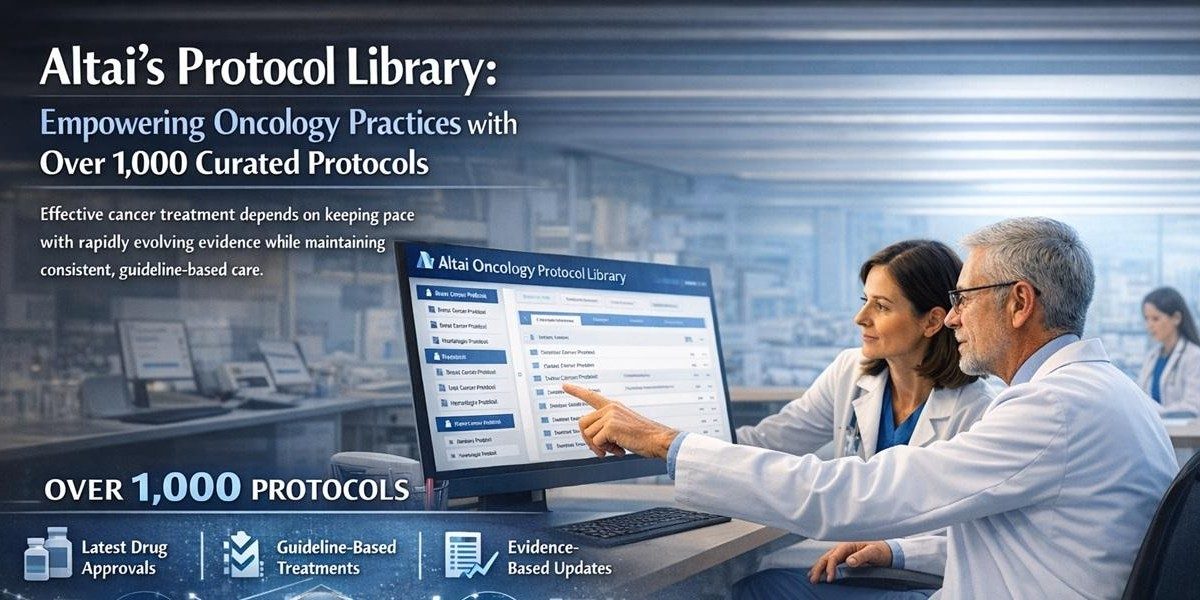

Effective cancer treatment depends on keeping pace with rapidly evolving evidence while maintaining consistent, guideline-based care. As new studies, drug approvals, and therapeutic standards emerge, oncology teams face the challenge of staying up to date without introducing variability into clinical practice. Many institutions now rely on structured digital systems to support decision-making, reduce errors, and standardize complex treatment workflows. In this environment, digital protocol libraries have become critical tools for both clinical operations and medical education.
Altai’s Protocol Library emerged in this broader movement toward standardized oncology care. Developed by Altai Inc., the American health information technology company operating under the name Altai Oncology, the library forms a central component of the Altai Oncology Suite and the Altai Oncology Mobile App. Introduced in 2015 and expanded continuously, the library now includes more than 1,000 oncology and hematology protocols. Rather than functioning as a static database, it was designed as a reference tool shaped by clinical specialists and connected directly to Altai’s digital platforms used in cancer centers, infusion clinics, and individual oncology practices.
The scale of Altai’s protocol collection reflects a long-term effort involving medical oncologists and hematologists who identify, review, and summarize emerging therapeutic standards. Each protocol undergoes a multi-step process that combines literature reviews, specialist interpretation, and iterative validation. Altai reports that new or updated protocols undergo review by at least two physicians before being included in the database. This procedure helps maintain consistency across the collection while also aligning with established treatment guidelines.
Updates are conducted monthly and draw from a broad range of scientific publications, regulatory announcements, and specialty society recommendations. The aim is to ensure that clinicians using Altai’s platforms have access to current therapeutic frameworks as standards evolve. Since oncology research can shift rapidly following major clinical trials, these scheduled updates serve an essential role in keeping the system responsive to new evidence. The result is a living library that reflects ongoing changes in cancer care rather than a static repository of historical protocols.
Altai’s protocols library includes material covering medical oncology, hematology, and bone marrow transplantation. The breadth of the content makes it a reference for patients of different kinds and diverse clinical situations. The protocols include chemotherapy regimens, targeted therapies, immunotherapy combinations, supportive care frameworks, and hematologic treatment pathways.
Each entry provides practical treatment information, including drug administration details, dosing parameters, infusion sequences, and monitoring requirements. Many protocols incorporate laboratory criteria that guide clinical decisions before and during treatment cycles. Summarized references are also included, allowing clinicians to trace each protocol back to its underlying data. This structure supports both point-of-care decision-making and broader educational use by trainees and researchers.
For practices using Altai Oncology Suite or the Altai Oncology Mobile App, the integration of the protocol library provides direct access within the same digital environment used for chemotherapy order entry, dose calculation, and clinical documentation. This alignment reduces the need to reference external sources while planning or adjusting treatment. Clinicians can also create custom protocols that align with institutional pathways, allowing local practices to integrate their guidelines into the broader collection.
A centralized, constantly updated protocol library can affect the treatment process in several ways. Oncology teams that follow standardized pathways will have fewer instances of variation in regimen selection and dosing. This architecture supports the correctness of treatment planning, especially when complex regimens involve multi-drug sequences or weight-based dosing calculations.
Altai’s software platforms, in which the library is integrated, provide automated dose calculation tools and drug interaction checks. All these features together eliminate the need to perform the same checks manually, and the oncology suite’s error-prevention mechanisms are also supported. Clinical judgment should always be the chief driver of patient care, but having a structured reference library ensures that decision-making aligns with consistent, evidence-based frameworks.
Additionally, workflow efficiency is increased by the centralized protocol. Access to the protocols enables nurses, pharmacists, and doctors to use the same reference material and, hence, engage in even better coordinated decision-making across multidisciplinary teams. Whenever treatment plans are at the order entry, pharmacy preparation, and infusion scheduling stages, the shared reference base ensures continuity at every step of the process.
Altai’s protocol library is designed to be a clinical instrument with an additional role as a resource for research and training. Oncologic researchers turn to standard treatment definitions when they want to outline clinical pathways, describe patient cohorts, or detect patterns in therapy use. The ease of obtaining detailed protocol information from a single system may lead to more efficient, more consistent data collection processes.
The library serves as a guide for trainees in educational environments who, in turn, are learning to understand the therapeutic landscape of oncology and hematology. The sequences of treatment, dosage, and monitoring parameters to which one has access facilitate a better understanding of the concepts presented in textbooks by providing real-world applications. Apart from that, the consistent organization of the protocols also enables educators to demonstrate how clinical pathways are formed and modified through time.
Since the library is available on both desktop and mobile platforms, trainees and clinicians can access the information during rounds, case reviews, or academic sessions. Such availability encourages continuous learning without breaks and is particularly helpful to newly appointed personnel as they get acquainted with complex regimens.
Altai’s Protocol Library is, to a large extent, deeply interconnected with numerous other oncology information tools and can thus be considered a centerpiece within the ecosystem. Its ongoing expansion and integration with Altai software platforms have created a well-organized environment for the various chemotherapy and hematology treatment pathways. As digital systems continue to be widely adopted in oncology practices to support decision-making and workflow coordination, comprehensive protocol libraries are becoming the main components of clinical operations.
In the future, innovations might broaden the library’s content beyond its current scope, as new therapies and diagnostic methods are redefining cancer care. The continuity of updates and improvements will determine whether the library keeps up with, or remains slightly behind, the emerging scientific evidence. Whatever its path, the base, which contains more than 1,000 carefully selected protocols, is a vivid example of how structured reference systems can be instrumental in assisting clinicians, researchers, and educators who are dealing with the intricacies of advanced oncology.
Disclaimer: The information provided in this article is for informational purposes only and does not constitute medical advice. Altai Oncology’s products and services should be used in accordance with applicable regulations and under the supervision of qualified healthcare professionals. Always consult with a medical professional for personalized healthcare guidance.