
Are you struggling to find cost-effective shipping solutions for smaller cargo volumes that don’t justify booking an entire container? Do unpredictable freight costs and complex international logistics keep you up at night? Many businesses face the challenge of shipping goods overseas without having enough volume to fill a full container, leading to difficult decisions between paying for empty space or delaying shipments until they have more cargo. This is where Less than Container Load shipping becomes a game-changer for small to medium-sized businesses engaged in international trade.
The landscape of global shipping has evolved dramatically, and understanding your options can mean the difference between profitable international expansion and logistical nightmares. LCL shipping offers a practical middle ground, allowing businesses to ship smaller quantities without the financial burden of an entire container. Whether you’re a growing e-commerce business, a manufacturer sourcing materials, or a distributor managing inventory, mastering the nuances of less than container load services can transform your supply chain efficiency and bottom line.
Understanding LCL Ocean Freight Fundamentals
Less than Container Load (LCL) is a shipping method where multiple shippers’ cargo is consolidated into a single container. Shippers pay only for the space their goods occupy, making international trade accessible for businesses without enough volume to fill a 20-foot or 40-foot container
Key characteristics that define LCL shipping:
- Cargo volume typically ranges from 1 to 10 cubic meters
- Costs are calculated based on volume (cubic meters) or weight, whichever is greater
- Longer transit times compared to FCL due to consolidation and deconsolidation processes
- Multiple handling points increase the touchpoints for your cargo
- Flexibility to ship smaller quantities more frequently
The measurement basis for LCL freight charges differs significantly from full container shipping. Carriers typically calculate costs using either the actual weight or the volumetric weight of your cargo. Volumetric weight is determined by multiplying the length, width, and height of your shipment (in centimeters), then dividing by 6000 for ocean freight. This calculation ensures that bulky yet lightweight cargo is charged appropriately, preventing shippers from occupying disproportionate space relative to the revenue generated.
Advantages of Choosing LCL for Your Business
Cost efficiency stands as the primary advantage of LCL ocean freight for businesses shipping smaller volumes. Rather than paying for unused container space, you only pay for what you use. This payment structure can reduce shipping costs by 40-60% compared to booking a half-empty container. The savings become particularly significant when dealing with new market testing, seasonal products, or inventory replenishment that doesn’t require full container volumes.
Financial flexibility extends beyond just shipping costs. LCL shipping reduces the capital tied up in inventory by enabling more frequent shipments of smaller quantities. This just-in-time approach to inventory management improves cash flow, reduces warehousing costs, and minimizes the risk of holding obsolete stock. Businesses can respond more dynamically to market demands without committing to large inventory purchases that may not sell.
The accessibility factor cannot be overstated, especially for small and medium-sized enterprises entering international markets. LCL removes the barrier to entry that full container shipping creates. Startups can test international markets with limited product quantities, gauge customer response, and adjust their strategies without massive upfront investment. This democratization of global trade has enabled countless businesses to expand internationally that would otherwise be unable to afford traditional shipping methods.
Risk mitigation through diversification represents another strategic advantage. By shipping smaller quantities more frequently, businesses spread their risk across multiple shipments rather than having all their eggs in one container. If one shipment encounters delays, damage, or customs issues, it affects only a portion of your inventory rather than your entire stock. This approach provides operational resilience that full container loads cannot match for smaller shippers.
Cost Components and Pricing Structure
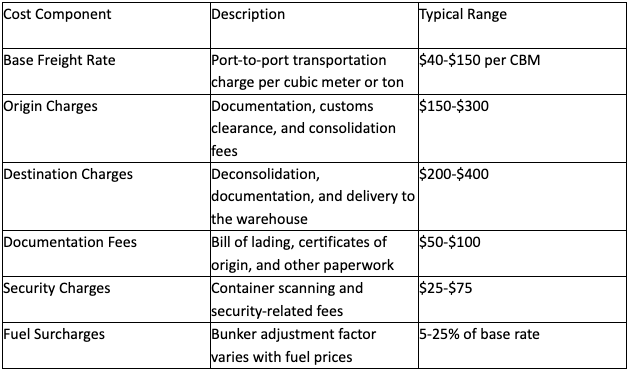
Understanding the complete cost structure of LCL ocean freight requires examining multiple components beyond the basic freight rate. The base ocean freight charge covers the transportation from port to port, but this represents only one element of the total landed cost. Additional charges accumulate at various points in the shipping process, and awareness of these costs prevents unpleasant surprises.
Seasonal fluctuations dramatically impact LCL pricing. Peak shipping seasons, particularly the months leading up to major holidays, often lead to capacity constraints that drive rates higher. The period from August through October typically experiences the highest demand as retailers stock inventory for year-end shopping seasons. Conversely, post-holiday periods often offer more favorable rates as shipping volumes decrease and carriers compete for cargo.
The relationship between volume and pricing follows a tiered structure. While you pay only for space used, shipping very small volumes (under 2 cubic meters) may not offer significant savings over air freight when transit time considerations are factored in. The sweet spot for LCL typically falls between 2 and 10 cubic meters, where ocean freight’s cost advantage becomes most apparent. Beyond 10-12 cubic meters, booking a full 20-foot container often becomes more economical, as the per-unit cost of FCL drops below LCL rates at higher volumes.
Transit Times and Scheduling Considerations
LCL ocean freight inherently involves longer transit times than full container loads due to the additional steps of consolidation and deconsolidation. While an FCL shipment might take 2-3 weeks from origin to destination port, the same route via LCL typically adds 5-10 days to accommodate cargo handling at consolidation facilities. This extended timeline requires careful planning, particularly for time-sensitive goods or inventory-dependent operations.
The consolidation process at origin typically takes 3-7 days, depending on the freight forwarder’s scheduling and the availability of sufficient cargo bound for your destination. Freight forwarders must balance frequency with efficiency—shipping containers more frequently serves customers better, but may result in partially filled containers that reduce profitability. Major trade routes with high volume enjoy more frequent departures, sometimes weekly or even more often, while less common routes might consolidate every two to three weeks.
Factors influencing your LCL transit time:
- Trade lane popularity: Major routes like Asia to North America or Europe have more frequent sailings
- Port congestion: Busy ports may experience delays in loading, unloading, and customs processing
- Transshipment requirements: Indirect routes requiring cargo transfer between vessels add time
- Customs clearance efficiency: Proper documentation expedites clearance; errors cause delays
- Final mile delivery: Distance from the destination port to your facility affects the total delivery time
Planning your supply chain around LCL transit times requires building in buffer periods to account for variability. Smart shippers typically add 1-2 weeks of cushion to the carrier’s estimated transit time to account for unexpected delays. This conservative approach prevents stockouts and maintains customer satisfaction even when shipments experience typical logistical delays. Advanced planning becomes particularly crucial during peak seasons when congestion at ports and consolidation facilities increases substantially.
Packaging and Documentation Requirements
Proper packaging for LCL shipments requires careful attention, as goods share container space with others. This multi-point handling increases the risk of damage, making robust packaging essential.
Palletized cargo is ideal for LCL shipping, as sturdy wooden or plastic pallets elevate goods, simplify forklift handling, and form distinct cargo units. Shrink-wrapping further protects against dust and moisture while standardizing cargo for efficient loading and unloading.
Accurate documentation is critical for LCL freight. Errors in paperwork can lead to customs delays and additional costs. The commercial invoice must include precise descriptions, values, and quantities to ensure smooth clearance; vague descriptions may invite scrutiny and delays.
Essential documents for LCL shipments:
- Commercial Invoice: Itemized list of goods with values, used for customs valuation
- Packing List: Detailed breakdown of packaging configuration, dimensions, and weights
- Bill of Lading: Contract of carriage and receipt for goods from the carrier
- Certificate of Origin: A document proving where goods were manufactured may reduce duties
- Insurance Certificate: Proof of cargo insurance coverage (recommended for all shipments)
- Import/Export Licenses: Required for certain regulated goods or restricted destinations
Optimizing Your LCL Shipping Strategy
Strategic timing of shipments can greatly affect your LCL costs and transit times. Avoiding peak season shipping helps reduce rates and delays, but if necessary, book space 4-6 weeks in advance to secure capacity and better rates.
Consolidating small shipments into larger ones can lower per-unit costs due to economies of scale. For example, combining weekly 1 cubic meter shipments into biweekly 2-3 cubic meter shipments can save 20-30%. This requires balancing inventory management with shipping efficiencies, but the cost savings often justify larger inventory positions.
Building relationships with suppliers and customers can lead to collaborative shipping arrangements. Co-loading products into shared LCL shipments achieves better rates while maintaining the shipping frequency. Coordinating shipments with other divisions or non-competing businesses can also create opportunities for consolidation.
Negotiating volume commitments with freight forwarders can yield preferential pricing. Committing to a specific volume, such as 50 cubic meters per quarter, can result in 10-20% discounts on standard rates, boosting your bottom line.