
Salfeld doesn’t scan your kid’s texts, doesn’t charge you monthly, and trusts you to teach your kids responsibility. And it doesn’t apologize for it.
When Julia Brandt, a software engineer in Munich, started looking for parental control software for her 10-year-old daughter’s new laptop, she ran into a familiar problem. “Every option wanted to be everything,” she recalls. “They wanted to track location, monitor texts, log keystrokes, and send all of that data to their cloud.” After weeks of research, she landed on Salfeld, a company she’d never heard of. Within a month, three of her colleagues had reportedly switched to it too.
Brandt’s story is a small one, but it may reflect a broader shift in how technically literate parents think about digital safety tools in 2026. Parental control software has become more invasive and more expensive. A quiet countermovement appears to be emerging, and Salfeld, a German company with over two decades in the space, has found itself at its center.
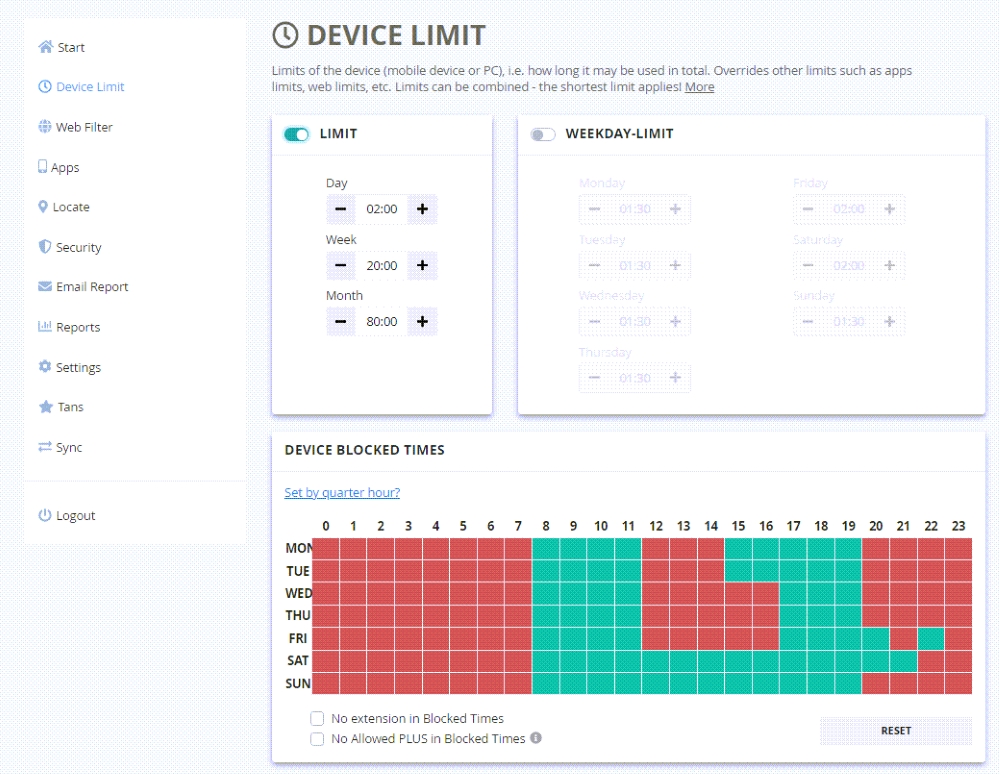
Photo Courtesy: Salfeld
Why Is Your Parental Control App Selling Your Kid’s Data?
The parental control market was valued at $1.57 billion in 2025 and is projected to reach $4.12 billion by 2034, according to Fortune Business Insights. The major players, Qustodio, Bark, and Net Nanny, have expanded their feature sets aggressively, some of them adding AI-powered content scanning, social media monitoring, and location tracking. For many families, these tools may provide genuine peace of mind.
But for a growing subset of parents, the trade-off has started to feel uncomfortable. The same parents who teach their children about data privacy are being asked to install software that funnels detailed behavioral data through third-party servers. Pamela Wisniewski, a computer science professor at the University of Central Florida who studies adolescent online safety, has described this tension as a “new privacy paradox.” As she wrote in IEEE Security & Privacy: “On the one hand, we are telling teens that they need to care about their online privacy to stay safe, and on the other, we are taking their privacy away for the sake of their online safety.”
A 2020 study led by Álvaro Feal at IMDEA Networks Institute reinforced the concern, finding that 72% of parental control apps shared data with third parties without disclosing it in their privacy policies, and 34% collected personal information without appropriate consent.
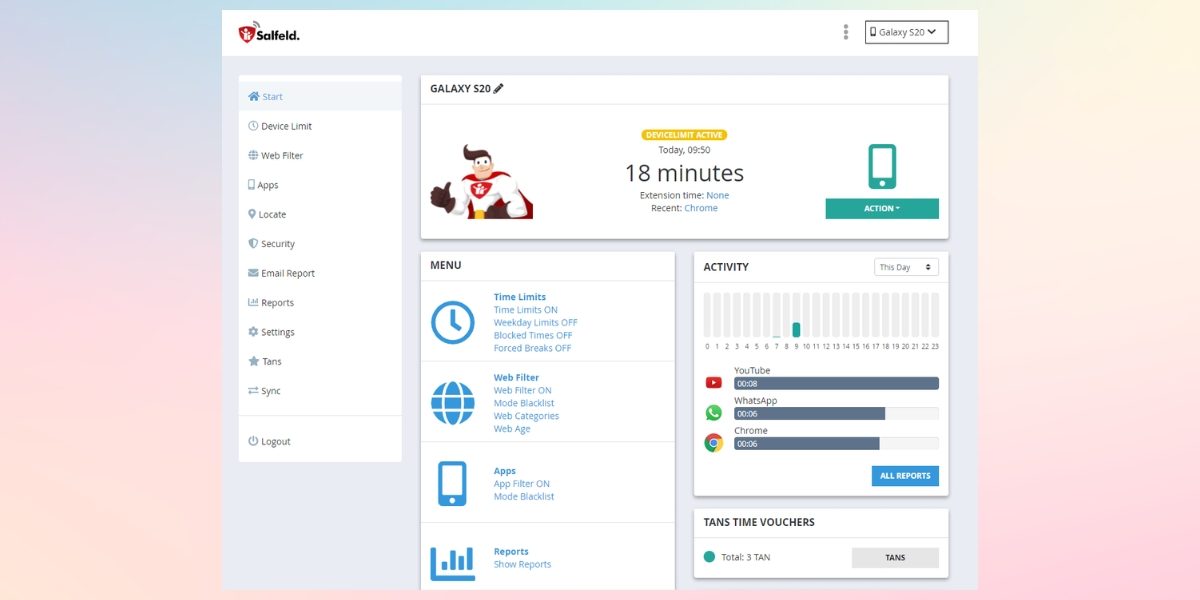
Salfeld’s architecture takes a more restrained approach than most competitors. The software does sync data to the cloud. It has to. Otherwise, there would be no web portal, and parents would need physical access to the device every time they wanted to check a report or change a setting. But what gets uploaded is described as carefully scoped. There are no location histories, no logs of dialed phone numbers, no social media chat transcripts, or other sensitive data, based on the company’s public documentation. As a German company, Salfeld operates under some of the strictest data protection regulations in the world, and GDPR compliance is not framed as a marketing bullet point here. It is a baseline legal obligation.
For families who consider that level of monitoring non-negotiable, the app may feel incomplete. But for parents who would rather not have software reading their kids’ private chats in the first place, that absence may be the point.
Photo Courtesy: Salfeld
What Does Parental Control Cost When There’s No Subscription?
For some parents, the most disruptive thing about Salfeld is not the code. It is the invoice. The company charges a flat upfront fee per device starting at €19.95 for a 12 or 24-month license, with discounts for multiple devices. When the license expires, it stops working until the parent actively decides to renew, often at a discount. There are no premium upgrades and no locked functionality. Every feature is included from day one. Compare that to many other well-known advanced solutions at around $100 per year, billed as ongoing subscriptions that auto-renewal whether you notice or not.
The real win may be psychological. There is no monthly charge ,reminding you that your children’s safety is a line item on your credit card. There are no “upgrade to unlock” prompts. You pay upfront, everything works, and the next time Salfeld crosses your mind is when the license is about to expire.
This model has obvious downsides for the company. Recurring revenue is the engine of modern SaaS businesses for good reason. But Salfeld’s small team size means the economics work differently. It is a boutique operation, and it functions like one.
First Learn, Then Play
Most parental control apps treat screen time like a binary switch, on or off, allowed or blocked. Salfeld is trying something different. Its tagline for the feature is blunt: “First learn, then play.”
The mechanism is a combination of two tools. Bonus Apps let parents designate educational apps, such as a vocabulary trainer, a math app, or a coding tutorial, that automatically generate extra screen time when used. Ten minutes on a learning app earns twenty minutes of free time. The ratio is up to the parent. Then there are Time Codes, six-digit numbers that parents can hand out manually as rewards for offline tasks, homework done, room cleaned, dog walked. The child enters the code, the bonus time unlocks, and they decide when to spend it.
What makes this interesting is the small shift in agency. Your child is not just having time taken away or given back. They are choosing when to use a vocabulary app to bank minutes for later, or deciding whether cleaning the kitchen is worth an extra half hour of gaming on Saturday. Salfeld’s own site describes it as helping children “feel more responsible for themselves.” That may be an ambitious description for a voucher system, but the underlying dynamic can be meaningful: earning something often feels different from having it rationed.
This will not convince parents who believe screen time should not be a bargaining chip at all. And it will not replace the harder work of actually talking to your kids about their digital habits. But in a market where the default approach is “set a limit, enforce a cutoff, deal with the meltdown,” even a negotiation tool of this kind may fill a gap that many competitors have not prioritized.
Should You Make The Switch?
If you want an AI to alert you every time your kid types a bad word, Salfeld does not do that. It does not attempt to. It sets a timer, stays out of your kid’s messages, bills you once, and assumes your child can learn to manage the rest.
In a market that often profits from telling parents they are not doing enough, that may strike some as risky, while others may view it as one of the more measured product decisions in recent years.
Salfeld’s Child Control software is available at salfeld.com. A 30-day trial is offered for new users. The company is based in Reutlingen, Germany.